#8 Post of 2015 – A Review of ‘God’s Crime Scene’


Normally, I don’t review books in the traditional sense. Instead I prefer to excerpt portions from the books I read and highlight them to you, my audience (I’ll probably still do that later on with this book). However, Jim Wallace was kind enough to send me a pre-publication copy of his new book, God’s Crime Scene: A Cold-Case Detective Examines the Evidence for a Divinely Created Universeand I’ve thoroughly enjoyed reading it over my summer vacation, so here goes!

Jim is a translator. He takes the sometimes complex arguments of academics and he translates them into a simpler form for his audience. This a crucial task for the Christian church, because without translators the vast majority of people will never understand what academics are saying about the Christian worldview. We need to know what the academics are saying because they are doing the research that either corroborates or rebuts the claims of Christianity.

There are two things, I think, that make Jim an especially effective translator. First, he has a knack for developing analogies and illustrations that communicate the complex ideas of Christian apologetics. Second, Jim is masterful at bringing his cold-case detective experience to bear on apologetics arguments. He demonstrated both of these talents in his first book, Cold-Case Christianity: A Homicide Detective Investigates the Claims of the Gospels, which analyzed the historical reliability of the New Testament documents.

The idea behind his second book, God’s Crime Scene, is that we are investigating the “crime scene” of the observable universe and we are trying to determine if the cause of the observable universe operated from inside of it or from outside of it. Wallace compares this investigation to that of a detective who arrives at a death scene where a dead body has been discovered. The detective must figure out whether the death was caused by the elements inside the death scene (e.g., disease, accident) or whether the cause of death was outside the death scene (e.g., murderer).

Wallace takes the reader through eight different pieces of evidence that must be analyzed at the “crime scene.” These evidences are : 1) the origin of the universe, 2) the fine tuning of the universe, 3) the origin of life, 4) the apparent design of life, 5) consciousness, 6) objective morality, 7) free will, and 8) evil. A chapter is dedicated to each of these.

Wallace not only steps the reader through the evidence in each chapter, but he teaches us how to think about the evidence, using his decades of experience as a detective and as a participant in numerous criminal trials. The task of any jury is to listen to the evidence and arguments made by both the prosecution and defense, to weigh what each side has presented, and then to render a decision about which side has presented the truth about what really happened.

In the same way, we are called to sit on a jury where the prosecution argues that the eight pieces of evidence lead to a theistic creator-God who exists outside the observable universe, and the defense argues that the eight pieces of evidence can be explained by the forces of nature contained inside the observable universe.

As an apologist who has been studying the evidences for Christianity for over a decade, all eight evidences that Wallace presents are familiar territory to me. He has certainly done his homework (extensive citations of scholars on both sides) and updated bits and pieces of the evidences and arguments, but this book is not primarily intended for someone like me.

Just as Lee Strobel brought the evidences for Christianity to a generation of people who had never heard of apologetics (yours truly included) using his background as a journalist, J. Warner Wallace is bringing the evidences for Christianity to yet another generation using his background as a cold-case detective.

Here’s to J. Warner Wallace and all the other translators. You’re doing essential work for the kingdom!
#9 Post of 2015 – Why Did Moses Separate the Virgins and Non-Virgins of Midian?

In Numbers 31:18, Moses commands the officers of the army to kill all the women who have had sex and only keep alive the girls who are virgins. What is going here? Why would Moses give this command?

In order to understand this verse, we first have to understand the background. The Midianites, under the counsel of Balaam, devised a plan to cause Yahweh, the God of Israel, to turn against his people. The plan, which was executed in chapter 25 of Numbers, was to seduce Israelite men into fornication (single men) and adultery (married men), and then formal worship of the Midianite gods, especially Baal of Peor.

According to Glenn Miller (Christian Thinktank website), the number of Midianite women involved in this conspiracy would have been 6 to 12,000. Yes, you read that correctly. It would also appear that the Midianite kings and husbands of these women were complicit in the conspiracy. They were willing to send their women into the Israelite camp as prostitutes, essentially, to cause the downfall of Israel.

God does indeed turn against his people, given the sexual and religious crimes they have committed. A plague kills some 24,000 children of Israel. The only reason the plague ends is Phinehas’s quick action to put an end to the sordid affair.

With this background in place, God orders the Israelites to subjugate the Midianites, taking vengeance for their moral atrocities. The Israelites easily win the battle and the army returns with thousands of women captives. At this point, Moses commands the officers to “kill every woman who has slept with a man, but save for yourselves every girl who has never slept with a man.”

It should be clear now that the females who the army has brought back are a mix of women who participated in the conspiracy and young girls who did not. Moses understandably considers the non-virgin women to be directly culpable for the deaths of thousands of Israelites. Setting this aside, they have shown already that they will turn the men of Israel away from Yahweh and toward Baal, causing further death and suffering in the future. These women simply cannot be allowed to survive.

Given Moses’ command, how could the Israelites tell the women apart? Glenn Miller explains that there were simple visual tests that could be applied:

“1) Was the female pre-pubescent? 2) Was the female wearing any attire, jewelry, or adornments required for/associated with virginity for that culture? 3) Was the female wearing any attire, jewelry, or adornments required for/associated with non-virginity for that culture (e.g., veil indicating married status)?”

He continues:

Because virginity was generally associated with legal proof for blood-inheritance issues in ancient cultures (e.g., land, property, kinship, relationships), virginity itself was often marked by some type of clothing (e.g., the robe of Tamar in 2 Sam 13) or by cosmetic means (cf. the Hindu ‘pre-marriage dot’); as was more typically non-virginal married status (e.g., veils, headwear, jewelry, or certain hairstyles).  Of course, non-virginal unmarried status (e.g., temple prostitutes and secular prostitutes) were also indicated by special markings or adornments (e.g. jewelry, dress—cf. Proverbs 7.10; Hos 2.4-5).

The young girls who were virgins would be taken in and cared for by Israelite families, partially to help replace the population of 24,000 who had died by the plague. The young girls would, like all other Israelite women, be married when they matured.

#10 Post of 2015 – Gay Marriage Is Forcing Us to Get Straight on the Old Testament

Post Author: Bill Pratt 

Recently I wrote a blog post on why Christians don’t stone people to death. I then wrote a 4-part series on how Christians should apply the Torah (first five books of the Old Testament). What do these posts have to do with gay marriage?

In a nutshell, Christians are quoting from Leviticus to prove that homosexual behavior is sinful and gay marriage proponents are quoting from Leviticus and other books of the Torah to prove that those books contain outdated moral commands that nobody follows any more.

Both groups are confused about how the Old Testament (the Torah in particular) is supposed to be applied to Christians.

Christians cannot just quote from Leviticus to show that homosexual behavior is wrong and leave it at that. As I showed in this blog post, the Law (aka the Torah) does not apply to Christians. Jesus fulfilled the Law. We are no longer under the direction of the Law. The Law was written to the Israelites as they traveled to the Promised Land, not to us.

The only legitimate means for applying the Law to our lives today is by identifying the timeless truths that were taught in the Law and correlate with New Testament teachings. I covered that in the 4-part series entitled “How Should Christians Apply the Law?

So, we don’t say that homosexual behavior is wrong because Leviticus says so. We say it is wrong because the teachings in Leviticus on homosexual behavior are timeless truths that are reiterated in the New Testament. Then we point to the New Testament passages that speak to homosexual behavior.

Now, to address the proponents of gay marriage who quote from the Torah to show that its teachings are outdated. Your quotations have no force with Christians. We are not arguing that every single command found in the Torah is to be applied today. In fact, to say that the Law applies directly to Christians today is to flatly contradict the New Testament writers!

This approach by proponents of gay marriage only works on Christians who are arguing that the Law can be applied to us today, and who never offer any evidence showing that the teaching is timeless and reiterated in the New Testament.

I have had two Christian teenagers in the last week tell me that proponents of gay marriage in their schools constantly use this illegitimate argument to prove that the Christian position against gay marriage is wrong. Both of them were confused about how to answer these charges because they had never been taught why Christians don’t stone people to death, as is commanded in the Law.

Pastors, teachers, apologists – we need to get straight on the Old Testament. Our brothers and sisters are not prepared to defend the real Christian position.

Why Isn’t There More Archaeological Evidence of the Kingdoms of Saul, David, and Solomon? Part 2

As we continue from part 1, Kitchen claims there are traces of direct evidence for David’s dynasty.
[T]he Tell Dan inscription and with virtual certainty the Moabite Stone each mention ‘the House of David,’ implying his former role as a personal dynastic founder, about 150 years after his death. Then, within barely 50 years of his death (ca. 970), we have what is in all likelihood “the heights of David” in the list of Shoshenq I (ca. 925), with a final t for final d exactly as in Ethiopia. (Alas, no clearly better and indisputable alternative can be offered, it seems!) The political situation of Hadadezer king of Aram-Zobah in circa 990 (reaching across the Euphrates) is extremely likely to find a reflex in the situation there in the time of Assur-rabi II of Assyria, as later reported by Shalmaneser III. So, explicit traces are beginning to emerge, even for the limited possibilities of the tenth century.

Kitchen then reminds his readers that explicit evidence is not the only kind of evidence.

It is equally important to measure off a document or account against what we know independently about the topics it includes. In this light much can be said: a little on Saul’s time, more on David’s, and much more on Solomon’s epoch.

Thus Saul’s regime was profitably compared with the ethos and practices of Levantine kingship. David’s ‘empire’ (inherited by Solomon) belongs to a particular type of ‘mini-empire,’ of a scope and nature only present and feasible within the interval between about 1180 and 870 and at no other time in the first millennium, being known also from Neo-Hittite and Aramean analogues.

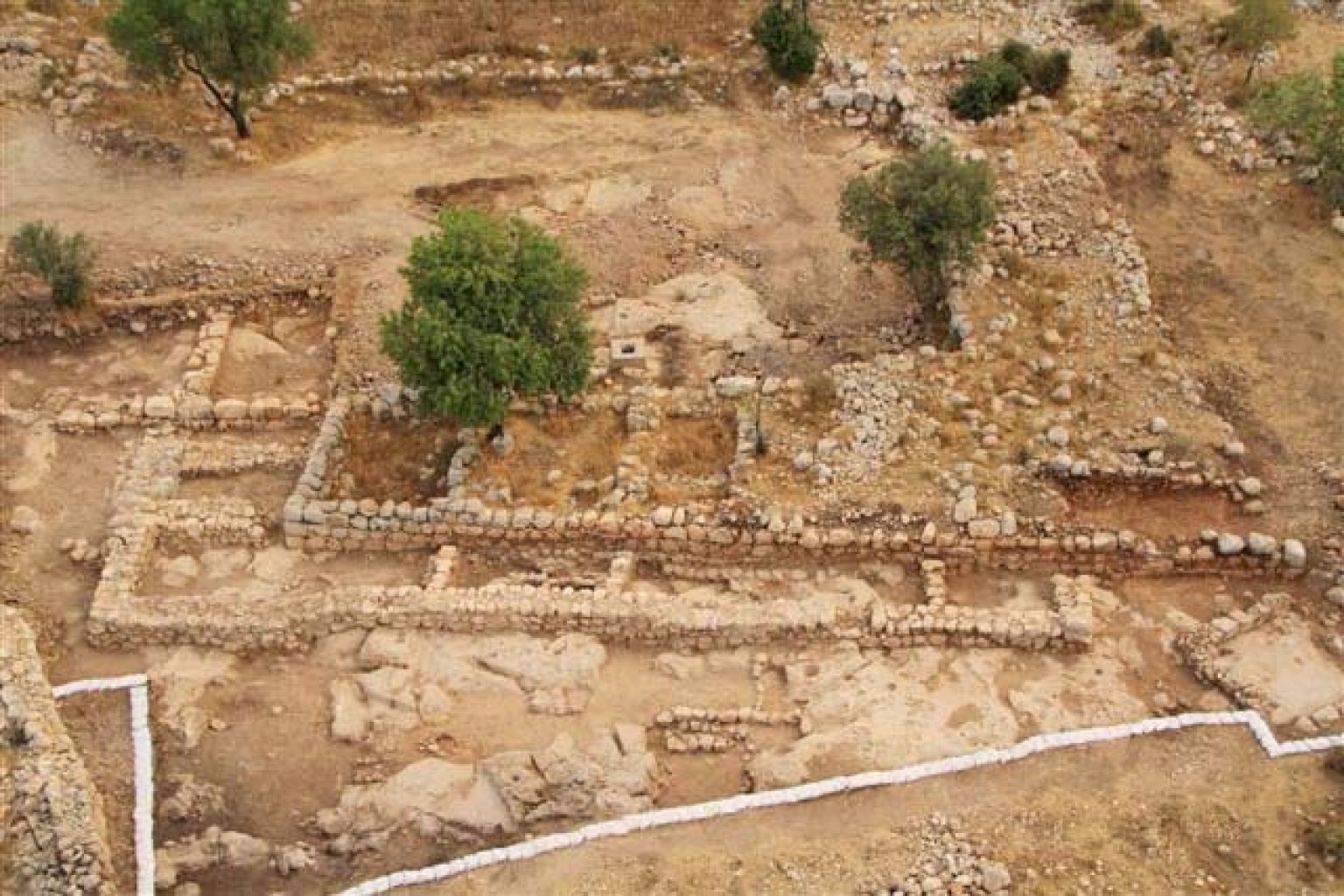
Under Solomon, foreign relations do fit the context of his day; his temple and palace complex (and their furnishings) find ample and immediate cultural analogues, in both scale and nature. This is also true of the scale of his revenues; in fact, his 20 tons of gold in a year is poverty compared with the spending of over 380 tons of precious metal by Osorkon I soon afterward, and the 7,000 tons of gold that Alexander the Great lifted from the vanquished Persian Empire later on. Poetry (David) and instructional wisdom (Solomon) belong well in the tenth century, with earlier roots, and ample successors. . . .

The physical archaeology of tenth-century Canaan is consistent with the former existence of a unified state on its terrain then (with some monumental architecture). Jerusalem cannot deliver much on this; but on normal datings, Hazor, Gezer, and Megiddo (largely) can. And the occupation of the rest of the area is also consistent with this; it was not a land of ghosts. . . .

In short, the testing of the biblical text against external data (texts and artifactual contexts) shows precious little fantasy and much realistic agreement in practical and cultural aspects. Much more might be examined, but the subjects reviewed here give some idea of the real situation.

Commentary on 1 Kings 6-8 (Solomon Builds the Temple)

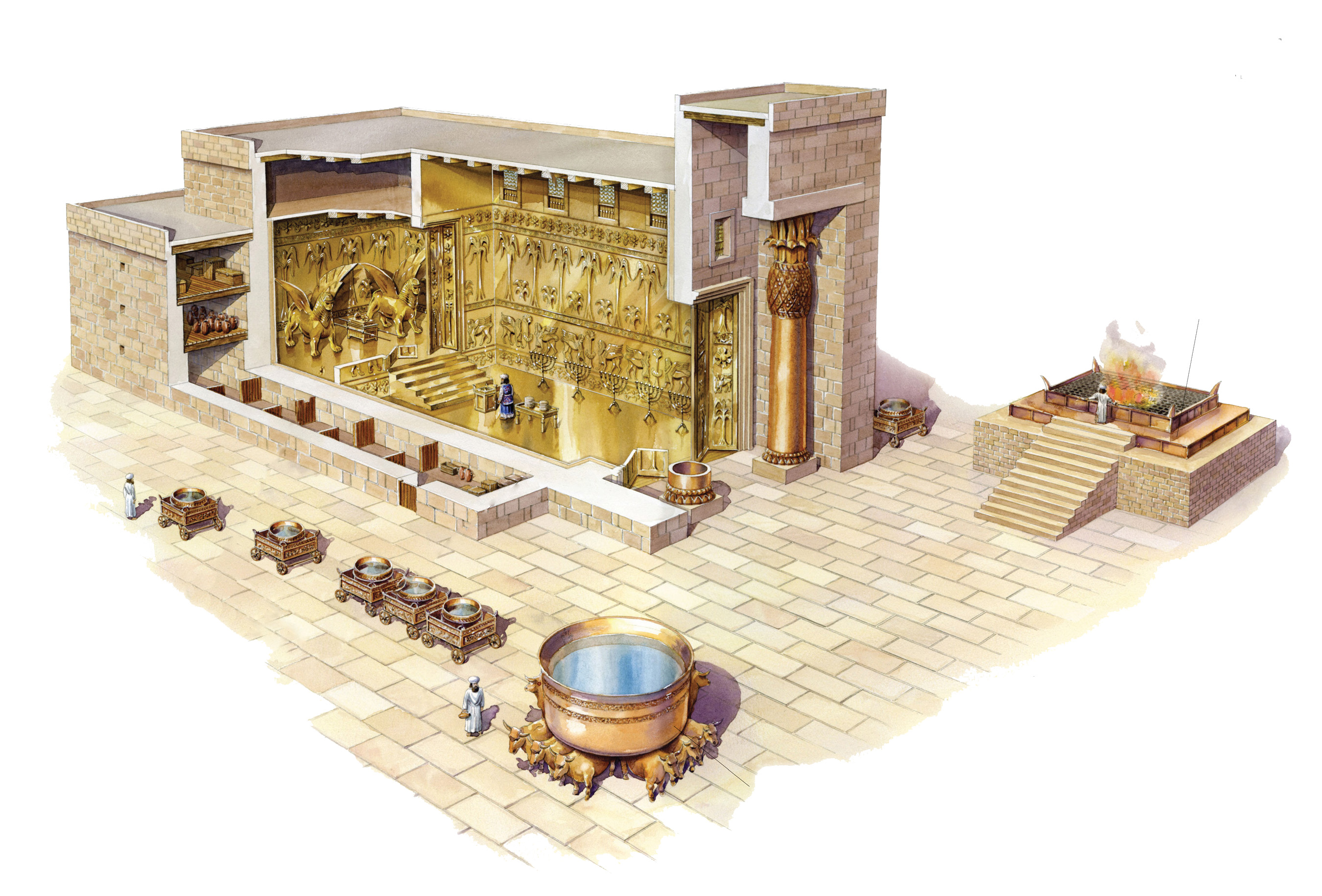
In chapters 6-8, the author reports the building of the temple that would become the permanent “home” of God among the Israelites. Verses 1-10, in chapter 6, tell us that temple construction began in 966 BC, Solomon’s fourth year as king. The project was completed and the temple dedicated 7 ½ years later. This structure would stand for almost four hundred years until it is destroyed by the Babylonians.

What did the temple look like? Paul R. House, in 1, 2 Kings, The New American Commentary, summarizes:

First, the temple was about ninety feet long, thirty feet wide, and forty-five feet high. By modern standards it was a fairly small worship center [with 2700 square feet of floor space]. Second, it had a portico, or porch (6:3), which ran ‘the width of the temple’ and projected out ‘from the front of the temple’ (6:3). Third, it was a three-story complex (6:6). Fourth, its various portions were carefully shaped at their quarries, then fitted, without hammering, on site (6:7). Fifth, its frame and beams were cedar (6:9). Sixth, the facility included a number of ‘side rooms’ (6:10) that probably were set aside for the priests’ use. In other words, the building was attractive, yet functional.

The rest of chapters 6 and 7 describe the interior of the temple and the bronze furnishings crafted by Huram of Tyre. We also learn in chapter 7 that Solomon built an entire palace complex after completion of the temple. His palace complex would take 13 years to finish, almost twice as long as the temple.

Once the temple construction finishes, it is time to bring the Ark of the Covenant to the Most Holy Place (Holy of Holies) inside the temple. Recall that the Ark has been residing in a specially constructed tent inside the City of David. Solomon has built the temple and his palace just outside the City of David, thus expanding the footprint of the city of Jerusalem, which includes all of it.

Solomon invites all the elders of Israel to witness the carrying of the Ark to the newly completed temple. The movement of the Ark and the subsequent dedication of the temple all take place during the Festival of Booths. Solomon extends the Festival from seven days to fourteen days to celebrate the dedication of the temple.

Once the priests finished placing the Ark in the Most Holy Place, a cloud (the glory of God) filled the temple, thus indicating that God has taken up residence among Israel.

Solomon then speaks to all the leadership of Israel about the meaning of this day. First, Solomon reminds them that God has kept the promise He made to David – that David’s son would build a temple for God. Second, God promised David that Solomon would sit on the throne of Israel, and that has also occurred. Third, Solomon has built a permanent structure for the Ark of the Covenant which contains the two stone tablets that Moses placed in the Ark almost 500 years prior.

Later in chapter 8, Solomon also reflects on God’s fulfillment of His promises to Abraham, Isaac, Jacob, and Moses. God promised the patriarchs that their descendants would have the land of Canaan – that was complete. God promised Moses that Israel would have a central place of worship – check. God promised that Israel would live in peace with her neighbors – and during Solomon’s reign that was the case. Solomon also prays that God will fulfill His promise of blessing all the nations of the world through Israel and her temple.

The dedication of the temple in 959 BC is regarded by most scholars as the pinnacle of Israel’s success as a nation. She was powerful, wealthy, and at peace. But before we get carried away, we must remember that God repeatedly warns Solomon, as He reminded David, that Israel’s blessings are contingent on Solomon’s obedience to the Torah. Although Solomon was seemingly off to a good start, it wouldn’t be long before Solomon’s disobedience would cost Israel dearly.

For an illustration of what Solomon’s temple may have looked like, click on this link.

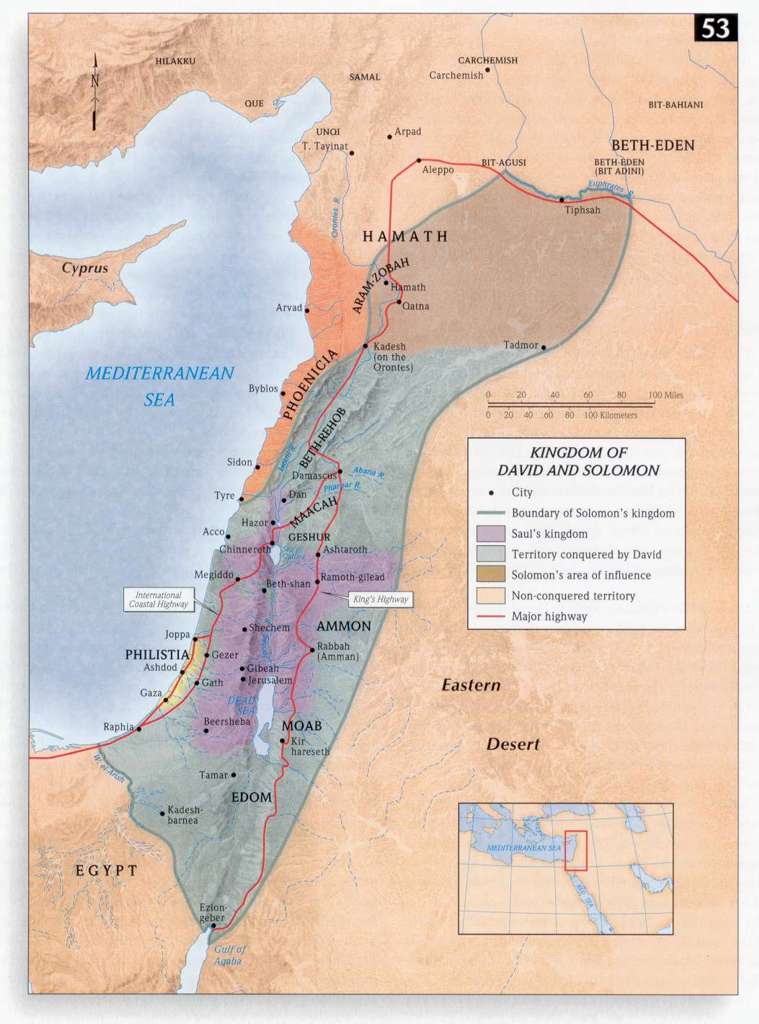
To see the geographical boundaries of Israel under Solomon’s rule, click on this link.

Does God Reveal Things Through Dreams?

In 1 Kings 3 God tells Solomon, in a dream, that He will bless him with incredible powers of wisdom and discernment. He will also give him riches and honor during his lifetime. All of these promises did come to pass, so are we to conclude that dreams are a normative means for God to communicate to Christians today?
First, it is indisputable that God communicated to people through dreams in the Bible. Examples are Joseph, son of Jacob (Genesis 37:5–10); Joseph, the husband of Mary (Matthew 2:12–22); and Daniel (Daniel 2:1; 7:1).

Second, there are numerous testimonies of converts to Christianity having dreams which seem to come from God. I personally have two friends who were powerfully impacted by dreams that pushed them toward faith in God. If you listen to missionaries speak about their experiences, they can recount story after story of God using dreams to bring people to faith.

However, many of us can think of those who claim the Christian God spoke to them through dreams, but we have serious doubts. Why? Because what they claim God told them clearly contradicts what is written in the Word of God.

This is the key to discerning whether God has spoken to you through a dream. Does what the dream told you line up with Scripture? If it does not, then you did not receive a message from God. God does not contradict Himself, so a dream, allegedly from God, cannot contradict the revealed Word of God.

So what if your dream does not contradict Scripture? What do you do? Gotquestions.org gives good advice:

If you have a dream and feel that perhaps God gave it to you, prayerfully examine the Word of God and make sure your dream is in agreement with Scripture. If it is, prayerfully consider what God would have you do in response to your dream (James 1:5). In Scripture, whenever anyone experienced a dream from God, God always made the meaning of the dream clear, whether directly to the person, through an angel, or through another messenger (Genesis 40:5–11; Daniel 2:45; 4:19). When God speaks to us, He makes sure His message is clearly understood.

Commentary on 1 Kings 3 (Solomon Asks for Wisdom)

The books of 1 and 2 Kings were originally a single work, but were separated into two parts when they were translated into the Greek New Testament (the Septuagint). The Septuagint also combined Samuel and Kings into a four-part history of the monarchy of Israel (First, Second, Third, Fourth Book of Kingdoms).

The author of Kings is unknown, but most scholars believe it was finally written and edited around 550 BC during the Babylonian exile by a Judahite. The author claims to use at least three sources for his information, although there are probably additional sources he does not mention. The three sources are 1) the Book of the Annals of Solomon, 2) the Book of the Annals of the Kings of Israel, and 3) the Book of the Annals of the Kings of Judah. These books were either part of the official royal archives, or they may have been written by Hebrew prophets during the 400 year span from Solomon’s rule to the capture of Jerusalem by the Babylonians.

The primary purpose of the author is to explain why the Jews are in exile by examining the kings who ruled Israel and Judah. Each king is evaluated based on whether they obeyed God’s commands in the Book of Deuteronomy, which is the summary of the Law given to Moses. The kings of the northern kingdom, Israel, disobeyed God so egregiously that they were overrun by the Assyrians a full 136 years before the southern kingdom of Judah was overrun by the Babylonians. Although there were a handful of kings who followed the Law, the vast majority did not, and so both Israel and Judah fell to foreign powers.

Chapter 3 of 1 Kings begins Solomon’s official reign as king of Israel in 970 BC. In verse 1, we learn that Solomon immediately forges an alliance with Egypt, his powerful southern neighbor, by marrying the daughter of Pharaoh. He brings her to Jerusalem and puts her in temporary quarters until his building projects are completed.

There is some debate among biblical interpreters as to whether Solomon is violating the Law with this marriage. Deuteronomy 7 prohibits marriage with Canaanite women, but Deuteronomy 21 allows for marriage of foreign (non-Canaanite women) captured in battle. It appears that Pharaoh’s daughter willingly accepted the worship of Yahweh and she is nowhere criticized by the writer for turning Solomon away from adherence to the Law.

In verses 2-3, the writer alerts us to the fact that the Israelites are worshiping at “high places,” which are shrines set up at various elevations to conduct worship of a deity. The reason given is that there is no central worship center for the Israelites yet. At this time, the Ark of the Covenant has been moved to Jerusalem, but the rest of the tabernacle still resides at a high place called Gibeon, which is about 5 miles north of Jerusalem.

Solomon travels to Gibeon to make sacrifices to God, probably during one of the seven annual festivals. That night, he encounters God in a vivid dream. God asks Solomon what he wants and Solomon answers that he desires a “discerning heart to govern your people and to distinguish between right and wrong.” Why? Because he is an inexperienced king (he was about 20 years old at the time) and he is expected to govern an enormous number of people.

Recall that a primary role of a king was to render judicial decisions in especially difficult cases where local judges were not able to settle a dispute. Years before, King David’s son Absalom undermined his authority by accusing David of neglecting his judicial role. Solomon knows he needs God’s help to do this job well.

It is also important to note that God is the source of all wisdom, and thus Solomon will only be truly wise and discerning if he follows the commands of God, given in the Law. Solomon cannot be wise without knowing and obeying the commands of God.

God is pleased with Solomon’s request and grants it. He will make Solomon the wisest man who ever lived. In addition, God will give Solomon those things he did not ask for: riches and honor. Solomon will also have a long life if he obeys the Law as his father David did.

Now that God has officially blessed Solomon’s reign, Solomon returns to Jerusalem and hosts a feast with sacrifices before the Ark of the Covenant. His rule is off to a great start!

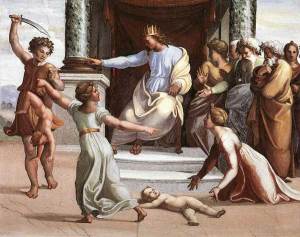
To prove to his readers that God truly blessed Solomon with supernatural wisdom, the author of 1 Kings, in verses 16-28, relates the most famous example of Solomon’s discernment at work. Two prostitutes, who live in the same house, each bear a child within 3 days of each other. One prostitute carelessly smothers her child while she sleeps. When she discovers what she’s done, she takes her dead baby and swaps it for the live baby who belongs to the other sleeping prostitute.

The next morning, the woman wakes with a dead baby beside her, but upon closer inspection she realizes it’s not her child at all. She figures out that the other prostitute has stolen her child to replace the one she lost. Of course, both women claim that the other is lying and that the live baby truly belongs to each of them. How can Solomon possibly decide who the mother of the living baby is?

Solomon’s solution is to announce that he will cut the baby in half with a sword so that each woman can have half a baby, the only “fair” solution. At this point, one woman speaks up and pleads for Solomon to give the baby to the other woman instead of killing him. The other woman tells Solomon to go ahead and kill the baby so that neither woman will have him. Solomon rightly discerns that the true mother must be the first woman who offered to give the baby up.

Verse 28 summarizes the reaction of the nation to Solomon’s ruling: “When all Israel heard the verdict the king had given, they held the king in awe, because they saw that he had wisdom from God to administer justice.”

Does the Bible Teach that Abortion Is Wrong?

Abortion is the intentional taking of the life of a child who is still living in the womb of her mother. Does the Bible have anything to say about this procedure? Even though abortion is not explicitly mentioned, there are basic principles taught in the Bible that lead us to conclude that abortion is immoral.

Here is the simplest form of the pro-life argument:

Premise 1: Intentionally killing an innocent human being is always morally wrong.

Premise 2: Abortion is the intentional killing of an innocent human being (except when the child’s death is not desired but results from saving the mother’s life).

Conclusion: Therefore, abortion is morally wrong (except as noted above).

Biblical support of premise 1 is found in Exodus 20:13: “You shall not murder.” This is a blanket ban on the killing of all innocent human life. But why does God consider the killing of innocent human life to be wrong at all? Why are humans special?

Genesis 9:6 explains: “Whoever sheds man’s blood, by man shall his blood be shed; for in the image of God He made man.” Only human beings are made in the image of God. Images of gods in the ancient world were supposed to symbolize and represent, in a very real way, the presence of the deity. Therefore, to kill an image-bearer was to kill that god’s representative, which was symbolic of killing the god himself. Whenever we kill an innocent human being, we are, in a symbolic sense, killing God.

The abortion proponent may argue, though, that the unborn human embryo or fetus is not a human being, and can therefore be killed. Biologically, we know this is false because once the sperm fertilizes the egg at conception, human life begins. There is simply no dispute about this among scientists.

The biblical writers seem to also have the same understanding, even though they did not comprehend the biological details that we do today. For example, Psalm 139:13-16 affirms that God is intimately involved in the development of the human embryo and fetus in the mother’s womb. “For you created my inmost being; you knit me together in my mother’s womb.” There is no hint in the Bible that human life begins only at birth, which is what the abortion proponent would need to prove his case.

Since the two premises of the argument above are true, the conclusion of the argument, that abortion is morally wrong, necessarily follows.

Commentary on Psalms 51 and 139 (Psalms of David)

Psalm 51 is traditionally thought to be David’s lamentations for his sins against Bathsheba and Uriah. As the psalm begins, David asks for God’s forgiveness. Why God? Because even though David sinned against Bathsheba, Uriah, and others, it is God whom he has grieved the most. When we sin, we sin first and foremost against God.

David acknowledges that God is a righteous judge and he also affirms that he has inherited a sinful nature. From his very conception he was sinful, thus affirming the doctrine of original sin, where the sinful nature of Adam and Eve has been passed down to all of their descendants.

David continues, in the psalm, to plead for God to purify him. This purification is not trivial, as Donald Williams and Lloyd Ogilvie, in Psalms 1–72, The Preacher’s Commentary Series explain.

The verb for ‘purge’ is intensive here, meaning ‘un-sin’ me, purify me from uncleanness. The word is commonly used in describing the cleansing of a leper’s house. Hyssop is also used to sprinkle blood in the rite of purification (Lev. 14:52). Similarly, hyssop was the agent used in spreading the blood of the Passover lamb on the lintels and doorposts of the Hebrew households in Egypt before the plague of death (Ex. 12:22). Underlying the purging of verse 7, then, is the concept of sacrificial blood. As we pray for purification, the leprosy of sin is removed.

David begs God to take away his guilt and to turn His face from David’s sins. David is concerned that God will take away His Spirit from David, just as He did with Saul. If only God will renew David in His eyes, David promises to evangelize and teach non-believers the ways of God.

David knows that his crimes merit the death penalty, according to the Law. If God will show him mercy, David will sing of His righteousness and publicly praise Him. David also knows that God wants a truly repentant and broken heart from David. David’s sacrifices mean nothing to God otherwise. Once David is restored, he asks that the nation of Israel also be restored so that she can once again give God the sacrifices He deserves. Allen Ross, in The Bible Knowledge Commentary (Old Testament:), summarizes Psalm 51:

The message of this psalm is that the vilest offender among God’s people can appeal to God for forgiveness, for moral restoration, and for the resumption of a joyful life of fellowship and service, if he comes with a broken spirit and bases his appeal on God’s compassion and grace.

Psalm 139 is a psalm of personal thanksgiving by David. In particular, David meditates on God’s omniscience and omnipresence. These two divine attributes lead David to understand God’s intimacy with His creation.

In verses 1-6, David affirms that God knows his every thought and his every action. In fact, God knows what David will say even before he says it. There is nothing about David that God does not know.

Is there anywhere David can go to avoid the all-seeing gaze of God? Is there any place he can travel to avoid intimacy with God? The answer given in verses 7-12 is “no.” Whether David is in heaven (the world above the surface of the earth) or hell (the world below the surface of the earth), God is there. Even if David flees to ends of the earth, God is there. Whether David is in darkness or light, God is with him. There is literally no place David can be where God is not holding David in His hand.

How does God know so much about David? Not only is He omniscient, but He created David in the womb. The embryonic David, in his mother’s womb, was skillfully woven together by God’s hand. He was involved with every detail of David’s growth in his mother’s womb. Going beyond the womb, every one of David’s days on earth were written ahead of time by God. There is nothing in David’s life that catches God by surprise.

In verses 17-18, David expresses wonder at God’s thoughts, and then abruptly, in verses 19-22, spells out his hatred for those opposing God. All those who speak against God, who take His name in vain, David hates with a “perfect hatred.” Donald Williams and Lloyd Ogilvie describe David’s hatred:

David’s strong reaction is not against ‘sinners.’ He is not a self-righteous judge who will not stain himself with this world. His reaction is against those who revile God’s name, who are His enemies (v. 20). It is those who hate God and rise up against Him that incur his wrath. And why is this so? Because the God who is so exquisitely described in verses 1–18 deserves our praise and worship. To withhold this is to deserve both human and divine wrath.

Finally, David invites God to test his own heart and mind to see if David is wicked in any way. He is willing to submit himself to God’s scrutiny. Williams and Ogilvie beautifully summarize the intimacy with each of us that God desires:

He formed us in the womb. He knows our frame. He sees our embryo. He fashions our days. He knows our thoughts. He hears our words. He knows when we sit down and when we stand up. He protects us. His hand is upon us. He who inhabits all things is near to us. We cannot escape His presence. In the light He sees us. In the dark He sees us. We are the continual object of His thoughts. He searches us. He changes us. Here is true intimacy, and if we can allow God to become intimate with us, we can establish a growing intimacy with each other. Secure in His presence and His love, we can risk opening up. We can even risk rejection, because we are held in His hand (v. 10).

Does God Hide His Face from Us?

In Psalm 27, David begs the Lord to not hide His face from him. In the context of the psalm, it appears that David is being attacked by his enemies, he has been praying to God to deliver him from these enemies, but God has not yet answered his prayers. Thus, to David, God is hiding His face. What are we to make of this? Goes God really hide from us?
Christian blogger Josh Fults has written an insightful article on this topic. First, Fults reminds us what God’s relationship was with mankind at the beginning:

We must remember, when God created mankind he walked among them. Instead of a game of hide and seek, we find in Genesis that God ‘walked with Adam and Eve in the cool of the day.’ So apparently, at the onset of creation, man and God enjoyed fellowship in a direct sense. Then sin entered the world, and who is it that we find hiding? God doesn’t hide. God doesn’t remove Himself. Instead we see Adam and Eve have made the decision to hide. It was man that hid initially and broke this extremely intimate connection between God and humanity.

Sin, then, has a direct bearing on God’s relationship with us. We cannot possibly answer the question of whether God is hiding without remembering this crucial point. In a fallen world, evil, pain, and suffering are regular occurrences. We certainly see David suffering many times in his life.

However, just because God is not saving us from all this pain and suffering as soon as we pray about it does not mean that He is hiding from us. This simply does not follow. In fact, David comes to realize this as well. At the end of Psalm 27, he states, “I am still confident of this: I will see the goodness of the LORD in the land of the living. Wait for the LORD; be strong and take heart and wait for the LORD.”

But if God is not always answering our prayers in the ways we want our prayers answered, then how is He communicating with us? Fults answers this question:

God reveals Himself expressively in His written word. ‘Beginning at Moses and all the Prophets, He expounded to them in all the Scriptures the things concerning Himself’ (Luke 24:27). God also revealed Himself explicitly to mankind through Jesus Christ. ‘And the Word became flesh and dwelt among us, and we beheld His glory, the glory as of the only begotten of the Father, full of grace and truth’ (John 1:14). We also see God make Himself known through nature.  ‘For His invisible attributes, that is, His eternal power and divine nature, have been clearly seen since the creation of the world, being understood through what He has made. As a result, people are without excuse’ (Romans 1:20). We also see that God communicates through His Spirit to us if we are willing to hear. ‘He will give you another Counselor to be with you forever. He is the Spirit of truth’ (John 14:16-17).The Spirit of God draws us to Himself. We also find that believers in Christ also reveal God to those around them, as we see in Acts 1:8 that Christians ‘will be My witnesses.’

So God does indeed reveal Himself in many different ways to us. Although we may feel like He is hiding from us, we must realize that it is sin, ultimately, that causes this feeling. Once we are in Heaven with God, we will never have this feeling again.

A Christian Apologetics Blog