Category Archives: Sunday School

Commentary on Proverbs 3 (Wisdom from Solomon)

Proverbs 3 begins by reminding the reader that the words of wisdom contained in these proverbs will prolong life and yield prosperity. In addition, the reader is commanded to live a life characterized by love and faithfulness.

Verses 5-8 are well-known verses that appear on the walls of many Christian homes. Duane A. Garrett, in The New American Commentary Volume 14 – Proverbs, Ecclesiastes, Song of Songs, explains what these famous verses mean.

The command to trust God ‘with all your heart’ means that the total personality is to be committed to God’s care, although it emphasizes the mind and volition. The prohibitions against depending on one’s own understanding and against intellectual pride (vv. 5b, 7a) implicitly reject a ‘secular’ search for wisdom and look back to the thesis of the book (1:7).

Although this passage certainly condemns any academic arrogance, it does not indulge in anti-intellectualism. The commitment of the heart to God means that all the beliefs and decisions of life are to be submitted to Yahweh. Even very practical decisions are in view here, and not just matters of academic pursuit. But the text is no more opposed to academic research per se than to any normal activity of life. Also, ‘understanding’ implies not just intellectual capacity but one’s own moral standards. One’s private vision of right and wrong must be submitted to God.

Solomon then instructs his son to honor God with his material wealth. If he does, God will reward him with overflowing barns and vats full of wine. But, Sid S. Buzzell reminds us in The Bible Knowledge Commentary (Old Testament:), “In general it is true that godliness results in gain, that piety brings prosperity (cf. v. 2; Deut. 28:1–14; Matt. 6:33). But this kind of generalization, common in Proverbs, does not disallow God from making exceptions. Otherwise God is invested in, rather than honored.”

Verses 11-12 balance out verses 9-10 by reminding the young man that God disciplines as well. The young man should not resent discipline, because that is what a loving father does.

Verses 13-20 are a hymn to wisdom. There are several points made about wisdom. First, wisdom is more valuable than wealth. The church father, Thomas Aquinas, famously ranked the top 8 goods for human beings and wealth came in last place. Solomon, in fact, personifies wisdom as a woman who holds wealth in her left hand. The left hand was considered to be the inferior, or weaker hand, in the ancient world.

Second, wisdom gives long life. Third, wisdom gives peace. Fourth, wisdom holds the keys to immortality, for that is what the “tree of life” refers to in the Book of Genesis. The readers of this proverb would surely make the connection that wisdom leads to the defeat of death itself.

Fifth, and finally, God Himself employed wisdom and knowledge to create the earth and the heavens above. If God embraces wisdom, then surely we, His creatures, should as well.

Verses 21-26 are another appeal from Solomon to his son to embrace wisdom. Why? Because the wise person will live a life characterized by security and safety compared to the fool who rejects wisdom. Duane Garrett reminds us that “verse 23 is a general promise; it is not an absolute guarantee that the wise will never have occasion to stumble. Compared to the unwise, however, they will experience tranquility.”

Verses 27-35 contain maxims on how to be a good neighbor. These are very practical pieces of wisdom that Solomon renders in a rapid-fire sequence.

First, don’t withhold good things from other people. Garrett writes, “’Those who deserve good’ may be laborers who have earned their pay, the poor who rightly plead for help, or suppliants at the city gates who call for justice. On the other hand, they could be those who have loaned money and deserve to be repaid.”

Second, “do not plot harm against your neighbor.” He lives near you and trusts you. Third, do not falsely accuse your neighbor. Fourth, do not envy a violent man. God curses the man of violence, but blesses the man of righteousness. Verse 34 is quoted in both James 4:6 and 1 Peter 5:5, as “God opposes the proud, but gives grace to the humble.” Sid Buzzell, commenting on verses 27-35, writes, “These verses show that the words ‘upright,’ ‘righteous,’ ‘the humble,’ and ‘the wise’ are basically synonymous in the Book of Proverbs.”

Commentary on Proverbs 1 (Wisdom from Solomon)

The book of Proverbs is a collection of collections on the subject of wisdom. There are several compilations in the book, including “the proverbs of Solomon son of David, king of Israel” (Pr 1– 24), “more proverbs of Solomon, copied by the men of Hezekiah king of Judah” (chs. 25– 29), “the sayings of Agur son of Jakeh” (ch. 30) and “the sayings of King Lemuel— an oracle his mother taught him” (ch. 31).

Solomon’s proverbs were written between 970 and 930 BC, while Hezekiah’s scribes compiled additional, “unpublished” Solomonic proverbs between 729 and 686 BC. Nothing is known of Agur and King Lemuel, so the dates of composition of their contributions are unknown.

The goal of the wisdom in Proverbs is to develop skill in living according to the order that is embedded in God’s creation. Most proverbs state a single general truth with little attempt to note exceptions and qualifications. Such an approach effectively emphasizes the principle taught by avoiding the distraction of qualifications.

Solomon is credited with writing three collected works of wisdom – Song of Songs in his youth, Proverbs during his middle years, and Ecclesiastes during his elder years. The Book of Proverbs contains Solomon’s advice to young people who are not yet old enough to have sufficient life experience to make good decisions. This is the stated purpose of Proverbs 1, which we will study in this lesson.

Verses 2-7 inform the reader immediately why he should read the proverbs that Solomon has written. It is to obtain wisdom, but Solomon describes several kinds of wisdom here. According to Duane Garrett, in Proverbs, Ecclesiastes, Song of Songs (New American Commentary), these verses outline four characteristics of wisdom.

First, it is practical. ‘Wisdom’ includes the idea of ‘common sense’ and the ability to cope with daily problems and can also refer to occupational skills (Exod 28:3; Ps 107:27). Second, it is intellectual. This is implied in words like ‘understanding’ and ‘knowledge.’ Solomon’s own fascination with natural history illustrates this (1 Kgs 4:33). Third, it is moral and involves self-control. This is indicated in words like ‘right and fair’ and ‘discipline.’ Fourth, Proverbs draws the reader into the mysteries of life. This is implied in terms like ‘parables’ and ‘riddles.’ The ancients were intrigued at riddles (Judg 14:12–19), but more is involved here than casual entertainment. Biblical wisdom seeks to resolve or at least adjust to the ambiguities of life. It seeks the reality behind the appearances. Not only that, it affirms that the believer can understand mysteries that outsiders cannot and so may couch its teaching in enigma (Matt 13:10–17).

Verse 7 gives the foundation of all wisdom, the fear of the Lord. Nobody can claim to be truly wise unless they have grounded their lives in the revelation of God. Only fools reject wisdom and God.

The wisdom taught by Solomon is grounded in God, but applies to worldly living. K. T. Aitken, in Proverbs (OT Daily Study Bible Series), explains,

The truly wise man of the world will be a man of faith. Equally, of course, a foundation is for building on. So the man of faith ought also to be a man of the world. The ‘fool’ who despises wisdom can therefore either be the man of the world who has no time for God, or the man of God who has no time for the world—or as we might say, either people who are so earthly minded as to be of no heavenly use; or people who are so heavenly minded as to be of no earthly use.

Solomon records his first specific exhortation to wisdom in verses 8-19. Verses 8-9 introduce a theme repeated throughout the book of Proverbs, which is that children are blessed when they heed the counsel of their parents. Parents have numerous life experiences to draw upon to make wise decisions, and children do not, thus children are advised to listen to their parents.

Verse 10-14 warn against peer pressure, in particular the pressure to join a gang who robs and kills innocent travelers. In the ancient world, like today, there was a constant enticement for young men to become members of violent gangs who would commit criminal acts to enrich themselves. The Crips and Bloods have been around for 3,000 years!

Solomon implores the young man to steer clear of these gangs. What these gang members don’t realize is that their violence is ultimately going to kill them. They are on a self-destructive path that will lead them to the grave.

Verse 17 has caused translators a lot of problems, as its meaning in the original Hebrew is unclear. We know that in the ancient world, hunters would lay nets on the ground with grain on them. Birds would land on the net to eat the grain, and the hunters would close the net around the birds, capturing them. Given these facts, Duane Garrett offers this interpretation of verse 17:

The line is best rendered, ‘In the eyes of a bird, the net is strewn [with grain] for no reason.’ In other words, the bird does not see any connection between the net and what is scattered on it; he just sees food that is free for the taking. In the process he is trapped and killed. In the same way, the gang cannot see the connection between their acts of robbery and the fate that entraps them.

Verses 20-33 personify wisdom as a woman. She calls out to anyone who will listen to her, but in particular simple ones, mockers, and fools. K. T. Aitken describes these three types of people to whom wisdom calls:

(1) The ‘simple’ is the inexperienced and gullible youth we met in 1:4. (2) The ‘scoffer’ is the person who is arrogant and self-opinionated, and always ready to debunk the views and beliefs of others. In Ps. 1:1 he takes his seat in company with the wicked and sinners. (3) The ‘fool’ (Hebrew kesil) is a downright stupid person. He mistakes his folly for wisdom and seems quite insensible to what is good, right and proper.

If these people reject the teachings of Wisdom, there are consequences. The woman Wisdom describes her reaction if she is rejected. “I in turn will laugh at your disaster; I will mock when calamity overtakes you— when calamity overtakes you like a storm, when disaster sweeps over you like a whirlwind, when distress and trouble overwhelm you.”

The fools who reject wisdom will inevitably get themselves into trouble and they will call on Wisdom to rescue them, but it will be too late. Wisdom will not answer and will not be found. The fool will suffer the consequences for his stupidity, possibly causing his own death.

Aitken compares Wisdom to the prophets of Israel, saying,

the accusation in these verses strikes the same note as the prophets’ indictment of Israel for spurning God: ‘they refuse to know me’ (Jer. 9:6), ‘they have not given heed to my words’ (Jer. 6:19), ‘they are not willing to listen to me’ (Ezek. 3:7, ‘[they] hate the good’ (Mic. 3:2), ‘[they] chose what I did not delight in’ (Isa. 65:12), ‘they have despised the Holy One of Israel’ (Isa. 1:4).

For Lady Wisdom, the fools’ response spelled rejection. That is often the way of God’s man or woman in the world. His spokespeople are seldom popular figures. The prophets were not, and neither was Jesus. For the fools themselves it spelled a wasted opportunity—and more!

Verse 33 offers the alternative to those who do listen. “But whoever listens to me will live in safety and be at ease, without fear of harm.”

Commentary on 1 Kings 11 (Death of Solomon)

Under Solomon, Israel reached its historical pinnacle with regards to geography, peace with her neighbors, and material wealth for the king and his administration. Solomon also established a large military, trade with nearby nations, and an impressive bureaucracy to administer the kingdom of Israel.

For many years, Solomon more or less obeyed the Torah, as his father David did. But as time passed, Solomon accumulated hundreds of wives who would become his downfall. This is where chapter 11 of 1 Kings picks up the narrative.

In verses 1-3, we learn that Solomon has married hundreds of foreign women, most of them for the purpose of making treaties with other nations. It was common practice for kings of this era to marry princesses from other nations to stabilize political relations. However, Solomon was not the king of a typical nation. Paul R. House, in 1, 2 Kings: An Exegetical and Theological Exposition of Holy Scripture (The New American Commentary), describes Solomon’s errors:

First, he has disobeyed Moses’ law for marriage, which constitutes a breach of the agreement Solomon makes with God in 1 Kgs 3:1–14; 6:11–13; and 9:1–9. Moses says in Deut 7:3–4 and Exod 34:15–16 that Israelites must not intermarry with noncovenant nations. Why? Because God says ‘they will turn your sons away from following me to serve other gods’ (Deut 7:4). Judgment will then result. Second, Solomon has broken Moses’ commands for kings (cf. Deut 17:14–20). Moses explicitly says, ‘He must not take many wives or his heart will be led astray’ (Deut 17:17).

In verses 4-8, the author of Kings reports that Moses’s dire predictions all come true with Solomon. Solomon not only tolerates his wives’ gods, he builds worship centers for them. Thus the Lord punishes Solomon in verses 9-13.

Because of Solomon’s sins against God, Solomon’s son would lose part of the kingdom. God tells Solomon,

I will most certainly tear the kingdom away from you and give it to one of your subordinates. Nevertheless, for the sake of David your father, I will not do it during your lifetime. I will tear it out of the hand of your son. Yet I will not tear the whole kingdom from him, but will give him one tribe for the sake of David my servant and for the sake of Jerusalem, which I have chosen.

Solomon’s son, Rehoboam, would rule over the tribes of Judah and Benjamin, but another king would rule over the other 10 tribes of Israel. Who would this other ruler be? The answer lies in verses 26-40.

One of Solomon’s own administrators, Jeroboam, is met on the road out of Jerusalem by the prophet Ahijah. Ahijah tells Jeroboam that God is going to make him king over the 10 tribes of Israel, excluding Judah and Benjamin. The reason he is taking this part of the kingdom away from Solomon’s son (and David’s grandson), Rehoboam, is because Solomon has worshipped other gods and has not followed the Law (or Torah) as his father David did. God promises Jeroboam that if he obeys the Torah, as David did, God will bless him with a dynasty. Solomon learns of this promise to Jeroboam and he tries to kill him, but Jeroboam escapes to Egypt until Solomon dies.

Chapter 11 ends with the death of King Solomon. He ruled 40 years and his son, Rehoboam, succeeded him. What can we learn from chapter 11 about God? Paul R. House writes,

Theologically, the passage reemphasizes God’s faithfulness. This time the author depicts the Lord as the God who keeps promises even when the person who is the object of the promise fails to be righteous. For David’s sake, and for the sake of Solomon, the Lord refuses to obliterate the nation. Despite this mercy, however, Israel must still face the consequences of idolatry. God does judge.

House also emphasizes what the chapter says about leaders who sin:

Further, the text stresses how a leader’s sin can impact others. Although it is doubtful that Solomon can be held responsible for introducing idolatry into Israel (cf. the Book of Judges), his religious open-door policy serves to legitimize the practice in a way that no commoner’s similar actions could. Just as one holy person, such as Abraham or Moses, can bless a whole people, so one significant idolater can create spiritual cancer in a people. Had Solomon continued to seek God’s favor rather than wealth and power, he could have helped Israel continue to enjoy prosperity. Instead, he illustrates the principle that sin always affects others.

A final point to be made is that God still expects obedience even in a multicultural, pluralistic society. Solomon could not use the excuse that he needed to bend the rules of the Torah to survive in the ancient near east. Likewise, we can’t expect God to bend the rules for us today when His principles become unpopular. He simply will not do that.

Commentary on 1 Kings 6-8 (Solomon Builds the Temple)

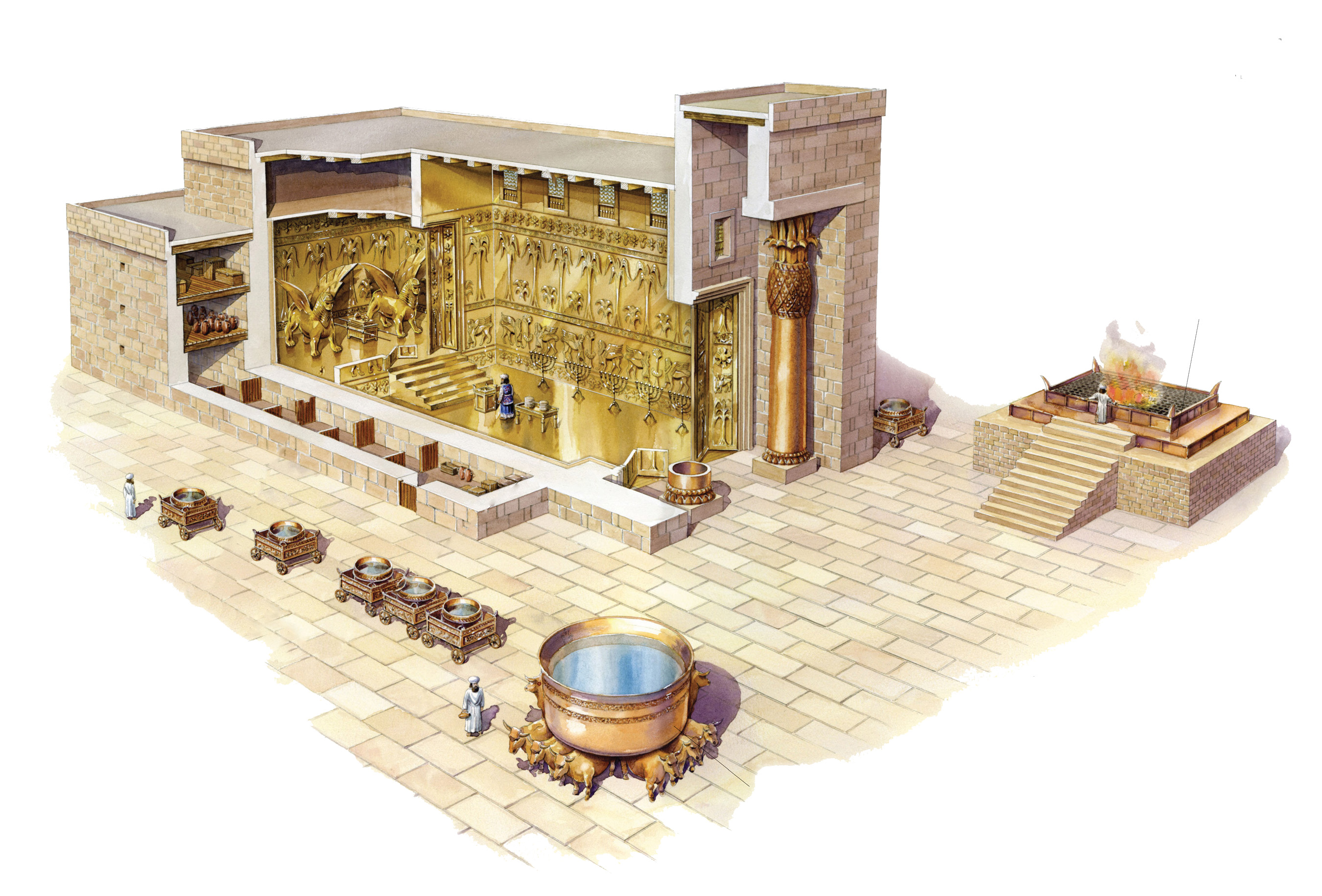
In chapters 6-8, the author reports the building of the temple that would become the permanent “home” of God among the Israelites. Verses 1-10, in chapter 6, tell us that temple construction began in 966 BC, Solomon’s fourth year as king. The project was completed and the temple dedicated 7 ½ years later. This structure would stand for almost four hundred years until it is destroyed by the Babylonians.

What did the temple look like? Paul R. House, in 1, 2 Kings, The New American Commentary, summarizes:

First, the temple was about ninety feet long, thirty feet wide, and forty-five feet high. By modern standards it was a fairly small worship center [with 2700 square feet of floor space]. Second, it had a portico, or porch (6:3), which ran ‘the width of the temple’ and projected out ‘from the front of the temple’ (6:3). Third, it was a three-story complex (6:6). Fourth, its various portions were carefully shaped at their quarries, then fitted, without hammering, on site (6:7). Fifth, its frame and beams were cedar (6:9). Sixth, the facility included a number of ‘side rooms’ (6:10) that probably were set aside for the priests’ use. In other words, the building was attractive, yet functional.

The rest of chapters 6 and 7 describe the interior of the temple and the bronze furnishings crafted by Huram of Tyre. We also learn in chapter 7 that Solomon built an entire palace complex after completion of the temple. His palace complex would take 13 years to finish, almost twice as long as the temple.

Once the temple construction finishes, it is time to bring the Ark of the Covenant to the Most Holy Place (Holy of Holies) inside the temple. Recall that the Ark has been residing in a specially constructed tent inside the City of David. Solomon has built the temple and his palace just outside the City of David, thus expanding the footprint of the city of Jerusalem, which includes all of it.

Solomon invites all the elders of Israel to witness the carrying of the Ark to the newly completed temple. The movement of the Ark and the subsequent dedication of the temple all take place during the Festival of Booths. Solomon extends the Festival from seven days to fourteen days to celebrate the dedication of the temple.

Once the priests finished placing the Ark in the Most Holy Place, a cloud (the glory of God) filled the temple, thus indicating that God has taken up residence among Israel.

Solomon then speaks to all the leadership of Israel about the meaning of this day. First, Solomon reminds them that God has kept the promise He made to David – that David’s son would build a temple for God. Second, God promised David that Solomon would sit on the throne of Israel, and that has also occurred. Third, Solomon has built a permanent structure for the Ark of the Covenant which contains the two stone tablets that Moses placed in the Ark almost 500 years prior.

Later in chapter 8, Solomon also reflects on God’s fulfillment of His promises to Abraham, Isaac, Jacob, and Moses. God promised the patriarchs that their descendants would have the land of Canaan – that was complete. God promised Moses that Israel would have a central place of worship – check. God promised that Israel would live in peace with her neighbors – and during Solomon’s reign that was the case. Solomon also prays that God will fulfill His promise of blessing all the nations of the world through Israel and her temple.

The dedication of the temple in 959 BC is regarded by most scholars as the pinnacle of Israel’s success as a nation. She was powerful, wealthy, and at peace. But before we get carried away, we must remember that God repeatedly warns Solomon, as He reminded David, that Israel’s blessings are contingent on Solomon’s obedience to the Torah. Although Solomon was seemingly off to a good start, it wouldn’t be long before Solomon’s disobedience would cost Israel dearly.

For an illustration of what Solomon’s temple may have looked like, click on this link.

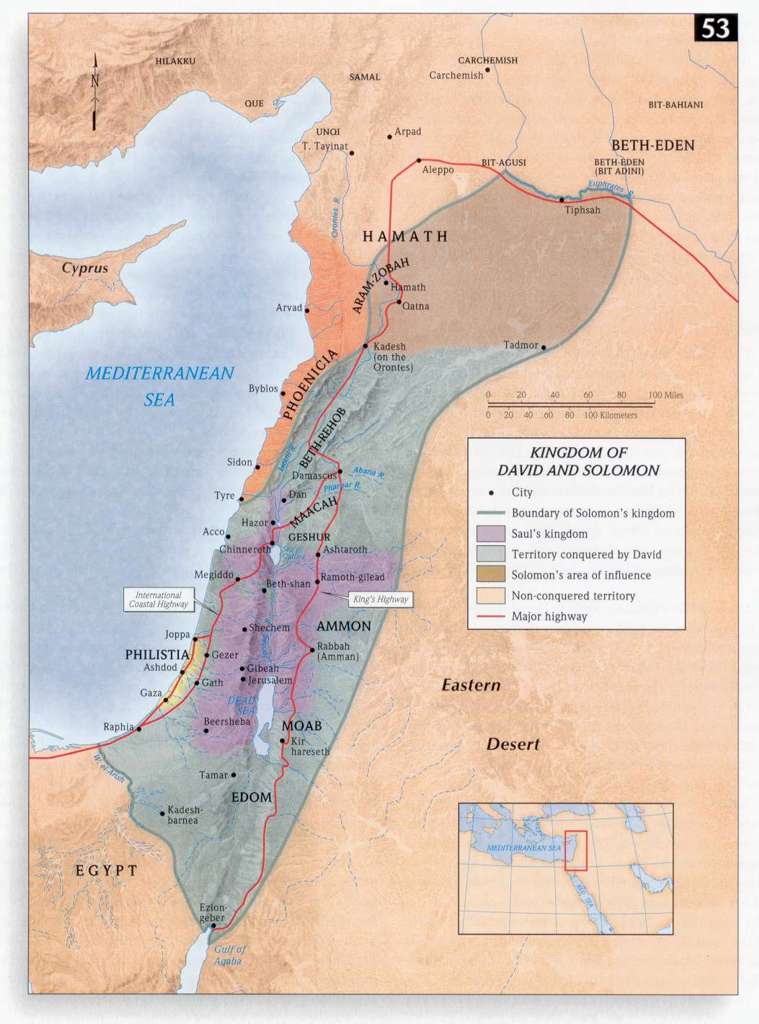
To see the geographical boundaries of Israel under Solomon’s rule, click on this link.

Commentary on 1 Kings 3 (Solomon Asks for Wisdom)

The books of 1 and 2 Kings were originally a single work, but were separated into two parts when they were translated into the Greek New Testament (the Septuagint). The Septuagint also combined Samuel and Kings into a four-part history of the monarchy of Israel (First, Second, Third, Fourth Book of Kingdoms).

The author of Kings is unknown, but most scholars believe it was finally written and edited around 550 BC during the Babylonian exile by a Judahite. The author claims to use at least three sources for his information, although there are probably additional sources he does not mention. The three sources are 1) the Book of the Annals of Solomon, 2) the Book of the Annals of the Kings of Israel, and 3) the Book of the Annals of the Kings of Judah. These books were either part of the official royal archives, or they may have been written by Hebrew prophets during the 400 year span from Solomon’s rule to the capture of Jerusalem by the Babylonians.

The primary purpose of the author is to explain why the Jews are in exile by examining the kings who ruled Israel and Judah. Each king is evaluated based on whether they obeyed God’s commands in the Book of Deuteronomy, which is the summary of the Law given to Moses. The kings of the northern kingdom, Israel, disobeyed God so egregiously that they were overrun by the Assyrians a full 136 years before the southern kingdom of Judah was overrun by the Babylonians. Although there were a handful of kings who followed the Law, the vast majority did not, and so both Israel and Judah fell to foreign powers.

Chapter 3 of 1 Kings begins Solomon’s official reign as king of Israel in 970 BC. In verse 1, we learn that Solomon immediately forges an alliance with Egypt, his powerful southern neighbor, by marrying the daughter of Pharaoh. He brings her to Jerusalem and puts her in temporary quarters until his building projects are completed.

There is some debate among biblical interpreters as to whether Solomon is violating the Law with this marriage. Deuteronomy 7 prohibits marriage with Canaanite women, but Deuteronomy 21 allows for marriage of foreign (non-Canaanite women) captured in battle. It appears that Pharaoh’s daughter willingly accepted the worship of Yahweh and she is nowhere criticized by the writer for turning Solomon away from adherence to the Law.

In verses 2-3, the writer alerts us to the fact that the Israelites are worshiping at “high places,” which are shrines set up at various elevations to conduct worship of a deity. The reason given is that there is no central worship center for the Israelites yet. At this time, the Ark of the Covenant has been moved to Jerusalem, but the rest of the tabernacle still resides at a high place called Gibeon, which is about 5 miles north of Jerusalem.

Solomon travels to Gibeon to make sacrifices to God, probably during one of the seven annual festivals. That night, he encounters God in a vivid dream. God asks Solomon what he wants and Solomon answers that he desires a “discerning heart to govern your people and to distinguish between right and wrong.” Why? Because he is an inexperienced king (he was about 20 years old at the time) and he is expected to govern an enormous number of people.

Recall that a primary role of a king was to render judicial decisions in especially difficult cases where local judges were not able to settle a dispute. Years before, King David’s son Absalom undermined his authority by accusing David of neglecting his judicial role. Solomon knows he needs God’s help to do this job well.

It is also important to note that God is the source of all wisdom, and thus Solomon will only be truly wise and discerning if he follows the commands of God, given in the Law. Solomon cannot be wise without knowing and obeying the commands of God.

God is pleased with Solomon’s request and grants it. He will make Solomon the wisest man who ever lived. In addition, God will give Solomon those things he did not ask for: riches and honor. Solomon will also have a long life if he obeys the Law as his father David did.

Now that God has officially blessed Solomon’s reign, Solomon returns to Jerusalem and hosts a feast with sacrifices before the Ark of the Covenant. His rule is off to a great start!

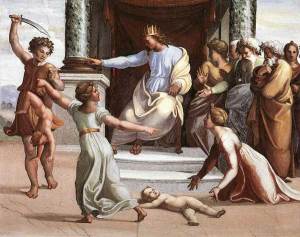
To prove to his readers that God truly blessed Solomon with supernatural wisdom, the author of 1 Kings, in verses 16-28, relates the most famous example of Solomon’s discernment at work. Two prostitutes, who live in the same house, each bear a child within 3 days of each other. One prostitute carelessly smothers her child while she sleeps. When she discovers what she’s done, she takes her dead baby and swaps it for the live baby who belongs to the other sleeping prostitute.

The next morning, the woman wakes with a dead baby beside her, but upon closer inspection she realizes it’s not her child at all. She figures out that the other prostitute has stolen her child to replace the one she lost. Of course, both women claim that the other is lying and that the live baby truly belongs to each of them. How can Solomon possibly decide who the mother of the living baby is?

Solomon’s solution is to announce that he will cut the baby in half with a sword so that each woman can have half a baby, the only “fair” solution. At this point, one woman speaks up and pleads for Solomon to give the baby to the other woman instead of killing him. The other woman tells Solomon to go ahead and kill the baby so that neither woman will have him. Solomon rightly discerns that the true mother must be the first woman who offered to give the baby up.

Verse 28 summarizes the reaction of the nation to Solomon’s ruling: “When all Israel heard the verdict the king had given, they held the king in awe, because they saw that he had wisdom from God to administer justice.”

Commentary on Psalms 51 and 139 (Psalms of David)

Psalm 51 is traditionally thought to be David’s lamentations for his sins against Bathsheba and Uriah. As the psalm begins, David asks for God’s forgiveness. Why God? Because even though David sinned against Bathsheba, Uriah, and others, it is God whom he has grieved the most. When we sin, we sin first and foremost against God.

David acknowledges that God is a righteous judge and he also affirms that he has inherited a sinful nature. From his very conception he was sinful, thus affirming the doctrine of original sin, where the sinful nature of Adam and Eve has been passed down to all of their descendants.

David continues, in the psalm, to plead for God to purify him. This purification is not trivial, as Donald Williams and Lloyd Ogilvie, in Psalms 1–72, The Preacher’s Commentary Series explain.

The verb for ‘purge’ is intensive here, meaning ‘un-sin’ me, purify me from uncleanness. The word is commonly used in describing the cleansing of a leper’s house. Hyssop is also used to sprinkle blood in the rite of purification (Lev. 14:52). Similarly, hyssop was the agent used in spreading the blood of the Passover lamb on the lintels and doorposts of the Hebrew households in Egypt before the plague of death (Ex. 12:22). Underlying the purging of verse 7, then, is the concept of sacrificial blood. As we pray for purification, the leprosy of sin is removed.

David begs God to take away his guilt and to turn His face from David’s sins. David is concerned that God will take away His Spirit from David, just as He did with Saul. If only God will renew David in His eyes, David promises to evangelize and teach non-believers the ways of God.

David knows that his crimes merit the death penalty, according to the Law. If God will show him mercy, David will sing of His righteousness and publicly praise Him. David also knows that God wants a truly repentant and broken heart from David. David’s sacrifices mean nothing to God otherwise. Once David is restored, he asks that the nation of Israel also be restored so that she can once again give God the sacrifices He deserves. Allen Ross, in The Bible Knowledge Commentary (Old Testament:), summarizes Psalm 51:

The message of this psalm is that the vilest offender among God’s people can appeal to God for forgiveness, for moral restoration, and for the resumption of a joyful life of fellowship and service, if he comes with a broken spirit and bases his appeal on God’s compassion and grace.

Psalm 139 is a psalm of personal thanksgiving by David. In particular, David meditates on God’s omniscience and omnipresence. These two divine attributes lead David to understand God’s intimacy with His creation.

In verses 1-6, David affirms that God knows his every thought and his every action. In fact, God knows what David will say even before he says it. There is nothing about David that God does not know.

Is there anywhere David can go to avoid the all-seeing gaze of God? Is there any place he can travel to avoid intimacy with God? The answer given in verses 7-12 is “no.” Whether David is in heaven (the world above the surface of the earth) or hell (the world below the surface of the earth), God is there. Even if David flees to ends of the earth, God is there. Whether David is in darkness or light, God is with him. There is literally no place David can be where God is not holding David in His hand.

How does God know so much about David? Not only is He omniscient, but He created David in the womb. The embryonic David, in his mother’s womb, was skillfully woven together by God’s hand. He was involved with every detail of David’s growth in his mother’s womb. Going beyond the womb, every one of David’s days on earth were written ahead of time by God. There is nothing in David’s life that catches God by surprise.

In verses 17-18, David expresses wonder at God’s thoughts, and then abruptly, in verses 19-22, spells out his hatred for those opposing God. All those who speak against God, who take His name in vain, David hates with a “perfect hatred.” Donald Williams and Lloyd Ogilvie describe David’s hatred:

David’s strong reaction is not against ‘sinners.’ He is not a self-righteous judge who will not stain himself with this world. His reaction is against those who revile God’s name, who are His enemies (v. 20). It is those who hate God and rise up against Him that incur his wrath. And why is this so? Because the God who is so exquisitely described in verses 1–18 deserves our praise and worship. To withhold this is to deserve both human and divine wrath.

Finally, David invites God to test his own heart and mind to see if David is wicked in any way. He is willing to submit himself to God’s scrutiny. Williams and Ogilvie beautifully summarize the intimacy with each of us that God desires:

He formed us in the womb. He knows our frame. He sees our embryo. He fashions our days. He knows our thoughts. He hears our words. He knows when we sit down and when we stand up. He protects us. His hand is upon us. He who inhabits all things is near to us. We cannot escape His presence. In the light He sees us. In the dark He sees us. We are the continual object of His thoughts. He searches us. He changes us. Here is true intimacy, and if we can allow God to become intimate with us, we can establish a growing intimacy with each other. Secure in His presence and His love, we can risk opening up. We can even risk rejection, because we are held in His hand (v. 10).

Commentary on Psalms 23, 27 (Psalms of David)

The Book of Psalms is a collection of five sets of books that were combined into a single biblical book. The psalms are primarily praises and prayers for temple worship or personal devotion.

The 150 psalms were composed over a period of about 1000 years, starting in the time of Moses (1400 BC) and stretching all the way to the Babylonian exile (586 BC). It seems that the Israelites were collecting and organizing individual psalms from the beginning of their organization as a nation.

Many of the psalms are anonymous, although all but 34 have superscripts that indicate authorship.  Of all the Psalms, at least 73 are attributed to David. Other authors are Asaph (Ps 50; 73– 83), the sons of Korah (42– 49; 84– 85; 87– 88), Moses (90), Solomon (127), Heman (88) and Ethan (89).

Psalm 23 may be the most famous of all the psalms, given that it is regularly quoted by non-Christians and non-Jews alike. Although it is brief, it has comforted millions of people for thousands of years.

Psalm 23 can be broken into two parts: God’s provision (verses 1-3) and God’s protection (verses 4-6). In verse 1, David compares God to a shepherd, a very common metaphor for God used both in the Old and New Testaments. Donald Williams and Lloyd Ogilvie explain, in Psalms 1–72, The Preacher’s Commentary Series:

In Psalm 80:1 God is addressed: ‘Give ear, O Shepherd of Israel, You who lead Joseph like a flock’ (see Gen. 49:24; Ezek. 34:11ff.). Israel’s kings are also called shepherds. After denouncing the unfaithful shepherds of His people, God promises, ‘I will set up shepherds over them who will feed them; and they shall fear no more, nor be dismayed, nor shall they be lacking’ (Jer. 23:4; cf. Ezek. 34:2). And Jesus identifies Himself as the ‘good shepherd,’ the Messianic King (John 10:11). His goodness is in His giving His life for the sheep.

A shepherd provides everything a sheep needs, and that is exactly how David sees God. A sheep needs rest, as do human beings, and God provides that rest when He makes us “lie down in green pastures.”

Sheep, like humans, also need food and drink, and God provides that as well when He leads us “beside quiet waters.” Our souls likewise need restoration, not just our bodies, and God provides that restoration. Once our souls are restored and transformed, God “guides [us] in paths of righteousness for his name’s sake.” Our restored souls do the work of God’s kingdom as representatives of the King of kings. Every good and loving deed we do is for God, our loving shepherd.

Williams and Ogilvie expand on Jesus’ role as our shepherd:

As our good shepherd, Jesus provides us with rest, food, and water. When we come to Him we enter His ‘Sabbath rest’ or salvation (Heb. 4:1–11). He feeds us with Himself because He is the bread which has come down from heaven. As Jesus tells the multitudes, ‘I am the bread of life. He who comes to Me shall never hunger, and he who believes in Me shall never thirst’ (John 6:35). Then Jesus gives us His Spirit to quench our thirst. Again He promises, ‘If anyone thirsts, let him come to Me and drink. He who believes in Me, as the Scripture has said, out of his heart will flow rivers of living water’ (John 7:37–38). John comments, ‘But this He spoke concerning the Spirit’ (John 7:39).

David also recognizes that God protects. In verse 4 we see that even though we are threatened with pain, suffering, and even death in this world, God is always with us. The destiny of a child of God is sealed, so there is no reason to fear. The rod and staff of a shepherd are used to protect a sheep from danger, and God will likewise protect His sheep.

Verse 5 then shifts the metaphor from shepherd to host. God celebrates David’s life with a banquet of food and drink, and in front of David’s very enemies. David is also anointed with oil, a sign of God’s blessing.

In verse 6, David affirms that God’s love and blessing on his life will continue throughout his life. Not only that, but David will live in God’s presence (His house) forever.

We now move to Psalm 27, another psalm of David. Verses 1-3 describe why David has no fear when his enemies attack him. David, during his life, was faced with attacks from King Saul, the Philistines, the Ammonites, the Amalekites, and even his own son. Each time, his life was in peril, so how could he possibly survive the repeated stress? Verse 1 answers the question.

God is David’s light, salvation, and stronghold. Salvation, in this sense, denotes being saved from physical death, although Christians may rightly apply the term to eternal salvation. Light refers to God’s holiness, but also to His bestowal of understanding on David. David is able to see his circumstances through God’s eyes, and not merely his own.

Williams and Ogilvie remind us of the importance of our reliance on God:

Faith or fear—these are our ultimate options. Either we can know the living God as our ‘light,’ ‘salvation,’ and ‘strength,’ or we are condemned to anguish as we move toward our final hour. The atheist philosopher Bertrand Russell put it, ‘The older I get, the more nervous I become.’ In contrast, two weeks before his death, Pope John XXIII said, ‘My bags are packed. I’m ready to go.’

In verses 4-6, David reveals what is most important to him: 1) to dwell in the house of the LORD, 2) to gaze upon the beauty of the LORD, and 3) to seek him in his temple. At the time David likely wrote this psalm, there was a tabernacle set up in Jerusalem which housed the Ark of the Covenant, the place where God promised to meet Israel on earth. Of course, the tabernacle was only meant to be a representation of God’s real home in heaven. In either case, David’s single biggest desire is to be where God is. David knows that if he is where God is, then David will be kept safe and will triumph over his enemies.

In verses 7-12, David shifts to a direct conversation with God. He is obviously in trouble and he is frustrated that God is not immediately saving him from his trouble. David wonders why it seems like God is not answering him, why it seems like God is hiding his face from David, why it seems like God is angry with Him, why it seems like God is rejecting him.

David reminds God that he desires to be led by God and that he desires to know the ways of God. It would not be right for God to turn David over to his enemies, when they are unjustly attacking David. David deserves God’s provision because he loves God, whereas his enemies are false witnesses.

In verses 13-14, though, David reminds himself and his readers that even though God does not appear to be helping him right at that moment, he is confident that He will. He will see God’s blessings while he is still alive, but he must wait for God.

Commentary on 1 Chronicles 28-29 (Death of David)

1 and 2 Chronicles were originally a single work that was separated into two books when it was translated into the Greek Septuagint. The Chronicles was written to the Jewish people after they returned from Babylonian exile in the 6th century BC.  Jewish tradition holds that Ezra was the author of Chronicles, but scholars are divided on the issue.

The book starts with genealogies stretching from Adam to the twelve sons of Jacob, to David, all the way to the exiles of Judah. It then records the accomplishments of King David and King Solomon, and lastly records the deeds of the kings of Judah after Solomon’s death. The book ends with Judah’s capture by the Babylonians and her subsequent exile, but the last couple paragraphs of 2 Chronicles skip ahead 70 years to the decree of Cyrus the Persian to allow the Jews to return to their homeland, and there the book ends. The most likely date for the book’s creation was some time after 400 BC, 150 years or so after the return from exile.

The author of the Chronicles used some non-biblical sources to compose his sweeping history, but it seems clear that he also had the following biblical books in front of him when he wrote Chronicles: the Pentateuch, Joshua, Judges, Ruth, 1 and 2 Samuel, 1 and 2 Kings, Psalms, Isaiah, Jeremiah and Lamentations.

The purposes of the author are at least three-fold. First, the exilic community needed to be reminded of its national origins, going all the way back to the dawn of mankind. Second, the Israelites needed to be reminded of their national unity under the great kings David and Solomon. Third, the Israelites needed to be reminded of the primacy of the Torah, received by Moses, and along with the Torah, the importance of proper temple worship mediated by the Levite priests.

Chapters 28-29 of 1 Chronicles record three important events: 1) David’s instructions to Solomon to build the temple, 2) Solomon’s anointing as king, and 3) David’s death. Verses 1-11 in chapter 28 get us started.

David, an old man now, summons all of the leadership of Israel to hear his final commands. We are immediately reminded of both Moses and Joshua speaking before their deaths to the leaders of Israel. David first explains that he wanted to build the temple for God, but God would not allow him because David was a warrior and had shed blood. Instead of David, God chose Solomon to build His house. Of all of David’s sons, Solomon would be the next king and he would have the honor of building the temple.

David then charges the leaders of Israel to “follow all the commands of the LORD your God, that you may possess this good land and pass it on as an inheritance to your descendants forever.” He turns to Solomon and instructs him to “acknowledge the God of your father, and serve him with wholehearted devotion and with a willing mind.” There are consequences for Solomon’s actions toward God. “If you seek him, he will be found by you; but if you forsake him, he will reject you forever.”

God will bless Solomon and Israel if they obey his commands (especially building the temple), but He will curse them if they do not follow His commands. This has been the consistent message from God to the people of Israel ever since they left the slavery of Egypt, and it is still His consistent message to us today.

Note also that David warns Solomon, “The LORD searches every heart and understands every motive behind the thoughts.” God is omniscient, or all-knowing. Neither Solomon nor anyone else can hide what they are thinking from God, as he sees everything with perfect clarity.

In verse 11, David gives Solomon detailed plans on how to build the temple, plans that are described more fully in verses 12-19. David tells the assembled crowd that these plans were inspired by God, so that there is no doubt that they should be followed to the letter. The temple is to be a continuation of the tabernacle, and so we see many parallels between David’s plans and the plans given to Moses in the Book of Exodus.

In chapter 29, verses 1-9, David announces the treasure he has donated to the temple building campaign and implores the leaders of Israel to likewise donate, so that Solomon has everything he needs to finish the divinely appointed construction project. The leadership responded with an outpouring of generosity and all Israel rejoiced.

In verses 10-13, David spontaneously praises God with a beautiful prayer. In this prayer he refers to God’s timelessness, omnipotence, beauty and majesty, sovereignty, and generosity. David thanks God, essentially, for being God! David realizes that literally nothing good is given to him or Israel without it coming from God. Of special note is that verse 11 was appropriated by the early Christian church as a doxology appended to the Lord’s Prayer: “Yours, O LORD, is the greatness and the power and the glory.”

David’s prayer continues in verses 14-19. He acknowledges that everything donated to build the temple comes from God in the first place. David knows that God can see the sincerity that accompanied the donations of the people of Israel. Their motives were pure. David then asks that God “keep this desire in the hearts of your people forever, and keep their hearts loyal to you.” Regarding Solomon, David asks God to “give my son Solomon the wholehearted devotion to keep your commands, requirements and decrees and to do everything to build the palatial structure for which I have provided.”

The next day David hosts a tremendous festival for the Lord, including sacrifices, eating and drinking, and the coronation of Solomon. It is likely that David and Solomon were co-regents for a time, until David eventually died. This was a common move by kings who wanted to ensure that their chosen successors were firmly established before the king’s death. Solomon’s rule begins with rich blessings from God and the full allegiance of the leaders of Israel.

Finally, in verses 26-30, the death of the greatest king of Israel, David, is reported. The writer informs us that David “ruled over Israel forty years—seven in Hebron and thirty-three in Jerusalem. He died at a good old age, having enjoyed long life, wealth and honor.”

J. A. Thompson, in 1, 2 Chronicles: An Exegetical and Theological Exposition of Holy Scripture (The New American Commentary) concludes:

The Chronicler presents not one but two great kings as the ideal for Israel. The one was David, the warrior-king, who subdued the enemies of the people of God and established a secure domain. He was now passing, and the other, Solomon, was taking his place. Solomon was a man of peace who would build up the prosperity of the nation. These two things together—victory over enemies and a reign of peace—are both essential. For Christian readers these two ideals are fulfilled in the one man, Jesus Christ. He conquers all his foes but at the same time establishes a reign of peace for his own people. In this the tandem of David and Solomon are a type of Christ.

Commentary on 2 Samuel 13-18 (Absalom’s Rebellion)

Chapter 13 begins with an ominous declaration: Amnon loves Tamar. Amnon is David’s firstborn son and heir to David’s throne. His mother is Ahinoam. Tamar is the daughter of David and Maacah. Maacah and David also have a son named Absalom, so Absalom and Tamar are brother and sister. Tamar is Amnon’s half-sister.

Amnon wants to have sexual relations with Tamar, but she is still a virgin and yet to be married. In addition, the Law specifically prohibits sex/marriage between half brothers and sisters. Amnon, however, doesn’t care about the Law and wants Tamar anyway.

Jonadab, Amnon’s cousin, suggests a plan for Amnon to be alone with Tamar. He is to pretend he is sick and request that Tamar come to his house to prepare food for him. When Tamar prepares bread for him, he orders everyone else out of the house. When she is alone with Tamar in his bedroom, he asks her to have sex with him.

Tamar, as a woman who knows the Law, refuses his advances. She knows that sex between brother and sister is forbidden, and she also knows that if she loses her virginity to Amnon, she will likely never marry. Her only option is to tell Amnon that he should petition King David to allow them to marry. Amnon is not interested in marriage, so he rapes her.

Once the deed is done, he kicks her out of his house and refuses, again, to marry her. In fact, verse 15 says that he hates her after they had sex more than he loved her before they had sex. We know, for sure, that Amnon simply lusted after her. There was no love involved.

Tamar tears her ornamented robe, which marked as her one of the virgin daughters of the king. There is no hiding what was done, as Tamar publicly mourns the loss of her virginity. Her full brother Absalom finds out what happened and takes her into his home. No man will want to marry her now. Absalom hates Amnon for what he has done, but he never tells him. David also finds out what happened and he is furious, but he does nothing about it.

Dale Ralph Davis, in 2 Samuel: Out of Every Adversity (Focus on the Bible Commentaries), faults David for his inaction:

It should have led to a righteous result. His anger should have led to justice. Amnon should have been punished and Tamar exonerated. Instead Amnon is not held accountable, Tamar receives no redress, and Absalom is handed a plausible excuse for revenge. David heard. He was very angry. And he did nothing.

Two years later, Absalom hosts a party at a place called Baal Hazor centered on the shearing of his sheep. He requests that David join him for the festivities, but David declines. Since David will not come, Absalom requests that Amnon come in his place, since the firstborn could represent his father. David agrees.

In verse 28, Absalom instructs his men to kill Amnon once he’s drunk, and this is exactly what they do. After two years of plotting revenge, Absalom acts and kills his half-brother, the heir to the throne.

Absalom flees to his maternal grandfather’s home in Geshur. He stays there for three years until David finally summons him to come back to Jerusalem. When he returns to Jerusalem, David refuses to see him for 2 more years. At the prompting of his trusted general Joab, David allows Absalom to come before him and they are reconciled. It had been 5 years since the murder of Amnon.

Not content with his circumstances, and perhaps still angry at his father for not punishing Amnon himself, Absalom begins to build a political following in Israel. He acquires a chariot with horses (the transportation favored by Canaanite royalty) and an entourage of 50 soldiers that would run ahead of the chariot. These are the trappings of royalty and power which support the image he wants to convey to the people of Israel.

Robert Bergen, in 1, 2 Samuel: An Exegetical and Theological Exposition of Holy Scripture (The New American Commentary)also notes:

The biblical narratives stretching from Exodus through this point in 2 Samuel are surprisingly negative in their portrayal of horses and chariots. The texts consistently depict only enemies of the Lord and his covenant people as having them. The Egyptians (cf. Exod 14:9–15:21; Deut 11:4; Josh 24:6), northern Canaanites (Josh 11:4–9; Judg 4:15; 5:19–22), and Arameans (8:4; 10:18) all used them unsuccessfully in battle against Israel. Thus, when Absalom linked them with himself, he was joining his ambitions with symbols of hostility against the Lord and Israel, and with ultimate failure.

Absalom also intercepts numerous Israelites at the gate of Jerusalem who are seeking judicial rulings from David. He lies to them, saying that David is not fulfilling his role as judge in Israel. Absalom suggests that he is perfectly willing to serve in this capacity. He also flatters the supplicants by always agreeing that their case is just.

After 4 years of Absalom’s campaigning at the gate, he is ready to make his move. He asks David for permission to travel to Hebron to make a sacrifice to God for allowing him to come back to Jerusalem from exile. David agrees to his request. Why did Absalom really want to go to Hebron? Robert Bergen explains:

At Hebron Absalom found himself twenty miles away from his father and protected by strong walls. From this relatively safe base of operations Absalom moved quickly to usurp David’s throne. He prepared for the public phase of his plot by sending secret messengers throughout the tribes of Israel (v. 10) to make a coordinated proclamation throughout the land. Once in place, they were to await ‘the sound of trumpets’ and then announce simultaneously that ‘Absalom is king in Hebron.’ Implicit in this proclamation was a call to arms for those who supported Absalom in his efforts.

Absalom also brings along 200 men from David’s administration to Hebron, letting them think they are guests at his sacrifice. This was a brilliant move by Absalom, depriving his father of 200 of his friends and advisors during the impending crisis. They would be forced to help Absalom or be killed. While in Hebron, Absalom also sends for one of David’s top advisors, Ahithophel. Recall that Ahithophel is the grandfather of Bathsheba, the woman who David seduced. It is quite possible that Ahithophel still harbors a hatred for David for what he did to Bathsheba and Uriah.

If there was any question whether Absalom would succeed in his coup, David receives a messenger in Jerusalem who gives him the horrible news: “The hearts of the men of Israel are with Absalom.”

Since there is not enough time to comment on all the events of chapters 15-17, here is a brief synopsis. David flees Jerusalem with his family, officials, and a small army of soldiers. He leaves behind 10 concubines to tend to operation of the royal palace while he is gone. He also leaves behind spies to inform him of Absalom’s plans.

Absalom moves into David’s palace and has sexual relations with the 10 concubines on the roof of the palace to publicly declare himself as king of Israel. After consulting two advisors, Ahithophel and Hushai (a spy for David), he gathers a large military force and leads them to kill David and defeat his army, who have crossed over to the east side of the Jordan River. David’s spies warn him of Absalom’s plans.

At the beginning of chapter 18, David divides his army into 3 groups, each commanded by one of his generals. The plan is to fight Absalom in the surrounding forests, where David’s forces will have a military advantage. David wants to go to battle, but his generals convince to stay behind. Before they leave, David commands the soldiers to be gentle with Absalom if they capture him. David, evidently, wants to be reconciled with him again.

In verses 6-8, we learn that David’s army defeats Absalom’s army. Some 20,000 soldiers die. Absalom’s fate is described in verses 9-15. As he is riding his mule, he gets stuck in low-hanging tree branches and is left hanging from the tree, still alive. Some of David’s soldiers spot him and tell Joab, David’s top general.

Joab asks the soldiers why they didn’t kill Absalom and they cite David’s instructions to be gentle with him. Joab takes matters into his own hands and he kills Absalom himself by plunging three javelins into him.  Thus ends the rebellion of David’s son Absalom.

What can we learn from this whole sordid affair? First, God’s prophetic words always come true. The prophet Nathan warned David that blood would not leave his house, and that a family member would sleep with his wives, thus rebelling against David. All of this came to pass with Absalom.

Second, the sins of parents are passed on to their children. Just as David illicitly slept with Bathsheba, Amnon had illicit relations with Tamar. Just as David has Uriah murdered, Absalom had Amnon murdered.

Third, note that Absalom never consulted God or his prophets. He only sought advice from men, none of whom had a word from God. This behavior mirrored that of the kings of the Canaanite nations. What a contrast with David! Robert Bergan draws out the contrast:

At every crux in his life, David sought the word of the Lord, either through an Aaronic priest (1 Sam 23:1–6; 2 Sam 5:19, 23) or a prophet (7:3–17). Absalom’s pursuit of and compliance with human counsel brought about the hasty end of his regime. David’s pursuit of and obedience to divine revelation brought him only success and dynastic blessings. By providing contrasting narrative portraits of these two Davidic kings, the author writes a prescription for the success of all future leaders in Israel: seek the word of the Lord through its authorized mediators and obey it.

Fourth, Absalom’s death carries theological significance. Bergen writes:

The words used by the soldier to report Absalom’s condition are of great theological and thematic significance: ‘Absalom was hanging [Hb., tālûy] in an oak tree.’ The word translated ‘hanging’ here is used only once in the Torah (Deut 21:23) to declare that ‘anyone who is hung [tālûy] on a tree is under God’s curse.’ Absalom had rebelled against divine law by rebelling against his father (cf. Exod 20:12; Deut 5:16; 21:18–21) and sleeping with members of David’s harem (Lev 20:11). Absalom had the massive armies of Israel fighting to protect him, and he was personally equipped with a fast means of escape not afforded other soldiers—a mule. Nevertheless, in spite of these seemingly insurmountable advantages, Absalom could not escape God’s judgment. The Lord had declared in the Torah that one who dishonored his father was cursed (Deut 27:16) and likewise that one who slept with his father’s wife was cursed (Deut 27:20)—Absalom, of course, had done both. Although no army had been able to catch Absalom and punish him, God himself had sent a curse against him that simultaneously caught and punished the rebel. The fearful judgments of the Torah had proven credible: the Lord had upheld his law.

Commentary on 2 Samuel 11-12 (David and Bathsheba)

In previous chapters, Israel has been at war with the Ammonites, but they have not yet completely defeated them. As chapter 11 begins, David sends the army to finish off the Ammonites once and for all. They have retreated to a city named Rabbah, so David’s forces are besieging Rabbah.
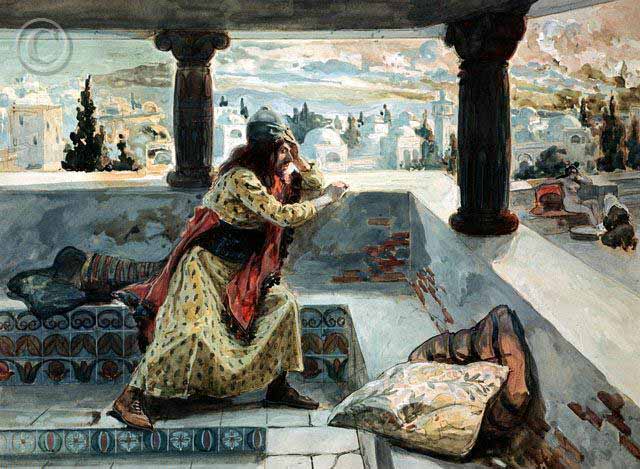
David, however, does not travel to the front lines and instead stays home during the siege. One evening, as David walks around the roof of his palace, he sees a beautiful woman bathing on another roof. He sends word for her to come to the palace, and then he has sex with her. She quickly learns that she is pregnant and tells David.

So who is this woman? Before David even sends for her, he learns that she is Bathsheba, “the daughter of Eliam and the wife of Uriah the Hittite.” Robert Bergen, in 1, 2 Samuel: An Exegetical and Theological Exposition of Holy Scripture (The New American Commentary), explains that “she was the daughter of one of David’s best fighters, the granddaughter of his most trusted counselor, and the wife of one of his inner circle of honored soldiers.” David is thus choosing to commit adultery and betray some of his most loyal followers.

Since Bathsheba is pregnant, the only way to hide the secret is for David to entice Uriah to sleep with Bathsheba immediately so that when the child is born everyone will think it belongs to Uriah. Since Uriah is off fighting the Ammonites, David summons him back to Jerusalem and encourages him to go to back to his house to rest and rejuvenate. Surely he will have intimate relations with his wife when he goes home.

Instead, Uriah sleeps at the palace with the servants. So David gives him alcohol and gets him intoxicated, assuming that his drunken stupor will cause him to go to his house and sleep with his wife. Again, Uriah refuses to go home.

Why does Uriah refuse to go home? Robert Bergen writes:

Uriah’s refusal to have sexual contact with his wife at this time was clearly an expression of his devotion to the Lord: all sanctioned military activity was a form of service to the Lord, and it required the Lord’s blessing for success. In order to maximize the probability of receiving that blessing in military endeavors, David seems to have required soldiers carrying out military assignments to keep themselves in a state of ritual purity, which necessarily meant refraining from all sexual contact (cf. 1 Sam 21:5; Exod 19:15). If Uriah had had sexual relations with Bathsheba, he would have rendered himself temporarily unfit for military service (cf. Lev 15:18) and thus unfit for service to the Lord.

Since Uriah refuses to sleep with Bathsheba, David concocts a new plan to murder Uriah, which will allow David to legally take Bathsheba into his household as her kinsman-redeemer. David sends a message, carried by Uriah, to his general, Joab. Joab is to mount a risky assault close to the walls of Rabbah, and make sure Uriah is part of the assault. When the soldiers come under attack, Joab is to withdraw the other soldiers so that Uriah is left alone and defenseless, to be killed by the enemy.

Joab does what David commands, but he loses several other soldiers in the assault, in addition to Uriah. The Ammonite archers of Rabbah slay the soldiers because they were so close to the city walls. Keep in mind that this assault was completely unnecessary as they had Rabbah surrounded. Given enough time, the city would have surrendered without this useless attack on the city wall.

So David has now committed adultery and murder. His commands to Joab are directly responsible for the death of Uriah, but indirectly responsible for the deaths of the other soldiers in the risky assault.

Upon hearing of Uriah’s death, Bathsheba mourns. After her mourning is over, she moves into the palace with David. How did David not arouse suspicion when he moved Bathsheba into the palace, married her, and then impregnated her? Robert Bergen offers a plausible explanation:

As perhaps in the case of Abigail, David may have been acting as a royal, surrogate kinsman-redeemer (Hb. gōʾēl). David might have claimed he was taking the gōʾēl responsibility on himself since Uriah was a foreigner who had no near kinsman living in Israel. As such, David would have assumed the lifelong responsibility of caring for the needs of Uriah’s widow and was obligated to father a child in order to raise up an offspring to preserve the family line of the deceased (cf. Gen 38:8; Deut 25:5–6; Ruth 4:5). Such a pretext would have made David’s actions toward Bathsheba following Uriah’s death seem truly noble and would have accounted nicely for the birth of the son.

Even though David may have fooled everyone else, he did not fool God. Chapter 11 ends on an ominous note for David: “But the thing David had done displeased the Lord.”

At the opening of chapter 12, the confrontation between God and David takes place through the prophet Nathan. Rather than accuse David of his sin, Nathan instead tells a story to incite David to accuse himself. Nathan tells the story of a rich man (he owns a large number of sheep and cattle) who steals the beloved lamb of a poor man (who owns no livestock except the lamb) in order to feed a traveler who has arrived at the rich man’s home.

Upon hearing the story, David exclaims, “As surely as the LORD lives, the man who did this deserves to die! He must pay for that lamb four times over, because he did such a thing and had no pity.” To which Nathan responds, “You are the man!”

Nathan then reveals the word of God that he received about David’s evil deeds. God reminds David that He gave him the throne of Israel, that He gave David everything that Saul had possessed, and that He was going to bless David even further. But David murdered Uriah and stole his wife from him.

The consequences that would follow are that David’s own household would suffer tremendously. His wives and concubines would be taken by a family member and this family member would publicly sleep with them. There would be public rebellion against the reign of David from within his own household. Robert Bergen elaborates:

Uriah had died because of David’s sin, but God decreed that death would enter David’s life as well: ‘the sword will never depart from your house’ (v. 10). This dark judgment presages fatal violence within David’s family and can be seen as the literary motivation for chaps. 13–19 as well as 1 Kings 1–2. All told, four of David’s sons would experience premature death—an unnamed son (cf. 12:18), Amnon (cf. 13:29), Absalom (cf. 18:14–15), and Adonijah (cf. 1 Kgs 2:25). Traditional Jewish and Christian interpretation of this passage has correlated the death of the four sons to be the ‘fourfold’ of v. 6. To remove all doubt about why this would occur, Yahweh restated the fundamental cause: ‘You despised me and took the wife of Uriah the Hittite to be your own.’

In verse 13, David, unlike Saul, when confronted with his sin simply states, “I have sinned against the Lord.” There are no excuses, no elaborate rationalizations, only heartfelt repentance. Note that even though David sinned against Uriah, his primary offense is sinning against God. By breaking God’s commands in the Torah, David despised God Himself.

The penalty for adultery and murder, as prescribed by the Torah, is capital punishment. Would the Lord take David’s life? Nathan reassures David that his life would be spared, but the life of his son would be taken instead. God strikes the child with an illness and David prays and fasts that God will change his mind and show mercy to his son. On the child’s seventh day of life, he dies. David, hearing of his son’s death, ceases his fasting, washes himself, puts on a change of clothes and eats a meal. His servants are confused at his actions, so he tells them his rationale:

While the child was still alive, I fasted and wept. I thought, ‘Who knows? The LORD may be gracious to me and let the child live.’ But now that he is dead, why should I fast? Can I bring him back again? I will go to him, but he will not return to me.

While the child was still alive, David prayed for God’s grace and mercy, even though he knew that God had already told him his son would die. Praying for a dead child is pointless as he knows he cannot bring the child back from the dead. David assures his servants that he will see his son again in the afterlife.

David and Bathsheba then conceive another child, and name him Solomon. Solomon is loved by God and given the Hebrew name Jedidiah, which means “loved by the Lord.”

If David is anointed by God, is a man after God’s heart, has been promised a dynasty, then how can we comprehend his heinous sins in chapter 11? Dale Ralph Davis, in 2 Samuel: Out of Every Adversity (Focus on the Bible Commentaries), puts it in perspective:

The unvarnished truth is that life for God’s people can be like that even in the supposed kingdom of God. That kingdom is not safe even in David’s hands. It is only safe when Jesus Christ rules and will rule with justice and righteousness. Yet until Jesus publicly enforces that just regime at his second coming, it will not be unusual for God’s people to suffer even within (what claims to be) the kingdom of God.