Category Archives: Sunday School

Commentary on Isaiah 6 (Isaiah’s Commission)

The traditional Jewish and Christian view is that the Book of Isaiah was written by the prophet of that name who lived during the 8th and possibly 7th century BC. Isaiah states that he is the son of Amoz and that his ministry coincided with the Judean kings named Uzziah, Jotham, Ahaz and Hezekiah. This indicates a prophetic ministry that lasted from about 740 to 700 BC, which is during the same time that the prophet Micah was ministering. It is likely that these two men were familiar with each other’s writings.

Isaiah’s primary audience was the people of Judah. They were failing to live according to the commands of God recorded in the Torah. Because of this disobedience, Isaiah prophesied future judgment on Judah. Isaiah didn’t stop with judgment, however. He also foretold of God’s salvation for the believing remnant of Israel, and for all those who worship Yahweh.

Isaiah is the most quoted Old Testament prophet by New Testament writers, and his book is the second most quoted in the New Testament, after Psalms.

The first five chapters of Isaiah record the sinfulness of the people of Judah, including greed, arrogance, drunkenness, injustice, oppression and murder. Because of their utter failure to follow the commands of Yahweh, judgment would be brought on them in the form of foreign aggression. God would use surrounding nations to punish Judah, eventually leading to the deportation of most of the survivors.

It is helpful to see Isaiah’s words in context with the historical situation in which he found himself. F. Derek Kidner writes, in the New Bible Commentary: 21st Century Edition:

In 740 BC the death of King Uzziah (6:1) marked the end of an ‘Indian Summer’ in which both Judah and Israel had enjoyed some fifty years’ respite from large-scale aggression. This would soon be only a memory. The rest of the century was to be dominated by predatory Assyrian kings: Tiglath-Pileser III (745–727), Shalmaneser V (726–722), Sargon II (721–705) and Sennacherib (705–681). Their ambitions were for empire, not for plunder alone; and in pursuit of it they uprooted and transplanted whole populations, punishing any sign of rebellion with prompt and hideous reprisals.

In 735 Jerusalem felt the shock wave of their approach, when the armies of Israel and Syria arrived to force King Ahaz into an anti-Assyrian coalition. Isaiah’s confrontation of the king (ch. 7) brought to light the real issue of this period, the choice between quiet faith and desperate alliances. The king’s decision to stake all, not on God but on Assyria itself, called forth an implied rejection of him and his kind, and the prophecy of a perfect king, Immanuel, to arise out of the felled stock of the Davidic dynasty.

Israel paid for her rebellion with the loss of her northern regions (‘Galilee’; 9:1) in c. 734 and of her national existence in 722. For Judah, bordered now by a cosmopolitan Assyrian province (2 Ki. 17:24) in the territory where Israel had stood, there was every discouragement to patriotic gestures.

After 5 chapters of railing against the sins of Judah, Isaiah recalls a vision he had of God. The year of the vision is about 739 BC, near the beginning of Isaiah’s ministry.

Chapter 6, verses 1-3 record these memorable words:

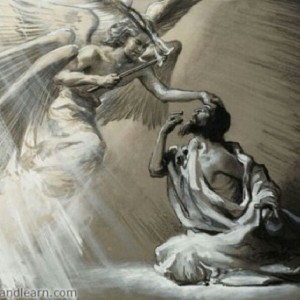
I saw the Lord sitting upon a throne, high and lifted up; and the train of his robe filled the temple. Above him stood the seraphim. Each had six wings: with two he covered his face, and with two he covered his feet, and with two he flew. And one called to another and said: ‘Holy, holy, holy is the LORD of hosts; the whole earth is full of his glory!’

Although God is spirit, He sometimes allows people to see a physical representation of Himself. To Isaiah, God is sitting high upon a throne in the temple that Solomon had built. His robe is so large it fills the entire room in which He is seated. While many Jews wondered where God was, Isaiah’s vision proves that He is reigning over the affairs of Judah and the rest of world.

God is surrounded by seraphim, which are angelic creatures with six wings each. This is the only place in the Bible where seraphim are mentioned. The Hebrew word means “to burn,” so many scholars suppose that the seraphim are burning with zeal for God.

John A. Martin writes, in The Bible Knowledge Commentary (Old Testament:), about the seraphim wings:

Covering their faces with two wings indicates their humility before God. Their covering their feet with two other wings may denote service to God, and their flying may speak of their ongoing activity in proclaiming God’s holiness and glory.

The seraphim are singing to one another: “Holy, holy, holy is the LORD of hosts; the whole earth is full of his glory!”

Martin continues his description of the scene unfolding in front of Isaiah.

In calling to one another the seraphs, whose number is not given, were proclaiming that the LORD Almighty is holy. The threefold repetition of the word holy suggests supreme or complete holiness. . . . Repeating a word three times for emphasis is common in the Old Testament (e.g., Jer. 22:29; Ezek. 21:27). The seraphs also proclaimed that His glory fills the earth (cf. Num. 14:21) much as His robe filled the temple. By contrast the people of Judah were unholy (cf. Isa. 5; 6:5) though they were supposed to be a holy people (Ex. 22:31; Deut. 7:6).

As the seraphs cried out, Isaiah saw the temple shake and then it was filled with smoke (Isa. 6:4). The thresholds (cf. Amos 9:1) were large foundation stones on which the doorposts stood. The shaking (cf. Ex. 19:18) suggested the awesome presence and power of God. The smoke was probably the cloud of glory which Isaiah’s ancestors had seen in the wilderness (Ex. 13:21; 16:10) and which the priests in Solomon’s day had viewed in the dedicated temple (1 Kings 8:10–13).

What is Isaiah’s reaction to be being in the presence of God? “Woe to me! I am ruined! For I am a man of unclean lips, and I live among a people of unclean lips, and my eyes have seen the King, the LORD Almighty.” Isaiah realizes that his sinfulness, along with the sinfulness of the people of Judah, render him ruined before God. He cannot do anything for God until he is forgiven.

In verses 6-7, a seraph flies to Isaiah and places a burning coal on his lips and proclaims that his sins have been paid for, taken away. As soon as Isaiah repented, God removed his sin. Now that Isaiah is reconciled to God, what will God ask him to do?

In verses 8-10, God asks for a volunteer and Isaiah steps up. What message would God have Isaiah deliver the people of Judah? Isaiah is to preach to Judah just as he has in the first five chapters of the book. He is to pronounce judgment on their sins and demand that they turn back to God.

However, God makes it clear to Isaiah that the more he preaches, the less the people will see, hear, or understand what he says to them. His preaching will be completely ineffective in bringing Judah to repentance. If God knows that the people will not repent, then why bother sending Isaiah?

John Martin explains that the “Lord did not delight in judging His people, but discipline was necessary because of their disobedience.” God does not short-circuit human psychology. He wanted to give the people of Judah every opportunity to hear the message of repentance so that they and their children would have no excuse. Nobody would ever be able to say that God never warned them, that God never commanded that they change their behavior. Isaiah was to make sure of that.

Even though God knows every human decision before it is ever made, in this instance He also allowed Isaiah to know. Perhaps this was grace from God to help Isaiah through the difficult years of his ministry. Isaiah always knew that his preaching was decreed by God, regardless of whether it ever changed anyone’s mind.

Isaiah asks God how long the people of Judah will refuse to repent. God responds that Judah will be destroyed and its people deported. This would occur when the Babylonians attack in 586 BC, some 100 years after Isaiah’s death, thus Judah would not listen to him during his lifetime. Not all will be lost, however. God would preserve a remnant of believers, a holy seed that would someday grow into the renewed people of God.

Commentary on Micah 1-6 (A Promised Ruler from Bethlehem)

The Book of Micah was likely written by the prophet of that name who lived during the 8th century BC. Micah was born in a town about 25 miles southwest of Jerusalem (in Judah), but he may have lived in Jerusalem during parts of his ministry. He prophesied during the reigns of the following kings of Judah: Jotham (750– 732 BC), Ahaz (735– 715 BC), and Hezekiah (715– 686 BC).

Thomas Finley, in the Apologetics Study Bible, Hardcover, provides additional information about Micah:

The identification of these kings does not mean that he was active from 750– 686 but that his ministry spanned parts of each reign. Since he predicted the fall of Samaria (722 b.c.), the bulk of his ministry probably took place between about 750 and 725 b.c. Jeremiah 26: 17-18 refers to Micah as prophesying during the time of Hezekiah. Determining exact dates, however, for each of the prophecies contained in the book is difficult. Micah was a contemporary of Isaiah, Hosea, and possibly Amos. His prophecies addressed Samaria and Jerusalem. Samaria was the capital of the northern kingdom (Israel) and Jerusalem of the southern kingdom (Judah). Even though Micah ministered in Judah, some of his messages were directed toward Israel.

In chapter 1, verses 1-9, the prophet Micah reports the vision he has of the destruction of Samaria and Jerusalem due to their sinfulness. Samaria is the capital of Israel and Jerusalem is the capital of Judah.

Micah calls on the entire world to heed God’s witness against them. God is coming down from heaven and He will be metaphorically stepping on mountains and crushing them under His feet upon his arrival. Why? For the sins of the people of Israel and Judah. In particular, the capital cities of Samaria and Jerusalem are responsible for the transgressions of their respective nations.

Micah, in verses 6-7, then prophesies the destruction of Israel and her capital city. Samaria will be laid waste. The money paid to the illicit temple prostitutes in Samaria for their “religious services” will be taken by another nation and used to fund its own temple prostitution. Likewise, this same nation will destroy all of the pagan idols in Samaria.

Who is the nation that will overthrow Israel? Assyria. In fact, in 725 BC, the Assyrian king, Shalmaneser V laid siege to Samaria and 3 years later it fell to the Assyrians. Micah foresaw this disaster years before it occurred, but his prophetic words were ignored.

The fall of Israel would also affect Judah. Micah also foresees, in verses 8-9, that Assyria will march through the territory of Judah, all the way to the gate of Jerusalem itself. Because of this vision, Micah marches through the streets of Jerusalem in mourning, trying to get the attention of the people living there, to no avail.

In the year 701 BC, 21 years after the fall of Israel, the Assyrian king Sennacherib would fulfill Micah’s prophecy by sweeping through Judah all the way to the doorstep of Jerusalem. Only through God’s intervention does Judah, ruled by King Hezekiah, survive. God strikes the Assyrian army with a plague and their military campaign against Judah promptly ends.

In chapter 3, verses 9-12, Micah continues to prophesy about Judah. The leaders of Judah, at the time Micah is alive, are corrupt. They deny justice to the poor and they accept bribes for judicial decisions. The Levitical priests are accepting wages above and beyond the required tithe to enrich themselves at other’s expense. The prophets sell their oracles to the highest bidder, instead of seeking the word of God. In all of this, the rulers, priests, and prophets in Jerusalem believe that they are exempt from the tragedy that befell Israel. Why? Because the temple of God is located in Jerusalem and so they believe that God will never destroy His temple, no matter how they behave. Micah knows they are wrong.

Because of the sin and corruption of Judah, Jerusalem will someday be destroyed, just as Samaria was. Micah later identifies the foreign invader as the Babylonians. In 586 BC, Micah’s prophecy would come true when King Nebuchadnezzar conquers Jerusalem.

Although Micah has pronounced the eventual destruction of both Israel and Judah, his message is not all doom and gloom. Micah foresees a day when God will raise up Jerusalem so that all nations will submit to her. Who will rule Jerusalem and the rest of the world in this future kingdom of peace and security?

Micah answers this question in chapter 5, verse 2.

“But you, O Bethlehem Ephrathah, who are too little to be among the clans of Judah, from you shall come forth for me one who is to be ruler in Israel, whose coming forth is from of old, from ancient days.”

Micah predicts that a ruler will be born in Bethlehem, which is the same place that his ancestor David was born. This ruler is the king whom God promised David in 2 Samuel 7, the future Anointed One, or Messiah. Micah is reminding his readers that the messianic promises made to David will indeed come to pass in the future. The apostle Matthew, in the 2nd chapter of his gospel, applies Micah’s prophecy to the birth of Jesus. He is the Messiah that Micah predicted would be born in Bethlehem, just as his ancestor David was.

Peter Craigie, in Micah, Nahum, Habakkuk, Zephaniah, Haggai, Zechariah, and Malachi (Daily Study Bible) explains the significance of Matthew’s quotation of Micah’s prophecy to the New Testament believer:

The deliverer has come to this world in the person of Jesus; like David, Jesus is the new Shepherd of God’s sheep, offering security from external enemies and a life of security. Jesus, of the Davidic line, is above all a gift of God to this world. To those who feel shut in on every side, like the besieged citizens of Jerusalem who first heard these words, Jesus brings the prospect of deliverance and security. And that is the essence of the Christmas message: God makes a gift to a besieged world through whom deliverance may come.

In verses 3-6, Micah reminds national Israel (and Judah in particular) that she will have to wait for the Messiah. Before he arrives, they will go through great pain, likened to a woman in labor. Kenneth Barker argues that the woman in labor is

a reference to Israel (Judah) or, more particularly, Zion (Jerusalem). Thus it would echo 4:9–10. God’s chosen people (the covenant nation), then, would bring forth the Messianic Ruler. The Ruler’s ‘brothers’ (=his people) would return from exile to join the other Israelites in Judah and Jerusalem as a restored, reunified, complete covenant nation again.

Verses 5-6 emphasize that all nations who attack God’s chosen people will be repelled by the Messiah. Under the Messiah’s rule, there will be peace on earth. Although Jesus did not bring peace on earth during his first coming, we know from the prophet Micah that he will bring peace during his future return.

Finally, in chapter 6, verses 6-8, Micah addresses an important question his readers would have had. What does God want from us? Micah speaks for Israel in verses 6-7 when he offers an answer to the question. The Israelites presume that merely offering sacrifices, in great numbers, and of great value, will appease God.

In verse 8, though, Micah writes what God truly desires from each Israelite and from each one of us. He wants our hearts and minds. He wants us to love Him and love our neighbors by showing them justice and mercy.

Walter Kaiser summarizes verses 6-8 in Hard Sayings of the Bible:

Thus this saying is not an invitation, in lieu of the gospel, to save oneself by kindly acts of equity and fairness. Nor is it an attack on the forms of sacrifices and cultic acts mentioned in the tabernacle and temple instructions. It is instead a call for the natural consequence of truly forgiven men and women to demonstrate the reality of their faith by living it out in the marketplace. Such living would be accompanied with acts and deeds of mercy, justice and giving of oneself for the orphan, the widow and the poor.

Commentary on the Book of Jonah

The Book of Jonah was most likely written by the prophet Jonah in the 8th century BC (sometime between 793 – 753 BC). Jonah lived in the northern kingdom of Israel during the reign of Jeroboam II and he (Jonah) is specifically mentioned in 2 Kings 14:25.

Jonah’s ministry began right after Elisha’s ended and Jonah was likely a contemporary of both Amos and Hosea in Israel. Amos warned Israel that she would be exiled “beyond Damascus” and Hosea specifically prophesied that Israel would be ruled over by the nation of Assyria, in which Nineveh is a major city.

The Book of Jonah is a straightforward narrative, so rather than recapitulate the story, I will instead answer some of the common questions that are raised about the story.

Question 1: Where was Nineveh and why was it considered wicked by God?

Answer 1: Nineveh was a major city and administrative district in the nation of Assyria. It was approximately 500 miles, or 1 month’s journey, from Israel. According to D. J. Wiseman in New Bible Dictionary,

It lay in the upper Mesopotamian plain, bounded on the west by the Syrian desert, on the south by the Jebel Hamrin and Babylonia, and on the north and east by the Urartian (Armenian) and Persian hills. The most fertile and densely populated part of Assyria lay east of the central river Tigris (‘Hiddekel’, Gn. 2:14, AV). The Heb. ’aššûr (Assyr. aššur) is used both of this land and of its people. The term Assyria was sometimes applied to those territories which were subject to the control of its kings dwelling at Nineveh, Assur and Calah, the principal cities. At the height of its power in the 8th–7th centuries BC, these territories included Media and southern Anatolia, Cilicia, Syria, Palestine, Arabia, Egypt, Elam and Babylonia.

The Assyrians were a war-like people known for committing brutal atrocities against their enemies. Billy K. Smith and Franklin S. Page write, in Amos, Obadiah, Jonah: An Exegetical and Theological Exposition of Holy Scripture (The New American Commentary),

Archaeology confirms the biblical witness to the wickedness of the Assyrians. They were well known in the ancient world for brutality and cruelty. Ashurbanipal, the grandson of Sennacherib, was accustomed to tearing off the lips and hands of his victims. Tiglath-Pileser flayed victims alive and made great piles of their skulls.

Question 2: Why did Jonah get on a ship heading west for a city in Spain (Tarshish) instead of going east to Nineveh where God commanded him to go?

Answer 2: There are two possible reasons. One, Jonah did not want to be God’s missionary to such a cruel and brutal group of people. Two, Jonah knew, because of the prophets Amos and Hosea, that Israel would someday be conquered by Assyria, so Jonah didn’t want anything to do with the nation who would soon subjugate his own people.

Question 3: What swallowed Jonah?

Answer 3: The Hebrew word allows for any large sea animal. It could have been a whale or a large fish of some kind. It had to be large enough to fit an adult male inside of it and there are plenty of sea creatures that have this capacity.

Question 4: What does Jonah pray about in chapter 2?

Answer 4:  Jonah realizes that he would have drowned if God had not provided the sea creature to save him, so he is thanking God for saving his life.

Question 5: Why would the Ninevites be so willing to repent after hearing a foreign prophet, Jonah, for only one day?

Answer 5: Leaving aside God’s influence on them, there may be other historical reasons why the Ninevites were so receptive to Jonah’s message. Walter Kaiser Jr. and Duane Garrett explain in the NIV, Archaeological Study Bible:

Nineveh’s historical situation during this period may explain the readiness of the king and his people to accept Jonah’s message. Assyrian power was at a particularly low point during the reign of Assur-dan III (773– 756 B.C.). Assyria had suffered military reverses, diplomatic setbacks, famine and domestic uprisings. In addition, an eclipse had taken place on June 15, 763 B.C., and this could have been regarded as a terrible omen (there had also been an eclipse in 784 B.C.). With all of this going on, it is not surprising that the Ninevites would have been especially jittery and ready to pay attention to a foreign prophet who suddenly appeared in their city.

Question 6: Why was Jonah angry with God after Nineveh repented and God did not bring calamity on them?

Answer 6: For the same reasons stated in answer 2 above. Jonah wanted God to punish Nineveh, not show mercy to them.

Question 7: What lesson does God teach Jonah in chapter 4?

Answer 7: Jonah is angry with God for killing a plant that was covering his head, and yet he is perfectly happy to allow God to kill 120,000 people living in Nineveh. The people of Nineveh belong to God, just as the people of Israel belong to God. A true prophet of God should pray for God’s mercy on all mankind, not just the tribe or nation to which he belongs.

Commentary on 2 Kings 4-5 (Elisha’s Ministry)

The prophet Elisha is one of the greatest miracle-performing personalities in the entire Bible. We already saw a couple of miracles from Elisha in chapter 2, but chapters 4-5 recall several more that parallel the ministries of Elijah, his spiritual father, and Jesus, his future Lord and Savior.

Elijah, when his ministry was beginning, brought the son of a widow back to life, the first miracle of its kind reported in the Bible. Would Elisha also be able to bring a child back from the dead? Chapter 4, verses 8-37, answers this question.

Elisha frequently traveled through a town called Shunem in the territory of Issachar. A wealthy woman there, whom the author refers to as the Shunammite, offers her house for Elisha to eat a meal whenever he is in the area. In fact, Elisha travels through the area so often that the wealthy woman asks her husband to add permanent sleeping quarters for Elisha on the roof of their house.

Elisha wants to thank the Shunammite, but he isn’t sure how. His servant Gehazi notices that she and her elderly husband are without children. To remain childless, as she had been, was considered to be a great curse on a husband and wife in ancient Israel. Elisha tells the woman that in one year she will be pregnant with a child and that is indeed what occurs. This miraculous birth was a gift from God to honor the Shunammite’s generosity toward Elisha.

Several years later, when the child is old enough to work during the harvest, he complains to his father that his head hurts. We are not told of the exact ailment, but some scholars have speculated that he suffered from a sun stroke. The child is taken to his mother and she sits with him for several hours, but he dies.

She takes him up to Elisha’s bed and lays him there and then quickly gathers a servant and donkey so that they can ride to Elisha’s home at Mount Carmel. When she arrives, Elisha figures out that her son is dead and he sends ahead Gehazi to heal the boy, but Gehazi fails to bring him back to life.

Elisha then arrives at the house of the Shunammite and performs almost the exact same ceremony that Elijah performed to raise the son of the widow. The results are the same. God miraculously raises the child from the dead. The reader is to understand that Elisha is every bit the equal of Elijah, able to even raise the dead.

As we skip to verses 42-44, we see that Elisha faces a situation where he must feed 100 men with only 20 loaves of bread. Elisha instructs the man with the 20 loaves to proceed feeding the men because God will miraculously multiply the bread to the point that there will even be some left over after every man is full. And that is exactly what happens.

Paul R. House, in 1, 2 Kings: An Exegetical and Theological Exposition of Holy Scripture (The New American Commentary), adds:

This miracle is paralleled in the New Testament by Jesus’ feeding of the multitudes. Such literary features as the questioning of whether there is enough bread to feed so many, the feeding of a large group, and the fact that there is ‘some left over’ appear in Matt 14:13–21; Mark 6:30–42; 8:1–21; Luke 9:13–17; and John 6:12–13. Jesus hoped the miracle would demonstrate his power and mercy, which would in turn lead to faith in him. Unfortunately, people merely tended to look for more miracles (Mark 8:12), and even the disciples saw the feedings as temporary relief from hunger instead of evidence of Jesus’ limitless provision (Mark 8:14–21). Elisha faced a similar problem, for his miracles helped preserve the faithful but never effected permanent change in the nation. Like Moses, Jesus and Elisha worked miracles that were signs of God’s kingdom breaking into history, and both were ignored by all but a remnant of Israel. Still, the remnant did emerge, so their work was not totally in vain.

Chapter 5 recounts the famous story of the healing of Naaman the Aramean (or Syrian) army commander. Naaman has some sort of serious skin disease, possibly leprosy. A captured Israelite servant working for his wife tells him about a great prophet in Israel who can heal him.

With a letter of introduction of his king, Naaman travels to Samaria, the capital of Israel, and presents himself to King Joram of Israel. The king panics because he has no idea how to heal Naaman and fears this will start a war with Syria.

Fortunately for Joram, Elisha hears of Naaman’s visit and tells Joram to send Naaman to Elisha, a true prophet of Israel. When Naaman arrives at Elisha’s residence, Elisha sends a messenger outside to tell Naaman to wash 7 times in the Jordan River and he will be healed. Naaman is angry at the prophet’s solution for healing him, as he expected Elisha to perform similar rituals to the prophets in Syria.

His servants, however, convince him to follow Elisha’s command and he washes himself in the river 7 times and is instantly healed after the 7th washing. Naaman returns to Elisha and makes a profession of faith in the one true God, Yahweh. “Now I know that there is no God in all the world except in Israel. Please accept now a gift from your servant.”

Elisha refuses payment from Naaman, but Naaman asks for two things from Elisha. First, he requests that Elisha allow him to carry soil from Israel to build an altar to Yahweh in Syria after he has returned. Second, he asks Elisha if Yahweh will forgive him when he is forced by the king of Syria to participate in the worship of the god Rimmon. Elisha assures him that he will be forgiven when he tells Naaman to “go in peace.”

Paul House writes about Naaman’s conversion:

This text contains one of the great Gentile conversion accounts in the Old Testament. Like Rahab (Josh 2:9–13), Ruth (Ruth 1:16–18), and the sailors and Ninevites in Jonah (Jonah 1:16; 3:6–10), Naaman believes in the Lord. From Gen 12:2–3 onward in the Old Testament, God desires to bless all nations through Israel. This ideal becomes a reality here due to the witness of the Israelite servant girl and the work of the Israelite prophet.

Naaman’s conversion includes a confession of faith. He states that no other god exists besides the Lord, a conclusion he draws from the fact that only the Lord can heal him. Hobbs correctly claims that Naaman’s confession consists of ‘words which accord closely with Elisha’s words in v. 8. Following a major theme of these chapters, Naaman realizes that only in Israel, and through Israel’s God, is healing to be found. Following this confession, Naaman’s actions support his new-found faith.’ Sadly, Naaman’s confession of faith condemns most Israelites of that era, since they have rejected the one true God and embraced gods that cannot heal. Jesus makes this point while rebuking the people of Nazareth in Luke 4:23–30.

Commentary on 2 Kings 1-2 (Elijah Goes to Heaven)

King Ahab, the enemy of Elijah, has died and his son Ahaziah has taken his place as king of Israel (the year is 853 BC). Elijah is still the anointed prophet of God, but his time is coming to an end. Some years earlier Elijah had already selected his successor, a young man named Elisha (see 1 Kings 19), but Elijah had a few remaining things to take care of before he was taken to heaven by God Himself.

As 2 Kings 1 opens, we learn that King Ahaziah has an unfortunate accident. He falls through a window in his home and seriously injures himself. Instead of consulting Yahweh or one of God’s prophets about his condition, he instead sends messengers to consult a Philistine god, Baal-Zebub. Baal-Zebub translates to “Lord of the flies” but most scholars seem to think that the writer of 2 Kings deliberately altered the real name of the god, Baal-Zebul, which means “Lord Prince” or “Exalted Lord,” to ridicule the fictional Philistine god.

The angel of the Lord gives a message to Elijah for Ahaziah: “Is it because there is no God in Israel that you are sending men to consult Baal-Zebub, the god of Ekron? Therefore you will not leave the bed you are lying on. You will certainly die!”

Elijah intercepts Ahaziah’s messengers on their way to Ekron and delivers the message from the angel of the Lord. The messengers return to Ahaziah and relay the message. Ahaziah’s reaction is to send two groups of 50 fifty soldiers to arrest Elijah and bring him to the king, but each group is immolated by fire from God. Amazingly, Ahaziah then sends a third group of soldiers, but this time the captain of the fifty begs Elijah for mercy instead of ordering Elijah to come with him as the previous two captains had done.

The angel of the Lord instructs Elijah to go with this third captain to personally deliver God’s message to Ahaziah. Elijah does indeed deliver the message to the king and the king dies shortly thereafter. His brother, Jehoram (or Joram), takes his place as king of Israel. Jehoram would reign for 12 years before his death, thus ending Ahab’s dynasty, as Elijah predicted.

Chapter 2 of 2 Kings records the passing of the baton from Elijah to Elisha. Elijah knows that today is his last day on earth because God has told him. Elijah travels to three different locations during the day (Bethel, Jericho, and the Jordan River), each separated by several miles. Each time he arrives, he suggests that Elisha stay behind and rest, but Elisha insists that he follow Elijah wherever he goes that day.

The implication is that Elijah is testing Elisha’s commitment to assuming the responsibility of becoming the primary prophet of God in Israel, taking over Elijah’s work. If Elisha will not follow his master to the very end of his life, then he is not fit to be the Prophet of Israel.

When they reach the Jordan River, Elijah rolls up his cloak, strikes the water, and the river dries up, allowing them to cross on dry land. After they’ve crossed, Elijah asks Elisha what he wants and Elisha responds that he wants to inherit a double portion of Elijah’s spirit. Since the firstborn of any man was entitled to his successor as head of the family, and the firstborn would receive a double portion of the inheritance given to all the children, Elisha was effectively asking to become Elijah’s spiritual successor.

Elijah tells Elisha that the evidence that God has chosen Elisha will be if Elisha sees Elijah taken up to heaven. Sure enough, as they are walking, “suddenly a chariot of fire and horses of fire appeared and separated the two of them, and Elijah went up to heaven in a whirlwind. Elisha saw this and cried out, ‘My father! My father! The chariots and horsemen of Israel!’ And Elisha saw him no more. Then he took hold of his own clothes and tore them apart.”

The chariot and horses of fire represent the might and power of the God of Israel. Elijah was used by God to project His power into the land of Israel. Likewise, Elisha would now be the chariot and horses of fire for Israel. Elisha considered Elijah to be a father to him and when Elijah departs in a violent storm, accompanied by chariots and horses of fire, he is overwhelmed and tears his clothes in mourning.

The final day of Elijah and the manner of his departure are full of theological importance. Consider the words of Paul R. House in 1, 2 Kings: An Exegetical and Theological Exposition of Holy Scripture (The New American Commentary):

Elijah’s ‘death’ has proven as spectacular as his life. Just as fire from heaven once proved Yahweh is more powerful than Baal, so now a similar heavenly fire proves that Elijah is the prophet par excellence. And just as another fire from heaven protected him from wicked King Ahaziah (1:9–12), so now it removes Elijah permanently from any further dangers or discouragements. Cogan and Tadmor note that this nondeath ‘invested him with the quality of eternal life, surpassing even Moses, the father of all prophets, who died and was buried (albeit by God himself: Deut 34:5–6).’ Because he never dies, Elijah later becomes the symbol for great future prophets, including the forerunner of the Messiah (Mal 4:5–6). Several Jewish legends also rise up concerning him, and the New Testament patterns its portrayal of John the Baptist (Matt 3:1–12; John 1:19–23) and one of the two witnesses of Rev 11:1–14 after Elijah’s ministry.

Elijah is understood by Jews to be the second Moses. His life has several parallels with Moses. John J. Bimson writes in the New Bible Commentary: 21st Century Edition,

Previous events in Elijah’s life recalled aspects of Moses’ ministry, e.g. like Moses, Elijah received a revelation of God on Mt Horeb, and his slaughter of the prophets of Baal had echoes of the aftermath of the golden calf incident (Ex. 32:25–29). Now he crossed to the eastern side of the Jordan (in a manner similar to the crossing of the Red Sea under Moses’ leadership), where Moses’ ministry also came to an end. Indeed, the end of Moses’ life was almost as mysterious as that of Elijah’s (Dt. 34:6). The parallels between the lives of the two men are underlined in the NT when they both appear speaking to Jesus at his transfiguration (Mt. 17:3).

Bimson continues,

Moses was the mediator of the covenant at Sinai/Horeb, the prophet (Dt. 18:15; 34:10) through whom Israel was brought into that covenant relationship and made the people of God. Elijah was the prophet through whom the people were turned back to the Sinai covenant and Israel’s special status was saved. In short, the parallels with Moses dramatically heighten Elijah’s importance in Israel’s history and in the books of Kings in particular.

Now that Elijah is gone, the reader wonders if God will give Elisha his mantle. Elisha calls out to God and strikes the Jordan River as Elijah did. The river dries up and he crosses back over to the western side, in the sight of a company of prophets. The prophets acknowledge that the spirit of Elijah has passed to Elisha and they bow down in respect.

In the remaining verses of chapter 2, Elisha is twice more confirmed as the successor of Elijah, the messenger of God. First, Elisha travels to Jericho from the Jordan River (just as Joshua did) and performs a miracle which purifies the polluted water supply. Recall that Joshua has cursed Jericho, but Elisha has now lifted the curse.  Second, as Elisha travels from Jericho to Bethel, a large group of young men (more than 40) mocks and threatens Elisha. As Elisha is now the spokesman for God in Israel, the young men are not only insulting Elisha, but they are insulting God Himself. Elisha curses them and God sends two bears into their midst; the bears maul 42 of them.

Just as Elijah is the second Moses, Elisha is the second Joshua. John Bimson writes,

If Elijah is identified as a second Moses, Elisha would appear to be in the mold of Joshua. As Joshua succeeded Moses as leader of the people, so Elisha succeeded Elijah, crossing the Jordan on dry land from east to west as Joshua did (14) and following in Joshua’s footsteps by going on to Jericho (15–22). (Even Elisha’s name recalls that of Joshua. Elisha means ‘God is salvation’, while Joshua means ‘Yahweh is salvation’.)

Elisha would serve God in Israel for about half a century and would perform numerous miracles intended to bring the people of Israel back to the true God who brought them out of Egypt.

Commentary on 1 Kings 17-18 (Ahab, Jezebel, and Elijah)

In the nation of Israel, since the division of the kingdom, there have been 7 kings and 4 different dynasties (successions of rulers who are of the same family). The year is 874 BC and the eighth king of Israel comes to the throne. His name is Ahab and his reign begins at about the time King Asa of Judah’s reign is ending.

Each of the previous kings of Israel has led the nation further and further from God, but Ahab is worse than all of them. Ahab marries a Phoenician princess named Jezebel in order to secure a trade alliance. Although this alliance helps Israel economically, it leads to spiritual disaster.

Jezebel is a devoted follower of the Phoenician god, Baal-Malquart (referred to as Baal hereafter). Baal is a storm god who is supposed to have power over the weather. Baal worshippers believed that he was responsible for the rain which enabled their crops to grow.

Jezebel’s intention was to have Baal worship replace worship of Yahweh in Israel. Her husband Ahab helped her by building a worship center for Baal in the capital of Israel, Samaria. He also built wooden poles for Asherah, the consort of Baal. Jezebel imported hundreds of Baal prophets into Israel to replace the prophets of Yahweh, whom she murdered.

At the peak of this crisis enters the greatest prophet of the Old Testament (after Moses), Elijah. In chapter 17, verses 1-6, we meet Elijah for the first time when he suddenly appears before King Ahab and tells him that, as a representative of the true God of Israel, there will be a severe drought in Israel for the next few years. Since Baal is supposed to control the rain in Israel, this is meant as a direct challenge to the growing Baal religion.

God then tells Elijah to hide from Ahab for the next few years, lest he be murdered by the king or his wife. God supernaturally sustains Elijah by first leading him to a secret water source and providing him food through ravens. Once the brook dries up, God tells Elijah to travel into the heart of Baal-worshipping Phoenician territory and stay with a widow and her son. Again, God miraculously provides all three of them food during the drought.

While he is staying with the widow and her son, the boy dies and the widow begs Elijah to help. Elijah prays to God and lies on top of the boy three times, after which the boy comes back to life. The widow rejoices, “Now I know that you are a man of God and that the word of the LORD from your mouth is the truth.” This is the first recorded incident of a person being brought back to life in the Bible.

In the third year of the drought, God commands Elijah to once again confront Ahab. Ahab has been searching for Elijah for three years, but he has been unable to find him. When Ahab sees Elijah, he asks, “Is that you, you troubler of Israel?” Elijah then issues a challenge to Ahab that he cannot refuse.

“I have not made trouble for Israel,” Elijah replied. “But you and your father’s family have. You have abandoned the LORD’s commands and have followed the Baals. Now summon the people from all over Israel to meet me on Mount Carmel. And bring the four hundred and fifty prophets of Baal and the four hundred prophets of Asherah, who eat at Jezebel’s table.”

Mount Carmel is evidently a place that held religious significance for both Yahweh and Baal worshippers. It is right on the border of Israel and Phoenicia, on the Mediterranean coast. What better place to have a showdown between these two gods? Once the prophets of Baal and Asherah are assembled on the top of Mount Carmel, in the sight of a large number of Israelites, Elijah explains the contest that is about to take place.

I am the only one of the LORD’s prophets left, but Baal has four hundred and fifty prophets. Get two bulls for us. Let them choose one for themselves, and let them cut it into pieces and put it on the wood but not set fire to it. I will prepare the other bull and put it on the wood but not set fire to it. Then you call on the name of your god, and I will call on the name of the LORD. The god who answers by fire—he is God.

Everyone agrees and the prophets of Baal place their bull on an altar and begin praying for Baal to answer with fire. For three hours they shout, but nothing happens. At noon, Elijah begins to taunt them.

“Shout louder! Surely he is a god! Perhaps he is deep in thought, or busy, or traveling. Maybe he is sleeping and must be awakened.”

Elijah’s mocking of the Baal prophets illustrates just how certain he is that the God of Israel is the only true God. Only a man of great conviction would stand in front of a hostile crowd of hundreds and make fun of their most sacred religious rituals!

For three more hours, the prophets of Baal shouted louder and even cut themselves in an attempt to get the attention of Baal. After 6 hours, the supposed storm god of Phoenicia, the god who controls the wind, rain, and lightning, does absolutely nothing.

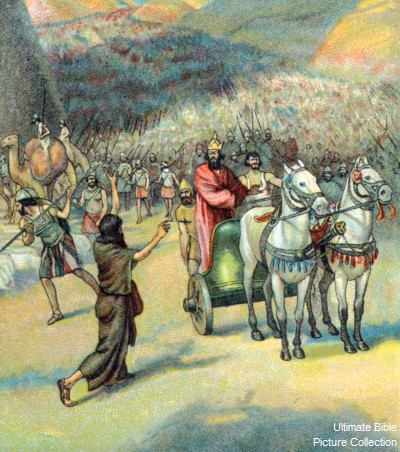
Elijah tells the prophets of Baal to step aside, for it is his turn. He builds up an altar made of 12 stones, for the 12 tribes of Israel. He then digs a trench completely around the altar. He places some wood and a bull (chopped into pieces) on top of the altar and then instructs bystanders to pour 12 large jars of water on the altar so that the excess water fills up the trench around the altar. If the bull catches fire, there will be no doubt that it is from God.

In one the most dramatic moments in all the Bible, Elijah steps forward and offers this prayer:

O LORD, God of Abraham, Isaac and Israel, let it be known today that you are God in Israel and that I am your servant and have done all these things at your command. Answer me, O LORD, answer me, so these people will know that you, O LORD, are God, and that you are turning their hearts back again.

Immediately, “the fire of the LORD fell and burned up the sacrifice, the wood, the stones and the soil, and also licked up the water in the trench.”

The assembled people of Israel loudly proclaim that Yahweh is the true God and they seize the false prophets of Baal and execute them. Elijah then tells Ahab to hurry home because a huge rainstorm is coming. Ahab does as he is told and shortly afterward, the first major rainstorm in years drenches Israel in a downpour, proving that Yahweh is God and Baal is a complete fiction.

Paul R. House, in 1, 2 Kings: An Exegetical and Theological Exposition of Holy Scripture (The New American Commentary), aptly summarizes the victory of God over Baal:
God sustains and protects his prophets, while Baal lets his die. Yahweh feeds the orphans and widows and raises the dead, while Baal lets the needy suffer and requires Anat to raise him from death. Yahweh can send fire or rain from heaven, but Baal cannot respond to his most valiant worshipers. A god like Baal is no God at all. A God like Yahweh must be God of all. Rain is not just rain here but evidence of the Lord’s absolute sovereignty over nature and human affairs.

Commentary on 2 Chronicles 14-15 (Reign of Asa)

Following Rehoboam’s death, his son Abijah occupies the throne of Judah until 911 BC. Abijah did not seek after God, but his son Asa would. Asa became king in 911 BC and remained in command until 870 BC. Chapters 14 and 15 of 2 Chronicles describe Asa’s reign.

Verses 1-8 of chapter 14 record Asa’s deeds during the first decade of his reign. Asa collects idols and destroys them. He also dismantles pagan worship centers and altars all over Judah. Because he obeys God, Asa is rewarded with a prolonged period of peace.

The peace enables Asa to mount a construction campaign where he fortifies the cities of Judah to protect against foreign attack. He also trains and equips a large army consisting of hundreds of thousands of soldiers.

Again, Asa clearly attributes the peace to his obedience toward God. He explains to Judah, “The land is still ours, because we have sought the LORD our God; we sought him and he has given us rest on every side.”

In fact, there are nine mentions of Asa seeking the Lord in chapters 14-16 of 2 Chronicles. The clear implication is that seeking the Lord (obeying His commands) leads to prosperity for Asa and for any other person who does likewise. Obviously, this principle is not to be carried too far. Even in Asa’s life, there are problems and we know that godly people in the Bible faced hardship, but the general principle still holds. Those who seek after God will generally experience greater prosperity than those who don’t.

At the end of ten years, a massive army threatens Judah, led by a man known as Zerah the Cushite. Most scholars believe that Zerah is a general under the command of the Egyptian Pharaoh, Orsokon, but there are others who argue that Zerah is operating on his own and has nothing to do with Egypt.

In any case, Zerah’s army advances all the way through Judah until they are a mere 25 miles southwest of Jerusalem, at a place called Mareshah. Instead of first leading an assault on Zerah, Asa prays to God for His favor in the upcoming battle, just as his ancestors David and Solomon prayed.

“LORD, there is no one like you to help the powerless against the mighty. Help us, O LORD our God, for we rely on you, and in your name we have come against this vast army. O LORD, you are our God; do not let man prevail against you.”

God indeed answers Asa’s prayer and causes the Cushites to flee. Asa chases them 20 miles further southwest and gathers plunder, including large numbers of livestock, from the land the Cushites previously occupied.

After Asa and his army return to Jerusalem, the capital of Judah, a prophet called Azariah meets with Asa and delivers a brief, but powerful prophecy. The most important words of the prophecy proclaim, “The LORD is with you when you are with him. If you seek him, he will be found by you, but if you forsake him, he will forsake you.”

Azariah reminds Asa of the period of the Judges, where the people of Israel did not seek the Lord. It was a time of great turmoil and distress, with never-ending wars. Azariah promises Asa that if he will continue his religious reforms, God will reward Asa and the kingdom of Judah.

Asa is encouraged by the prophet and continues his reforms. He gathers the livestock plundered in the battle against Zerah and prepares a covenant renewal ceremony during the Pentecost feast in the 15th year of his reign. The author of Chronicles notes that Israelites from the tribes of Ephraim, Manasseh and Simeon had emigrated to Judah because of Asa’s obedience to God. They too participate in the covenant renewal

J. A. Thompson, in The New American Commentary Volume 9 – 1, 2 Chronicleswrites:

The Davidic kings showed an inclusive concern for the whole of Israel. This appears repeatedly from 1 Chr 13:1–5 onward. A special point is made of the inclusion of people from the north (cf. 11:13–17). These northerners came in large numbers from Israel to Jerusalem when they saw that Asa’s God was with him.

The author of Chronicles describes the covenant ceremony:

At that time they sacrificed to the LORD seven hundred head of cattle and seven thousand sheep and goats from the plunder they had brought back. They entered into a covenant to seek the LORD, the God of their fathers, with all their heart and soul. . .. They took an oath to the LORD with loud acclamation, with shouting and with trumpets and horns.

Asa was so zealous for the Lord that he went as far as removing his own grandmother from her office as queen mother because she was worshipping Asherah, the pagan mistress of God. Asa destroyed the pole she was using in her worship, and burned it in the valley that divides Jerusalem and the Mount of Olives. Because of Asa’s action, he was rewarded with relative peace for most of his reign.

Commentary on 1 Kings 12 (Division of the Kingdom)

Solomon has died, so now his son Rehoboam is going to take over as king of all Israel in 931 BC. Rehoboam travels to a place called Shechem to meet with the leaders of the 10 northern tribes, where he presumes that he will be coronated king (Judah and Benjamin are the other 2 tribes in the south).

Recall that Shechem has a lot of history with the people of Israel. Thomas L. Constable, in The Bible Knowledge Commentary (Old Testament:), writes,

Shechem afforded a fitting site for the coronation of a king of Israel. At Shechem Yahweh first appeared to Abraham in the land and promised to give him all of Canaan (Gen. 12:6–7). Jacob later settled there (Gen. 33:18–20) and Joseph was buried there (Josh. 24:32). After they had entered the Promised Land the Israelites, at Shechem in the valley between Mount Ebal and Mount Gerizim, dedicated themselves to keep the Mosaic Law (Josh. 24:1–27). This sacred spot now reminded the Israelites of their divinely revealed destiny as a nation and of God’s faithfulness.

Unfortunately for Rehoboam, a surprise awaits him at Shechem. The northern 10 tribes select a former administrator under Solomon, Jeroboam, to speak for them. Jeroboam complains to Rehoboam that Solomon placed a heavy tax burden on the northern tribes, including forced labor for construction in Jerusalem and other places in the territory of Judah. David and Solomon were from the tribe of Judah, and so Rehoboam is continuing their dynasty. The northern tribes demand that Rehoboam lighten the burden before they will accept him as king.

In verses 6-11, Rehoboam consults for three days with two different groups of advisors. The older advisors, who served under Solomon, advise that he tell the northern tribes that he will lighten their tax burden. The younger advisors, who are contemporaries of Rehoboam, advise the opposite. They want him to tell the northern tribes that his tax burden will be far heavier than his father’s. Their idea is to instill fear into the northern tribes so that they will back down.

Rehoboam unwisely follows the advice of the younger generation. Instead of the northern tribes being cowed, they rebel against Rehoboam and declare their independence from the tribe of Judah and from the dynasty of David. Rehoboam sends one of his labor administrators to meet with the rebellious leadership, but he is stoned to death and Rehoboam has to flee Shechem to avoid the same fate. The author of 1 Kings notes that “Israel has been in rebellion against the house of David to this day.”

Jeroboam is made king over the 10 northern tribes, which comes to be called Israel, and Rehoboam is made king over the two southern tribes (Judah and Benjamin), which comes to be called Judah. Rehoboam gathers an army to attack Israel immediately after his return to Jerusalem, but the prophet Shemaiah tells Rehoboam that he should not attack Israel, for the rebellion of Israel was God’s doing. Recall that God had promised to split the kingdom in two because of Solomon’s idolatry.

In verses 25-33, we learn that Jeroboam builds shrines and altars throughout Israel so that he can prevent his people going to the temple in Jerusalem to worship. He is afraid that if they go to Jerusalem, they will want the two kingdoms to reunite, with Rehoboam in command. Two of the shrines, placed in Bethel and Dan, feature golden calves. The calves, themselves, are probably not meant to be worshipped, because the invisible God is supposed to “stand” upon the backs of the calves, but this distinction is quickly lost on the people of Israel, who start worshiping the calves themselves.

In addition, Jeroboam replaces the Levite priests with illegitimate priests from other tribes, and even commissions new religious festivals for Israel. The Levites would eventually leave Israel and migrate down to Judah because of Jeroboam’s actions.

The splitting of the kingdom leads to serious consequences that would unfold over the next several centuries. First, neither Israel nor Judah would ever gain the prestige of the united kingdom. They would both be attacked by neighboring nations and suffer through numerous wars.

Second, the religious reforms instituted by Jeroboam would lead Israel further and further from obedience to the Law. As the decades went by, the true lovers of Yahweh would stream out of Israel down to Judah to worship and live. Israel’s kings are noted again and again for their disobedience to God’s laws.

Third, the prophetic movement gained importance. God would appoint prophets over the next several hundred years to challenge the rulers of Israel and Judah to follow the Law. This would cause many of the prophets to be hated by the kings and people of Israel and Judah, who did not want to hear about their sins.

See this chart to understand the succession of kings and prophets from 930 BC to 586 BC in both kingdoms. Israel is conquered and destroyed as a nation in 722 BC, while Judah suffers the same fate in 586 BC.

Go to this link to see a map of ancient Israel and Judah.

Commentary on Ecclesiastes 11-12 (Wisdom from the Preacher)

Chapter 11, verses 1-6, give financial and investment advice. In verses 1-2, Solomon is recommending that the reader spread out her investments over 7 or even 8 different areas. The phrase “cast your bread upon the waters” refers specifically to maritime trade. Solomon’s reign was characterized by extensive sea trade with other nations. By spreading out your investments, you will reduce your risk when catastrophes occur.

Verses 3-6 admonish the reader to get to work and stop waiting on perfect timing. A person who is a farmer, for example, cannot predict when the rain will fall, when storms will fall trees, where winds will carry seeds. We cannot even understand how God breathes life into a fetus, which is fundamental to human existence. We simply cannot understand all of God’s plans. The wise person is industrious and productive all the time, not waiting around to figure out what the future will bring.

In verses 7-10, Solomon reminds us that life is short. Death is rapidly approaching and we must take advantage of the days of our youth while it is still possible. He specifically advises, “Follow the ways of your heart and whatever your eyes see, but know that for all these things God will bring you to judgment.”

What are we to make of this advice? Donald R. Glenn, in The Bible Knowledge Commentary (Old Testament:), explains:

Solomon reiterated his advice to enjoy life (cf. v. 8), emphasizing that a person should do so in his youth. Elsewhere Solomon had said that enjoying life consists of eating and drinking (2:24; 3:13; 8:15; 9:7), wearing nice clothes and pleasant lotions (9:8), enjoying marital bliss (9:9), and finding satisfaction in one’s work (2:24; 3:22; 5:18). Now Solomon encouraged his readers to do whatever their hearts desired (‘follow the impulses of your heart and the desires of your eyes,’ 11:9; NASB). However, those desires should be tempered with an awareness that God will judge.

What wonderful freedom these verses give the Christian! Do what you want to do, within the confines of God’s law. Enjoy the good things God has provided you and seek after what interests you, but always remember that God judges your heart.

Chapter 12, verses 1-8, command the reader to “Remember your Creator in the days of your youth.” This command, according to Glenn, “means to revere God, to keep His laws faithfully, to serve Him responsibly, remembering that because He created people, everyone owes Him his life.”

What awaits all of us in old age is not pleasant, and Solomon vividly depicts the arrival of old age with several metaphors in verses 1-5. Duane A. Garrett, in Proverbs, Ecclesiastes, Song of Songs (New American Commentary), provides the following interpretations.

Verse 2 refers, likely, to an eye condition such as glaucoma. The elderly will slowly lose their eyesight.

The “keepers of the house,” in verse 3, probably refer to the hands, which tremble in old age.

The “strong men,” says Garrett, “are the major muscle groups of the legs and back.”

“The ‘grinders’ are teeth, which have ceased to chew food because they are few. Those who look out of windows are again the eyes, although growing ‘dim’ may refer to a lack of sparkle in the eye rather than inability to see well.”

In verse 4, “the shutting of doors refers to the ears, as people shut doors when they want to exclude outside noise. Deafness is meant, as indicated by the sounds of grinding and singing fading out. But rising up at the sound of birds alludes to a cruel paradox of old age: one cannot hear well, but one sleeps so lightly that the slightest disturbance is sufficient to take away sleep.”

In verse 5, “fear of heights and danger in the street means that the feebleness of the body takes away accustomed manliness. The metaphor of a declining household is abandoned here. The blossoming of the almond tree is the turning of the hair to white.

The reference to the grasshopper is obscure, but probably it should be rendered, ‘And the grasshopper becomes heavy,’ a hyperbole meaning that even something as light as a grasshopper seems too heavy to lift.”

“And desire no longer is stirred” refers to loss of appetites, likely sexual desire.

In the end, a man dies and goes to his eternal home. Verses 6-7 again command the reader to remember God before death arrives. Every activity of a human being is meaningless because of death, so how does Solomon advise us all to deal with this reality?

Verses 9-14 conclude his treatise. Solomon reminds us of his authority. His words are wise, knowledgeable, and true. He carefully thought about what he should write. Ultimately, his advice comes from the Shepherd, or God Himself. He warns the reader that there are plenty of other books written to impart wisdom, but chasing after these teachings is wearisome.

Garrett writes about verse 12, “A more probable translation is: ‘Beyond all this, my son, be advised: Of making many books there is no end.’ The contrast is not between the study of canonical versus noncanonical wisdom but between failure to appreciate wisdom on the one hand and excessive zeal for study on the other.”

Solomon’s conclusion: “Now all has been heard; here is the conclusion of the matter: Fear God and keep his commandments, for this is the whole duty of man. For God will bring every deed into judgment, including every hidden thing, whether it is good or evil.”

Garrett summarizes the lessons to be taken from the book of Ecclesiastes:

For us the ‘meaninglessness’ of life which the Teacher so ruthlessly exposes would seem to lead to despair or nihilism; for him it is an incitement to true piety. The insignificance of all that is done under the sun leaves him awestruck and silent before God. His inability to control or predict the future provokes him to dependence on God. The futility of attempting to secure his future through wisdom or acts of religion (e.g., making vows) leads him not to impiety but to an understanding of the true nature of obedient trust.

Seen in this light, to ‘keep his commandments’ is not to behave with the self-satisfied arrogance of religious presumption, nor is it a nod to piety from an otherwise impious book. Rather, it is the deepest expression of humble acceptance of what it means to be a human before God. Solomon as the Teacher, in his address to his aristocratic colleagues, has anticipated perhaps the deepest mystery of the gospel: The just shall live by faith (Hab 2:4; Rom 1:16–17; Gal 3:11; Heb 10:38).

Commentary on Ecclesiastes 2-3 (Wisdom from the Preacher)

The English title, Ecclesiastes, comes from the Septuagint. The Greek word means “preacher” and translates the Hebrew title, which apparently referred to the office of a preacher or teacher. It is derived from the Hebrew word Qohelet, meaning “to assemble.”

The Book of Ecclesiastes is an advanced wisdom text intended for adults. The Hebrews did not include it in the wisdom works used to educate their children because of its contents.

The traditional view of authorship is that King Solomon wrote the book late in his life, around 940 BC. However, many scholars, perhaps the majority, believe that Ecclesiastes was not written by Solomon, but by an anonymous author as late as 200 BC.

Biblical scholar Tom Howe summarizes the theme of Ecclesiastes:

Although the tone of the book as a whole seems to be pessimistic, Qohelet is not a pessimist. Rather, his goal is to demonstrate that life is meaningless, unless one lives it in the fear of God, keeping His commandments and enjoying life as a gift from Him. Ultimately, Qohelet is urging the reader not to trust in anything in this life to provide meaning and value. Rather, one should trust only and always in God, and live life before Him.

In chapter 2, verses 1-11, Solomon writes about his experiments with pleasure. His goal was to see if the meaning of life consisted in earthly pleasures. Solomon attempted to laugh as much as possible, but he didn’t find meaning in laughter. He drank wine and became intoxicated, but didn’t find meaning in that either.

He built houses, gardens, vineyards, parks, water reservoirs. He bought numerous slaves and livestock. He amassed gold and silver. He brought hundreds of beautiful women into his household so that he could have sex with them. He reports that he denied himself no pleasure that he desired.

After denying himself no pleasure, did he finally find the meaning of life? He answers, “Yet when I surveyed all that my hands had done and what I had toiled to achieve, everything was meaningless, a chasing after the wind; nothing was gained under the sun.”

Solomon, it should be noted, is not saying that laughter, wine, building projects, wealth, etc., are all bad. There is a time and place for all these things. The point is that none of them can provide a person a meaningful life by themselves. Something is missing.

In verses 18-26, Solomon then considers his labors from another perspective. What would become of all the wealth that he had amassed, all of the building projects, all of the work that he had accomplished during his life?

The truth is that everything Solomon built will be left to his children, to those who live after he dies. His children, who did not work for what he gives them, may be fools who squander all of the work which Solomon completed. Three times in these verses Solomon laments that “this too is meaningless.” If all of a man’s labor merely gets passed on to those who had nothing to do with it, then what is the point of all this labor? What is the point in working hard in this life?

In verses 24-26, we get to a central theme of Ecclesiastes. Solomon’s answer to the question of the meaning of life is the following:

“A man can do nothing better than to eat and drink and find satisfaction in his work. This too, I see, is from the hand of God, for without him, who can eat or find enjoyment?”

Is Solomon teaching that we should all just eat, drink, and be merry? Is that all there is to life? Not at all. Duane A. Garrett, in Proverbs, Ecclesiastes, Song of Songs (New American Commentary)writes:

We should not understand ‘nothing is better than’ in a rigidly literal sense, as if the Teacher were saying that enjoyment of food and possessions is the goal of life. In context he is talking about how one should view life with respect to labor and the fruit of labor. He is not, therefore, negating the worth of higher values. But he insists that people should learn how to enjoy the return they get on their labor. Indeed, the ability to enjoy and use the good things of life (i.e., material things) is itself a gift of God. Those who belong to God should above all others have a capacity to enjoy life.

In chapter 3, verses 1-11, Solomon teaches his readers that there is a time for everything. The verses move back and forth between desirable and undesirable aspects of life. They are meant to represent the totality of human existence.

Duane Garrett expresses the meaning of these verses:

Life is composed of joy and sorrow, building and destroying, and living and dying. Each comes at the proper time. This reminds us that we are creatures of time and not yet able to partake of the joys of eternity. No one can be happy who has not come to grips with the reality that life is full of changes and sorrows as well as continuity and joy. We must accept that we are mortal and governed by time.

Donald R. Glenn, in The Bible Knowledge Commentary (Old Testament:), adds:

(1) Solomon observed that God … has made everything beautiful (or, ‘appropriate’; the same word is trans. ‘proper’ in 5:18) in its time, that is, God in His providential plans and control has an appropriate time for every activity. (2) Solomon observed that God has put eternity in the hearts of men. People have a longing or desire to know the extratemporal significance of themselves and their deeds or activities. (3) Solomon added that people cannot know the works of God … from beginning to end, that is, they cannot know the sovereign, eternal plan of God. Human labor is without profit because people are ignorant of God’s eternal plan, the basis by which He evaluates the appropriateness and eternal significance of all their activities. Because of this ignorance there is an uncertainty and latent temporality to the value of all one’s labor.

So how is mankind supposed to cope with the tension of a temporal life and a desire for immortality?

Verses 12-13 repeat the theme of the book: “I know that there is nothing better for men than to be happy and do good while they live. That everyone may eat and drink, and find satisfaction in all his toil—this is the gift of God.”