Category Archives: Books of the Bible

Commentary on 1 Samuel 17-18 (David and Goliath)

The events of chapter 17 occur several years after David is invited to stay at King Saul’s residence. It appears that at some point, Saul’s condition must have improved and David was allowed to go back and help his father with his sheep.

In verses 1-3, we learn that the Philistines have assembled an army only 15 miles west of Bethlehem. The Israelites respond by amassing an army to confront the Philistines, and they both encamp facing each other across a valley, atop two ridges.

Rather than initiating a full-on assault of Israel, the Philistines elect to send their mightiest warrior, Goliath, down to the valley to invite a champion from Israel to face him in combat to the death. The losing side would surrender to the winning side and the battle would be avoided. This form of representative combat was not unknown in the ancient near east, although the Israelites rarely, if ever, practiced it. Goliath seems to have to explain to the Israelites how it will work in verses 8-11, which implies the Philistines were familiar with the concept and had even put it to use before.

Goliath is described as being almost 10 feet tall in some ancient manuscripts, and almost 7 feet tall in other manuscripts. Regardless of which is correct, the average Israelite soldier would have been about 5 feet tall, so Goliath would have seemed like a giant at either height. Goliath is dressed in the armor and weaponry of a heavy infantryman. Robert Bergen, in 1, 2 Samuel: An Exegetical and Theological Exposition of Holy Scripture (The New American Commentary), describes Goliath:

Protecting his trunk was ‘a coat of scale armor weighing five thousand shekels’ (= 126 pounds). Completing his body armor were ‘bronze greaves’ (v. 6) or knee and shin protectors. A covering of this weight and composition would have drastically reduced Goliath’s ability to respond with quickness and agility in close combat and suggests that he did not expect a skirmish involving hand-to-hand combat.

Goliath’s weaponry was as overwhelming in appearance as his height and armor. He had ‘a bronze scimitar’ (Hb. kîdôn; NIV, ‘javelin’), a curved sword, ‘slung on his back.’ In addition, he had a spear whose ‘shaft was like a weaver’s rod.’ This description may relate to the size and weight of the spear’s shaft or, more probably, to the fact that it had a loop of cord attached to it. At the head of Goliath’s spear was a massive ‘iron point’ that weighed ‘six hundred shekels’ (= 15.1 lbs.). Iron was the preferred metal for implements of warfare because it was strong, nonmalleable, and could retain a sharp edge much better than bronze. A weapon of this massive weight, while intimidating in appearance, would have been quite awkward to use; it was apparently designed mainly to intimidate.

For forty days, the Israelites, led by King Saul, do not send a representative forward because they are scared and intimidated by Goliath. Meanwhile, young David, who is under the age of 20 and unable to serve in the military, is bringing supplies to his three brothers and their unit since Jesse’s home is only 15 miles away. When David arrives at the front lines with his supplies, he asks his brothers what is happening. They explain to him the situation and he is greatly upset that Goliath has been allowed to insult the God of Israel.

Due to his outspoken anger, David is invited to see King Saul, and he offers to fight Goliath himself. Saul counters that David is only a boy, but David explains that since God has been with him, he has been able to kill a lion and a bear who attacked his sheep. Saul relents and allows David to fight Goliath, hoping that God is still with David.

Rather than fight with Saul’s armor and sword, David decides to only bring his shepherd staff and a sling to the battle with Goliath. As David descends into the valley and approaches Goliath, Goliath mocks him and curses David in the name of David’s gods. Here is David’s response:

You come against me with sword and spear and javelin, but I come against you in the name of the LORD Almighty, the God of the armies of Israel, whom you have defied. This day the LORD will hand you over to me, and I’ll strike you down and cut off your head. Today I will give the carcasses of the Philistine army to the birds of the air and the beasts of the earth, and the whole world will know that there is a God in Israel. All those gathered here will know that it is not by sword or spear that the LORD saves; for the battle is the LORD’s, and he will give all of you into our hands.

For David, this is not just a military engagement, but a solemn religious duty. Leviticus 24:16 commands the death penalty for anyone who blasphemes God. Goliath had repeatedly blasphemed against God for 40 days, and did it yet again when David came to face him. This demonstrates one way is which David is a man after God’s heart, because he takes the words of the Torah (the Law) so seriously. In David’s mind, God Himself would help David carry out the commands of the Law.

In verses 48-51, we witness one of the quickest battles in the history of combat. As Goliath lumbers toward David, David runs toward Goliath, places a stone in his sling and whips it at Goliath’s head. The stone hits his forehead, breaking Goliath’s skull, and he drops dead. David takes Goliath’s own sword and decapitates him, making it clear to the Philistines that Goliath is dead.

Instead of honoring the deal they had made with Israel, the Philistine army turned and fled. The Israelites followed after them, chasing them back to their fortresses at Gath and Ekron. The Israelites then came back and plundered the camp that was abandoned by the Philistine army.

What happened to David after this great victory? Saul invited him to his home permanently, whereupon David and Saul’s oldest son, Jonathan became best friends. In fact, Jonathan symbolically cedes his right to the throne of Israel by giving David his robe, tunic, sword, bow, and belt.

Saul gives David a high rank in the army and whenever David goes out to fight, he is successful against his enemies. In fact, he is so successful that the women of Israel would chant, “Saul has slain his thousands, and David his tens of thousands.”

Saul becomes extremely jealous of David and in one episode at Saul’s house, Saul enters an ecstatic state and twice throws a spear at David with the intent to kill him. Both times he misses, however. From then on, Saul is constantly plotting how to ruin David. He sends him on numerous military campaigns, hoping he will die in battle, but David is always successful and is never harmed. For the next 10 chapters of 1 Samuel, Saul would plot to kill David and David would always escape.

The contrast between David, a man indwelt by the Spirit of God, and Saul, a man rejected by God, is illustrated over and over during the remainder of 1 Samuel. David wins battle after battle and Saul descends into madness as each day goes by.

Commentary on 1 Samuel 15-16 (God Rejects Saul and Anoints David)

Between chapters 8 and 15 in 1 Samuel, Israel has received the king she requested in the person of Saul. From the beginning, we know that Saul was not a man “after God’s heart” and although Saul has some military successes against Israel’s enemies, especially the Philistines, his disobedience of God’s commands would eventually cause him to lose his kingship.

Chapter 15 is where this finally occurs. Samuel, the prophet who speaks for God, commands Saul to launch a military campaign against the Amalekites, the long-time enemy of Israel who attacked Israel as she left the slavery of Egypt (see Exodus 17). God had previously promised that the Amalekites would be punished for their wicked actions against Israel. We know that the Amalekites attacked Israel when she was weary from the trek out of Egypt. But even worse, they came up behind the Israelites and massacred the weakest members of Israel who were bringing up the rear of the Israelite caravan. Amalekite aggression against Israel continued for hundreds of years, right up to the present day.

Given that the attack on the Amalekites was to execute divine judgment, Saul was instructed to kill everyone in the battle and to kill all of the livestock. The Israelites were not to get any financial gain from this attack as they were merely the instruments of God’s justice.

Unfortunately Saul disobeys God in two ways: he keeps Agag, the king of Amalek, alive, and he keeps the best livestock from Amalek alive. God grieves over Saul’s blatant disobedience and He instructs Samuel to confront Saul. When Samuel asks Saul why the best livestock were kept alive, Saul blames the soldiers and then adds that the livestock will be used to sacrifice to God, hoping this will get him off the hook.

Samuel then utters profound words to Saul in verse 22:

“Does the LORD delight in burnt offerings and sacrifices as much as in obeying the voice of the LORD? To obey is better than sacrifice, and to heed is better than the fat of rams.”

Even if Saul was planning on sacrificing the livestock, which is debatable since it appears to be an excuse, God wants obedience first. Sacrifice without obedience is pointless. A person who follows the rituals of worship, but flagrantly disobeys God’s other commands, does not please God. The consequence of Saul’s sin is that God rejects him as king. Saul begs for Samuel to change his mind, but God has made His decision.

In a sad epilogue, Samuel must kill King Agag himself, since Saul failed to do so. Afterwards, he returns to his home, never to see Saul again. From that day on, God’s prophet will never again counsel Saul, as God has turned His back on Saul’s reign over Israel.

Chapter 16 opens with God telling Samuel to stop grieving Saul, as He is ready to select a new king. The king will be a son of Jesse of Bethlehem. In order to prevent Saul from realizing what is going on, Samuel takes a cow with him and tells the elders of Bethlehem that he is there to perform a sacrifice. Samuel also invites Jesse and seven of his sons to the sacrifice.

Before the sacrifice occurs, Samuel has each of Jesse’s sons stand before him to see which one God will anoint as the new king of Israel. Each of Jesse’s seven sons parade in front of Samuel, but God doesn’t choose any of them.

Samuel is surprised that God doesn’t select the oldest son of Jesse, Eliab, because he is both tall and handsome, and seemingly perfect for the role of king. God responds to Samuel, “Do not consider his appearance or his height, for I have rejected him. The LORD does not look at the things man looks at. Man looks at the outward appearance, but the LORD looks at the heart.”

This verse is the very heart of 1 and 2 Samuel and one of the most instructive verses in the entire Bible. Robert Bergen, in 1, 2 Samuel: An Exegetical and Theological Exposition of Holy Scripture (The New American Commentary), writes, “The Lord alone has the capacity to observe and judge a person’s ‘heart’ (Hb. lēb), that is, one’s thoughts, emotions, and intents. On God’s scales these matters outweigh all other aspects of a human life.”

After having dismissed seven of Jesse’s sons, Samuel asks if he has another son, and Jesse informs him that he does, but that he is the youngest and is tending sheep. They send for him and God tells Samuel that this boy, the youngest of eight sons, is to be anointed the new king of Israel. The boy’s name is David. In verse 13, we learn that the Spirit of the Lord immediately came upon David “in power.”

Verses 14-23 end the chapter with the story of how David comes to be an armor-bearer for King Saul, the very king he would some day replace. God has sent an angel of judgment to Saul because of his disobedience, and this angel torments Saul. Saul’s servants suggest to him that finding someone who can play the harp when Saul is tormented will make him feel better.

Saul agrees and the servants recommend David. One servant describes what he knows of David, “I have seen a son of Jesse of Bethlehem who knows how to play the harp. He is a brave man and a warrior. He speaks well and is a fine-looking man. And the LORD is with him.” Thus David is brought into the royal household and becomes a trusted member of King Saul’s entourage.

Why was this young shepherd-boy chosen by God to be king some day? He wasn’t as tall or as good-looking as his older brothers. We know that God’s choices do not always line up with man’s choices, because God sees the heart and we do not. Think about David’s descendant, Jesus of Nazareth. He was an unlikely candidate as well. Dale Ralph Davis, in 1 Samuel: Looking on the Heart (Focus on the Bible Commentaries) writes:

Perhaps at no time did the living God disclose a more flabbergasting choice than in the case of David’s greater Descendant. The vote was in. The folks at home said, “He’s just one of us” (Mark 6:3). Others complained, “He has too much fun” (Matt. 11:18–19), and still others objected, “He’s not from the right place” (John 7:41–42). But the clincher for many was: “Messiahs don’t suffer” (Matt. 27:42–43). And what clout did this opinion pack? None. “The stone which the builders rejected has become the head of the corner” (Ps. 118:22; see 1 Pet. 2:4). What should we deduce from that? We should realize Yahweh made his choice (Ps. 118:23a), and we should relish it (Ps. 118:23b). There is a delight we should have over Yahweh’s unusual, unguessable ways. It honors him when we revel in his surprises.

Commentary on 1 Samuel 7-8 (Israel Asks for a King)

First and 2 Samuel were originally a single work that was separated into two books centuries after composition. These books continue the historical narrative where Judges and Ruth end. Since the books of 1 and 2 Samuel cover a period in Israel’s history of about 150 years (1120 to 970 BC), it seems that several sources were used to put together the books in their final form. Scholars aren’t sure when 1 and 2 Samuel were finally composed, but a date between 800 and 700 BC seems likely.

The events in 1 and 2 Samuel center around three main figures—Samuel, Saul, and David. First Samuel opens with the narrative of Samuel’s birth, an event which occurred about 1120 BC, and 2 Samuel concludes with David on his deathbed, which is dated at 971 BC.

Robert Bergen writes in the Apologetics Study Bible,

The books of Samuel are especially valuable for Christians because they lay the foundation for the all-important doctrine of the Messiah, the ultimate descendant of David who would sit on an everlasting throne ruling over God’s people and bring deliverance and justice. The promises God made to David in 2 Samuel 7 created hopes and expectations that the NT writers understood to have been fulfilled by Jesus.

The book of 1 Samuel starts with the birth of Samuel, the greatest judge and prophet since Moses and Joshua lived. During the first six chapters of the book, while Samuel is growing up, Israel suffers defeat at the hands of the Philistines, and even loses the Ark of the Covenant to them.

God punishes the Philistines by bringing plagues against them until they finally return the ark to the Israelites 7 months later. The Israelites keep the ark at a place called Kiriath Jearim, a settlement 10 miles northwest of Jerusalem, since the place the ark had been kept during previous centuries, Shiloh, had been destroyed by the Philistines. The ark would reside there for 20 years before Samuel’s public ministry would begin in chapter 7, verse 2.

In verses 2-6, we learn that after 20 years of mourning and repentance (roughly 1084 BC), the Israelites have reached a point where they are truly seeking God. We can only surmise that those 20 years of “repentance” were not genuine in the eyes of God. The Israelites were likely calling out to God for rescue from the Philistines, while at the same time still worshiping the false gods of Canaan.

But, after 20 years, Samuel senses that Israel is ready to sincerely turn back to God and he instructs them to stop worshiping the gods of Canaan and only worship the one true God. They agree to do so, and to memorialize this new commitment to God, Samuel calls for an assembly at a place called Mizpah. At Mizpah Israel gathers to admit their sin before God and ask for his forgiveness. Samuel also becomes the official leader of Israel at this time.

In verses 7-11, the Philistines decide to attack the Israelites during their assembly at Mizpah. The people of Israel ask Samuel to cry out to God for protection, and God answers his prayers with loud thunderclaps which frighten the Philistines and cause them to turn around and flee. Israel chases after the Philistines and wins a significant military victory.

Samuel commemorates their victory with a stone monument, and the Philistines do not attack Israel again during the rule of Samuel (approximately 30 years).

Chapter 8 resumes the narrative some 30 years later when Samuel has become an old man. Samuel has appointed his two sons to be judges, but they are both corrupt and not servants of God, like their father. The leaders of Israel come to Samuel and demand that he appoint a king “such as all the other nations have.”

Samuel, knowing this request from the elders of Israel is misguided, prays to God about it. God reveals to Samuel that Israel is rejecting God’s leadership over them, not Samuel’s. Nevertheless, he commands Samuel to accede to their demand for a king, but he wants Samuel to first warn them what will happen when their new king takes charge.

In verses 10-18, Samuel describes to Israel exactly how a monarchy will work. The king will take the people’s sons to build up his military, he will take their daughters to serve him and the officials in his government, he will take their choicest land, their servants, and their livestock to give to his officials, and he will demand a tithe of 10% from everyone to build his treasury. They will effectively become slaves to the king.

After hearing Samuel’s warning, the leaders of Israel respond, “We want a king over us. Then we will be like all the other nations, with a king to lead us and to go out before us and fight our battles.”

God grants their wish and promises them a human king. How sad for Israel. It is God who promised throughout the Torah (Pentateuch) to fight their battles for them, to drive out the Canaanites, to defeat their enemies. And that is exactly what God did for Israel when the people were worshiping and obeying Him. Recall the victories under Moses and Joshua. Recall the defeat of the Philistines under Samuel. In every battle, God was leading the army of Israel to victory, not a human king.

The fundamental problem with Israel is that they want to be “like all the other nations” instead of the holy nation that God had called them to be.

Was it wrong for Israel to ever ask for a king? No, because Deuteronomy 17 makes provision for a human king to rule over Israel. But, Deuteronomy 17 also commands Israel to only accept a king who God chooses. This king will be different from the kings of all the other nations, as he will be completely dedicated to serving God. He will not multiply his wealth, he will not multiply his wives, he will not build a bloated military, and he will study God’s word every day of his life. But Israel did not care about finding a king who loved God. They wanted to rush the process and find someone ahead of God’s timing.

Israel will have to suffer through a king not of God’s choosing to get to a king of God’s choosing. This king of God’s choosing would then become the ancestor of the King of kings, Jesus Christ Himself. Jesus will embody all the attributes that a king should have, ruling with perfect justice and mercy. All believers await the day when his reign begins!

Commentary on the Book of Ruth

The Book of Ruth is placed right after Judges in the Christian Old Testament, as part of the Historical Books section. As with most other books in the OT, the author is not known for sure, although Jewish and Christian tradition point to the prophet Samuel. If it was Samuel, it would have been written before the year 1000 BC, which is about the latest date for Samuel’s death.
The main purpose of the Book of Ruth is to communicate the ancestry of King David, the greatest king of Israel, who would rule from 1010 to 970 BC. The events in Ruth likely take place around 1100 BC, or toward the end of the rule of the judges. The period of the judges would end when Saul was anointed as the first king of Israel in 1050 BC.

The story of Ruth is also a sharp contrast to the depressing history of the period of the judges. In contrast to the Canaanized judges (e.g., Gideon, Jephthah, and Samson), the characters in Ruth are, for the most part, faithful to God, kind in their dealings with each other, and otherwise exemplary individuals.

The story of Ruth is meant to tell the story of the bloodline of King David, the greatest king Israel would ever have. Ruth is David’s great-grandmother, but the writer of the Book of Ruth wants to chronicle how exactly it came to be that the great grandmother of David could be a foreign woman from Moab.

The story begins in chapter 1 with a husband, wife, and two sons leaving Bethlehem, a small town in the territory of Judah, to go to Moab, a neighboring nation that had been unfriendly to Israel in the past (recall that King Balak from the Book of Numbers was from Moab). The reason given is that there was a famine in Bethlehem.

Why was there a famine? Remember that the books of Leviticus (26:18-20) and Deuteronomy (28:23-24) both recorded God’s commitment to cursing Israel with famine if they chased after foreign gods, and we know from the Book of Judges that they certainly did.

The two sons married Moabite wives, but after 10 years, the father, Elimelech, and the two sons, Mahlon and Kilion, had died. Naomi, the widow of Elimelech, decided to travel back to Bethlehem because she heard that God had brought an end to the famine.

Naomi tells her two daughters-in-law that they should abandon her and go back to their Moabite families so that they could remarry. In the ancient world, an unmarried woman was in a very precarious position, as she had to rely on her relatives to support her. Naomi knew that the girls would be better off going back to their own families and finding new husbands than coming with her to Bethlehem in a foreign land where remarriage was unlikely.

One of the daughters-in-law, however, refuses to abandon Naomi, and pledges not only to accompany her, but to adopt Naomi’s people as her own, and Naomi’s God as her own. Her name is Ruth.

In chapter 2, after Naomi and Ruth have returned to Bethlehem, they are faced with the difficulty of getting food for themselves. Ruth volunteers to go to a local farmer’s field and gather the leftover grain from the harvesting that was going on at the time. Daniel Block, in Judges, Ruth: An Exegetical and Theological Exposition of Holy Scripture (The New American Commentary), explains:

The Mosaic law displayed particular compassion for the alien, the orphan, and the widow by prescribing that harvesters deliberately leave the grain in the corners of their fields for these economically vulnerable classes and not go back to gather (liqqēṭ) ears of grain they might have dropped (Lev 19:9, 10; 23:22; Deut 24:19). As a Moabite and a widow Ruth qualified to glean on two counts. But for these same two reasons she could not count on the goodwill of the locals, hence her concern to glean behind someone who would look upon her with favor.

Ruth happens to choose the fields of a man named Boaz, a relative of Naomi’s former husband Elimelech. Boaz arrives to find Ruth working hard in his fields to pick up the scraps of grain left over by his harvesters. After finding out that Ruth has forsaken her own people and country to help her poor widowed mother-in-law, he rewards Ruth’s efforts by 1) telling her to continue working in his fields, 2) promising her safety, 3) offering her water whenever she needs it, 4) feeding her a meal of bread, wine vinegar, and roasted grain, 5) and instructing his workers to leave behind extra grain for Ruth to gather.

Ruth returns home that evening with a large amount of grain and explains to Naomi Boaz’s generosity. Naomi thanks God for Boaz and tells Ruth to continue going to Boaz’s fields until the grain harvest is over. A young, widowed woman like Ruth would be in great danger from being raped, and so not only was Ruth able to gather plenty of food at Boaz’s fields, she would not have to worry about her safety.

In chapter 3, Naomi instructs Ruth to seek the hand of Boaz in marriage. Her reasoning is that Boaz is a close relative of her late husband, and that he is therefore obligated to buy the property that Elimelech and his sons left behind, but also obligated to marry the widow of Elimelech’s son, Mahlon, so that she can bear children which will grow up to claim that property.

Land was passed on from father to son, and since Naomi’s sons were dead, there was nobody to whom Elimelech’s land could pass. Naomi herself was too old to conceive any more children, but her daughter-in-law, Ruth, was young and able to conceive and bear children. If Ruth had children, those children would grow up and inherit the land owned by their grandfather. Otherwise, Elimelech’s descendants would lose the land forever.

Ruth was to go to a public threshing floor where Boaz would be working, and wait for him to go to sleep. The threshing floor was being used by Boaz to thresh and winnow the grain he had harvested. John Reed, in The Bible Knowledge Commentary, provides the setting:

The people of Bethlehem took turns using the threshing floor. The floor was a flat hard area on a slightly raised platform or hill. In threshing, the grain was beaten out from the stalks with flails (cf. 2:17) or was trodden over by oxen. Then in winnowing the grain was thrown in the air and the wind carried the chaff away. The grain was then removed from the threshing floor and placed in heaps to be sold or stored in granaries.

Threshing and winnowing were a time of great festivity and rejoicing. Naomi knew that Boaz was threshing his grain on the day that she had chosen for her plan. She also knew that Boaz would be sleeping near his grain that night, to protect it.

When Boaz went to sleep, Ruth was to lay down at his feet, uncover his feet, and wait. This was a customary way for a woman to signal that she was asking a man for marriage.

When Boaz awakes, he is stunned to find Ruth asking him for marriage. He is surprised because he is much older than her, and she chose him over other younger men. We can assume that Ruth was a very attractive young lady!

There is, however, a catch. Boaz tells Ruth that there is a closer relative than he who must be given the first chance to buy Elimelech’s land and marry Ruth. If this other man decides not to take the opportunity, Boaz will.

In chapter 4, Boaz gathers the elders of the town and offers the closer relative the land and Ruth in marriage. The man declines and lets Boaz buy the land and take Ruth as his wife instead. Why might the other man have declined? The text doesn’t tell us explicitly, but it seems that he is without sons and he is afraid that if he has children with Ruth, then his lands will pass to her sons in the names of Elimelech, Mahlon, and Kilion.

At the end of chapter 4, we learn that Ruth and Boaz do have a son named Obed. Obed becomes the father of Jesse, and Jesse becomes the father of David, the greatest king of Israel.

God’s hand can be seen throughout this narrative. First, God causes the famine which drove Elimelech and his family to Moab. Second, the clear implication is that God was at work when Ruth “happened” to end up in the fields of Boaz. Of all the fields she could have chosen, it was clearly providential that she chose Boaz’s fields.

Third, Block points out that Naomi’s plan for Ruth to petition Boaz for marriage was fraught with danger:

Ruth’s preparations and the choice of location for the encounter suggest the actions of a prostitute. Under normal circumstances, if a self-respecting and morally noble man like Boaz, sleeping at the threshing floor, should wake up in the middle of the night and discover a woman beside him, he would surely have shooed her off, protesting that he had nothing to do with women like her. But if Ruth’s actions are questionable ethically, her demand that Boaz marry her are highly irregular from the perspective of custom: a foreigner propositioning an Israelite; a woman propositioning a man; a young person propositioning an older person; a destitute field worker propositioning the landowner. But instead of taking offense at Ruth’s forwardness, Boaz blesses her, praises her for her ḥesed, calls her ‘my daughter,’ reassures her by telling her not to fear, promises to do whatever she asks, and pronounces her a noble woman (ʾēšet ḥayil). This extraordinary reaction is best attributed to the hand of God controlling his heart and his tongue when he awakes.

Fourth, God ensures that it is Boaz who marries Ruth, not the other relative. Fifth, and finally, God sees to it that Ruth bears a child, Obed, who will be the grandfather of King David. Why does David matter so much? Because God promised to bring the Messiah through David’s descendants. Reed writes,

“Jesus Christ’s lineage, through Mary, is traced to David (Matt. 1:1–16; cf. Rom. 1:3; 2 Tim. 2:8; Rev. 22:16). Christ is therefore called “the Son of David” (Matt. 15:22; 20:30–31; 21:9, 15; 22:42). Christ will someday return to earth and will sit on the throne of David as the millennial King (2 Sam. 7:12–16; Rev. 20:4–6).”

God fulfills his promises of a Messiah and a future redeemer of mankind, Jesus Christ, through the faithful actions of Ruth and Boaz, two godly people who lived 1000 years before He was born.

Commentary on Judges 1-2 (Disobedience and Defeat)

The Book of Judges continues the historical narrative where Joshua ended. The author of Judges is unknown, although Jewish tradition ascribes authorship to the prophet Samuel. Samuel may have written portions of the book, but there were likely later editors that compiled it into its final form. Scholars date the final composition of Judges from some time between 700 and 1000 BC.

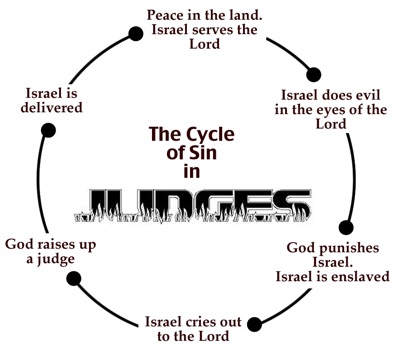
Judges describes the period between the initial conquests of Canaan (around 1400 BC) to the time of the first king of Israel, Saul (around 1050 BC). Thus the entire span of the book is about 350 years. During this time period, Israel consists of 12 separate tribes, all of whom experience cycles of 1) sinning against God, 2) being oppressed by various Canaanite groups, and 3) then being rescued by judges. The book mentions 12 judges, but there were likely many more.

The judges were men and women, usually military leaders, whom God used to rescue the different tribes in Israel from their Canaanite oppressors. Why is it that the Israelites were not taking all the Promised Land as they had been commanded? Why is it they were losing military battles against their enemies? Sin. The theme of the Book of Judges is the “Canaanization of Israel.” Instead of obeying God, the Israelites adopted the practices of the very people who God sent them to drive out of the land.

As we begin looking at chapter 1 in Judges, it is helpful to understand the historical context that Israel is within. The Chronological Study Bible: New King James Version summarizes the situation:

Having established at least a foothold in the land of Canaan, Israel now organized itself into a loose confederation of independent tribes. The link connecting these clans was their God. The tribes celebrated common religious festivals at the shrine where the ark of the covenant was kept. The shrine was movable, but it was most often located at Gilgal and Shiloh. The tribal confederation had military purposes as well. When an outside people invaded, the clans were to join in a holy war. Some leader would take the initiative and summon the tribes to battle. These leaders, for the most part, we call the judges. The judges led makeshift armies, but they did not have to face the forces of the major empires. Through most of the period of the judges, Egypt and the countries of Mesopotamia were weak and preoccupied with internal problems. The wars of the Book of Judges are waged against unconquered Canaanites and such small neighboring nations as Edom, Midian, and Ammon.

Verses 1-10 in chapter 1 of Judges describes the first actions of Israel after Joshua’s death. God commands the tribe of Judah to set out from Gilgal (Israel’s home base at this time) and take the land promised to them (see this map to remember where Judah was given land).

The tribe of Simeon would go along with Judah since Simeon’s allotted land was inside of Judah’s. The actual men, Judah and Simeon, had been full brothers, both having Leah as their mother and Jacob as their father.

Verses 4-10 describe successful military campaigns against Canaanites and Perizzites living in Bezek, against the city of Jerusalem, and against the “Canaanites living in the hill country, the Negev and the western foothills.” They also successfully conquered the city of Hebron.

In verses 17-21, we learn that the Judahites continued to attack additional cities: Zephath, Gaza, Ashkelon, and Ekron. In verse 19, however, we start to see the first signs of failure. The writer records that Judah was unable to drive “the people from the plains, because they had iron chariots.” We also see that the “Benjamites, however, failed to dislodge the Jebusites, who were living in Jerusalem; to this day the Jebusites live there with the Benjamites.”

Verses 27-36 report even more disturbing news. The other tribes had utterly failed to drive out the Canaanites living in their allotted territories. What was going on? Didn’t God promise to give the Israelites the Promised Land? Wasn’t He going ahead of them to win their military victories for them? How is it that most of the tribes of Israel were not, in fact, driving out the Canaanites? Chapter 2 gives us the answer.

In verses 1-3, the angel of the Lord (possibly God Himself) accuses the Israelites of disobedience. They had made covenants with the Canaanites and had adopted their religious, cultural, and ethical practices. Thus God would “not drive them out before you; they will be thorns in your sides and their gods will be a snare to you.”

Verses 6-23 now give the more detailed account of exactly what went wrong after Joshua died. Things started out well during the lifetimes of the elders who witnessed the miracles of the conquest under Joshua. After that generation died off, the next generation, who had not witnessed the miraculous events of the conquest, began to worship the gods of the Canaanites.

Recall that the worship of the Canaanite deities went hand in hand with all of the other immoral practices of the Canaanites: incest, bestiality, child sacrifice, etc. The Israelites were turning their backs on God and becoming “Canaanized.” God tells them that they will be trapped, ensnared by the false gods of Canaan. Daniel Block, in Judges, Ruth: An Exegetical and Theological Exposition of Holy Scripture (The New American Commentary) writes,

When the Israelites observed the prosperity of the Canaanites, the latter’s’ gods seemed to offer so much: fertility, prosperity, security. But Yahweh hereby turns their twisted theological thinking against them. Rather than finding new freedom in the religious structures of the Canaanites, the Israelites would be caught in the trap of their gods, like a fly in a spider’s web.

God was angry over their sin and handed them over to their enemies. In fact, God was actively enabling their enemies to defeat them every time they went out to battle! This is exactly what God promised He would do if Israel disobeyed.

From time to time, the people of Israel would remember God, cry out in distress, and beg Him for help against their enemies. During these periods, verses 16-19 explain that God would raise up a judge. The judge was a military leader who would rescue the Israelites from their oppressors. But as soon as the judge died, the people would revert back to worshiping the gods of Canaan. The rest of the Book of Judges records the actions of several judges that ruled over the various tribes of Israel for next few centuries.

Daniel Block concludes:

By way of reflection, from this text the reader has learned the Israelite [Yahwist] definition of apostasy. Apostasy means abandoning Yahweh in favor of other gods; it means claiming to be the people of Yahweh while acting as if one belongs to Baal. This perfidy is expressed in transgressing Yahweh’s covenant, not walking in his way, not listening to his voice, not heeding his commandments, especially his call for exclusive allegiance. Unlike the gods of the surrounding nations, Yahweh would tolerate no rivals. There is no room in Yahwistic faith for accommodation to pagan notions or customs. At the same time the reader is reminded of the patience and grace of Yahweh.

The cycle of disobedience, repentance, forgiveness, and deliverance would repeat over and over again. In fact, the tribes of Israel during this time are representative of humanity. We constantly disobey, repent, gain forgiveness and deliverance from our sins, and then disobey again. The only person who ever broke this cycle is Jesus Christ. He is the first and only human to never disobey God the Father. His sinless life broke the endless cycle recorded in the Book of Judges.

Commentary on Joshua 1-2 (Rahab and the Spies)

Joshua is the first book following the Pentateuch and it begins the series of books in the OT that are called the Historical Books (Joshua – Esther). The author of Joshua is unknown, although large portions of the book appear to have been written by a person who experienced the events recorded in the book. Early Jewish tradition indicates that Joshua himself was the primary author of the book, although some sections were likely added by later editors. If we accept Joshua as the primary author, then the book was likely completed near the end of Joshua’s life, around 1375 BC.

The events of Joshua start where Deuteronomy ended, with the Israelites across the Jordan River from the city of Jericho. The book describes the conquest of the Promised Land by Israel, a fulfillment of the promises God made to Abraham, Isaac, and Jacob hundreds of years prior. The original audience of the book would have been Israelites who lived after the conquest (which lasted about 7 years). The events in the book span the years from approximately 1406 – 1375 BC (about 30 years).

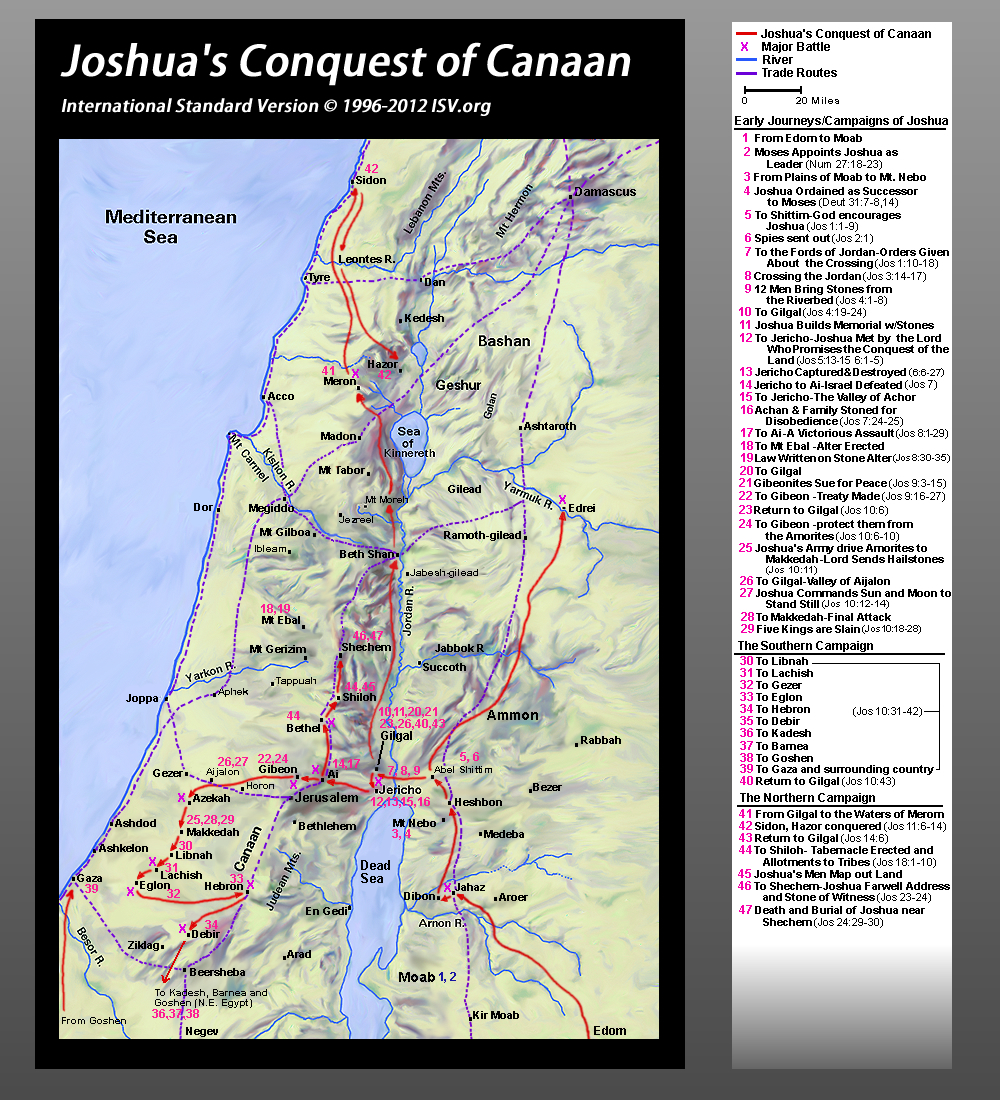
For a map of the conquest of Canaan, please go to this link.

Verses 1-5 in chapter 1 of Joshua give incredible encouragement to Joshua and the entire nation of Israel. God tells Joshua, his appointed leader, to get the people ready to cross the Jordan River and take possession of the land that God promised to them. God again delineates the borders of the Promised Land, giving the northern, southern, eastern, and western borders.

To Joshua specifically, God promises, “No one will be able to stand up against you all the days of your life. As I was with Moses, so I will be with you; I will never leave you nor forsake you.” Although this reaffirms a promise God had already made to Joshua (Deut 31:8, 23), I’m sure Joshua needed all the assurance he could get, given the mission he was about to undertake. The words “I will be with you” repeat identical promises made by God to Isaac (Gen 26:3), Jacob (31:3), and Moses (Exod 3:12). Joshua is, therefore, to be compared to the former great servants of God.

In verses 6-9, God tells Joshua how he will successfully take the Promised Land. Joshua must obey the Law given by God through Moses. It is only by obeying the Law that Joshua will be successful in his mission of possessing the Promised Land of Canaan. In verse 8, God tells Joshua to “meditate on it day and night.” What does this mean? David M. Howard, Jr., in Joshua: An Exegetical and Theological Exposition of Holy Scripture (The New American Commentary), explains:

The idea of meditating here is not the one commonly familiar in the late twentieth century, namely, of emptying the mind and concentrating on nothing or on self or on visualizations of various types; much of this type of meditation is indebted to Eastern mystic religions. Rather, the Old Testament concept of meditation involves two things: First, a focus upon God himself (Ps 63:6 [Hb.7]), his works (Pss 77:12 [Hb. 13]; 143:5), or his law (Josh 1:8; Ps 1:2), and second, an activity that was done aloud. This is why God told Joshua that this lawbook should not leave his mouth (as opposed to, e.g., his heart or his mind).

In the ancient world, reading silently was mostly unknown. Almost everyone read aloud. Interestingly, modern science has shown that reading aloud aids in the memorization of a text over and above reading silently.

Joshua tells the officials among the people to get them ready to cross the Jordan River in a few days, and then he turns his attention to the tribes of Reuben, Gad, and Manasseh. Recall that Moses already gave them their land east of the Jordan River. Joshua reminds them that they must provide soldiers for the conquest of the land west of the Jordan River. Only after all the land west of the Jordan is conquered can their soldiers return home.

In verses 16-18, all of Israel promises to obey Joshua as the rightful successor of Moses. All twelve tribes are committed to the conquest of Canaan under the leadership of Joshua.

In chapter 2, Joshua sends two spies across the Jordan River to the city of Jericho to look over the land. The spies enter Jericho and stay in the house of a woman named Rahab. There is some scholarly dispute as to whether Rahab is an innkeeper or a prostitute. In any case, the king of Jericho hears about the two men and sends a message to Rahab to turn them over.

Rahab hides the men on her roof and lies to the king’s messengers, telling them that the Israelites have left the city and that they can catch them on their way back across the Jordan.

In verses 8-13, we read some of the most remarkable verses in the Bible. A pagan woman, possibly a prostitute, makes a confession of faith! Rahab acknowledges that God has given the land to the Israelites, then she recounts the stories she’s heard about God parting the Red Sea and God defeating the kings Sihon and Og. Dale Ralph Davis, in Joshua: No Falling Words (Focus on the Bible), writes about Rahab’s confession of faith thus far:

This was the basis of her faith; she had heard about the mighty acts of God. This is the normal way of coming to faith. Biblical faith is based on at least some knowledge, data, and evidence. Even couples who ‘fall’ in love don’t come to love each other merely by sighing or groaning or oohing and ahhing; rather they talk, communicate, find out about each other—their past, their likes, their dislikes, their character, and so on. Even romance has some basis in knowledge. So is the case with faith. Faith is not just a warm, cozy feeling about God. Faith grows, if at all, out of hearing what God has done for his people.

Rahab then clearly states that the God of Israel is sovereign over all the heavens and earth. Her response to the God of Israel is to plead for mercy for herself and her family. She knows that Jericho will fall and that her family will be trapped inside.

Davis writes,

Here is the evidence of faith. Genuine faith never rests content with being convinced of the reality of God but presses on to take refuge in God. Rahab not only must know the clear truth about God but also must escape the coming wrath of God. It isn’t just a matter of correct belief but of desperate need. Saving faith is always like this. It never stops with brooding over the nature or activity of God but always runs to take refuge under his wings. Amazingly, Rahab not only trembles before the terror of the Lord but also senses that there might be mercy in this fearful God.

The spies agree to save the lives of all in her house when the city is attacked. Since her house is built into the city wall, she is to gather everyone inside and hang a scarlet cord in the window so that the Israelite army can identify her house from outside the city.

The spies slide down a rope hung from Rahab’s window, wait 3 days for the Jericho search party to return, and then go back across the Jordan River to tell Joshua, “The LORD has surely given the whole land into our hands; all the people are melting in fear because of us.” What a difference is the report from these spies versus the spies from Numbers 13-14!

Commentary on Job 38-42 (Job Meets God)

Through Job 37, Job has listened to three “friends” and Elihu speak to him about why he is suffering so badly. Job, in turn, has responded to each of them, declaring his innocence and demanding that God give him answers. Finally, in Job 38, Job gets his wish.

Out of a violent storm God speaks to Job, but his message will not at all be what Job was hoping for. Instead of answering Job’s questions about whether God is just in his treatment of Job, God challenges Job. Eugene Peterson’s translation of verses 1-3, in The Message, captures the force of God’s challenge:

Why do you confuse the issue? Why do you talk without knowing what you’re talking about? Pull yourself together, Job! Up on your feet! Stand tall! I have some questions for you, and I want some straight answers.

Over the next few chapters, God asks Job more than 70 questions having to do with the creation and control of the natural world, none of which Job can possibly answer. In verses 4-7, God asks Job, “Where were you when I laid the earth’s foundation?” In verses 8-11, God asks Job who it was that placed boundaries around the seas and controls where they are allowed to go.

If Job wants to question God’s dealings with human beings, then Job needs to prove that he has the knowledge and wisdom that God has. If he can’t even understand how the inanimate objects of the natural world were made or how they are controlled by God, then what chance does Job have of understanding God’s treatment of mankind?

Roy Zuck, in The Bible Knowledge Commentary, explains:

What was the purpose of God’s rebuking response? By displaying His power and wisdom, God showed Job his ignorance and impatience. How could Job comprehend or control God’s ways with man, when he could not comprehend or control God’s government in nature? Since Job could not answer God on these matters how could he hope to debate with God? Since God has His own ways and designs in the sky and with animals, does He not also have His own purposes in His dealings with people? Though people cannot understand God’s doings, they can trust Him. Worship should stem from an appreciation of God Himself, not a comprehension of all God’s ways. Though puzzled, people should still praise.

In chapter 42, Job, after having been questioned by God, responds. Instead of demanding more answers from God, instead of questioning God further, Job answers the only way a man can who has seen the living God face to face, with awe and repentance.

Again, Eugene Peterson captures Job’s thoughts well in Job 42:1-6:

I’m convinced: You can do anything and everything. Nothing and no one can upset your plans. You asked, ‘Who is this muddying the water, ignorantly confusing the issue, second-guessing my purposes?’ I admit it. I was the one. I babbled on about things far beyond me, made small talk about wonders way over my head.  You told me, ‘Listen, and let me do the talking. Let me ask the questions. You give the answers.’ I admit I once lived by rumors of you; now I have it all firsthand—from my own eyes and ears! I’m sorry—forgive me. I’ll never do that again, I promise! I’ll never again live on crusts of hearsay, crumbs of rumor.

So how did God answer Job’s questions about the justice of his suffering? God showed Job Himself. There is no greater answer to any question a man could have than coming face to face with God. Once we understand who God is, our questions vanish into thin air because we realize that our doubts about God’s justice, knowledge, wisdom, and goodness are preposterous. As the Creator of everything, the sovereign ruler of the universe, can we really stand in judgment over God? No, and that is what Job finally realized.

Commentary on Job 21

In the previous 20 chapters of the book of Job, Job’s three friends have argued that Job is being punished for sins he has committed. Their theology is simple: God always and immediately punishes the wicked and always and immediately blesses the righteous.

In chapter 20, Zophar summarizes this theology: “Surely you know how it has been from of old, ever since mankind was placed on the earth, that the mirth of the wicked is brief, the joy of the godless lasts but a moment.”

In chapter 21, Job answers Zophar. He starts in verses 1-3 by begging his “friends” to listen to him. Job requests that they stop mocking him for a moment and pay attention to what he has to say.

In verses 4-16, Job reminds his friends, first, of the horrible condition he is in. Then he begins to dismantle their faulty theology.  Job points out several facts about the wicked.  The wicked live to a ripe old age with their children. Their houses are secure, seemingly with no judgment from God.  The livestock of the wicked prosper, the wicked enjoy music, and the wicked even die in comfort. To top it off, they tell God to leave them alone! Contrary to Zophar’s theology, justice is not always and immediately meted out. Often the godless prosper and the godly perish.

On to verses 17-21. To Bildad’s claim that “the lamp of the wicked is snuffed out” (18:5) in death and that calamity and disaster are ready to overtake him (18:12), Job asks how often (three times in 21:17–18) do these things really happen? Theologian Roy Zuck, in The Bible Knowledge Commentary, notes, “This so-called fate allotted by God’s anger to the wicked hardly fits the facts. Sinners are seldom blown away suddenly and easily like straw or chaff.”

In verses 22-26, Job reminds us that one man dies having lived a full and vigorous life, while another man dies having lived a life of bitterness and deprivation. Yet both men end up in the same place after they die. Zuck reminds us,

Wealth or health are not ways by which to judge a person’s character. One may be wicked, and die either young or old; or he may be godly, and die either young or old. These facts obviously conform more to reality than did the rigid view of Job’s three prattling prosecutors.

In verses 27-34, Job wonders how it is that his friends are unaware of these facts. Do they not speak to travelers who can tell them numerous stories about how the wicked never face justice for their crimes? No, the wicked are often carried to their grave by a massive funeral procession, and given great honor, because no one dare challenge them while they are alive. Job’s friends are fools and their theology is bogus.

Commentary on Job 1

Having finished the book of Deuteronomy, we now move to the book of Job. Although the events of Job cannot be easily dated, there is some consensus that they occurred during the period of the Patriarchs (Abraham, Isaac, and Jacob). Or, to put a wide range of dates on the events of Job, we can say that they probably occurred between 2000 – 1000 BC. Because we are unsure of the dating, we choose to place Job in between Deuteronomy and Joshua chronologically.

The author of Job is unknown. Christian tradition holds that Job himself was the author, but some scholars believe that Moses or Solomon were the original authors. In any case, there has never been any dispute among Jews or Christians that the book of Job is inspired by God and belongs in the canon of Scripture.

In chapter 1, verses 1-5, we are introduced to Job. We learn several important things about him: 1) he was blameless and upright, fearing God and shunning evil, 2) he had a large family consisting of 7 sons and 3 daughters, 3) he was incredibly wealthy, 4) he was known as the greatest man in his area of the world, and 5) he frequently offered sacrifices for his children for he feared they may have sinned.

The purpose of this first section is to communicate clearly to the reader that Job is a God-fearing man who has been richly blessed by God. It is critical to keep these facts in mind before proceeding to read the rest of the book of Job.

In verses 6-8, we are suddenly taken to God’s throne room in heaven where angels present themselves to God. One angel, Satan, draws the attention of God. God asks Satan what he thinks of Job, a man who fears God and shuns evil.

In verses 9-11, Satan accuses Job of only worshiping God because of all the material blessings he has received from God. Take away his blessings, Satan argues, and Job will curse God. God agrees to allow Satan to test Job, but restricts him from physically harming Job. Notice that Satan is clearly under God’s command, and there is nothing that Satan can do without God allowing it.

The central theme of the book of Job is the question of why we should fear God. John Sailhamer explains it this way:

What motivates the kind of godly living exemplified in the righteous man Job? Is it the possessions and security that God has given him? Or would a truly wise man continue to live a godly life, even in the face of material loss and suffering? Satan’s answer was ‘No! Take away his blessings and Job will not continue to live a godly life.’ God, however, knowing that true wisdom is its own reward, answered ‘yes’ in Job’s behalf. A truly wise man seeks to live a godly life regardless of the earthly rewards.

Verses 13-19 describe the disasters brought upon Job by Satan. First, Job’s oxen and donkeys are carried off by Sabean marauders, and the servants watching over them are killed. Second, Job’s sheep and more servants are killed by fire from heaven. Third, another group of marauders, the Chaldeans, steal Job’s camels and kill yet more of his servants. Fourth, Job’s children are all killed when a windstorm destroys the house they are feasting in.

It is hard to imagine what it would be like to face such loss, so how would Job respond? Would he curse God?

Not only did Job not sin, but he fell to the ground in worship, and uttered some of the most famous lines from Scripture:

“Naked I came from my mother’s womb, and naked I will depart. The LORD gave and the LORD has taken away; may the name of the LORD be praised.”

To make the point crystal clear, the text then reads “In all this, Job did not sin by charging God with wrongdoing.”

In the remainder of the book, Job is comforted by four friends who each try to explain to him how it is that such disaster could befall him. The first three friends are all convinced that Job must have sinned before God, and that Job’s catastrophic losses are punishment for his sin. Job denies this is the case, and we, the readers, know that Job is right. We know that Job is righteous and is not being punished for wrongdoing.

The fourth friend, Elihu, offers that God may be disciplining Job, not for something he had done, but to prevent foolish pride. Elihu advises Job to fear God and not question His justice.

Job, in response to his friends, never curses God, but he does accuse God of being unjust toward him. He demands that God explain himself, and Job even suggests that there needs to be a third-party mediator between himself and God to decide who is in the right. God eventually does appear to Job and answer his accusations at the end of the book. That will be covered in a later lesson.

Why Think Moses Was the Primary Author of Deuteronomy?

In chapter 34 of Deuteronomy, there are textual indications that Moses did not write the book of Deuteronomy.

First, chapter 34 records the death of Moses, but how could he record the events surrounding his own death?

Second, verses 1 and 2 state that the Promised Land includes “Gilead to Dan, all of Naphtali, the territory of Ephraim and Manasseh, all the land of Judah as far as the western sea.” The problem here is that only Reuben, Gad, and Manasseh had been given their land up to this point. Dan, Naphtali, Ephraim, and Judah would not receive their land until many years after Moses died.

Third, the author states in verse 10 that “since then, no prophet has risen in Israel like Moses.” This sentence would only make sense if someone was writing this text well after Moses’s death.

Do these texts prove that Moses did not write Deuteronomy? No, not at all. It is entirely possible that Moses wrote most of the book, but that later writers added to the end of the book. In fact, Jewish tradition holds that Joshua wrote some, if not all, of chapter 34.

We have strong internal evidence that Moses did indeed write the majority of the book of Deuteronomy from Deut 31:9 and 31:24. These verses reveal Moses’s command to the Levites to take the law Moses wrote down and store it with the ark of the covenant. Taken in context, what parts of Deuteronomy would have been considered the law?

Eugene Merrill, in The Book of Deuteronomy (New International Commentary on the Old Testament), describes what verse 9 and 24 would be referring to:
The term for ‘law’ (here tôrâ) normally refers to the Mosaic writings generally, but in the context of Deuteronomy it must be limited to that book alone and, in fact, to just the covenant text of chaps. 5–26 (plus the blessings and curses of chaps. 27 and 28).

Therefore we conclude that at least chapters 5-28 were most likely written by Moses, and quite possibly more. To think that chapter 34 proves that Moses had no hand in the composition of Deuteronomy is simply wrong.