Which Part of Evolution Are We Talking About?

Post Author: Bill Pratt

I have followed the intelligent design (ID) movement for several years now and there is an error that I’ve seen opponents of ID make over and over.

The error is confusing the idea of common descent with the idea of random mutation and natural selection.

Common descent refers to the idea that all animal life is related, that if we trace back each living animal’s ancestry, we would find common ancestors.  If every animal could trace back its family history through ancestor.com, we would all find that we came from the same great, great, great (insert great thousands or millions of times) grandparents.  Some of us are closer relatives than others but we are all related if we go back far enough in history.  The idea of common descent can be supported by evidence from the fossil record and by comparing the DNA sequences of different kinds of animals.

The idea of random mutation and natural selection attempts to explain how animals have changed over time into all the diverse species we see today and in the fossil record.  Every time an animal reproduces, there is a chance for a genetic mutation occurring in the process.  If the mutation that the offspring inherits is helpful to its survival until it, too, can reproduce, well then the mutation is passed on to the next generation, and so on.

In this way, the genetic code is altered, and if enough of these mutations occur over time, you get a new species of animal.  The empirical evidence for this mechanism only demonstrates very small, and in many ways, trivial instances of change (e.g., finch beaks, peppered moths, antibiotic resistance, fruit fly mutations).  There is no empirical evidence of large scale evolution due to random mutation and natural selection (see Michael Behe’s The Edge of Evolution and my recent post on this topic).

Which idea does ID challenge?  Common descent or the mechanism of random mutation and natural selection?

ID theory almost exclusively addresses the mechanism of random mutation and natural selection, not common descent.  ID challenges the idea that complex, specified biological systems can develop through random mutation and natural selection.  Regardless of this fact, time and again, opponents of ID throw evidence of common descent at ID proponents, only revealing their ignorance of ID.  Just recently on this blog, as I was discussing the lack of empirical evidence for random mutation and natural selection, I was treated to commenters’ arguments again for common descent; the error seems pervasive.

It is time that we understand the difference between these two ideas.  I would love to hear good arguments against ID theory, but first ID opponents actually need to do some reading and try to understand what they are opposing.  Almost 9 times out 10, when I read opponents of ID, they badly  misunderstand the theory.  If anyone can point me to actual ID opponents who understand ID, I would much appreciate it.
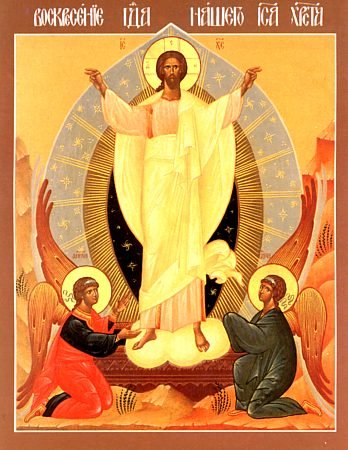
Why Do We Celebrate Easter?

Post Author: Bill Pratt

We celebrate Easter because it commemorates the resurrection of Jesus Christ.  Christians believe that Jesus was killed by crucifixion on a Friday and then actually came back to life on the following Sunday.

Some may ask, “So what?”  Why is it important that Jesus rose from the dead?

There are many answers to that question, including the fact that Jesus predicted this miracle ahead of time as proof that he is the Son of God.  But today I want to highlight a passage from 1 Cor. 15 where the apostle Paul explains why the resurrection is important to believers in a very practical way.

But if it is preached that Christ has been raised from the dead, how can some of you say that there is no resurrection of the dead?  If there is no resurrection of the dead, then not even Christ has been raised.  And if Christ has not been raised, our preaching is useless and so is your faith.  More than that, we are then found to be false witnesses about God, for we have testified about God that he raised Christ from the dead. But he did not raise him if in fact the dead are not raised. For if the dead are not raised, then Christ has not been raised either.  And if Christ has not been raised, your faith is futile; you are still in your sins. Then those also who have fallen asleep in Christ are lost.  If only for this life we have hope in Christ, we are to be pitied more than all men (1 Cor. 15:12-19).

Christ’s resurrection is the central teaching of Christianity.  According to Paul, if he wasn’t resurrected, then Christianity is a complete sham; all who believe in Christ for salvation are still in their sins and to be pitied if Christ was not raised.

For those of us who are believers, the resurrection is extremely important.  If Christ was not raised, we have no hope.

But Paul does not leave us hanging.  In verse 20, he makes clear what really occurred: “But Christ has indeed been raised from the dead, the firstfruits of those who have fallen asleep” (1 Cor. 15:20).

Paul concludes his treatment of the resurrection with these words: “Death has been swallowed up in victory” (1 Cor. 15:54).

The resurrection of Christ is the ultimate reassurance to all believers that death has finally been defeated.  We will all be resurrected, just as Christ.  Once you understand that Easter is a celebration of the defeat of death, you will finally understand why we celebrate this holy day.

Thanks be to God for a risen Savior!

What Happens to Us When We Gain New Knowledge?

Post Author: Bill Pratt

OK, I admit we’re in deep waters with this question, but I’ve been studying epistemology, the investigation of human knowledge, for the last few months and I have run across a short section in a book I’m reading that struck me as particularly profound.

Before I discuss that section, I want to share a common question that people ask me.  The question is this: “Why do you read and study so much?  What’s the point of it all?  Is there no end to your search for knowledge?”  Generally these are people who don’t know what to think of all the books I read, of the blog posts I write, of the seminary courses I take.  To them, it might all be a colossal waste of time.

The only way I can answer this question is that once I started studying the teachings of Christianity, my mind literally awakened to an immense world that I never knew existed.  Since that time, I have felt an incredible drive, almost a primal need, to learn as much as I can about God, humans, and the world we live in – in that order of importance.  I can’t get enough of it and I don’t think I ever will.

Is something wrong with me and people like me?  Sometimes I wonder, but then I ran across a passage in a book that explains why I do what I do – why I want to know things.  The book is An Elementary Christian Metaphysics by Joseph Owens and is one of the most difficult books I’ve ever read.  It is as abstract as you can possibly get, because the book is mostly about the concept of existence, of what it means for something to exist.  There is no more basic subject than that, and thus it makes for abstract reading.

So what does the book have to say?

Through sense cognition a man is able to become [in his mind] one by one the . . . things he encounters in his daily life.  He enriches himself with their forms as he perceives each of them [as they really are], and conserves the forms in his imagination.

Think about this.  We actually become the things we perceive as we bring them into our mind.  We are enriched by the things we come to know and we are able to preserve these things in our mind even after we stop seeing them.

Through intellection [man] is able to transcend the confines of the here and now, and become objects whose extent is unlimited.

How does this work?  We are able to identify common natures in things, and once we identify a common nature, we are able to know all things that possess that common nature.  For example, when we understand the concept of humanity as a nature, we now understand what all humans are like in their common humanity.  We can know what humans were like in the past, in the present, and in the future without ever seeing all instances of human beings.  That’s amazing when you think about it.

Though remaining an individual he is brought into a life that bursts away from the ghetto of his immediate surroundings and extends as far as do the natures of the things with which he comes in contact. . . . Through science he can enrich himself with myriad forms that could never impinge themselves on his immediate cognition.

The intellect and the ability to know things expands the universe far beyond what a man can directly see or hear.  How far can man go?

In grasping the [existence] of sensible things . . . he has the starting point from which he can reach [God].  By intellective reflection [man] becomes himself . . . and is himself in a way that enables him to dominate his own activity.  Knowing his own actions through reflection he has starting points for the investigation of spiritual nature.

Thus we are the only animals that can reach God by reflecting on ourselves.  We see that we have a spiritual nature, that we have a mind, that we think, feel, and will.  As Owens reminds us, this reflection provides the starting point for us to know that God exists.

Owens concludes:

The kinds of things that a man can know through his intellect are consequently unlimited. . . . Intellection, therefore, is able to enrich the knower cognitionally with the form of anything whatsoever.  Those forms remain with the knower permanently as [intellectual likenesses] in which the thing may again be actually known at any time.  There need be little wonder, then, that Aristotle saw in intellection the supreme happiness and destiny of man, and that according to the Christian the Beatific Vision is the ultimate goal of human living.

I believe that God has placed the desire to know in all humans, and that He has given some of us extra doses of that desire.  That is why I want to know.  Why has God given man the desire to know?  Because the pursuit of knowledge, for the Christian, eventually culminates in the ultimate human experience, seeing God in the Beatific Vision.  It doesn’t get any better than that.

Did Jesus’s Disciples Think He Was God? Part 2

Post Author: Bill Pratt

Continuing from part 1, there are additional lines of evidence showing that Jesus’s disciples thought he was God.  Again, this material is excerpted from theologian Norman Geisler’s book, Systematic Theology, Volume 2.

Picking up where we left off, the third line of evidence is that the disciples attributed the powers of God to Jesus.

According to Geisler:

There are some things only God can do, but these very things are attributed to Jesus by His disciples. He is said to be able to raise the dead (John 5:21; 11:38–44) and forgive sins (Acts 5:31; 13:38). Moreover, He is said to have been the primary agent in the creating of the universe (John 1:2–3; Col. 1:16) and in sustaining its existence (Col. 1:17). Surely only God can be said to be the Creator of all things, and the disciples claim this power for Jesus.

Fourth, the disciples associated Jesus’ name with God’s.

How did this happen in the New Testament?  Here are some examples:

Often in prayers or benedictions, Jesus’ name is used alongside God’s, as in “Grace and peace to you from God our Father and the Lord Jesus Christ” (Gal. 1:3; Eph. 1:2). The name of Jesus appears with equal status to God’s in the so-called trinitarian formulas: For example, the command to go and baptize “in the name [singular] of the Father and of the Son and of the Holy Spirit” (Matt. 28:19). Again this association is made at the end of 2 Corinthians: “May the grace of the Lord Jesus Christ, and the love of God, and the fellowship of the Holy Spirit be with you all” (13:14). If there is only one God, then these three persons must by nature be equated.

Fifth and finally, the disciples called Jesus God.

Geisler catalogues examples from the apostles John and Paul, and the writer of Hebrews.  All three call Jesus God in multiple ways.

First, the apostle John:

Thomas saw His wounds and cried, “My Lord and my God!” (John 20:28). The prologue to John’s gospel also minces no words, stating, “In the beginning was the Word, and the Word was with God, and the Word [Jesus] was God” (John 1:1).

Paul and the writer of Hebrews provide several more examples:

Paul wrote, “Theirs are the patriarchs, and from them is traced the human ancestry of Christ, who is God over all, forever praised!” (Rom. 9:5). He calls Jesus the one in whom “all the fullness of Deity lives in bodily form” (Col. 2:9). In Titus, Jesus is “our great God and Savior” (2:13), and the writer to the Hebrews says of Him, “Your throne, O God, will last for ever and ever” (Heb. 1:8). Paul says that before Christ existed in the “form of a servant,” which clearly refers to being really human, He existed in the “form of God” (Phil. 2:5–8 NKJV). The parallel phrases suggest that if Jesus was fully human, then He was also fully God. A similar term, “the image of the invisible God,” is used in Colossians 1:15 to mean the manifestation of God Himself. This description is strengthened in Hebrews, where it says, “The Son is the radiance of God’s glory and the exact representation of his being, sustaining all things by his powerful word” (Heb. 1:3).

Geisler summarizes all of the evidence nicely:

In summary, there is manifold testimony from Jesus Himself and from those who knew Him best that Jesus claimed to be God and that His followers believed this to be the case. They claim of the carpenter of Nazareth these unique titles, powers, prerogatives, and activities that apply only to God. There is no reasonable doubt that this is what they believed and what Jesus thought of Himself according to the New Testament.

Did Jesus’s Disciples Think He Was God? Part 1

Post Author: Bill Pratt

A couple of years ago, I wrote seven posts on the subject of whether Jesus claimed to be God.  At the end of those posts, I promised to follow up with an additional series of posts discussing whether Jesus’s disciples thought he was God.  Better late than never, I suppose.  Here begins that series.

There are several lines of evidence captured by theologian Norman Geisler in his book, Systematic Theology, Volume 2, that point to the fact that Jesus’s disciples did indeed believe he was divine.

First, the disciples attributed titles of deity to Jesus.

The apostle John referred to Jesus as the “the first and the last” (Rev. 1:17; 2:8; 22:13); “the true light” (John 1:9); the “bridegroom” (Rev. 21:2); “Savior of the world” (John 4:42; cf. Isa. 43:3).  He also attributed to Jesus the role of “Redeemer” in Rev. 5:9.

The apostle Peter called Jesus the “rock” and “stone” (1 Peter 2:6–8; cf. Ps. 18:2; 95:1); and “the Chief Shepherd” (1 Peter 5:4).

The apostle Paul referred to Jesus as the “rock” (1 Cor. 10:4) and the “bridegroom” (Eph. 5:22–33).  According to Geisler, “The Old Testament role of ‘Redeemer’ (Hosea 13:14; Ps. 130:7) is given to Jesus by Paul in Tit. 2:13–14.  Jesus is the forgiver of sins in Col. 3:13 and He is  “Christ Jesus, who will judge the living and the dead” (2 Tim. 4:1).

What is so special about these titles?  Geisler explains, “All of these titles are unique to Jehovah (Yahweh) in the Old Testament but are given to Jesus in the New Testament.”  The disciples were steeped in the Old Testament and would have only applied these titles with great care.  If they did not think Jesus was divine, they would have never used these words to describe him.

Second, the disciples considered Jesus the Messiah-God.

The New Testament opens with a passage concluding that Jesus is Immanuel (“God with us”), which refers to the messianic prediction of Isaiah 7:14. The very title “Christ” carries the same meaning as the Hebrew appellation “Messiah” (“Anointed One”). In Zechariah 12:10, Jehovah says, “They will look on me, the one they have pierced.” The New Testament writers apply this passage to Jesus twice (John 19:37; Rev. 1:7) as referring to His crucifixion.

But there is more, as Geisler elaborates on Paul’s view of Jesus.

Paul interprets Isaiah’s message, “For I am God, and there is no other.… Before me every knee will bow; by me every tongue will swear” (Isa. 45:22–23) as applying to his Lord, “at the name of Jesus every knee should bow … and every tongue confess that Jesus Christ is Lord, to the glory of God the Father” (Phil. 2:10–11). The implications of this are strong, because Paul says that all created beings will call Jesus both Messiah (Christ) and Jehovah (Lord).

There are several more lines of evidence that Geisler presents.  We’ll cover these in future posts, so ya’ll come back now!

Who Did Joshua Kill in Jericho?

Post Author: Bill Pratt

Many Christians, as they read the book of Joshua, are uncomfortable with the accounts of conquest that are recorded there.  The conquest of Jericho is the first in Canaan for the Israelites.  The biblical writer describes the battle of Jericho this way in Josh. 6:20-21:

When the trumpets sounded, the army shouted, and at the sound of the trumpet, when the men gave a loud shout, the wall collapsed; so everyone charged straight in, and they took the city.  They devoted the city to the LORD and destroyed with the sword every living thing in it—men and women, young and old, cattle, sheep and donkeys.

What causes many of us discomfort is the phrase “men and women, young and old.”  It seems that we must understand Joshua’s conquest of Jericho as a complete annihilation of a major population center, including non-combatants who are women, children and the elderly.

Christian scholar Paul Copan strongly disagrees with this understanding of the attack on Jericho in his book Is God a Moral Monster?: Making Sense of the Old Testament God.  Copan marshals a case to dispute the traditional view of Jericho being a major population center with loads of non-combatants living in it.

His argument rests on two primary points.  First, the language found in Josh. 6:21 should be understood as Near Eastern warfare rhetoric.  In other words, Joshua’s original audience would not have understood the sentence, “They devoted the city to the LORD and destroyed with the sword every living thing in it—men and women, young and old, cattle, sheep and donkeys” as literally meaning that.  Instead, they would have heard Joshua describing a decisive military victory.

Joshua’s conventional warfare rhetoric was common in many other ancient Near Eastern military accounts in the second and first millennia BC.  The language is typically exaggerated and full of bravado, depicting total devastation.  The knowing ancient Near Eastern reader recognized this as hyperbole; the accounts weren’t understood to be literally true.

Copan cites several examples of Near Eastern warfare accounts which used hyperbole to describe their victories, including accounts originating from Egyptians, Hittites, and Assyrians.  This historical data casts new light on how we should understand biblical warfare accounts, especially those recorded in Joshua.

Copan’s second point is that the city of Jericho is not a large population center containing numerous non-combatants which were killed in the assault.  According to Copan, the language used in Joshua 6 is “stereotypical Near Eastern language [which] actually describes attacks on military forts or garrisons, not general populations that included women and children.  There is no archaeological evidence of civilian populations at Jericho or Ai” (emphasis added).

Copan goes on to explain:

Given what we know about Canaanite life in the Bronze Age, Jericho and Ai were military strongholds.  In fact, Jericho guarded the trade routes from the Jordan Valley up to population centers in the hill country. . . . That means that Israel’s wars here were directed toward government and military installments; this is where the king, the army, and the priesthood resided.  The use of ‘women’ and ‘young and old’ was merely stock ancient Near Eastern language that could be used even if women and young and old weren’t living there. . . .  The text doesn’t require that women and young and old must have been in these cities.

If this is true, then what of Rahab?  According to Copan, “Rahab was in charge of what was likely the fortress’s tavern or hostel.”  Evidently it was common for a fortress to have a tavern where “traveling caravans and royal messengers would . . . stay overnight.”  Most of Jericho would have consisted of soldiers, priests, and political leaders.

Copan’s argument is compelling, as it cites ancient Near Eastern historical data to place in context what the original readers of Joshua’s book would have understood.  This is exactly what the historical-grammatical method of biblical interpretation calls us to do.  As we gather more data about the ancient Near East, we must constantly refine our understanding of the biblical texts.

When Reading the Bible, When Should We Look for Application?

Post Author: Bill Pratt

If you’re reading a Bible passage, when should you start thinking about how it applies to your life?  Many of us think that this is the first thing we should do after reading a passage, but I want to discourage that way of thinking.

Before thinking about how a passage applies to us, we should first spend our time trying to find the objective meaning of the text.  What was the original author trying to say to the original audience?

Theologian Norman Geisler, in his Systematic Theology, Volume One has some helpful advice for us:

The objective meaning of a text is the one given to it by the author, not the one attributed to it by the reader. Readers should ask what was meant by the author, not what it means to the reader. Once a reader discovers what the author meant by the text, he has obtained its objective meaning. Thus, asking, “What does it mean to me?” is the wrong question, and it will almost certainly lead to a subjective interpretation. Asking of the author, “What did he mean?” will almost certainly lead the reader in the right direction, that is, toward the objective meaning.

The first step, then, is to figure out what the author’s intended meaning of the text is.  Many of us are tempted to skip this step because, well, it’s hard.  It’s a lot easier to just read some verses and try to apply them to our own experiences.  Figuring out what the original author meant might require we spend some time studying the text, consulting a Bible dictionary, reading a commentary.

It’s true that trying to find out the original meaning of the text can be hard work, but most things in life worth having come from hard work.  Bible study is no exception.  Once you’ve discovered the meaning of the text, then start thinking about how it applies to your life.  Remember that the text only has one meaning, but it may have several applications or implications.

Geisler offers this example from science to make this more concrete: “Einstein knew that e=mc2 (Energy equals mass times the speed of light [constant] squared), and so does an average high school science student. However, Einstein knew many more implications of this than the average high school student.”

You must first understand what is meant by e=mc2 before thinking about all of its implications.  The better a student understands the meaning of e=mc2, the more implications he will see.  Likewise, when you read a Bible passage, work to understand what the author intended to say to his original audience.  Once you’re comfortable that you have the objective meaning, then start your search for the implications of the text for your life.  If you get these out of order, you’ll surely get way off track with your understanding of the Bible.

Does God Pose an Authority Problem for You?

Post Author: Bill Pratt

Many of the people I know who reject God or who have crafted a God that makes no demands on them have a fundamental problem with authority.  They don’t want anybody telling them what to do.

For a person who wants complete autonomy, who chafes at the thought of anyone having authority over them, a creator God who makes demands is way inconvenient.

Many people who believe in God, but also have this authority hang-up, create their own version of God.  This God gives them what they want when they want it.  He approves of everything they do, as long as they are just trying to be happy.  He encourages them to follow their desires, wherever they lead.  C. S. Lewis compared this God to a senile, old grandfather who never says “no” to his grandchildren.  You want chocolate for breakfast, lunch, and dinner?  No problem!

Is this the Christian God?  Philosopher Paul Moser answers the question:

It would be a strange, defective God who didn’t pose a serious cosmic authority problem for humans.  Part of the status of being God, after all, is that God has a unique authority, or lordship, over humans.  Since we humans aren’t God, the true God would have authority over us and would seek to correct our profoundly selfish ways.

If you are “worshiping” a God who makes no demands on you, you’re worshiping no God at all.  You’re just trying to find a deity to make you feel good about your selfish choices.  What’s the point?

Can Fossils Indicate Ancestry?

Post Author: Bill Pratt

In most cases, fossils cannot give us ancestry, according to paleontologist Donald Prothero.  This statement, coming from Prothero, shocked me when I first read it, because it seems like fossil news headlines always make claims about ancestry, but here is Prothero, a staunch supporter of evolution, disagreeing.

Let me explain, lest I be accused of quote mining.  In his book Evolution, Prothero dedicates an entire chapter to explaining how scientists classify plant and animal life.  According to Prothero, the dominant method used today is cladistics, where the relationships among animals and plants are determined by the comparison of shared derived characters.  This theory has only taken hold in the last few decades, replacing older systems of classification.

A cladogram (cladistic diagram) comparing an assortment of vertebrates (e.g., lamprey, shark, frog, cow, monkey, human) might look at shared derived characters such as jaws, vertebrae, lungs, four legs, hair, mammary glands, opposable thumb, and stereovision.  Cladograms are powerful tools for classifying life because they are using directly observable evidence taken from living animals and from fossils.  But do cladograms indicate fossil ancestry?  Only minimally.  Here is Prothero:

Some aspects of cladistic theory have proven more difficult for many scientists to accept.  For example, a cladogram is simply a branching diagram of relationships between three or more taxa.  It does not specify whether one taxon is ancestral to another; it only shows the topology of their relationships as established by shared derived characters.  In its simplicity and lack of additional assumptions, it is beautifully testable and falsifiable.

Prothero explains that cladistics frustrate some evolutionists who want to say more about ancestry from the cladograms, but Prothero urges caution:

The biggest sticking point is the concept of ancestry.  We tend to use the term ancestor to describe certain fossils, but we must be careful when making that statement.  If we want to be rigorous and stick to testable hypotheses, it is hard to support the statement that ‘this particular fossil is the ancestor of all later fossils of its group’ because we usually can’t test that hypothesis.  Because the fossil record is so incomplete, it is highly unlikely that any particular fossil in our collections is the remains of the actual ancestor of another taxon.

What is refreshing about these statements from Prothero is that we are seeing actual scientific restraint when it comes to the analysis of fossils.  Unfortunately this kind of restraint is almost never present when the news media trumpet a new fossil find.  We only hear about “missing links” and how “X is the ancestor of Y” throughout the reports.

To be fair to Prothero, he does believe that ancestry can be verified if the fossil sample size is large enough.  In his own research on planktonic microfossils, he claims that there are enough layers of fossils to draw scientific conclusions about ancestry.

Planktonic microfossils aside, it is time that palentologists become more careful with their language and stop referring to new fossils in sensational terms.  In most cases, there is no way to determine ancestry; we can look at what features a new fossil shares with other taxa, but that is usually as far as we can go.

Do We Have Intuitive Knowledge?

Post Author: Bill Pratt

Philosophers who study how we know things (epistemologists) have long debated whether we have innate or intuitive knowledge.  This kind of knowledge is often referred to as a priori knowledge.  It is knowledge that one has prior to or independently of sense experience. It cannot be proven by experience.

The debate over a priori knowledge is important to Christians because atheists, agnostics, and naturalists often deny the existence of most kinds of a priori knowledge and claim that we can only know what we observe with our senses.  For example, do we know that raping little children for fun is wrong?  Most people would say “yes” and in a poll I ran last week on the blog, 89% did answer “yes.”  Now, this is hardly a scientific poll, but the results, I think, are still indicative.

This is an example of a priori knowledge, because we don’t come to this conclusion by observing the world around us – we just know intuitively that raping little children for fun is wrong.  Philosopher Louis Pojman lists eleven examples of propositions that have been proposed as a priori knowledge by epistemologists:

  1. If John is taller than Mary and Tom is taller than John, Tom is taller than Mary.
  2. 5 + 7 = 12
  3. Nothing is both red and green.
  4. Some sentences are not both true and false.
  5. If Socrates is a man and all men are mortal, Socrates is mortal.
  6. Every event has a cause.
  7. All bodies are extended.
  8. A greatest possible being necessarily exists.
  9. It is wrong to harm people just for the fun of it.
  10. If I believe I exist, I exist.
  11. Not both p and not-p.

These propositions represent several different categories of knowledge: mathematics, knowledge of “greater than,” laws of logic, morality, deductive logic, causality, knowledge of space, knowledge of God, and introspective knowledge.

Philosopher Alvin Plantinga holds that a priori knowledge, besides being true, must fulfill four conditions:

  1. The proposition p must be believed and believed to be necessarily true.
  2. You must be able to form the belief immediately upon understanding it.
  3. The proposition p must not be believed on the basis of perception, memory, or testimony.
  4. The belief must be accompanied with a certain phenomenal feel, what the rationalists call intuition.

What do you think?  Do you think certain kinds of knowledge are built in to human beings, that we just know some things intuitively?  If so, what kinds of things do you think we know intuitively?

I’ve given you 11 examples of what some philosophers have considered to be a priori knowledge, but I’d like for you to vote in the poll below.  The assignment is easy: tell us which of the 11 propositions, once you’ve read and understood the terms in them, are intuitively obvious or self-evident.  I look forward to seeing the results.

A Christian Apologetics Blog