All posts by Bill Pratt

What Is the Christian Worldview? Part 1

Stained glass at St John the Baptist's Anglica...

Post Author: Bill Pratt

According to James Sire in The Universe Next Door, a worldview is the following:

A commitment, a fundamental orientation of the heart, that can be expressed as a story or in a set of presuppositions (assumptions which may be true, partially true, or entirely false) which we hold (consciously or subconsciously, consistently or inconsistently) about the basic constitution of reality, and that provides the foundation on which we live and move and have our being.

It’s how we view the world!  All of us have a worldview, whether we realize it or not.  For those of us who are Christian, our faith heavily informs our worldview, or at least it should.  A person’s worldview should ideally answer a set of questions which are foundational to human existence.  These questions can be asked in several ways, but here are my versions of these questions:

  1. What is ultimate reality?
  2. Where did the world around us come from and what is its nature?
  3. What are human beings and where did they come from?
  4. Why do humans suffer?
  5. Is there a way for humans to be saved from suffering?
  6. How do I know right from wrong?
  7. What is the meaning or purpose of my life?
  8. What happens to me when I die?

You can evaluate any person’s worldview by asking them for answers to these questions.  Not only will you have a fascinating conversation, but you will learn what makes the other person tick.  You will get to see the world through their eyes.

So the next obvious question is this: how would a Christian answer these eight questions?  Christianity certainly offers compelling responses to these questions, as you would expect.  Below I will give you brief answers and then perhaps we can flesh them out if you (my blog-reading friends) would like to discuss them in the comments.

Question 1: What is ultimate reality?

Christians believe that the ultimate reality is God.  The Christian God has a number of qualities, but here are some of the most important: God is infinite, personal, sovereign, good, holy, transcendent, omniscient, and omnipotent.

Question 2: Where did the world around us come from and what is its nature?

Christians believe that the world around us is composed of time, space, matter, and energy, as scientists have demonstrated.  We believe that this physical world was spoken into existence by God.  We believe that God is separate from the world and not actually part of the world.

Question 3: What are human beings and where did they come from?

Human beings are soul and body.  We possess spiritual and physical dimensions.  We are created in the image of God, which means we represent God on earth as his representatives.  Being in God’s image, humans are also personal, intelligent, and moral beings.

Question 4: Why do humans suffer?

Humans suffer because of the Fall.  The Fall occurred when the first two human beings, Adam and Eve, rejected God and sought to usurp his position.  This rebellion – acting in a way contrary to God’s will –  introduced the disease of sin into the world, a disease which is passed on to every human generation.  All human suffering is ultimately the result of this pivotal event in human history.

I’ll finish up with answers to the last four questions in the next post.  See you then!

Researchers Show How Wind Could Have Parted the Red Sea

Post Author: Bill Pratt

A study has just been released where researchers have shown how wind could have parted the Red Sea.

Researchers at the National Center for Atmospheric Research and the University of Colorado have found a location in the Nile River’s ancient delta where an east wind — blowing at 63 mph for 12 hours — could have pushed back the waters and exposed a muddy land bridge.

When the wind died down, the water would have come rushing back, according to NCAR’s Carl Drews, lead author of a paper published today in the journal PLoS ONE.
The article describes how Drews came to his conclusions:
Drews scoured old maps of the way the Nile River delta and the waterways around the Red Sea’s Gulf of Suez may have looked thousands of years ago. Eventually, he found a map that showed an ancient river merging with a coastal lagoon near the Mediterranean, forming a U shape.

“It formed this bend in the body of water facing east,” Drews said. “When the wind blew from the east, the water would split around the bend — you can imagine that peninsula cutting the water like a ship’s prow.”

Ultimately, Drews didn’t know what was possible until he ran a computer simulation. When he did, he found that if a 63 mph wind blew for 12 hours, the 6-foot-deep water in the east-facing bend would have been pushed back, creating a dry passage more than two miles long and three miles wide.

Who knows if this is really what happened.  We’ll probably never find out for certain, but these sorts of historical scientific investigations always fascinate me, as they pull back the curtain to let us see how God may have used nature to perform some of his most spectacular miracles.

A Simple Argument for God’s Existence

Post Author: Bill Pratt

A couple months ago, we featured a 7 minute audio clip from philosopher Peter Kreeft’s lecture on arguments for God’s existence.  For this post, we are presenting an additional clip from the lecture – this time on the first cause argument for God’s existence.  Again, Kreeft does a wonderful job simplifying the argument so that anyone can understand.  Enjoy!

[audio:https://www.toughquestionsanswered.org/wp-content/uploads/2010/09/Arguments-for-the-Existence-of-God-First-Cause.mp3|titles=The First Cause Argument]

Is Hawking’s Theory about the Creation of the Universe New?

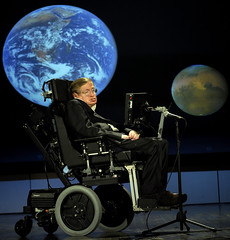
Stephen Hawking NASA 50th (200804210002HQ)

Post Author: Bill Pratt

I was discussing Hawking’s recent book with a regular blog commenter who mentioned that Hawking’s ideas on the creation of the universe were new and that he hadn’t had time to look into them.  This got me thinking about whether Hawking really was on to some new formulation of physics that had never been published before.

It turns out the answer is “no,” according to physicist Stephen Barr.  In his article, “Much Ado About ‘Nothing’: Stephen Hawking and the Self-Creating Universe,” he traces the genesis of Hawking’s ideas:

The idea that Hawking is now touting is not new—in fact, within the fast-moving world of modern physics it is fairly old. My first introduction to it was reading a very elegant theoretical paper entitled “Creation of Universes from Nothing,” written in 1982 by the noted cosmologist Alexander Vilenkin, who argued that our universe might have arisen by a “quantum fluctuation.”

This idea is sometimes referred to as the quantum creation of the universe. There are different variants, but the basic idea is well-known among particle physicists and cosmologists.

Barr then proceeds to describe the nature of this theory:

Right up front, it must be noted that this idea is extremely speculative, has not yet been formulated in a mathematically rigorous way, and is unable at this point to make any testable predictions. Indeed, it is very hard to imagine how it could ever be tested. It would be more accurate to call these “scenarios” than theories.

Having said this, though, Barr warns readers not to blindly dismiss the idea of quantum creation.  He explains that it is based on applying quantum mechanics to entire universes.  Although quantum mechanics is well understood at a sub-atomic level, Hawking and others are speculating what quantum mechanics might look like at the level of entire universes.

After expanding upon the theory of quantum creation, Barr ultimately comes to this point:

Perhaps my explanations are not really necessary. Even the most casual readers recognize that the cosmological theories put forward by Hawking do not bear upon larger questions that motivate classical views of creation out of nothing. Non-scientists are quick to ask the obvious questions. Why a system obeying quantum mechanics, M-theory, superstring theory, or whatever laws of physics that make scientific speculations possible in the first place? Why not no system at all, with no laws at all, no anything, just blank non-being?

Let’s put Hawking’s theories in perspective.  What exactly can these theories tell us?

Physics scenarios and theories are merely mathematical stories. They may be fictional or describe some reality. And just as the words of a book by themselves can’t tell you whether it’s fact or fiction—let alone have the power to make the world they describe real—so with the equations of a physics scenario. As Hawking once understood, equations may turn out to be an accurate description of some reality, but cannot not confer reality on the things they describe.

Finally, Barr reminds us:

There are two answers to the question: “Why does anything exist rather than nothing at all?” The atheist answers, “There is no explanation.” The theist replies, God. An intelligent case can be made for either answer. But to say that the laws of physics alone answer it is the purest nonsense—as Hawking himself once realized.

How Should We Respond to Name-Calling?

Post Author: Bill Pratt

We don’t have a serious problem on our blog with commenters calling each other names.  I have had to delete very few comments because someone crossed over the line of good taste.  Every once in a while, though, people forget their manners and start hurling accusations at each other.  When someone calls you a name during a serious discussion, what should you do?

Recently I came across a short article written by the folks at Stand to Reason which suggests a good idea.  When someone calls you a name, just ask for a definition of the name they called you.  That’s all.

This approach will often work because people are rarely thinking clearly when they call names.  When you ask them to define the word they used to describe you, it will generally bring them back to rationality.

The article lists three likely results of using this tactic:

1. It will give them pause the next time they think about calling you a name. If they have to define every “bad” word they call you (intolerant, narrow-minded, homophobic, judgmental, etc.), then they’re less likely to call you a name and more likely to explain their concern. That makes for a more productive conversation.

2. It will make it more difficult for them to define you, a friendly person who is merely asking for a definition, in a horribly negative way. Instead, they’ll soften the definition and it won’t have the same negative rhetorical impact that the word had.

3. Their definition will likely also apply to them.

I think this is solid advice that any of us can use when a conversation becomes heated and names start flying.

Why is Stephen Hawking Wrong about God?

Post Author: Bill Pratt

In Stephen Hawking’s latest book, The Grand Design (I haven’t read it yet, but I have read Hawking’s introduction and pre-release interviews), he offers explanations as to why our universe exists and why there is such incredible fine tuning in our universe to support advanced life on earth.  His answer seems to be that the laws of physics are the explanation.  There is no need for God.

Enter Professor John Lennox.  He wrote an excellent piece recently dealing with Hawking’s claims head on.  Lennox begins:

According to Hawking, the laws of physics, not the will of God, provide the real explanation as to how life on Earth came into being. The Big Bang, he argues, was the inevitable consequence of these laws ‘because there is a law such as gravity, the universe can and will create itself from nothing.’

Unfortunately, while Hawking’s argument is being hailed as controversial and ground-breaking, it is hardly new.

For years, other scientists have made similar claims, maintaining that the awesome, sophisticated creativity of the world around us can be interpreted solely by reference to physical laws such as gravity.

It is a simplistic approach, yet in our secular age it is one that seems to have resonance with a sceptical public.

But, as both a scientist and a Christian, I would say that Hawking’s claim is misguided. He asks us to choose between God and the laws of physics, as if they were necessarily in mutual conflict.

But contrary to what Hawking claims, physical laws can never provide a complete explanation of the universe. Laws themselves do not create anything, they are merely a description of what happens under certain conditions.

Lennox then goes on to further explain the mistake that Hawking is making:

What Hawking appears to have done is to confuse law with agency. His call on us to choose between God and physics is a bit like someone demanding that we choose between aeronautical engineer Sir Frank Whittle and the laws of physics to explain the jet engine.

That is a confusion of category. The laws of physics can explain how the jet engine works, but someone had to build the thing, put in the fuel and start it up. The jet could not have been created without the laws of physics on their own  –  but the task of development and creation needed the genius of Whittle as its agent.

Similarly, the laws of physics could never have actually built the universe. Some agency must have been involved.

To use a simple analogy, Isaac Newton’s laws of motion in themselves never sent a snooker ball racing across the green baize. That can only be done by people using a snooker cue and the actions of their own arms.

The rest of Lennox’s article takes on other aspects of Hawking’s arguments and is well worth reading.

*Another response: Alister McGrath has also written a brilliant article addressing Hawking’s book.

Is God Subject to Logic?

Post Author: Bill Pratt

Over the past couple years of blogging, one of the most common areas of confusion in the blog comments has been about the relationship between logic and God.  Did God create logic like he created humans?  Did logic exist before God, so that God is subject to logic?  Can’t God do away with the laws of logic?  Can’t he violate the laws of logic?

The first thing we need to do is define what logic is.  A simple definition of logic is “the study of right reason.”  The foundation of right reason is embodied in three laws of logic that are undeniable.

The law of non-contradiction states that a thing cannot be both A and non-A at the same time and in the same sense.

The law of excluded middle states that a thing is either A or non-A.

The law of identity states that if a thing is A, then it is A.

All logic, and thus all right reasoning, is built off of these three laws.  They are undeniable.

So now to the question.  Are these laws subject to God or is God subject to them?

The answer is that the laws of logic are part of the nature of God.  In other words, logic is built into God.  He did not create logic like he created humans, but neither did logic exist as some sort of entity outside of God.  Since God has always existed, and the laws of logic are based in God, then the laws of logic have always existed as well.

Can God violate the laws of logic?  No, because he cannot not be himself.  Whatever God is, he is eternally.  God does not shut down various attributes of his being, like cutting off lights in different parts of the house.  God is logical, he always has been logical, and he always will be logical.

Someone might object, “Doesn’t this mean God is limited by logic?”  This objection has always struck me as strange because logic is synonymous with rationality.  Is God limited to being rational?  Well yes, in the same way he is “limited” by his goodness, or his beauty, or his holiness.  God is never evil, ugly, or unholy; likewise, God is never illogical or irrational.

It is extremely important to note that humans could never know anything about God without the laws of logic.  Without the laws of logic, God could exist and not exist, God could not be God, God could be good and non-good (evil), and so forth on and on.  Logic is essential to our knowing God.  Christians who denigrate logic are, in effect, denigrating the foundational tools that we have to know anything about God.

Another objection that has been raised is that since God can do the impossible, then when we say he cannot be illogical, then we are saying he cannot do the impossible.  The misunderstanding comes from the word impossible.  Biblically, God may do what is impossible for human beings to do, but the Bible does not say that God can do what is logically impossible.

For example, objectors may argue, “God can raise people from the dead, but that’s impossible!”  Well, that’s impossible for humans, but it’s not logically impossible.  There is a big difference between the two.

In summary, logic is built into God as part of his nature, so God is not subject to logic as if logic is some force outside of him.  But he is “subject” to logic because he cannot deny himself.

Could Aliens Be Non-Carbon Based?

Animation of the structure of a section of DNA...

Post Author: Bill Pratt

The scientists at Reasons to Believe have always argued that finding advanced life on other planets is extremely improbable, considering the hundreds of conditions that must be simultaneously met for a planet to support advanced life.  Earth is quite unique in this regard.

When I’ve mentioned this to friends and family, they sometimes express skepticism and claim that maybe there are life forms that could exist with different chemistry than the carbon-based life on earth.

In an article published last year, Dr. Fazale Rana argued that non-carbon based life forms are just not feasible.  Rana explains:

Of the 112 known chemical elements, only carbon possesses sufficiently complex chemical behavior to sustain living systems.  Carbon readily assembles into stable molecules comprised of individual and fused rings and linear and branched chains. It forms single, double, and triple bonds. Carbon also strongly bonds with itself as well as with oxygen, nitrogen, sulfur, and hydrogen.

What about silicon?  This is the most common idea I hear.  Rana  replies:

Silicon belongs to the same chemical group as carbon and should display similar chemical properties, prompting some astrobiologists to propose that life could be based on this element. But while silicon does form rings and chains, these structures lack the stability and the range of complexity found in carbon-based compounds. Silicon-silicon bonds are much weaker than the corresponding carbon-carbon bonds, and unlike carbon-carbon bonds, they are susceptible to oxidation.

Silicon won’t work.  Then what about arsenic or phosphorus?  Rana explains:

Though arsenic and phosphorus share some chemical properties, the two elements display significantly different chemistries as well. Phosphorus is a nonmetal. Arsenic is a metalloid.  Phosphorus reacts with oxygen to form chemical compounds called phosphates. These groups take part in the linkages that constitute the backbone of the DNA molecule by reacting with the sugar, deoxyribose. The sugar-phosphate linkages are described as phosphate esters. Arsenic will also form a compound called arsenate by reacting with oxygen. Arsenates and phosphates display some chemical similarities, but esters formed with arsenates are unstable. They could never be used to construct the backbone of DNA––considered indispensable for life––or another similar compound.

The bottom line is that based on all the known chemical elements, scientists are fairly confident that advanced alien life would have to be carbon-based, which places severe limitations on the kinds of environments that our E.T. friends could live in.  Don’t hold your breath for an alien visitation any time soon.

An Illustration of the Incarnation from the Movie Avatar

Post Author: Bill Pratt

Although I have written negatively of the overall theme and message of Avatar, there is an interesting analogy of the Incarnation of Christ that can be taken from the film.  I heard this analogy in a podcast by William Lane Craig, and I think it may help some people understand this important Christian doctrine.

Craig was debating a Muslim recently and he wanted to help the Muslim audience understand how Jesus could be both God and man at the same time.  The doctrine of the Incarnation states that Jesus is one person who possesses two natures, one divine and one human, but Muslims sometimes struggle with this concept, thinking that if Jesus is human, he cannot also be God.

Here is where the movie Avatar comes in.  The hero of the movie, Jake Sully, is a crippled human that cannot walk.  As the movie progresses, Sully is able, through technology, to take on the nature of one of the natives of the planet Pandora, the Na’vi.

Sully’s mind unites with a Na’vi body, and for the rest of the movie he is both human and Na’vi; he possesses two natures.  Like Jesus, Sully is one person with two natures.  Sully can do things in his Na’vi nature that he cannot do in his human nature, like moving his legs and physically connecting his mind with the planet Pandora.  Likewise, Jesus is able to do things in his divine nature (e.g., raise people from the dead, still storms)  that He cannot do in his human nature.

Like any analogy, this one has its weaknesses, but I thought it was an interesting way to illustrate the Incarnation using the plot of a popular movie.  If it helps you, great!  If it doesn’t help, forget about it.

What Are Nine Common Errors When Interpreting Biblical Narratives?

Post Author: Bill Pratt

Our local church, Cornerstone, has embarked on a year-long study of the Book of Joshua.  Our pastor, Dr. Byrd, is going to prepare detailed sermon notes each week, which will then be translated by the other pastors into lessons for Sunday school classes.

As we kick off this series in Joshua, I have been drawn back to one of my favorite books on biblical interpretation, Gordon Fee and Douglas Stuart’s How to Read the Bible for All Its Worth.  In the past I shared ten principles for interpreting Old Testament narratives from their book, but this time I want to highlight nine errors that are commonly made when interpreting biblical narratives, also from their book.

Allegorizing.  “Instead of concentrating on the clear meaning of the narrative, people relegate the text to merely reflecting another meaning beyond the text.”

Decontextualizing.  “Ignoring the full historical and literary contexts, and often the individual narrative, people concentrate on small units only and thus miss interpretational clues.  If you take things out of context enough, you can make almost any part of Scripture say anything you want it to” (emphasis added).

Selectivity.  “It involves picking and choosing specific words and phrases to concentrate on while ignoring the others and ignoring the overall sweep of the narrative being studied.”

Moralizing.  “This is the assumption that principles for living can be derived from all passages.  The moralizing reader, in effect, asks the question , ‘What is the moral of this story?’ at the end of every individual narrative.  An example would be, ‘What can we learn about handling adversity from how the Israelites endured their years as slaves in Egypt?’  The fallacy in this approach is that the narratives were written to show the progress of God’s history of redemption, not to illustrate principles.”

Personalizing.  “Also known as individualizing, this refers to reading Scripture in the way suggested above, supposing that any or all parts apply to you or your group in a way that they do not apply to everyone else.  This is, in fact, a self-centered reading of the Bible.  Examples of personalizing would be, ‘The story of Balaam’s talking donkey reminds me that I talk too much.’  Or, ‘The story of the building of the temple is God’s way of telling us that we have to construct a new church building.'”

Misappropriation.  “It is to appropriate the text for purposes that are quite foreign to the biblical narrative.  This is what is happening when, on the basis of Judges 6:36-40, people ‘fleece’ God as a way of finding God’s will!  This, of course, is both misappropriation and decontextualizing, since the narrator is pointing out that God saved Israel through Gideon despite his lack of trust in God’s word.'”

False appropriation.  “It is to read into a biblical narrative suggestions or ideas that come from contemporary culture that are simultaneously foreign to the narrator’s purpose and contradictory to his point of view.”

False combination.  “This approach combines elements from here and there in a passage and makes a point out of their combination, even though the elements themselves are not directly connected in the passage itself.”

Redefinition.  “When the plain meaning of the text leaves people cold, producing no immediate spiritual delight or saying something other than what they wish it said, they are often tempted to redefine it to mean something else.”  Fee and Stuart use the example of 2 Chronicles 7:14-15: “If my people, who are called by my name, will humble themselves and pray and seek my face and turn from their wicked ways, then will I hear from heaven and will forgive their sin and will heal their land. Now my eyes will be open and my ears attentive to the prayers offered in this place.”  Christians today want to apply this promise to their own land, but as Fee and Stuart point out, this promise was only directed toward the ancient land of Israel.

As our church moves through the Book of Joshua, I hope we can avoid these common errors.  The most important step in interpreting any biblical text is to first work very hard to discover what the original author was trying to communicate to the original audience.  Only after we have done the hard work of finding the original meaning can we then apply the text to our contemporary world.