What Were the Reformers’ Views on Infant Baptism? – #6 Post of 2010

Post Author: Bill Pratt

According to church historian John Hannah, there were four major Protestant streams that developed during the Reformation in the 16th century: Anglicanism, Lutheranism, Calvinism, and Anabaptism.  Each of these streams placed great stress on the idea of salvation by faith alone, yet they did not all agree on what infant baptism means or whether it should even be done.

To my knowledge, all the reformers rejected baptism as the cause of a believer’s salvation; again, salvation is by faith.  An infant obviously cannot believe on her own, so if baptism is only a sign of the faith a person possesses, then why are infants baptized?

First, let’s look briefly at Calvinism.  According to Hannah, “Calvin defended the baptism of infants, believing that children of the godly are born members of the church by virtue of the hereditary nature of the Abrahamic covenant, circumcision having been replaced in the New Covenant with baptism as a sign.”

For Calvin, since infants were circumcised under the Old Covenant, infants should be baptized under the New Covenant.  Infant baptism does not cause regeneration, but it ensures that the child will be taught what she needs to know about Christ when she gets older, so that she can then exercise her own faith.  If she dies before she can exercise her own faith, Calvin believed that God could still save her, as He is not limited to save only those who exercise faith (although that is the normal way).

The Anglicans closely followed Calvin on the issue of infant baptism.

Luther also held very similar views to Calvin.  He believed that infants, who cannot exercise faith, should be baptized because of the faith of their parents and church family.  The faith of the church family could not directly save the infant, but their faith would later help the child to grow in knowledge and receive her own faith from God.  Again, infant baptism signifies the entrance of the child into the church where she can be instructed.

The last group, the Anabaptists, differ greatly from the other three streams.  The Anabaptists believed that a sign should always follow the thing it signifies, not anticipate it.  Hannah explains further Anabaptist views: “People are born into the world lost and need to be regenerated.  One does not enter the church as a citizen as one enters the state.  In the latter one is naturally born into it; in the former one is spiritually born into it.  The state is not the church; the church is not the state.”

The earliest confession of the Anabaptists states: “Baptism shall be given to all those who have learned repentance and amendment of life, and to all those who walk in the resurrection of Jesus Christ, and wish to be buried with him in death. . . . This excludes all infant baptism . . . .”

So what do you think?  Should infants be baptized?  Please vote in the poll below.

Is Intelligent Design Creationism? – #7 Post of 2010

Post Author: Bill Pratt

Many journalists confuse the Intelligent Design (ID) movement with young earth creationism.  Some of this confusion is nothing more than intellectual laziness, but some of it is caused by ID opponents repeating the assertion over and over again as a rhetorical strategy.

Here is an interview excerpt from Thomas Lessl, a professor at the University of Georgia and an expert on rhetoric (see the entire interview here):

One consistent pattern in the scientific mainstream’s response to ID has been to try to identify it with scientific creationism, to paint it with the same brush so to speak.  Such allegations are still frequently made – that ID is merely “creationism dressed up in a cheap tuxedo”.   This is what movement scholars call a strategy of “evasion”, an institutional effort to slow the momentum of a movement by pretending that it doesn’t exist – or in this case by pretending that it is made up of merely radical fundamentalists of no account.  This strategy is still being plied in the mass media, for public audiences that remain largely ignorant about the differences between these two movements.

Let’s look again at what the actual proponents of ID say about this issue.  Answering the question as to whether ID and creationism are the same, the Discovery Institute says:

No. The theory of intelligent design is simply an effort to empirically detect whether the “apparent design” in nature acknowledged by virtually all biologists is genuine design (the product of an intelligent cause) or is simply the product of an undirected process such as natural selection acting on random variations. Creationism typically starts with a religious text and tries to see how the findings of science can be reconciled to it. Intelligent design starts with the empirical evidence of nature and seeks to ascertain what inferences can be drawn from that evidence. Unlike creationism, the scientific theory of intelligent design does not claim that modern biology can identify whether the intelligent cause detected through science is supernatural.

Maybe you still aren’t convinced, though.  Well, let’s also look at what one of the largest young earth creationist organizations in the world says about whether ID is the same as creationism.  Below is an audio podcast from Ken Ham, the president of Answers in Genesis.

There you have it.  Creationists claim that ID is not creationism and ID proponents claim that ID is not creationism.  For anyone that has studied these two different movements, the differences are obvious.  The only reason why the two are confused is due to ignorance or a rhetorical strategy used to confuse the public and marginalize ID without having to confront its ideas.  I think it’s time for the rhetorical strategy to be put to rest – let’s focus on the actual arguments.

A Summary of the Craig vs. Tooley Debate at UNCC – #8 Post of 2010

Post Author: Bill Pratt

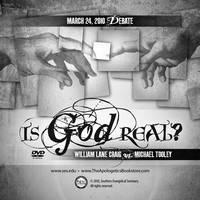
On March 24, 2010, Christian philosopher William Lane Craig debated agnostic philosopher Michael Tooley about whether God exists.  I attended the debate and thought I would share a summary with you.

Craig opened with 5 well-known arguments for the existence of God (some of which we’ve presented on TQA in the past – follow the hyperlinks):

  1. cosmological
  2. teleological
  3. moral
  4. resurrection of Jesus
  5. religious experience

Tooley opened with one argument for the improbability of God’s existence: the argument from evil.

Let’s look at this argument more closely.  Tooley defined God as an all-powerful, all-knowing, and morally perfect being.  What he wanted to show is that the existence of this kind of God is improbable because of the existence of evil.

He first catalogued all sorts of evils – the list was quite thorough and even poignant.  Following this shop of horrors, he argued that there are certain kinds of evil where the unknown good properties of that evil (granting that God can bring good out of evil) are outweighed by the bad properties that we know come from evil.  Put another way, he admitted that an all-powerful and all-knowing God could have good reasons for evil, but that we can inductively show that these good reasons cannot outweigh the “bad” from these evils.

His conclusion: since it is improbable that an all-good God could have sufficient good reasons for evil that outweigh the bad associated with evil, then it is is improbable that this all-good God exists.

How did Craig respond?  Craig responded by pointing out that you cannot assign probabilities to the existence of unknown good reasons for evil.  It’s like someone holding a giant bag of marbles and asking you: “What is the probability that, if you reached in, you would pull out a red marble?”  You could not assign a probability because you don’t know if there are any red marbles in there at all!  Tooley, likewise, is somehow claiming to assign probabilities to whether God could have unknown (his word) good reasons for evil.  This is clearly impossible to do with an all-knowing and all-powerful being.

How did Tooley respond to Craig’s arguments for God’s existence?  Well, he didn’t really address the cosmological and teleological arguments, content to let them stand.  He did address the moral argument by claiming that you can have objective moral values without the existence of God – he pointed to several philosophers who have tried to argue this way.

He addressed the argument from the resurrection by saying that all this proves is that the God of the Old Testament exists, and that this God is demonstrably not perfectly moral – he quoted many passages from the OT that seem to indicate an immoral God.

He addressed the argument from religious experience by saying that people from all sorts of religions have religious experiences, so this cannot establish the God of Christianity.

There were, of course, rebuttals given by Craig to Tooley’s critiques, but I won’t go into all of that today.  In the end, here is how they closed.

Tooley claimed that his argument from evil demonstrated that an all-good God is unlikely to exist.

Craig claimed that since Tooley had not addressed the cosmological or teleological arguments, that Tooley was, in effect, admitting that an intelligent, powerful, personal, non-spatial, timeless, creator of the universe exists; he just disputed that this creator was perfectly good.  The fact that Tooley conceded so much in the debate was not lost on the audience.  It was strange that he focused solely on the morality of God.

One final point to mention is the debating style of Michael Tooley.  Tooley is obviously an accomplished and brilliant scholar, but his presentation was extremely difficult to follow.  He presented a host of PowerPoint slides that he read from in rapid-fire fashion.  Since his argument from inductive logic was quite complex (he said as much), I would wager that a very small percentage of the audience could follow it.  That was unfortunate because none of us are served well by failing to understand all sides of a debate.  I have studied these kinds of arguments for many years, and I was barely able to follow his argument; he was just moving way too fast.

In addition, Tooley prepared slides for his rebuttals ahead of the debate and so found himself prepared to refute Craig on points that Craig never introduced.  He relied almost 100% on these prepared slides, again reading from them, line by line.  It was as if he did not want to respond real-time to Craig, and this came across poorly, since Craig did respond real-time to Tooley’s arguments.

Much more could be said about the debate.  If anyone else attended, tell us about what you thought.  We’d love to hear from you.

Is the Qur’an Wrong about Jesus? – #9 Post of 2010

Post Author: Bill Pratt

It may surprise some Christians that the Qur’an, the holy book of Islam, speaks about Jesus.  In fact, the Qur’an speaks of Jesus as a great prophet of God and records some of the miracles that Jesus performed.

However, the Qur’an denies one important event in the life of Jesus, his crucifixion.  According to the Qur’an, Jesus was never crucified by the Romans.  He was taken straight to heaven without being executed.

Herein lies a couple of significant problems, it seems, for Islam.  First, virtually every professional historian who has studied the events of Jesus’ life agrees that he was killed by crucifixion.  This fact is just not debated by any reputable scholars, as far as I am aware.

Second, we have another problem, what Jesus scholar Mike Licona calls the “Islamic catch-22.”  You see, Jesus predicted that he would die a violent death, predicted it several times.  According to Licona, “We find this reported in Mark, which is the earliest Gospel, and it’s multiply attested in different literary forms, which is really strong evidence in the eyes of historians.”

So what?  How is that a problem for Muslims?  Licona explains:

If Jesus did not die a violent and imminent death, then that makes him a false prophet.  But the Qur’an says that he’s a great prophet, and so the Qur’an would be wrong and thus discredited.  On the other hand, if Jesus did die a violent and imminent death as he predicted, then he is indeed a great prophet – but this would contradict the Qur’an, which says he didn’t die on the cross.  So either way, the Qur’an is discredited.

If the Qur’an, which Muslims claim is perfect, contains an error as egregious as denying the crucifixion of Jesus, it simply cannot be trusted to be a reliable historical document.

Did the Early Church Believe in a Literal Thousand-Year Reign of Christ on Earth? – #10 Post of 2010

Post Author: Bill Pratt

The Book of Revelation, according to some Christians, teaches a literal thousand-year reign of Christ on earth after his second coming (see Rev. 20).  This will then be followed by the creation of a new heaven and new earth. This view is known today as premillenialism.

But there are other Christians, in fact, the majority, who interpret the thousand years in Rev. 20 as a spiritual reign of the church which started at Christ’s first coming and ends at his second coming.  This view is known today as amillenialism.

The proponents of both of these views have an array of arguments to support their positions, but what was the view of the early church?

It seems that up until the third century, the early church was primarily premillenialist.  Writers like Irenaeus, Justin Martyr, and Tertullian all thought the second advent of Christ was imminent and that he would inaugurate his thousand-year reign on earth.

The tide, however, started to turn with the writings of Origen in the early third century, who adopted an allegorical method of interpreting Revelation.  Origen believed that the thousand years represented a spiritual reign of the church.  His disciple, Dionysius of Alexandria, continued the attack against premillenialism and turned the eastern church away from it.

In the western church, Augustine, in the late fourth century, began to teach amillenialism, siding with the Alexandrians in the east.  His views of eschatology (the end times) were detailed in his most famous work, The City of God.

From the time of Augustine until the Reformation in the sixteenth century (~1,100 years), amillenialism was the dominant view in the church.

The story obviously doesn’t end there, but you now have a brief introduction of what happened in the first fifteen hundred years of Christianity with respect to the millennium scribed in Rev. 20.

What about you?  Which view do you think is more likely correct?  Do you think there will be a literal thousand-year reign of Christ on earth (i.e., premillenialism) or do you think the thousand years mentioned in Rev. 20 is a spiritual reign of the church which ends at Christ’s second coming (i.e., amillenialism)?

Do The Creeds Matter?

Post Author:  Darrell

I recently spent some time on a Christian Facebook page that ministers to Mormons.  It is mostly made up of ex-Mormon Christians who feel very strongly about their faith and want to reach out to Mormons.  They write articles explaining the differences between Traditional Christianity and Mormonism and the problems with Mormon Theology and History in general.

A few days ago I had a cordial conversation with a Mormon gentleman regarding the Nicene Creed.  We were discussing the development of the creed, what its terms mean, and what the ante-Nicene Fathers believed in regards to the nature of God.  For those who are not familiar with Mormonism, the Nicene Creed is a particular point of contention for them as its teachings are in stark contrast to Mormonism.

While we were in the midst of the conversation an administrator on the website stepped in and deleted nearly our entire conversation.  When I asked why she did this, she proceeded to tell me that the Nicene Creed doesn’t matter and that the creeds are irrelevant to the subject of defining God, and she chastised me for being “overly intellectual.”

This has led me to do some pondering over the last few days.  What do Evangelical Christians believe when it comes to the Nicene Creed?  Does it matter?  Are any of the creeds relevant today?  Are they authoritative or are they simply their writer’s opinions?

Share your thoughts with me on this poll.  Once I’ve had a chance to digest the various opinions, I’ll likely write a blog post sharing some of my thoughts.

What Is the Gospel?

Post Author: Bill Pratt

You would think this question would be pretty easy to answer because the gospel message is something that Christians talk about all the time.  However, it is difficult to find the gospel explained in one place within the Bible.  There is, however, one passage where the gospel is defined, and that is in Paul’s first letter to the Corinthians, specifically 1 Cor. 15:1-8.  Here it is:

Now, brothers, I want to remind you of the gospel I preached to you, which you received and on which you have taken your stand.  By this gospel you are saved, if you hold firmly to the word I preached to you. Otherwise, you have believed in vain.

For what I received I passed on to you as of first importance: that Christ died for our sins according to the Scriptures, that he was buried, that he was raised on the third day according to the Scriptures, and that he appeared to Peter, and then to the Twelve.  After that, he appeared to more than five hundred of the brothers at the same time, most of whom are still living, though some have fallen asleep.  Then he appeared to James, then to all the apostles, and last of all he appeared to me also, as to one abnormally born.

Theologian Scot McKnight summarizes some key points from this text in the December issue of Christianity Today.  First, “this is the gospel handed on to Paul (v. 3), which suggests it was the gospel the earliest apostles preached.”

“Second, the gospel saves people from their sins (v. 2-3).”

“Third, the essence of the gospel is the story of Jesus (vv. 3-8) as the completion of Israel’s story (v. 3).  Both the word Christ (Messiah) and the phrase ‘according to the Scriptures’ are central to how the apostles understood the word gospel.”

So what is the gospel?  According to McKnight, “Added together, it means this: The gospel is first and foremost about Jesus.  Or, to put it theologically, it’s about Christology. . . . ‘To gospel’ is to tell a story about Jesus as the Messiah, as the Lord, as the Son of God, as the Savior.”

Gary Habermas often summarizes these verses in this way: the gospel is the deity, death, and resurrection of Jesus.

If you’ve overlooked these verses in the past, go back and study them.  After all, we need to constantly remind ourselves of the message we are to give the world.

Is God the Source of Morality?

Post Author: Bill Pratt

Christians assert that God is the only source of morality.  Wanting to reject this assertion, atheists sometimes offer a counter-argument which claims to invalidate the Christian God as the source of morality.

The challenge is often referred to as the Euthyphro Dilemma because it was first raised in Plato’s dialogue Euthyphro.  The argument goes like this.  Either something is good because God commands it, or else God commands something because it is good.

Christians have problems with both options.  If you say something is good because God commands it, then right and wrong are arbitrary.  God could command tomorrow that murder, rape, and theft are right, and that love, kindness, and generosity are wrong.  That seems bizarre; it runs counter to all of our common moral intuitions.  It also conflicts with traditional and orthodox concepts of the Christian God.  If murder and rape can be declared good, then we have no idea what kind of God we are worshiping.

On the other hand, if God commands something because it is good, then goodness exists outside of God.  The ground for morality would then be independent of God –  a stand-alone entity.  God would be subservient to this source of morality, and therefore not God at all.  The Christian God is not subservient to anything outside himself.

What is the solution to this dilemma?  Christians have split this apparent dilemma by offering a third option: goodness is part of God’s nature.  God, according to Christians, is the good.  God commands the good because he is essentially good.  His nature does not change, so he cannot declare murder to be right tomorrow.  On the other hand, morality does not exist outside of him, but as part of him.  He is only subservient to himself, which is no subservience at all.

It turns out that no dilemma really exists once you understand the nature of God.  He truly is the source for all moral values and duties.

What Was Jesus’ Birth Really Like?

Post Author: Bill Pratt (re-posted from last year)

New Testament scholar Ben Witherington III has written a brief  article that discusses the birth narrative as conveyed in Luke 2.  Witherington reminds us that the modern version of Jesus’ birth is not exactly faithful to the biblical account.  “Like works of art that have been lacquered with coat after coat of varnish, the original stories are hardly visible any more.”

Some the key differences are the following:

  1. “Today, it is difficult to conceive the Nativity without an ox and ass, for example, although neither Matthew nor Luke mentions animals. (Rather, St. Francis, the great medieval lover of animals, is credited with building the first manger scene complete with live animals.)”
  2. “The three wise men are also permanent fixtures in our image of the Nativity, although they don’t arrive, according to Matthew 2, until several days after the birth of Jesus (the epiphany to the shepherds does, however, take place the same day).”
  3. “It is not the case that Mary and Joseph were forced to stop somewhere beside the road because Mary suddenly went into labor. Rather, Luke 2:6 tells us that ‘while they were there,’ that is, in Bethlehem, ‘the time came for her to deliver her child.'”
  4. “Luke never suggests that this birth was in any way miraculous or unusual. (The miracle is said to have happened, rather, at Jesus’ conception.)”

One of the greatest differences has to do with the actual birthplace of Jesus.  Here an extended quote from Witherington is warranted:

Where did they stay in Bethlehem? Luke tells us that after the birth, Mary put the baby in a “manger,” or corncrib, because there was “no room for them at the kataluma” (Luke 2:7)—a Greek term he uses elsewhere to mean “guest room” (see Luke 22:11). When Luke wants to speak about an inn, he calls it pandocheion (see Luke 10:34). Thus, Luke says nothing about the Holy couple being cast out of an inn and Mary having to bear the child in a barn. Historically, it is far more likely that Mary and Joseph had their child in the humble back portion of the ancestral home where the most valued animals were fed and, in the winter, housed, because the guest room in the family home was already occupied. In any case, Bethlehem was such a small village, on a minor road, that it is not even clear it would have had a wayside inn. Admittedly, Jesus’ beginnings were humble—but we don’t need to mythologize them into some story about a baby being cast out by the world.

There are lots of other interesting historical tidbits in the article, so make sure you read the whole thing.

A Christian Apologetics Blog