What Does The Burning Bush Symbolize?

Post Author:  Darrell

I have long cherished the story of the Lord’s appearance to Moses in the Burning Bush from Exodus Chapter 3.  I am sure you know the story. Moses left Egypt and set up his home in Midian.  The Lord appeared to him in the midst of the burning bush in an effort to get his attention and call him back into His service to free the Children of Israel from the Egyptians.  At first glance, the use of a burning bush appears to be nothing more than a tool to get Moses’ attention.  It seems to be a way of saying, “Hey you!  Pay attention!  This is not just your run-of-the-mill conversation.  I am serious!”  However, I have to admit that in the back of my mind I have often wondered if there is a deeper meaning in the Lord’s choice of a bush that burns with fire yet remains unconsumed.  It seems to be a very specific choice.  So why did He choose it?

As some of you know, my wife and I have become catechumens in the Eastern Orthodox Church.  As a result, I have spent some time this Christmas season reading the hymns of the Church as they relate to the birth of Christ, and I have come across an interpretation of the Burning Bush that has really intrigued me.

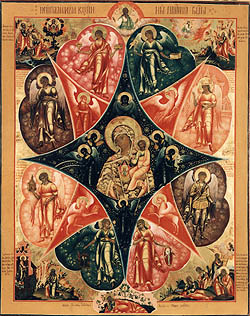
The Orthodox Church makes heavy use of typology, a method of exegesis that views older biblical events, places, and things as a foreshadow or prefiguration of later biblical events, places, and things.  There is an ancient teaching that the burning bush is a Type of the Virgin Mary and the Church.  The reasoning goes like this:

  1. God is referred to numerous times in the Bible as the Consuming Fire, e.g., Exodus 24:17, Deuteronomy 4:24, Deuteronomy 9:3, and Hebrews 12:29.
  2. Jesus and the Holy Spirit are both Fully God.
  3. The Burning Bush, despite the presence of the Lord, remained unconsumed.
  4. Mary, despite bearing Jesus in her womb, remained unconsumed.
  5. The Church, despite the indwelling of the Holy Spirit, also remains unconsumed.

 I must admit that I never noticed this relationship before, but coming across it and pondering it has really touched my heart.  Mary carried the All-Consuming fire in her womb, yet God condescended Himself enough so as not to consume her.  Mary is, in many ways, the Unburnt Bush (this is a title given to her in Orthodox Tradition).  Today, the Church has the All-Consuming fire living within it.  God condescends Himself enough to take up residence in our hearts, yet we, like Mary, remain unconsumed.  How glorious this is!

You showed Moses, O Christ God,
An image of your most pure Mother
In the bush that burned yet was not consumed,
For she herself was not consumed,
When she received in her womb the fire of divinity!
She remained incorrupt after her pure childbearing!
By her prayers, O greatly merciful One,
Deliver us from the flame of passions,
And preserve your people from all harm!
(Orthodox Kontakion Hymn)

Glory to Jesus Christ!

What Happens When the Church Is Married to Nationalism? Part 1

Post Author: Bill Pratt

One of the most important historical facts about the life of Dietrich Bonhoeffer was his reaction to the Nazi take-over of the Lutheran state church in Germany in the 1930’s.  Eric Metaxas, in his magnificent biography of Bonhoeffer, devotes an entire chapter to Nazi theology.  The program developed by the Nazis to coopt religion in Germany is of seminal importance to Christians today and in the future.

Metaxas starts by describing Hitler’s approach to Christianity:

One sometimes hears that Hitler was a Christian. He was certainly not, but neither was he openly anti-Christian, as most of his top lieutenants were. What helped him aggrandize power, he approved of, and what prevented it, he did not. He was utterly pragmatic. In public he often made comments that made him sound pro-church or pro-Christian, but there can be no question that he said these things cynically, for political gain. In private, he possessed an unblemished record of statements against Christianity and Christians.

According to Hitler, Christianity preached “meekness and flabbiness,” and this was simply not useful to the National Socialist ideology, which preached “ruthlessness and strength.” In time, he felt that the churches would change their ideology. He would see to it.

But Hitler’s lieutenants were far more anti-Christian than he was.  Metaxas traces the plans of Hitler’s henchmen:

Since Hitler had no religion other than himself, his opposition to Christianity and the church was less ideological than practical. That was not the case for many leaders of the Third Reich. Alfred Rosenberg, Martin Bormann, Heinrich Himmler, Reinhard Heydrich, and others were bitterly anti-Christian and were ideologically opposed to Christianity, and wanted to replace it with a religion of their own devising. Under their leadership, said Shirer, “the Nazi regime intended eventually to destroy Christianity in Germany, if it could, and substitute the old paganism of the early tribal Germanic gods and the new paganism of the Nazi extremists.”

Metaxas singles out Himmler as particularly hateful of Christianity:

Himmler was the head of the SS and was aggressively anti-Christian. Very early on, he barred clergy from serving in the SS. In 1935 he ordered every SS member to resign leadership in religious organizations. The next year he forbade SS musicians to participate in religious services, even out of uniform. Soon afterward he forbade SS members to attend church services. For Himmler, the SS was itself a religion, and its members, postulants in its priesthood. Many SS rituals were occultic in nature. Himmler was deeply involved in the occult and in astrology, and much of what the SS perpetrated in the death camps bore Himmler’s saurian stamp.

Heydrich, another of Hitler’s top officials, famously said, “Just you wait. You’ll see the day, ten years from now, when Adolf Hitler will occupy precisely the same position in Germany that Jesus Christ has now.”

Rosenberg, another important figure in the Nationalist Socialists, was tasked with putting together a thiry-point program for the future National Church of the Third Reich.  According to Metaxas, “Rosenberg’s plan is some of the clearest proof that exists of the Nazis’ ultimate plans for the churches.”  Below are some excerpts from that plan:

13. The National Church demands immediate cessation of the publishing and dissemination of the Bible in Germany. . . .     

14. The National Church declares that to it, and therefore to the German nation, it has been decided that the Fuehrer’s Mein Kampf is the greatest of all documents. It . . . not only contains the greatest but it embodies the purest and truest ethics for the present and future life of our nation. 

18. The National Church will clear away from its altars all crucifixes, Bibles and pictures of saints.     

19. On the altars there must be nothing but Mein Kampf (to the German nation and therefore to God the most sacred book) and to the left of the altar a sword.     

30. On the day of its foundation, the Christian Cross must be removed from all churches, cathedrals and chapels . . . and it must be superseded by the only unconquerable symbol, the swastika.

Those were the plans of the Nazis, but an interesting question to answer is, “How did the Lutheran church in Germany react to the attempted Nazification of their church?”  In part 2 of this post series, we will look at that question.

Should the Word of God Be Preached in Church?

Post Author: Bill Pratt

Well, yes, of course, but that’s not the view of all pastors who call themselves Christian.   I just finished Eric Metaxas’ brilliant biography of Dietrich Bonhoeffer, and I was struck by Bonhoeffer’s view of the liberal churches in Manhattan during the early 1930’s.  In a fascinating season of Bonhoeffer’s life, he visited New York City to study at Union Theological Seminary.  What he found at the liberal seminary and the liberal churches around the seminary profoundly shocked him.

During this period in America, the battle between the Christian fundamentalists and the liberals was in full swing, and Manhattan was the epicenter of the struggle.  As Bonhoeffer became familiar with the students at the staunchly liberal Union Theological Seminary, here is what he found:

There is no theology here. . . . They talk a blue streak without the slightest substantive foundation and with no evidence of any criteria. The students—on the average twenty-five to thirty years old—are completely clueless with respect to what dogmatics is really about. They are unfamiliar with even the most basic questions. They become intoxicated with liberal and humanistic phrases, laugh at the fundamentalists, and yet basically are not even up to their level.

If this was the condition of the seminary, the nearby churches were just as bad.  

Things are not much different in the church. The sermon has been reduced to parenthetical church remarks about newspaper events. As long as I’ve been here, I have heard only one sermon in which you could hear something like a genuine proclamation, . . .  One big question continually attracting my attention in view of these facts is whether one here really can still speak about Christianity, . . . There’s no sense to expect the fruits where the Word really is no longer being preached. But then what becomes of Christianity per se?

Bonhoeffer continues:

In New York they preach about virtually everything; only one thing is not addressed, or is addressed so rarely that I have as yet been unable to hear it, namely, the gospel of Jesus Christ, the cross, sin and forgiveness, death and life.

If the Word of God is not preached in a church, then what is?  In Manhattan during the 1930’s, here is what you could expect:

So what stands in place of the Christian message? An ethical and social idealism borne by a faith in progress that—who knows how—claims the right to call itself “Christian.” And in the place of the church as the congregation of believers in Christ there stands the church as a social corporation.

Sadly, there are still “churches” that are stuck in the liberal mode of the 1930’s.  Just as Dietrich Bonhoeffer was repulsed by these churches in the early twentieth century, so should we be in the early twenty-first century.

His words ring true.  What we need to hear from our pulpits is the “gospel of Jesus Christ, the cross, sin and forgiveness, death and life.”  My wife and I thank God that he led us to a church 14 years ago where our pastor, Dr. Rick Byrd, has consistently preached the Word of God, week in and week out.  If you cannot say the same about your pastor, it may be time for you to move on.  You are being starved of the bread of life.

How Should You Evaluate Someone’s Claims?

Post Author: Bill Pratt

In the internet world we live in, there are literally hundreds of millions of people making claims about every subject under the sun.  In the past, when the internet did not exist, there were far fewer voices making claims in a public fashion.  A person wanting to make public claims had to be published, get on the radio, get on TV, or make a movie.  None of these were easy to do, and so few people did.

Since there were far fewer voices before the internet age, we thought we could better ascertain their credentials to decide whether we could trust what they were saying.  Many of us assumed (incorrectly) that if somebody was published or was featured on a TV program, then what they said was most likely true.  After all, there had to be some kind of vetting process, right?  This was an easy way to evaluate their claims without doing any work.

Since there are now millions of people making their viewpoints publicly known, we can no longer be so lazy.  Since anyone can say anything, and expose it to everyone through the internet, we have to figure out how to evaluate whether someone’s claims are true, not based on the person making the claim, but based on their actual words.

So how do we go about doing this?  Brian Auten, at Apologetics 315, wrote a nice introduction to critical thinking called 15 Ways to Detect Nonsense.  Please take a look at his post and get started on the road to thinking critically.

What About Genocide in the Old Testament?

Post Author: Bill Pratt

I’ve mentioned Paul Copan’s book Is God a Moral Monster?: Making Sense of the Old Testament God before, but I ran across this video clip where historical Jesus scholar Mike Licona interviews Copan about alleged genocide in the Old Testament.  Copan summarizes some very key arguments from his book during this informative clip.

httpv://youtu.be/4lap_BdOJQo

What Kind of a Skeptic Are You?

Post Author: Bill Pratt

One of our goals with this blog, from the beginning, was to try to answer honest questions that people have about the Christian faith.  Why do I stress the word honest?  Because one of the first things you learn when you write a blog about ultimate issues (i.e., God, morality , meaning of life) is that many of the questions you get asked are not from people who are honestly seeking an answer.  Instead, these folks think they already know the answer and their goal is to merely make the post author look bad.

This makes running a blog like Tough Questions Answered challenging, because there are people who do have honest questions, and you don’t want to ignore them or let them get drowned out by the first group I mentioned.

I ran across a blog post recently, written by Barnabas Piper, that sheds some light on the difference between the honest questioner and the person who has already made up his mind.  Here is an extended quote from the post:

There’s a fine line . . . between being someone who questions things and being a skeptic. In fact, many people would call someone who questions everything a skeptic.  Here’s the thing; I don’t think many skeptics actually question anything.  They may phrase their challenges as questions, but their heart is set on rejection and disproving.  To truly question something is to pose questions to it and about it for the sake of understanding.  This may lead to disproving or rejecting, but the heart behind it is in learning. . . .  If the heart of the questioning is to learn, then ask away. 

I think he put his finger on it.  If the questioner is set on learning, then these are the people I want to spend the most time with.  I do not mind spending some time, also, with those who are dogmatically opposed to me, but I have to realize in those situations that the dialogue is an illusion – they are not trying to understand a thing I’m writing.

One commenter, Daron, said the following in reaction to Piper’s post:

It is very easy to spot the type of “Skeptic” being discussed. They gainsay everything they read on a Christian blog – usually the most picayune detail or lowest-hanging fruit – because no matter what they find to question, it justifies their predetermined rejection of belief.

I can relate to this comment.  Often I will write a blog post about topic X, but instead of responding to topic X, commenters will pick up on some detail in the blog post that has little to do with the central point and blast me for it.  Why?  I can honestly say I have never, to my recollection, gone to someone’s blog or website and made comments with the sole purpose of making them look bad.  It just seems like such a waste of time.

Let me end this post with a plea I’ve made before.  When you read our blog posts, or someone’s comments about a post, please try to understand what they are saying, and above all, be charitable!  Assume the author is well intended.  Give each other the benefit of the doubt, and all of our conversations will be so much more fruitful.  By the way, I am preaching to myself as much as anyone else; we all need to work on being more charitable toward each other.

Must We See to Believe?

Post Author: Bill Pratt

Thomas, the disciple of Jesus, is famous for the following statement: “Unless I see the nail marks in his hands and put my finger where the nails were, and put my hand into his side, I will not believe it.”

There have always been people like Thomas who demand that they directly experience something before they believe it exists.  During the Enlightenment in Europe, the philosophical theory of empiricism came to embody this principle for the modern world.

According to Garrett DeWeese, “the Enlightenment doctrine of empiricism holds that all knowledge of the world is empirical,” or all knowledge comes from our sensory experience.  The philosopher David Hume took this notion so far that he denied that we could know that our selves exist.

DeWeese continues:

Today the spectacular successes of the natural sciences have enshrined empirical investigation as by far the best – and for most people, the only – way to know.  But what about things we can’t sense?  Is nonempirical knowledge possible?  The question is crucial, for a great many important things can’t be known through our senses – things such as whether we have a soul and whether God exists.

If empiricism is true, then our knowledge becomes incredibly limited, and, in fact, the Romantics and German idealists that came after Hume and Kant were repelled by empiricism and rejected it as far too limiting of human knowledge.  Is empiricism true?

No.  Notice first that the claim “All knowledge of the world is empirical” is itself not an empirical statement.  How could we know that [claim] through our senses?  The claim is self-refuting.  But beyond that, there are good reasons to think that at least some knowledge of the world is nonempirical . . . .  Beliefs that certain things exist may be inferred from empirical observations.  This is how we justify belief in such things as electrons, gravitational fields, beauty, or love.  And similarly for belief in God.

DeWeese further explains:

We can know some things without using our senses at all.  For example, we can know much about ourselves through introspection (a nonempirical process).  We can know that we have minds that think, believe, hope, fear, and so on, and that we are not identical to our bodies.  Many ethicists claim that moral knowledge is accessible through intuition or conscience or pure reason.

Here is the bottom line.  Our senses serve us well, but they are limited.  We are more than our senses, and we can know more than what we directly experience with our senses.  Our lives would, in fact, be unlivable if we could only know what our senses directly bring to us. 

Unlivable?  Look at the words of David Hume, one of the most famous empiricists of modern history, speaking of his empiricist theories:

Most fortunately it happens, that since reason is incapable of dispelling these clouds, nature herself suffices to that purpose, and cures me of this philosophical melancholy and delirium. . . . I dine, I play a game of backgammon, I converse, and am merry with my friends; and when after three of four hours of amusement, I wou’d return to these speculations, they appear so cold, and strain’d, and ridiculous, that I cannot find in my heart to enter into them any farther.

Did Jesus Lie to His Brothers?

Post Author: Bill Pratt

Patti, a reader of Tough Questions Answered, asked the other day if Jesus lied to his brothers in John 7:8-10.  She claims that an atheist pointed these verses out to her.

So, what’s going on here?  Must we read these verses in John 7 as Jesus purposely deceiving his brothers?  First, let’s look at the passage in question, starting at John 7:1:

After this, Jesus went around in Galilee, purposely staying away from Judea because the Jews there were waiting to take his life. But when the Jewish Feast of Tabernacles was near, Jesus’ brothers said to him, “You ought to leave here and go to Judea, so that your disciples may see the miracles you do.  No one who wants to become a public figure acts in secret. Since you are doing these things, show yourself to the world.”  For even his own brothers did not believe in him.

In these verses, Jesus’ brothers are taunting him.  They are urging him to go to the Feast and perform public miracles instead of avoiding Judea, where the Feast would be held.  What was Jesus’ response to them?

Therefore Jesus told them, “The right time for me has not yet come; for you any time is right.   The world cannot hate you, but it hates me because I testify that what it does is evil. You go to the Feast. I am not yet going up to this Feast, because for me the right time has not yet come.”  Having said this, he stayed in Galilee.

Jesus tells his brothers twice that “the right time has not yet come.”  He tells them to go to the Feast without him.  What does Jesus do next?

However, after his brothers had left for the Feast, he went also, not publicly, but in secret.  Now at the Feast the Jews were watching for him and asking, “Where is that man?”  Among the crowds there was widespread whispering about him. Some said, “He is a good man.”  Others replied, “No, he deceives the people.”  But no one would say anything publicly about him for fear of the Jews.  

Here is where the alleged deception occurs.  In verse 10, Jesus goes to the Feast after all, but in secret.  Did Jesus ever publicly reveal himself at the Feast or did he remain at the Feast in secret?

Not until halfway through the Feast did Jesus go up to the temple courts and begin to teach.  The Jews were amazed and asked, “How did this man get such learning without having studied?”

Jesus chose to publicly reveal himself halfway through the Feast, or about the fourth day.  So, did he purposely try to deceive his brothers?  I think not.

As is clear from the context of the passage, Jesus’ brothers were encouraging him to make a public spectacle of himself at the beginning of the Feast. 

Jesus tells them, simply, that his timing for a public appearance at the Feast is not their timing.  He arrives at the Feast in secret and he does not appear publicly until halfway through the Feast.  Verse 14 pointedly refers to Jesus’ timing, a piece of information that would seem irrelevant if we did not know about Jesus’ conversation with his brothers.

There is simply no deception going on here.  If Jesus were lying to his brothers, and did not want them to know he was going to the Feast, then why did he appear publicly in the middle of the Feast, where he could be sure his brothers would see and hear him preaching?  That scenario does not make sense.

The straightforward reading of this text indicates that the author (John) is trying to contrast Jesus’ timing with his brothers’ taunting.  In order to show that Jesus lied, one has to prove that Jesus told his brothers that he was not going to the Feast at all, and that interpretation of these verses is highly implausible.

A Christian Apologetics Blog