Commentary on Exodus 2 (Birth of Moses)

Post Author: Bill Pratt 

After Pharaoh’s previous failures, he tries yet another approach to break the will of the Hebrews. In verse 22 of chapter 1, he decrees that every male child of the Hebrews must be thrown into the Nile River.

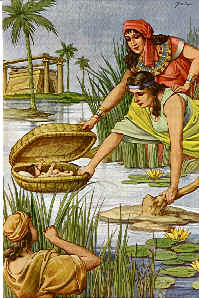
One boy, however, is not immediately thrown into the Nile, but is hidden by his parents. We know that these Hebrew parents are descended from Levi, one of Jacob’s twelve sons. Once the boy is old enough so that he can no longer be hidden (3 months), his mother places him in a papyrus basket and sets him among some reeds along the edge of the Nile. The boy’s older sister (we learn her name is Miriam from Ex 15:20) is told to watch what happens to him.

None other than Pharaoh’s own daughter spots the basket and discovers that it contains a Hebrew infant. The baby’s sister, having watched this play out, then offers assistance to the Pharaoh’s daughter. The baby’s own mother is paid by Pharaoh’s daughter to nurse the child! After he is done nursing (somewhere between 2 and 5 years later), the boy is returned to the Pharaoh’s daughter, and she names the child Moses.

There is great irony in this narrative because Moses’s mother places Moses in the Nile River, just as Pharaoh decreed, and Moses is rescued from the Nile by Pharaoh’s own daughter. No matter what Pharaoh plans, he is always thwarted by God. God is in control of events, not Pharaoh.

Starting in verse 11, the remainder of Exodus 2 records several significant events in Moses’ life.  Acts 7:22 claims that “Moses was instructed in all the wisdom of the Egyptians and was powerful in his words and deeds,” but his peaceful and privileged upbringing would soon come to a tumultuous end.

In verses 11-14, we learn that Moses killed an Egyptian who was beating a fellow Hebrew. According to Acts 7:23, this happened when Moses was approaching 40 years old. There is definite foreshadowing here, as Moses will deliver Israel from oppression just as he delivered the Hebrew from being beaten. Moses subsequently learns that his crime has been discovered and Pharaoh attempts to kill him for it.

In order to save his life, Moses flees Egypt to a place called Midian. He comes to the aid of some women at a well, and the father of these women invites Moses to marry into his family, taking his daughter Zipporah as a wife. Moses and Zipporah have a son and name him Gershom, which means “I have become an alien in a foreign land.”

According to John Hannah in The Bible Knowledge Commentary, “For 40 years (Acts 7:30) Moses undertook the toilsome life of a sheepherder in the Sinai area, thus gaining valuable knowledge of the topography of the Sinai Peninsula which later was helpful as he led the Israelites in that wilderness land.”

Verses 23-25 remind the reader that many years pass and the Pharaoh who tried to kill Moses dies. More significantly, “God heard their groaning and he remembered his covenant with Abraham, with Isaac and with Jacob.” God will not forget his promises to the Patriarchs.

Did God Reward the Midwives for Lying?

Post Author: Bill Pratt 

Shiphrah and Puah did indeed lie to Pharaoh about the Hebrew women giving birth quicker than the Egyptian women. Doesn’t the Bible expressly condemn lying? Yes, it does in several places. So what are we to make of these verses in Exodus 1? How is it that God rewarded the midwives for lying to Pharaoh?

One approach is to say that God rewarded the midwives for not killing the Hebrew boys, but that he did not approve of their lying to Pharaoh about it. In this way, God did not reward them for a lie and there is no longer a problem.

This solution, however, does not seem to take the text seriously. The lie to Pharaoh appears to be integral to the saving of the boys’ lives. There would be no reason for the author to include the lie if it wasn’t necessary to save those newborns. Nowhere in the following verses does God disapprove of the lie. In fact, the text clearly states that the midwives were rewarded by God.

The conclusion seems to be that God rewarded the midwives for disobeying Pharaoh and lying to Pharaoh. But, the disobedience and lying were only approved because they were saving innocent human lives. That is the key. Lying is wrong in most circumstances, but when innocent human lives were at stake, the midwives chose the higher good and God approved. God always wants us to choose the higher good when moral commands conflict.

Commentary on Exodus 1 (The Israelites Oppressed)

Post Author: Bill Pratt 

Verses 1-5 remind the reader that 70 people came down to settle in Goshen, which is a district of Egypt situated in the northeast corner of the nation. The twelve sons of Jacob (Israel) are listed and grouped according to their birth mothers. The numbering of 70 is a reference back to Gen 46:27 where all of the descendants of Jacob who entered Egypt are named.

In verses 6-7, we learn that after Joseph and all his brothers died, the Israelites experienced tremendous population growth. Note the similarity between Gen 1:28 and Ex 1:7. God had commanded Adam and Eve to be fruitful and multiply, and that is exactly what the Israelites have done.

Goshen was a land of great natural resources that allowed the Israelites to settle down and practice agriculture instead of being primarily nomadic, as their ancestors were. The stable food supply undoubtedly contributed greatly to their prosperity. Things were going so well for the Israelites, they had forgotten that they were strangers in a strange land. Their home was to be in Canaan, not Egypt.

Although the Israelites had lived in Goshen for hundreds of years, their life in Egypt was about to be massively disrupted.  Egypt, like any other nation, experienced political turmoil and changes in governance. The writer of Exodus announces that a new king (Pharaoh) came to power, and this king, evidently, either knew nothing or cared nothing about Joseph’s role in Egyptian history.

Some historians have speculated that the new king knew about Joseph, but because the king was bringing a new regime into power that was very different ethnically (non-Semitic) from the previous regimes, he no longer trusted the Hebrews (who were Semitic) to align themselves with his regime’s interests. Since Goshen bordered Canaan, where Egypt’s enemies were located, the Israelites could easily ally themselves with Canaanite nations who wanted an easy path into the heart of Egypt.

The new Pharaoh’s first plan to deal with the Israelites was to enslave them. They would be forced to build the store cities of Pithom and Rameses. However, contrary to his plans, the Israelites continued to increase in number. The clear message here is that the Gentile king of Egypt cannot thwart God’s plans for his people. The Pharaoh’s plans simply backfire on him.

Starting in verse 15, Pharaoh tries plan B to stop the multiplication of the Israelites. He calls two of the Hebrew midwives to him (they were probably leaders or representatives of a much larger number of midwives), and commands them to kill the boy babies when they are born. The midwives, Shiphrah and Puah, however, decline to obey Pharaoh, and let the boys live.

The reason given for the midwives disobeying Pharaoh is that they “feared God.” The message to the reader is that when a person in authority over us gives us a direct command that contradicts God’s unmistakable will, we are to disobey.

The midwives, when questioned by Pharaoh, tell him that Hebrew women give birth more quickly than Egyptian women, and so the midwives arrive too late to kill the baby boys. In the context of the narrative, the midwives are obviously lying to Pharaoh, but they are lying to save lives.

It is reasonable to assume that Pharaoh is counting on the midwives to surreptitiously kill the newborns without the mothers realizing what is going on. The plan counts on the skills and obedience of the midwives to carry it out. If the Hebrew mothers catch on, they will simply avoid using the midwives.

If Shiphrah and Puah refused to go along, it is reasonable to assume that Pharaoh would find other midwives to kill the Hebrew boys. By convincing Pharaoh that the plan simply won’t work because of how quickly Hebrew women gave birth, Pharoah abandoned the plan altogether instead of drafting more midwives.

Pharaoh’s plan B, to control the Israelites, backfires on him, just as his first plan did. The Israelites “became even more numerous” and because the midwives feared God and saved the lives of the baby boys, the midwives were also rewarded with families of their own.

Why Do We Need a Sunday School Reformation? Part 3

Post Author: Bill Pratt 

In part 2, we looked at how we might teach the contents of the Bible in a systematic way by looking at how colleges and universities teach their students. But there are specialized schools that teach the Bible, seminaries.

How do seminaries teach the Bible to their students? When I was attending Southern Evangelical Seminary, we took four classes that covered the entire Bible: two Old Testament classes and two New Testament classes.

These classes moved systematically through each book of the Bible, covering authorship, theological themes, major actors, major events, dating of the events, and literary structure. Now, the books in the Bible, as they are currently arranged, are not all in chronological order, but my seminary professors made sure we understood how all of the books chronologically fit together.

Do any of the Sunday school curricula that are commonly offered in churches use this concept of moving chronologically through the historical narratives of the Bible? None that I’ve ever seen. Instead, what is most often used is a topical curriculum.

A topical curriculum is structured around singular doctrines or applications of the contents of the Bible. For example, there may be a series of lessons on how to apply the Bible’s teachings to the issue of human sexuality. The curriculum will jump around the Bible, picking verses here and there that talk about sexuality.

Or maybe there will be a series on a single doctrine, such as atonement for sins. In this case, the curriculum will, again, jump around the entire Bible, highlighting verses that talk about the atonement.

These topical curricula are not systematic. They are not chronological. They leave the SSG members without a grounding in the overarching historical narrative of the Bible.

Imagine studying the events of World War II. Instead of moving chronologically through the events of WWII, what if the curriculum started with a series of lessons on the bravery of the men who attacked the Axis powers around the world? And then moved to a series on the resistance movements that formed in all the different countries occupied by Japan and Germany. And then moved to a series on how to apply the efficiency of American artillery factories to your own factory or business. And so forth and so forth.

Would each of these lessons be interesting, in and of themselves? Sure. We could learn something from each of these lesson series. But here is the key question: after these lessons, how well would we understand why WWII started in the first place, who the major players were during the war, how events unfolded once the war started, what the major battles were during the war, and how the war was brought to an end?

We might know bits and pieces about the overarching history of WWII, but we certainly would not be experts on WWII. We couldn’t teach others about WWII. We couldn’t explain the reasons WWII happened. We couldn’t explain the major players in the war. We would have a bunch of disjointed facts about the war, and that’s all. In no way would any college, university, or school agree that we had been taught WWII adequately. We would flunk any exam we were given on the facts of WWII.

Now let me be clear. Are topical curricula necessarily bad? No. If your SSG members are well grounded in the historical narrative of the entire Bible, then topical curricula can be wonderful, because now you’re building on a firm foundation of biblical knowledge. But before that foundation is there, the topical curriculum is ineffective.

But this is where we are with SSG members. They know disjointed bits and pieces about the Bible, but most of them (youth and adults) have no idea how it all connects. They don’t know the major components of the overarching biblical narrative. They don’t know the Word of God. We need a reformation because our students are flunking their exams.

Why Do We Need a Sunday School Reformation? Part 2

Post Author: Bill Pratt 

In part 1, I argued that the primary purpose of Sunday school, or Sunday small groups (SSG’s), is for the group members to learn, in a systematic and thorough manner, the contents of the Bible. If you’re with me so far, then it’s time to explain why I think so many churches are failing to fulfill this purpose.

Curriculum. By curriculum, I mean the lessons that are given to the SSG members each week, 52 weeks a year. The curriculum outlines what the SSG will study over the church year (in the long term) or church quarter (in the short term), it provides teaching aids to the teachers, and it either provides or directs the members to material that should be read ahead of time in preparation for each week’s lesson.

So what is wrong with the majority of curricula that I have taught and used over the last decade as a SSG teacher and leader? There is not a systematic approach to teaching through the contents of the Bible.

How might a curriculum provide this systematic approach? For the answer to this question, we need to look at how schools, colleges, and universities teach any subject. For any subject, be it math, science, or social studies, the curriculum is designed to start with a logical beginning point, build from that beginning week after week so that each lesson builds on the previous, and eventually end when the subject has been covered in its entirety.

If we think about what the Bible is, it consists of 66 separate pieces of literature, with each piece of literature building upon the other. In fact, many of the books of the Bible are historical narratives, which means that they are recounting historical events. Each of these narratives builds upon the narratives that preceded. The historical narratives start in the Book of Genesis and flow all the way through the Book of Revelation.

Yes, the Bible also contains poetry, wisdom literature, and personal letters. But all of these other literary genres hang on the structure of the historical narratives. In other words, without the narratives, the other literature loses much of its meaning and context.

So how is historical narrative studied in high schools, colleges, and universities?

Chronologically. The lessons are arranged in the order in which events occurred. If we are studying World War II, we start with the years leading up to the beginning of the war in the 1930’s, and we end with the treaties that were signed to officially end the war in 1945. For the Bible, you would start with Genesis, as those events occurred first, and you would end with Revelation because those events will occur last.

In part 3, we will continue to look at SSG curricula.

Why Do We Need a Sunday School Reformation? Part 1

Post Author: Bill Pratt 

After teaching both adult and youth Sunday school classes for over a decade, I have determined that we need a Sunday school reformation. If the primary purpose of Sunday morning small groups (SSG’s) is to educate church members on the contents of the Bible, the Word of God, then we are failing badly. This is not just a criticism of my own church, because we are just one of thousands of churches all around the world that are not fulfilling the purpose of SSG’s.

Let me stop here, because some of you are already disagreeing with me. You deny that the primary purpose of SSG’s is to learn the contents of the Word of God. You believe that the primary purpose is evangelism, or building community, or even prayer. While I agree that these are important secondary purposes of SSG’s, they cannot be the primary purposes. Why?

There is no point in evangelism if we don’t know what we are supposed to evangelize. The contents of our evangelism comes from the Bible. It makes no sense to carry a message to the lost when we aren’t too clear on what that message is. We can only get clear through studying the Bible.

What about building community? A community is only as strong as what it is based upon. A church community must be built on the doctrines and teachings of that church. The doctrines and teachings of a Christian church come, first and foremost, from the Bible. Therefore, there can be no meaningful church community if the community doesn’t know what the Bible teaches. The liberal Christian churches have tried to build community on anything but the Bible, and their numbers have been in precipitous decline.

What about prayer? Well, prayer is pretty ineffective if we don’t know who we are praying to. God is known, most fully, through His Word. If we don’t know his Word, then our knowledge of the one to whom we pray is shallow. Shouldn’t we know a lot about the person to whom we direct all of our prayers? Prayer is also ineffective if we don’t know what God wants us to pray about. The Bible tells us exactly what God wants from our prayer life, so our knowledge of the Bible reflects directly on our prayers.

So here is where we are so far. Although community, evangelism, prayer, and possibly other things are important for SSG’s, those secondary purposes can never be successful without first taking care of the number one purpose for SSG’s: learning the contents of the Word of God, the Bible.

This point is worth repeating. If your goal through your SSG’s is to build community among your church members, you will fail unless you make sure that your members are learning the Bible in a systematic and thorough manner. There are no shortcuts. There is no way to get around this fact. The strongest communities are built around common language, common stories, common knowledge.

In part 2, I will talk about why we are failing to teach our church members the contents of the Bible in a systematic and thorough manner.

The Comfy Cocoon of Knowing You’re Right

Post Author: Bill Pratt
Imagine a man named Charles. Charles is dogmatic about his beliefs concerning the origin of the universe, the existence of God, right and wrong. Charles is an evangelist who loves telling people about his beliefs. He writes a lot of blog posts and sometimes he comments on other people’s blog posts. Whenever he gets an opportunity to explain to people why his views are correct, he jumps at it.
Charles converted to his views as an adult after spending many years on the other side. He has an inside view of the other side and knows all of their weaknesses. He feels sorry for those still on the other side, as he knows they are wrong about reality, wrong about the big questions of life.

Charles has surrounded himself with those who think like him. He congregates with them, buys books written by them, votes like they vote. Charles has found a community that affirms what he believes.

Charles no longer feels a need to consider the evidence the other side provides for their viewpoint. He looked at it briefly in the past, but it is so obviously wrong that he didn’t have to spend much time before he moved on to other things. Now, when he interacts with the other side, he just does so to shake them out of their ignorance. He knows their arguments are weak, so he doesn’t really pay much attention to them.

Charles, more recently, has grown less patient with the other side and has started calling them names and insulting them, mostly anonymously or through social media. He just wishes they would snap out of their uninformed beliefs. When he encounters the other side these days, he sees them as the enemy. They represent what is wrong with the world.

Charles doesn’t feel too bad any more when people on the other side are demonized or mocked by his friends. I guess he’s just used to it. The other side is, after all, irrational and deluded.

Charles now lives in a very comfortable cocoon, a safe place he has constructed for himself. He knows he is right. He knows his friends are right. He knows the other side is evil, deluded, even hateful. If the other side would just go away, the world would be so much better off. In the mean time, though, the cocoon is pretty nice.

He is protected from having to actually think about the other side most of the time. What’s the point? He already thought about it a while back. No need to dig it all up again. No need to leave the cocoon.

Do the Genealogies Allow Us to Date the Events of Genesis 1-11?

Post Author: Bill Pratt 

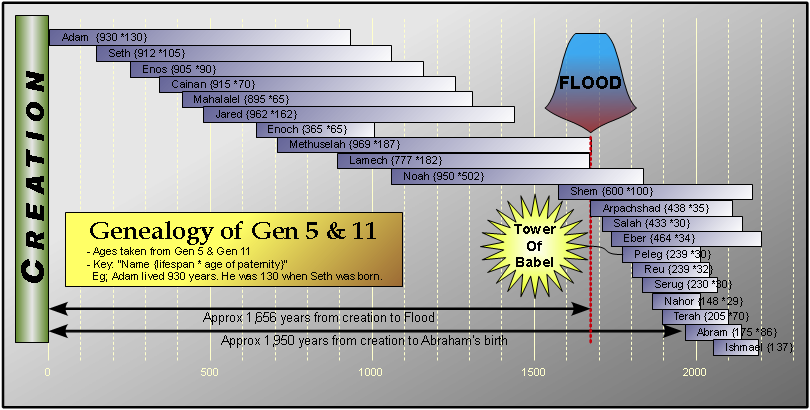
A few Christians have mistakenly supposed that they can use the genealogies in Genesis 5-11 to add up the number of years between Adam and Abraham.  By doing this math, they surmise that the world was created somewhere around 4000 BC.

Hebrew scholars, however, have pointed out that the genealogies are not meant to give exact lineages, such as one might find on ancestor.com.  They often would skip many generations, as they were focused on particular ancestors for particular reasons.

We know that the biblical authors did this.  For example, Matthew’s genealogy of Jesus consists in three sets of 14 generations.  The number 14 was important because 7 was thought to symbolize completion or perfection.  But we know that when Matthew says that “Joram fathered Uzziah,” he omits three generations (see 2 Ch 21:4-26:33) so as to accomplish the desired pattern of 14.  In Hebrew, to say someone “fathered” someone else can also mean that they are an ancestor or forefather of that person.  It does not always mean that they are the parent of the person.

The bottom line is that one has to be very careful with interpreting genealogies in the Bible.  They cannot be used to precisely date any event without other corroborating data.

Why Is There Human Pain and Suffering?

Post Author: Bill Pratt 

Why is there so much pain and suffering in the world?  Some people blame God, or they claim that because there is so much pain and suffering, God must not exist.  The Bible, however, disagrees.

Genesis 3 makes it clear that mankind was to live in perfect peace in paradise on earth.  It was the disobedience of Adam and Eve, the representatives of the human race, which introduced pain and suffering.  Without their sinful act, the world would still be paradise.

It is not God’s fault that humans suffer.  He gave our ancestors a clear choice and they chose poorly.

Who Made God? (Again)

Post Author: Bill Pratt 

If God created everything, then who created God?

The Christian answer to this question is that nobody created God because He is the one self-existent, uncaused, uncreated, eternal Being. Only things that come into existence need a cause, but God never came into existence. He has always existed and will always exist.

It is impossible for God not to exist.  While the universe and everything in it came into existence, and therefore all need a cause, God is the only Being that exists necessarily and eternally.

To ask a Christian who made God, then, is to ask who made the un-made or who created the un-created. It’s a nonsense question.

A Christian Apologetics Blog