How Many Israelites Left Egypt? Part 1

Post Author: Bill Pratt 

In Exodus 12:37, the NIV translation of the Bible says, referring to the Israelites leaving Egypt during the Exodus, “There were about six hundred thousand men on foot, besides women and children.” What has puzzled Bible scholars and archaeologists about this number is that it seems far too large. If we add the women and children, we are looking at over 2 million Israelites. Estimates of the total world population at that time are between 25 and 100 million people, and the Israelites are referred to, in the Bible, as small in numbers compared to other people groups in the ancient near east.

Now, it is not impossible that there were literally 2 million Israelites that left Egypt, but there are other ideas about how to translate Exodus 12:37. Biblical scholar Douglas Stuart offers a persuasive alternative explanation in his Exodus: An Exegetical and Theological Exposition of Holy Scripture (New American Commentary). According to Stuart,

The Hebrew of the Exod 12:37 says literally, “The Israelites traveled from Rameses to Succoth, about six hundred ‘elephs of foot-soldiers, besides women and children.” The NIV translation, like most English translations, contains two arguable assumptions on the part of the translators: that ʾeleph should be translated “thousand,” and that raḡlı̂ in the expression raḡlı̂ haggĕbārı̂m should be translated “men.” Both of these assumptions are, in our opinion, incorrect.

The second, which assumes that raḡlı̂ can mean “men,” is not supportable in any Old Testament context. Some lexicons go so far as to suggest that the term in the singular might mean a “man on foot,” but none could rightly suggest that it means simply “man.” In the grammar of the verse, the addition of the appositional noun haggĕbārı̂m (lit., “[the] young men”) simply clarifies the age of the man/men in question. Since raḡlı̂ always occurs in contexts describing soldiers, including the present context (note the wording “all the LORD’s divisions” in v. 41), and differs from any of the usual terms for “man” or “men,” there really can be little doubt that it should be rendered “foot soldier” or, as some do, “infantryman” wherever it occurs in the Old Testament. The full expression raḡlı̂ haggĕbārı̂m, then, means “young foot soldiers.”

Stuart’s first argument is that the NIV has mistranslated the text as “men on foot” when it should say “foot soldier” or “infantryman.” This is important because the Hebrew text seems to be counting the size of the Hebrew army, not the total population. But we are still left with how to translate the word ‘eleph.

Because the question of the meaning of ʾeleph, however, is so much greater an issue for people as it relates to the accuracy of the Scripture and the proper interpretation of various stories involving the Israelite exodus and conquest of Canaan, the discussion of this term requires a far more extensive review. The reader should bear in mind, however, that Moses did not refer to six hundred ʾelephs of “men” who left Egypt but to six hundred ʾelephs of foot soldiers. He was counting God’s army, not all the people of Israel . . . .

With this in mind, Stuart now takes up the challenge of translating the word ‘eleph. We’ll look at that in part 2.
Did God Harden Pharaoh’s Heart Against His Will?

Post Author: Bill Pratt 

In verse 21 of Exodus 4, God tells Moses, “When you return to Egypt, see that you perform before Pharaoh all the wonders I have given you the power to do. But I will harden his heart so that he will not let the people go.” This raises the question: how can God blame Pharaoh for his stubbornness if God is the one making Pharaoh stubborn?

The answer lies in the rest of the Book of Exodus. Nine times the hardening of Pharaoh’s heart is ascribed to God (4:21; 7:3; 9:12; 10:1, 20, 27; 11:10; 14:4, 8). Another nine times the hardening of Pharaoh’s heart is blamed on Pharaoh himself (7:13-14, 22; 8:15, 19, 32; 9:7, 34-35). In addition, Pharaoh alone hardens his heart during the first five plagues, and it is not until the sixth plague that God confirms Pharaoh’s choice to be stubborn.

The Bible, therefore, teaches that Pharaoh is responsible for hardening his own heart and that God is confirming what Pharaoh wants to do. It is not the case that God is forcing Pharaoh to be stubborn when Pharaoh really wants to be agreeable and compliant with Moses’ demands. There is no evidence for this in the text.

Commentary on Exodus 5 (Bricks Without Straw)

Post Author: Bill Pratt 

After successfully convincing their fellow Israelites that the God of their ancestors had sent them, Moses and Aaron boldly approach Pharaoh and request that he let them go to the desert to worship. Pharaoh’s response frames the events that will take place in chapters 7 through 12 of Exodus.

Pharaoh’s response is, “Who is the LORD, that I should obey him and let Israel go? I do not know the LORD and I will not let Israel go.” The purpose of the 10 plagues that will follow is to demonstrate to Pharaoh, the people of Egypt, and the reader, who the God of Israel is.

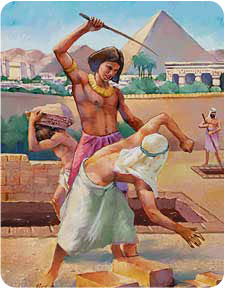
Not only does Pharaoh reject their request, he acts to further punish the Israelites and turn them against Moses and Aaron. In verses 4-11, Pharaoh accuses Moses and Aaron of distracting the Israelites from their work, that of making bricks for Egyptian construction projects (see this link for more detail on brick-making).

Typically, when bricks were made, the Egyptians would supply the Israelite laborers with straw to mix with clay in order to mold the bricks. Instead, the Israelites would now be expected to gather their own straw to make the bricks, and the number of bricks they would have to make would not decrease, but stay the same.

In verses 12-14, the Israelites fail to make the required number of bricks, and the Israelite foremen are beaten. Disillusioned with the impossible task they’ve been given, the foremen go before Pharaoh to complain about their plight. Pharaoh, showing no mercy, responds, “Lazy, that’s what you are—lazy! That is why you keep saying, ‘Let us go and sacrifice to the LORD.’ Now get to work. You will not be given any straw, yet you must produce your full quota of bricks.”

The foremen now realize that Pharaoh is punishing them because of Moses and Aaron, so in verses 20-21 they confront the two men and ask that God judge them for inciting Pharaoh. What a turn of events! A short time earlier, the leaders of Israel were receiving Moses and Aaron with joy, and now they are cursing them. The fickleness of Israel toward God’s prophets will be a central theme of the Bible all the way up through the deaths of Jesus and his apostles.

Moses then questions God, saying, “O Lord, why have you brought trouble upon this people?” God, however, in chapter 6, verse 1, reassures Moses. He explains, “Now you will see what I will do to Pharaoh: Because of my mighty hand he will let them go; because of my mighty hand he will drive them out of his country.”

The focus, again, is put back on God. Moses and Aaron can do nothing for the Israelites, on their own. Only God, acting on behalf of Israel, can effect their release from bondage. Pharaoh has thrown down the gauntlet, so to speak. He has refused to even allow the Israelites to worship God for a measly three days. He has questioned the very existence of the God of Israel. In the following chapters, God will make himself known to Pharaoh and to all the people of Egypt.

Commentary on Exodus 4 (Moses Returns to Egypt)

Post Author: Bill Pratt 

Chapter 4 of Exodus can be split into 3 sections: Miraculous Signs for Moses, Moses’ Return to Egypt, and the Reunion of Moses and Aaron.
The first section (Miraculous Signs for Moses) starts at verse 1 and goes through verse 17. In verse 1, Moses expresses, for the third time, his reluctance to go back to Egypt. Moses asks, “What if they do not believe me or listen to me and say, ‘The LORD did not appear to you’?”

God then provides three miraculous signs that are to be given to the Israelites to prove that Moses is a true messenger from God. First, his shepherd’s staff would turn into a serpent and then back into a staff. Second, Moses’ hand would become leprous, and then return to normal. Third, water from the Nile would be transformed into blood.

Each of these miracles were meaningful to the Israelites. The staff/serpent miracle represented God’s power over Pharaoh, as Pharaoh was represented by a serpent. The leprous hand miracle symbolized God saving Israel from their suffering. The Nile River-becoming-blood miracle indicated God’s power over all of the Egyptian gods.

Even after these assurances, though, Moses still protested, this time saying that he was not eloquent of speech. God reminds Moses that He is the creator of the human mouth and that He will teach Moses what to say, but Moses continues to protest, angering God.

Because Moses refuses to speak for Him to Pharaoh and the Israelites, God suggests that Moses take along his brother, Aaron, to speak for Moses. This situation is illustrative of what happens when a child of God refuses to do what God wants done. Instead of God being thwarted, He simply brings in another person to complete the tasks. Man’s refusal to obey God does not prevent God’s plans from being accomplished.

The second section of Exodus 4 takes place in verses 18-26. God tells Moses in verse 19 that it is safe for him to return to Egypt because all of the people who wanted him for murder are dead. Moses then starts back toward Egypt with his wife and two sons, Gershom and Eliezer.

In verses 21-23, God tells Moses what to say to Pharaoh. God also tells him how Pharaoh will react to his words, and what the consequences of his reaction will be. After Moses shows the miraculous signs to Pharaoh, his heart will be hardened. In other words, Pharaoh will become more and more stubborn and refuse to give in to Moses’s requests. God warns Moses that Pharaoh’s stubbornness will eventually lead to Pharaoh losing his firstborn son.

In verses 24-26, there is a brief episode where Moses’s wife, Zipporah, circumcises their son in order to save his life. Even though the NIV translates verse 24 as Moses being the one God would kill, there is reason to believe from the Hebrew text that it was his son that would be killed. These verses remind us that God will hold his people accountable for obeying him. Moses, as the future leader of Israel, was disobeying a clear command from God to have his sons circumcised. Fortunately his wife acted quickly to resolve the crisis.

In the third section of chapter 4, Moses and Aaron reunite and together go back to Egypt to meet with the elders of the Israelites. Aaron tells the elders everything God commanded Moses to say, and he performs the miraculous signs that would prove they were true messengers of God. The Israelites were convinced and bowed down to worship God.

Is Your Church Open-Minded?

Post Author: Bill Pratt 

Recently my wife and I were in Charleston, SC on a weekend getaway. If you’ve never been to Charleston, it is famous for its horse-drawn carriage rides around the historic downtown area of the city. We took one of these carriage rides and had a great time listening to our guide as we meandered through the sights of Charleston.

One thing the guide said to us, though, provoked me. He was commenting on the various churches in the city, and he mentioned that he preferred the more open-minded churches in the city and he recommended a couple of them to us if we wanted to attend a service Sunday morning.

My wife also caught his comments and we started talking later about what he meant. Given our extended conversations with him, it became clear that he was referring to the liberal Episcopal churches in Charleston as more open-minded, and the conservative Baptist churches as, well, not.

What I found interesting is that the guide assumed that a person’s first criterion for choosing a church is that it should be open-minded. That strikes me as so odd. My first criterion for choosing a church is the following: Are they teaching the truth about God? 

G. K. Chesterton once said, “Merely having an open mind is nothing. The object of opening the mind, as of opening the mouth, is to shut it again on something solid.” I am far more concerned with knowing what a church has shut its mind on than what it has opened it to.

Churches are supposed to teach us about ultimate reality, about God himself. They are supposed to addressed the most serious questions that human beings face in this life and the next. What churches teach have a tremendous impact on our morality, wisdom, and final destinies.

So why in the world would I want to attend a church that is open-minded about all those things? I want answers. I want the truth because I want my life to conform to the way the world really is. An open-minded church is a church that is failing to serve its congregation.

Is your church open-minded about God, sin, the afterlife, morality, and justice? If so, then get out of there as quick as you can. You have chosen badly.

What Is the Human Species?

Post Author: Bill Pratt 

What is the essence of being human? What makes a human a human? What is the human species?

Philosopher David Oderberg argues that the true essence of being human is captured in two words: rational animal. This is, of course, the classical definition of the human species given to us by Aristotle, but Oderberg thinks it is still the best definition.

There is little disagreement on what an animal is, but what about rationality? Oderberg offers a succinct analysis of what it means to be rational, and therefore what it means to be human:

Being rational, the rational animal has the capacity for such things as: abstract thought, that is, the ability to abstract from particulars to reach general judgments involving concepts; language; knowledge of why it does many of the things it does, what Aristotelians call knowledge of finality; the conscious ordering of ends or objectives; development of and adherence to a life plan; reflection, meditation, puzzlement over, attempts to understand and resolve, matters concerning its own life, the lives of others (be they rational or not), the state of the world, the connections between things and events; and a moral life, with all that is entailed by a grasp of morality as a system of norms for living. We can easily add to the list, of course: humor, irony, aesthetic sensibility, the creation and maintenance of families and political societies . . . we all know the sorts of things we rational animals are capable of.

Oderberg zooms in further to be clear about what rationality entails:

All I claim here is that rationality as the capacity for abstract conceptual thought is explanatorily basic relative to a large number of the sorts of characteristic listed here. Language is the most important case in point.

Abstraction from particulars and ascent to the level of conceptual thought necessarily involves some kind of representational system because it essentially involves the composition and division of concepts: mental elements are put together or divided in order to make judgments, and judgments are put together to make inferences. The elements have to have some kind of meaningful structure, by which I mean a structure involving at least the basic operations of reference, predication, logical operation, and the like, put together in a certain way, such that other ways of combination are excluded. A creature that can do all of this must have language; in fact, language is what I have just described.

And this is what has fascinated every thinking person since the dawn of mankind. Of all the millions of animal species, why is there only one that is rational? Why did human beings win the rationality lottery, going away? Why was there only one winner instead of dozens or even hundreds or thousands? Of course, this question is answered in the first chapter of the first book of the Bible. Check it out if you haven’t read it recently.

What Is the Difference Between LORD and Lord?

Post Author: Bill Pratt 

In Exodus 3, we see God called “I am” and also “LORD.” Both names are derived from the same Hebrew verb. “LORD” is reused more than 5,000 times in the Old Testament (OT), but “I am” is never used again in the OT.

When the word “LORD” (all caps) is used in the OT, it is a translation of the Hebrew word YHWH (“Yahweh”) that means “he who is present” or “he who is.” The word “Jehovah” is another translation into English of “Yahweh.”

Jewish readers substitute the word Adonai (“Lord”) when they come upon the divine name of God. All of these different names are referring to the same God of Abraham, Isaac, and Jacob.

Did the Israelites Steal from the Egyptians?

Post Author: Bill Pratt 

Some Bible critics claim that God commands the Israelites to steal (plunder) from the Egyptians in verse 22 in Exodus 3. How could God command theft?

The context around verse 22, however, makes it clear that the Israelites were to ask the Egyptians for valuable items that they could take with them into the desert. The Egyptians were paying back the Israelites for the mistreatment they endured.

It is certainly lawful for someone to be repaid for crimes committed against them, and this is exactly what happened when the Egyptians willfully gave their possessions to the departing Israelites.  They certainly did not steal from them.

Commentary on Exodus 3 (Moses and the Burning Bush)

Post Author: Bill Pratt 

Chapter 3 of Exodus recounts one of the most famous passages in all of Scripture, the story of Moses and the Burning Bush. Moses is tending his father-in-law’s flocks near a mountain called Horeb. Some scholars believe that this mountain is identical with Mount Sinai, where Moses would later receive the Ten Commandments.

At the mountain, Moses sees the angel of the Lord appearing as flames burning in a bush, but the bush is not consumed by the fire. In verses 4-6, God calls out from the bush (“angel of the Lord” and “God” are sometimes used synonymously) and identifies himself as the “God of your father, the God of Abraham, the God of Isaac and the God of Jacob.”

God gets straight to the point with Moses and tells him, in verses 7-10, that he is to go back to Egypt and bring the Israelites out of captivity, and then take them “into a good and spacious land, a land flowing with milk and honey.” This is the land that was promised to Abraham, Isaac, and Jacob, by God. After long years in Egypt, the descendants of Abraham would finally receive their inheritance.

Moses, however, had doubts about his own abilities, so he asks God exactly how He will get the people out of Egypt. God then reassures Moses over the next 10 verses by promising that He will be with him.

First, he assures Moses that the Israelites will be brought out of Egypt and travel back to this very mountain, to worship.

Second, God tells Moses to inform the elders of Israel that “I am who I am” is the God who sent Moses to them. This is the same God as the “God of your fathers—the God of Abraham, the God of Isaac and the God of Jacob.” This name of God (“I am who I am”) can be paraphrased as “It is I who am with you.” Recall that to the ancient Hebrews, names conveyed the essence of who a person was. So God is reminding the Israelites that the one who promised to be with them sent Moses.

God is also called Yahweh, which means “he who is present” or “he who has promised to be present with his people.”

Third, Moses, after having identified God, is to tell the elders of Israel that God has heard their cries and is going to bring them out of Egypt and “into the land of the Canaanites, Hittites, Amorites, Perizzites, Hivites and Jebusites—a land flowing with milk and honey,” or the Promised Land.

Fourth, God foretells that Moses will ask Pharaoh (king of the Egyptians) permission for the Israelites to go out into the desert and worship for three days, but Pharaoh will refuse. God will then strike the Egyptians with “wonders” and then Pharaoh will let them go.

Finally, God predicts that the Israelites will ask the Egyptians for “articles of silver and gold and for clothing,” and that they will give these things to them as the Israelites leave. Thus the Israelites will be paid back for the suffering they endured under Egyptian rule.

It is important to note that verses 18-22 are all predictions of what will happen in the future. The reader who studies the rest of the book of Exodus will see that all that God promised to Moses in Exodus 3 does come to pass. Again, the message to the reader is that God is in control. Nothing that Pharaoh can do will thwart God’s plans.

Why Are Wells Involved in So Many Old Testament Marriages?

Post Author: Bill Pratt 

The astute Bible reader will notice that Moses is the fourth important character in the Pentateuch to find his wife through an incident at a well. The other three are Isaac, Jacob, and Judah. Does this repetition indicate that these stories are being fabricated? Is it possible that wells were involved in all of these marriages?

Hebrew biblical writers were not just writing history in a dry and disinterested way. They commonly highlighted repeating patterns to emphasize theological points. It is entirely likely that these well stories did actually occur, and that the writer of the Pentateuch wanted to emphasize them.

Theologian John Sailhamer notes that these four men, who are in the central line of God’s promised blessing, “take wives from outside the land and the chosen people. In each case the wife is introduced by means of the scene at the well. ”

Sailhamer continues, “It is possible, then, that the pattern established by means of these well narratives is intended to show that behind the apparent anomaly of an important and prominent patriarch taking a wife from another people there lies the ever-present will of God.” (emphasis added)

In other words, the people chosen by God are birthed through God-ordained marriages. Once again, we see that he is in control, not the human patriarchs.

A Christian Apologetics Blog