Does God Punish Children for Their Parents’ Sins?

In Exodus 20:5-6, the text says “I, the Lord your God, am a jealous God, punishing the children for the sin of the fathers to the third and fourth generation of those who hate me, but showing love to a thousand generations of those who love me and keep my commandments.” Many people mistakenly presume that these verses state that God punishes children for the sins of their parents, even if the children are innocent of those sins themselves. Is this right?

No, it clearly is not the right interpretation, as we are reminded in Deut 24:16 that “Fathers shall not be put to death for their children, nor children put to death for their fathers; each is to die for his own sin.” So what does it mean?

According to biblical scholar Douglas Stuart in his Exodus: An Exegetical and Theological Exposition of Holy Scripture (New American Commentary),

this oft-repeated theme speaks of God’s determination to punish successive generations for committing the same sins they learned from their parents. In other words, God will not say, ‘I won’t punish this generation for what they are doing to break my covenant because, after all, they merely learned it from their parents who did it too.’ Instead, God will indeed punish generation after generation (‘to the third and fourth generation’) if they keep doing the same sorts of sins that prior generations did. If the children continue to do the sins their parents did, they will receive the same punishments as their parents.

In fact, if we finish reading verse 6, we see that God’s real desire is for his people to love Him and keep his commands so that He can show His love to a thousand generations.

Commentary on Exodus 19-20 (The Ten Commandments)

At the beginning of chapter 19, the Israelites have finally reached the base of Mount Sinai, on the third day of the third month after the Exodus from Egypt (48 days).  The people of Israel would reside at Mount Sinai for a full year – the rest of the Book of Exodus, all of the Book of Leviticus, and the first ten chapters of the Book of Numbers all take place here.

In verses 3-6, God speaks to Moses and announces the covenant that He will make with Israel. God first reminds Israel that He brought them out of Egypt. He then tells them that if they will obey His commands, He will bless them as His special people – “Although the whole earth is mine, you will be for me a kingdom of priests and a holy nation.” Note that this is a conditional covenant with Israel. They will only be blessed if they obey God.

Douglas Stuart, in his Exodus: An Exegetical and Theological Exposition of Holy Scripture (New American Commentary), notes that this covenant “represents the separation of his chosen people from the general world population, or, stated in terms of the overall biblical plan of redemption, the beginning of the outworking of his intention to bring close to himself a people that will join him for all eternity as adopted members of his family.”

Additionally, “full monotheism is expressed in the words ‘although the whole earth is mine.’ This is one of the clearest early statements of monotheism in the Bible and certainly must have represented a sudden education for many of those present to hear Moses first relay these words to the people, since so many of them had grown up polytheists.”

In verses 7-8, the people agree to God’s covenant. Unfortunately, the remainder of the Old Testament conveys the sad truth that the Israelites were unable to hold up their side of the bargain.

God then tells Moses to prepare the Israelites for His coming in great glory on the mountain at Sinai. Moses warns the people to stay back from the mountain or they will be put to death. After three days of preparation, the people of Israel assemble at the foot of the mountain and God puts on an amazing display of pyrotechnics – thunder, lightning, fire, smoke, tremors. God again warns Moses that only he and Aaron are allowed to go up the mountain.

Once everyone has been assembled, God starts to speak to the Israelites and his first words to them are the Ten Commandments, or literally the “Ten Words.” The commandments are outlined in other parts of the Bible in different order, so they have been numbered in different ways by modern Jews and Christians. It seems that the best way to harmonize most of the biblical texts is the following:

Ex 20:2-6 – 1st commandment “You shall have no other gods before me.”

Ex 20:7 – 2nd commandment “You shall not misuse the name of the Lord your God.”

Ex 20:8-11 – 3rd commandment “Remember the Sabbath day by keeping it holy.”

Ex 20:12 – 4th commandment “Honor your father and your mother.”

Ex 20:13 – 5th commandment “You shall not murder.”

Ex 20:14 – 6th commandment “You shall not commit adultery.”

Ex 20:15 – 7th commandment “You shall not steal.”

Ex 20:16 – 8th commandment “You shall not give false testimony against your neighbor.”

Ex 20:17a – 9th commandment “You shall not covet your neighbor’s house.”

Ex 20:17b – 10th commandment “You shall not covet your neighbor’s wife, or his manservant or maidservant, his ox or donkey, or anything that belongs to your neighbor.”

Another popular way to delineate the Ten Commandments is to make verses 4-6 be the second commandment and to combine verses 17a and 17b as one commandment.

These ten commands from God are general moral instructions that can be applied to all sorts of specific situations. The many other laws found in Exodus, Leviticus, and Deuteronomy are all applications of the Ten Commandments.

Following is a brief word on each commandment.

The 1st commandment is a straightforward command to worship only Yahweh, the God of Israel. The Israelites were surrounded by cultures where polytheism (worship of multiple gods) was the norm. God is teaching his people that they are to discard all of the other false gods that were worshipped in Egypt and that will be worshipped in Canaan.

The 2nd commandment is meant to teach the Israelites how they are to call on Him. They are not to presume upon Him, but to treat His name with dignity and respect befitting the Creator of the universe.

The 3rd commandment instructs Israel to rest every 7th day and to assemble in worship on that day, repeating the pattern of the creation week.

The 4th commandment reminds children, both young and old, that they are to respect and honor their parents for as long as the children live. Even after their parents have died, they are to honor the teachings and instructions of their parents. This command assumes that the parents taught correctly about God, so it is not a blanket command for children to blindly follow their parents, even when their parents are clearly wrong about God.

The 5th commandment repeats what God taught in Genesis 9:6, that one man is not to take the life of another man without proper justification.

The 6th commandment reiterates God’s restrictions on sexual intercourse. It is to occur between a man and a woman who are married.

The 7th commandment forbids taking what does not belong to you.

The 8th commandment stresses honesty and accuracy.

The 9th and 10th commandments forbid a person to passionately desire or yearn for that which belongs to his neighbor, whether that be his neighbor’s spouse, property, or wealth. In essence, any kind of covetousness is prohibited.

How Can We Picture Heaven?


Christians frequently fail to picture what Heaven will be like. Movies often portray Heaven as a silly place with people floating on clouds and angels playing harps. But we know from the Bible that the eternal Heaven will be centered around a transformed and reconstituted Earth. If that’s the case, then maybe Heaven is a little easier to picture.

Randy Alcorn offers some very practical advice to the person who cannot picture what Heaven will be like. In his book, aptly named Heaven, Alcorn explains that in order to get a picture of Heaven, “you don’t need to look up at the clouds ; you simply need to look around you and imagine what all this would be like without sin and death and suffering and corruption.”

He continues:

When I anticipate my first glimpse of Heaven, I remember the first time I went snorkeling. I saw countless fish of every shape, size, and color. And just when I thought I’d seen the most beautiful fish, along came another even more striking. Etched in my memory is a certain sound— the sound of a gasp going through my rubber snorkel as my eyes were opened to that breathtaking underwater world.

I imagine our first glimpse of Heaven will cause us to similarly gasp in amazement and delight. That first gasp will likely be followed by many more as we continually encounter new sights in that endlessly wonderful place. And that will be just the beginning, because we will not see our real eternal home— the New Earth— until after the resurrection of the dead. And it will be far better than anything we’ve seen.

So how can we get a preview of Heaven?

So look out a window. Take a walk. Talk with your friend. Use your God-given skills to paint or draw or build a shed or write a book. But imagine it—all of it— in its original condition. The happy dog with the wagging tail, not the snarling beast, beaten and starved. The flowers unwilted, the grass undying, the blue sky without pollution. People smiling and joyful, not angry, depressed, and empty.

If you’re not in a particularly beautiful place, close your eyes and envision the most beautiful place you’ve ever been— complete with palm trees, raging rivers, jagged mountains, waterfalls, or snow drifts. Think of friends or family members who loved Jesus and are with him now. Picture them with you, walking together in this place. All of you have powerful bodies, stronger than those of an Olympic decathlete. You are laughing, playing, talking, and reminiscing. You reach up to a tree to pick an apple or orange. You take a bite. It’s so sweet that it’s startling. You’ve never tasted anything so good.

Now you see someone coming toward you. It’s Jesus, with a big smile on his face. You fall to your knees in worship. He pulls you up and embraces you. At last, you’re with the person you were made for, in the place you were made to be. Everywhere you go there will be new people and places to enjoy, new things to discover. What’s that you smell? A feast. A party’s ahead. And you’re invited. There’s exploration and work to be done— and you can’t wait to get started.

Sign me up. I can’t wait to get there.

If We Witness a Miracle, Will We Believe?

Some skeptics claim that if they only see a miracle, they will believe in God. If God would write something in the clouds, or appear in a burning bush and speak directly to them, they would believe.

Let’s test this theory out. What we find when we read the Book of Exodus is that God performed one miracle after another for months, even years. First, there were the 10 plagues that God brought on the Egyptians. Then there was the crossing of the Red Sea. There was the cloud pillar by day and pillar of fire at night.

In Exodus 16 we see even more miracles. God provides food (manna) for the Israelites every morning. On every 6th day, he provides a double portion of manna. He also miraculously preserved the manna for 2 days so that it wouldn’t rot.

The miracle parade goes on and on for the Israelites. So, according to our skeptic, the Israelites who witnessed all of these miracles day after day should have all trusted and believed in God, right? Those of you who have read the rest of Exodus and the following books of the Old Testament know that the Israelites time and again did not trust God. In fact, their lack of faith in God is a central theme of the entire Old Testament!

Even though miracles may help many people to believe in God, they clearly do not convince everyone. A person who simply does not want to believe in God can shove aside any and all evidence that might convince them. Their problem is not with the evidence, but with their heart.

Commentary on Exodus 16 (Manna and Quail)

Following the crossing of the Red Sea, the Israelites continued to travel south in the desert of the Arabian peninsula. As they moved further away from Egypt, they simultaneously moved further away from civilization. They became more and more hungry because there were few plants and animals for them to eat. This is the situation when Exodus 16 picks up.

In verses 1-3, we discover that the Israelites have been in the wilderness for over a month, and they are grumbling about their situation. They complain to Aaron and Moses that they were better off in Egypt than they are now. At least in Egypt, they were eating. Douglas Stuart notes in his Exodus: An Exegetical and Theological Exposition of Holy Scripture (New American Commentary), “This was the first time the Israelites made the ‘if only we had died in Egypt argument,’ but it would not be the last (see Num 11:4, 18; 14:2; cf. 20:3; Josh 7:7).”

God decides to test the faith of the Israelites by offering them a very unconventional food source, “bread from heaven.” The test is simple. The people of Israel are to gather food provided by God each morning, but only enough for that day. On Friday, the sixth day, they are to gather enough food for two days.

Stuart explains: “Moreover, God was teaching them a concept: that he was their ultimate provider, the one who from heaven gave them not necessarily what they expected but what they really needed. Thus his satisfying them with the bread of heaven becomes a theme of Scripture that not only refers to the manna described in this account (cf. Ps 105:40; Neh 9:15) but to the ultimate provision of eternal sustenance, Christ himself (John 6:31–58).”

In verses 6-11, Moses and Aaron remind the people that it is actually God they are grumbling against, not Moses and Aaron. But, they assure the people that God has heard their complaints and is going to provide meat in the evening and bread in the morning. Once they gather around the pillar of cloud, which is God’s presence among them, God reiterates what Moses and Aaron told them. What is the purpose of God miraculously providing this food? “Then you will know that I am the Lord your God.”

Douglas Stuart elaborates on God’s plans for the Israelites: “God was testing his people throughout the exodus events: leading them in odd directions without fully explaining why (14:1–4), surprising them with potentially destructive enemy attacks even after they had left Egypt (14:10ff.; cf. 17:8ff.), requiring them to walk into and through deep ocean water (14:15ff.), and taking them to locations that lacked the necessities of life (as in 15:23ff. and 16:2ff.). All of these challenges were part of a plan to develop a people’s willingness to trust him. Explaining everything in advance would have run counter to that plan. It was necessary for Israel to learn faith while confused, while afraid, while desperate—not just in theory but under pressure of actual conditions where survival was uncertain and faith was tested to the limit.”

The meat appears that very evening in the form of quail, and in the morning a bread-like substance appears which the Israelites have never seen before. They actually name the substance “What is it?” This translates into English as manna. Once the manna appeared, the Israelites gathered it as instructed, only gathering one omer per person. An omer is equal to about 2 quarts.

Moses gave an additional command, however. Nobody was to save the manna overnight. It must be eaten the same day it was collected. Why would God command this? To force the Israelites to rely on him daily for their food. Some Israelites, thinking they could hoard the manna, saved it overnight, but the next morning it was “full of maggots and began to smell.”

Recall that on the 6th day, each person was to gather 2 omers, or twice as much as the other days. Why is this? God explains in verse 23. “‘Tomorrow is to be a day of rest, a holy Sabbath to the Lord. So bake what you want to bake and boil what you want to boil. Save whatever is left and keep it until morning.” Every seventh day was to be a day of rest, so God did not want the people of Israel gathering food and cooking it on the day of rest, the Sabbath.

The daily giving of the manna was so important to God and the Israelites that God commanded them to set aside a single omer of manna and keep it as a reminder of God’s daily provision of food for the 40 years they spent in the wilderness. It wasn’t until they entered the Promised Land that the manna ceased to appear each morning.

What Role Does Polygamy Play in Islam? Part 1

We’ve already seen, from William Tucker, in his book Marriage and Civilization: How Monogamy Made Us Human, how polygamy breeds violence. The largest religion in the world that endorses polygamy is Islam. Tucker takes a look at how polygamy and Islam have interacted.

Through the Koran and the Hadith (thousands of pages of commentary by people who knew Mohammed), Islam regulates the daily life of the believer as few religions have ever done. Among these rules are rules governing polygamy. Mohammed sanctioned the practice, but tried to limit it by prescribing that a man could take only four wives and had to support all equally.

He did not, however, abide by this rule himself. All told, Mohammed had an estimated thirteen wives, with perhaps eleven at one time. His inner circle also took numerous wives.

Tucker then asks the key question: “What happens in a society, like Islamic society, where men at the top can accumulate multiple wives and men at the bottom are left with nothing?”

The answer:

Well, holy war, jihad, was part of Islam from the beginning. After conquering the Middle East and North Africa, Muslim armies pushed into sub-Saharan Africa and the Caucasus in search of slaves. In the West, slavery was about work. When Western merchants shipped slaves to the New World, male slaves outnumbered females two to one. In Islamic countries, female slaves outnumbered male slaves by the same ratio. These “slaves” were in fact extra wives and concubines.

Even the steady supply of women slaves from conquered lands did not solve the problem. Tucker continues:

Despite the supply of women from conquered provinces, there was always a shortage, and the most common reaction of lower-caste Islamic men deprived of women became the desert retreat where dissident sects plotted the overthrow of the regime.

Of these perhaps the most extraordinary was the “Assassins,” a Shia sect founded in Egypt in the eleventh century that became the scourge of rulers all over the Islamic world. The Assassins established themselves in the Castle of Alamut, a mountain redoubt in northern Persia that is still difficult to reach today. There they set up an early version of al Qaeda, training young recruits to plant “sleeper cells” around the Middle East and insinuate themselves into the circles of the prominent officials they wanted to assassinate.

The famous traveler and explorer, Marco Polo, in 1273, described what he saw when he passed through this same area:

The Old Man kept at his court such boys of twelve years old as seemed to him destined to become courageous men. When the Old Man sent them into the garden in groups of four, ten or twenty, he gave them hashish to drink. They slept for three days, then they were carried sleeping into the garden where he had them awakened.

When these young men woke, and found themselves in the garden with all these marvelous things, they truly believed themselves to be in paradise. And these damsels were always with them in songs and great entertainments; they received everything they asked for, so that they would never have left that garden of their own will.

And when the Old Man wished to kill someone, he would take him and say: “Go and do this thing. I do this because I want to make you return to paradise.” And the assassins go and perform the deed willingly.

Tucker puts this into perspective:

So began the familiar Islamic pattern: young men with very little hope of rising in society are offered enlistment in a dissident sect that sanctifies violence, promises revolution, and offers martyrs a prize of seventy-two virgins. This is how polygamous societies end up at war with their neighbors.

A shortage of women means a volatile male population. Lower-status males are either turned into eunuchs or formed into slave armies (the Mamluks of Egyptian history) or molded into assassins and terrorists and sent off to holy war. Seventy-two virgins await in heaven— a reward it should be noted, that does not have any particular appeal to the female half of the population.

More on Islam and polygamy in part 2 of this post.

How Do Palestinian Names Lend Credence to the Gospels?

Are the Gospel accounts of Jesus’s life rooted in first century Palestine or are they legendary accounts written more than a hundred years later? What of the so-called apocryphal gospels (e.g., Gospels of Thomas, Mary, Judas) that also claim to be true accounts of Jesus’s life? A few biblical scholars claim that the apocryphal gospels deserve as much attention as the four canonical gospels.

Biblical scholar Craig Hazen, in a blog post, brings to our attention new archaeological evidence that bolsters the authenticity of the canonical gospels and undermines the authenticity of the apocryphal gospels. What is this new evidence that roots the canonical gospels firmly in the first century?

Over the last decade, a new area of research has confirmed that the writers of the Gospels did indeed have the kind of intimate and detailed knowledge of life in that time and place. And this new research comes from an in-depth study of personal names.

In 2002 an Israeli scholar by the name of Tal Ilan did some seemingly boring work that has yielded some important dividends for New Testament authentication. She sorted through documents, engravings, scraps of papyrus, ossuaries and the like from the time period surrounding Jesus and the apostles in order to make a list of over 3,000 personal names — along with whatever bits of information she could find about those names. It was as if she were compiling a phone book from ancient trash heaps.

So what? How could this list of ancient names have anything to do with the historical authenticity of the Gospel accounts?

Because of her work, it became possible for the first time to find out what personal names were the most popular during the time of Jesus and how those names were used. Why is this important? Well, if the Gospel writers really had no solid contact with the characters in the stories, if they were writing decades later and had never visited the lands about which they were writing, getting the names right would be unlikely to the point of impossible.

Hazen offers this example to drive the point home:

It would be as if a person who had never set foot out of California were attempting to write a story about people living in Portugal 60 years ago and the writer perfectly captured all the details of the personal names of the day without traveling, without the Internet, without encyclopedias or libraries. Clearly, guesses and intuitions about Portuguese names from over a half-century earlier are exceedingly unlikely to match the real situation on the ground.

So how does Ilan’s list match the names used in the four New Testament Gospels?

But this new research shows that the Gospel writers were “spot on” in regard to the popularity, frequency, proportion and usage of personal names in the text of Scripture, indicating very deep familiarity with life in the exact area and timeframe of Jesus and his earliest followers. British New Testament scholar Richard Bauckham did some exhaustive work correlating New Testament names . . .  with the list of 3,000 names compiled by Ilan and concluded the following:

  • The Gospels were nearly perfect in how they captured the frequency of names among Palestinian Jews of the time. For instance, Ilan’s list of the 10 most popular names matched rank for rank the list of the most frequent names in the Gospels and Acts. This is an extraordinary confirmatory correlation.
  • By contrast, if you examine the most popular Jewish names in a different region (such as Egypt) at the time, the list is dramatically different. The pattern of names does not match what we know the pattern to be in Palestine.
  • Also by contrast, if you examine the names that appear in the Apocryphal Gospels (such as the Gospels of Thomas, Mary, Judas), you discover that the frequency and proportion of names in these writings do not match what we know to be true of names from the land and time of Jesus. Hence the Apocryphal Gospels do not have the ring of authenticity with regard to personal names and are rightly called into question.

Fascinating results! If you want to learn more about these names, I would recommend reading Richard Bauckham’s book, Jesus and the Eyewitnesses: The Gospels as Eyewitness Testimony, where he provides a lot more detail.

What Are the Advantages of Monogamy?

William Tucker, the author of Marriage and Civilization: How Monogamy Made Us Human, quotes extensively from Joseph Henrich of the University of British Columbia, Robert Boyd of UCLA , and Peter Richerson of UC Davis, from a published article entitled “The Puzzle of Monogamous Marriage.” The article first notes the following paradox:
The anthropological record indicates that approximately 85 per cent of human societies have permitted men to have more than one wife (polygynous marriage), and both empirical and evolutionary considerations suggest that large absolute differences in wealth should favour more polygynous marriages. Yet, monogamous marriage has spread across Europe, and more recently across the globe, even as absolute wealth differences have expanded.

The authors contend that

norms and institutions that compose the modern package of monogamous marriage have been favoured by cultural evolution because of their group-beneficial effects—promoting success in inter-group competition. In suppressing intrasexual competition and reducing the size of the pool of unmarried men, normative monogamy reduces crime rates, including rape, murder, assault, robbery and fraud, as well as decreasing personal abuses.

By assuaging the competition for younger brides, normative monogamy decreases (i) the spousal age gap, (ii) fertility, and (iii) gender inequality. By shifting male efforts from seeking wives to paternal investment, normative monogamy increases savings, child investment and economic productivity. . . . Polygynous societies engage in more warfare.

According to the authors,

The 15 per cent or so of societies in the anthropological record with monogamous marriage fall into two disparate categories: (i) small-scale societies inhabiting marginal environments with little status distinctions among males [i.e. hunter-gatherers] and (ii) some of history’s largest and most successful ancient societies.

Tucker explains what this means:

In other words , Western European, American, and East Asian societies live in relative peace and prosperity because they honor and enforce monogamous marriage, as did the earliest human societies . Meanwhile, the reason other societies remain relatively poor and plagued by internal violence is because they have reverted to polygamy and continue to practice it.

Henrich, Boyd, and Richerson go on to summarize the civilizing benefits of monogamy:

1. The pool of unattached men is reduced so that they do not form a potentially disruptive residue in society.

2. Crime is reduced since most crimes are committed by unmarried males. (In addition, longitudinal studies show that fewer crimes are committed by the same men when they marry.)

3. Political coups and factional fighting become less common because there are fewer single men willing to enlist in rebel armies.

4. Society becomes more productive because men work more when they are married.

5. Children do better because men invest in them instead of using their resources to obtain more wives.

6. Spousal relations improve because men and women are more dedicated to each other instead of merely entering an economic/ reproductive relationship.

7. Child marriages disappear and the age gap between husbands and wives narrows. There is reduced inequality between men and women and spousal abuse declines.

8. Young women are no longer hoarded and sequestered by their families in order to protect the value of the brideprice. Marriages become elective and more stable.

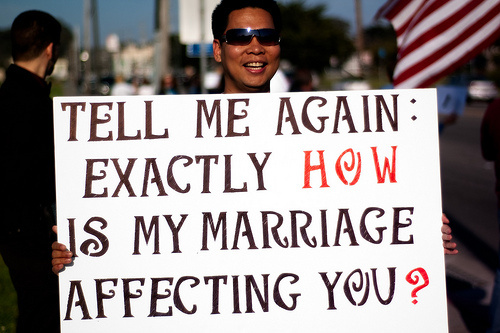
Will Gay Marriage Weaken Monogamy?

Post Author: Bill Pratt 

William Tucker, in his book Marriage and Civilization: How Monogamy Made Us Human, argues that the weakening of monogamy in modern America is cause for great concern. He goes to great lengths to show that monogamy is what makes us human, and is what has allowed western civilization to flourish.

Tucker explains:

From an evolutionary standpoint, gay marriage is a non-starter. It is only a few decades old and has played no part in evolutionary or human history. Whether it emerges as a symbol of a society’s respect for marriage or a symbol of its undoing remains to be seen.

Tucker is unsure of whether gay marriage will support or undo monogamy, but he asks gay marriage proponents to consider the following:

The important thing for supporters of same-sex marriage is to draw a stark line between acceptance of gay marriage and acceptance of an “anything-goes” attitude toward marriage, which says that it makes no difference whether people tie the knot or live in sin, whether they marry a man and a woman or marry two wives or three wives (because polygamy is always lurking at the edge of these discussions), or whether they marry their dog or their cat or a favorite lampshade.

Far more fundamental than the issue of same-sex marriage is that we arrive at a biological, anthropological, and historic understanding of the role that monogamy has played in the evolution of human society.

This is a real problem for gay marriage supporters. Most of them cannot articulate principled reasons why people should not live in sin, marry multiple spouses, or marry their dog or cat. In other words, they have been so busy arguing for gay marriage that they have made no effort to guard traditional marriage.

Tucker believes that this is a colossal mistake. His view, supported by plenty of evidence throughout his book, is that the loss of traditional monogamous marriages will be a catastrophe for human civilization. Without monogamy, violence and warfare become far more common. That is not a condition any of us want to live in.

How Are Polygamy and Warfare Related?

Post Author: Bill Pratt 

William Tucker, in his book Marriage and Civilization: How Monogamy Made Us Human, makes the case that polygamy and warfare are inextricably linked. Tucker writes:

The hallmark of a polygamous society is that there is always a shortage of women. The Nash Equilibrium is upset and men compete more aggressively for women, since there are never enough to go around.

What is the Nash Equilibrium?

Nash’s thesis, still the mainstay of all game theory, says that a system can reach an equilibrium without maximizing the interest of every individual player. This occurs when the system reaches a point where each player has achieved the best outcome they can under the existing rules. For a large heterosexual group with the same number of males and females, monogamy satisfies Nash Equilibrium. Each player has optimized his or her outcome under the rules of the existing system. More to the point, the only way any individual can improve his or her outcome is by breaking the rules. But this causes other kinds of disruption and works to the disadvantage of the entire group. It can be prevented by other members constantly enforcing the rules.

So how do polygamous societies deal with the deficit of women available for marriage?

In organized polygamous societies the problem is resolved by having men buy their wives. The “brideprice” is the hallmark of a polygamous society, whereas the dowry— an extra incentive attached to an older or unattractive daughter— is the hallmark of a monogamous society. There are no “old maids” in a polygamous society, since women can become second or third or fourth wives of powerful men.

In his 1981 book, A Treatise on the Family, Nobel Prize– winning economist Gary Becker argued that families of young women become the biggest supporters of polygamy because they possess an inherently scarce resource. Love matches and independent liaisons are frowned upon because they risk reducing the brideprice. In order to preserve their market value, young women must be veiled or sequestered and kept out of contact with young men. Because of the difficulties in finding brides, older men with lesser means are forced to look among younger and younger cohorts. Child marriages become common. Given the degree of sexual inequality and the great age differences that result, the personal bond between husbands and wives is not strong and there is very little companionate marriage.

So where does warfare enter the picture?

For primitive tribes, however, there is always one way of resolving this dilemma— raiding neighboring villages for their women. Academic anthropologists often have great difficulty dealing with this. In Marriage, Family, and Kinship, a book published in 1983 by the Human Area Relations Files at Yale University, for instance, Melvin and Carol R. Ember conducted a study that looked for correlations between polygamy and male-female imbalances. “[I]t appears that the cross-cultural evidence is consistent with the old notion that polygyny may generally be a response to an imbalanced sex ratio in favor of females,” they wrote.

What creates the imbalance? “It appears that an imbalanced sex ratio in favor of females may be produced by warfare that results in a high mortality rate for males.” They parsed the data looking for correlations between high rates of warfare and polygyny and sure enough, there it was. “[W]e find that a high male mortality rate in warfare is fairly strongly associated with polygyny. . . . In sum, it seems that the cross-cultural evidence presented here is consistent with the theory that societies with a high male mortality in warfare are generally likely to have an imbalanced sex ratio in favor of females and, presumably for that reason, are likely to practice polygamy.”

The Embers argue that “warfare kills a lot of men and leaves a surplus of women. The only way to make sure everyone is married is to allow polygamy.” Tucker believes the causal relationship posited by the Embers is exactly backwards.

Societies that are polygamous to begin with go to war precisely because they have created an imbalance by letting each man take more than one wife. This creates a demand for more women that can only be resolved by stealing women from other tribes. Thus warfare and polygamy become mutually reinforcing.

A Christian Apologetics Blog