#8 Post of 2016 – Does John 1:1 Say that Jesus is Merely a God, Not the God?

Jehovah’s Witnesses are famous for mistranslating John 1:1. They argue that the verse identifies Jesus as a god rather than as God Himself. Andreas Kostenberger, in The Gospels and Acts (The Holman Apologetics Commentary on the Bible), explains why their translation is incorrect.

Interestingly, around 1950 there was a change in how Jehovah’s Witnesses dealt with this verse. Before 1950, they carried a copy of the American Standard Version of the Bible. However, the problem they faced was that the ASV rendered verse 1 accurately with the phrase ‘the Word was God.’ In an effort to resolve the difficulty this rendering posed for its theology, the Watchtower Society (the Jehovah’s Witnesses’ publishing group) issued its own translation of the Bible, which rendered the verse as ‘the Word was a god’ (Reed 1986, 71). However, there are several reasons why this translation is inaccurate.

First, John, as a monotheistic Jew, would not have referred to another person as ‘a god.’ The Jews had no place for demigods in their belief system.

Second, if John had placed a definite article before theos, he would have abandoned the distinction between the two persons he established in the previous clause (‘the Word was with God’).

Third, the view defended by Jehovah’s Witnesses misunderstands Greek syntax. It is common in Greek for a predicate noun to be specific without having an article. For example, later in this chapter reference is made to Nathanael’s confession of Jesus, ‘you are the King of Israel’ (1: 49), with no article being before ‘King’ in the Greek (for other NT examples of this construction, see 8: 39; 17: 17; Rom 14: 17; Gal 4: 25; Rev 1: 20). From these examples, it is clear that the lack of an article in Greek does not necessarily imply indefiniteness (‘a’ god).

Finally, John could have used the word theios if he were simply trying to say that Jesus was ‘divine’ (i.e., that he had God-like qualities) rather than being God himself. The anarthrous (article-less) theos is most likely used to explain that Jesus ‘shared the essence of the Father though they differed in person’ (Wallace 1996, 269). As D. A. Carson explains, ‘In fact, if John had included the article, he would have been saying something quite untrue. He would have been so identifying the Word with God that no divine being could exist apart from the Word. In that case, it would be nonsense to say (in the words of the second clause of this verse) that the Word was with God.’

#9 Post of 2016 – Commentary on 2 Kings 18-19 (Hezekiah and Sennacherib)

Chapter 18 introduces King Hezekiah of Judah, one of the godliest rulers of Judah since Solomon. As is the case with many kings of the time, he reigned with both his father and son in addition to reigning by himself. He reigned as coregent with his father Ahaz for 14 years (729–715 BC). He reigned alone for 18 years (715–697) and then as coregent with his son Manasseh for 11 years (697–686).

What is remarkable about Hezekiah is that, in direct contrast to King Hoshea of Israel, “he did what was right in the eyes of the LORD, just as his father David had done.” Only three other kings of Judah are given the same commendation: Asa, Jehoshaphat, and Josiah. We know that Hezekiah destroyed pagan worship centers, removed idols, and even broke into pieces the bronze snake that Moses had fashioned back during the exodus, for it had become an object of worship.

From the book of 2 Chronicles, we also learn that Hezekiah cleansed and re-consecrated the temple, and then reintroduced the sacred feasts and festivals that Judah had failed to observe. Hezekiah was so confident in the Lord that he rebelled against the Assyrians and successfully mounted attacks against the Philistines. As the idolatrous nation of Israel was being ransacked by the Assyrians, Judah was experiencing a revival under Hezekiah’s leadership.

Peace with Assyria would only last 14 years for Hezekiah, however. In 701 BC, the Assyrian King Sennacherib sweeps into Judah and overruns all of the fortified cities of Judah except for Jerusalem itself. (Note that the following section of 2 Kings 18:13-19:37 is also recorded in the Book of Isaiah [chaps. 36–37] with only minor changes.) What caused Sennacherib to launch this invasion?

Thomas L. Constable writes, in The Bible Knowledge Commentary (Old Testament), that

Sennacherib was a less capable ruler than his father. During Sennacherib’s first four years on the throne he was occupied with controlling Babylon. During this time an alliance had formed in which cities of Phoenicia and Philistia as well as Egypt (under Shaboka) and Judah (under Hezekiah) joined together to resist Assyria. Certain that Sennacherib would try to put down this uprising, as Sargon had done, Hezekiah prepared for an Assyrian invasion by fortifying Jerusalem (cf. 2 Chron. 32:1–8).

Sure enough, once Sennacherib had dealt with the Babylonians, he turned his attention to the rebellion in the south. After rolling through most of Judah’s territory, he sets up a temporary headquarters in the Judean city of Lachish.

Hezekiah panics and pays off Sennacherib by emptying his royal treasury and even removing the gold plating on the doors of the temple. However, this ransom does not succeed. Sennacherib sends an army along with three of his highest ranking officers to send a message to Hezekiah. The message to Hezekiah is received by three of his ministers and is summarized as:

  1. Hezekiah was foolish to align with Egypt against Assyria, since Egypt is weak.
  2. The God of Judah was obviously upset with Hezekiah because Hezekiah had removed the high places in Judah against God’s wishes. God had thus commanded Assyria to conquer Judah. Paul R. House, in 8, 1, 2 Kings, The New American Commentary, adds, “This sort of propaganda about other countries’ deities abandoning their adherents was a standard Assyrian ploy when they invaded and conquered another nation. Cogan notes that the Assyrians routinely told their enemies that their gods were angry with them, that the gods had abandoned them, and that these gods counseled them to surrender to the Assyrians. It is not unusual, then, for the spokesman to try such tactics on Judahites. What the speaker has not grasped, however, is that he addresses monotheists committed to separatist Yahwism, not the typical polytheists he is used to manipulating.”
  3. The people of Jerusalem will suffer greatly from the siege and Hezekiah cannot protect them.
  4. If they will surrender, they will be moved peacefully to a distant land where they will be able to live their lives and prosper. (This is an interesting way to sell deportation.)
  5. None of the other gods of the nations Assyria has conquered have been able to withstand the king of Assyria (who serves the Assyrian god Assur). Why would they think Judah will be the first?

In chapter 19, verses 1-7, Hezekiah sends his ministers to the prophet Isaiah to get his counsel. Isaiah assures the ministers that God will send Sennacherib away and that he will eventually be killed by the sword in his own land.

In verses 8-13, Sennacherib sends a letter to Hezekiah warning him not to be deceived by his god into believing that Jerusalem will be protected from the Assyrian army. He then lists 9 other nations that have fallen to the Assyrians and repeats that none of those gods protected those nations.

Hezekiah receives the letter, goes to the temple, and prays to God. Hezekiah appeals to God’s honor and the fact that Sennacherib has mocked Him. Hezekiah understands that Yahweh is the only real God in existence, but Hezekiah asks God to prove this fact to the rest of world by saving Jerusalem.

The prophet Isaiah announces to Hezekiah that God has heard his prayer and that He will indeed save Jerusalem. In verses 21-28, God speaks to Sennacherib and the nation of Assyria directly. God reprimands Sennacherib for thinking that he can conquer Jerusalem and for dishonoring the Holy One of Israel. Even though Sennacherib believes that all of his military successes are due to his own power and prowess, God corrects him and states that He is the One who has orchestrated everything that has occurred from the beginning. Because of Sennacherib’s arrogance, God will ensure that Assyria is treated just like she has treated her enemies.

God then speaks to the people of Jerusalem and tells them that they will survive the devastation brought by Assyria. Thomas Constable explains the meaning of verses 29-31:

For two years the people of Jerusalem would be able to eat the produce of their land. It would not be stolen by the Assyrians who would have lived off the land if they had returned to besiege the capital. The Judeans had not been able to plant crops outside the city walls because of the Assyrians’ presence. But God promised that He would feed them for two years by causing the seed that had been sown naturally to grow up into an adequate crop. The third year people could return to their normal cycle of sowing and reaping.

This provision of multiplied food was further designed to illustrate God’s plan to multiply miraculously the people of Judah who had been reduced to small numbers. Sennacherib claimed to have taken 200,150 prisoners from Judah. However, though Judah seemingly might cease to be a nation through attrition, God promised to revive it. Like the crops, a remnant of people would take root … and bear fruit, that is, be established and prosperous. God’s zeal on behalf of His people would perform this (cf. Isa. 9:7).

Finally, in verses 32-34, God reveals the immediate fate of Jerusalem:

Therefore thus says the LORD concerning the king of Assyria: He shall not come into this city or shoot an arrow there, or come before it with a shield or cast up a siege mound against it. By the way that he came, by the same he shall return, and he shall not come into this city, declares the LORD. For I will defend this city to save it, for my own sake and for the sake of my servant David.

That night, the angel of the Lord strikes down the entire Assyrian army camped outside Jerusalem. Sennacherib returns to his capital, Nineveh, without defeating Hezekiah and Jerusalem. Some 20 years later, Sennacherib is murdered by his two oldest sons in the temple of the Assyrian god, Nisroch. They were attempting a coup because Sennacherib had chosen their younger brother to succeed him as king of Assyria. Everything God said would occur did occur.

#10 Post of 2016 – Are Christians Not to Judge?

Numerous people have read Matthew 7:1 out of context and come to the conclusion that Christians aren’t supposed to judge anybody’s behavior. David Croteau, in Urban Legends of the New Testament, writes an entire chapter to explain why this conclusion is incorrect. First, Croteau fleshes out the faulty position:

All forms of judging are commanded to cease. Don’t judge other people, believers or unbelievers, based on what you see them doing, on their lifestyle, on how they dress, or on what music they listen to. Jesus is calling us to a higher standard, to put aside our differences and live in unity with one another. Judging others disrupts unity; it divides the church. The world is looking at us wondering if we’ll ever be united, if we’ll ever demonstrate love for one another. The more we judge one another, the weaker our witness will be.

Croteau then explains, in detail, what Matthew 7:1 does not mean.

The Greek word translated ‘judge’ by virtually every Bible translation has a range of meanings. It can refer to making a selection (‘prefer’), passing judgment based on the correctness of something (‘discern’), or judging someone to be guilty (‘condemn’).  The prohibition in Matthew 7: 1 is against condemning other people. Jesus is commanding them not to be severely critical and judgmental. The Sermon on the Mount calls on Christians to judge others in the sense of being discerning.

Jesus’ illustration immediately following this prohibition is primarily intended to communicate the hypocritical penchant humans have for criticizing others while tolerating the same (or worse) behavior in themselves (Matt 7: 3– 5). Jesus concludes that illustration by saying that after the log is removed from your own eye, then you will be able to see clearly enough to help your friend by removing the speck from his eye. This means that you will have to see the speck, the ‘minor shortcoming,’ in order to remove it. This involves judging (in the sense of discernment) on some level.

In Matthew 7: 6, Jesus prohibits his followers from giving ‘what is holy to dogs’ or from tossing ‘your pearls before pigs.’ Obedience to Jesus’ words requires discerning the identity of the ‘dogs’ and of the ‘pigs.’

Finally, how are Jesus’ followers expected to watch out for ‘false prophets’ (Matt 7: 15) if they are prohibited from discerning who is false? From the larger context of Matthew’s Gospel, one passage in particular sticks out as relevant: Matthew 18: 15– 20. Jesus commands his followers to rebuke fellow followers when they sin. The process outlined in these verses involves much judging, again, in the sense of discernment. John Stott aptly concludes that ‘the command to judge not is not a requirement to be blind.’

In the context of the entire New Testament, a prohibition against discernment appears to fail as well. Jesus’ own teaching in John 7: 24 appears to contradict Matthew 7: 1 on the surface: ‘Stop judging according to outward appearances; rather judge according to righteous judgment.’ Here is an explicit command from Jesus to ‘judge,’ using the same word as in Matthew 7: 1. In the context Jesus is discussing how the Jews (or possibly the Jewish leaders) were passing judgment on Jesus (referring to discernment) regarding his actions on the Sabbath (see John 7: 23). So he commands them to cease discerning based on ‘mere appearances’ (NIV), a phrase that refers to a ‘superficial’ discernment. Instead of discerning superficially, they are commanded to discern based on a ‘righteous judgment.’ Jesus is explaining that a right or correct judgment of himself will lead them to conclude that he is actually fulfilling the laws of circumcision and Sabbath (cf. John 7: 22– 23).

Croteau goes on to provide other examples in the New Testament where Christians are commanded to judge. He concludes:

A strong case can be made that the overall teaching in the New Testament is for Christians to be discerning in areas including others’ sin and false teaching. Christians should diligently discern in at least both of these areas.

If Christians are to judge, then what is Jesus teaching in Matthew 7?

In contrast to interpreting Matthew 7: 1 as a prohibition against discernment, it is a prohibition against an overly judgmental attitude. Jesus’ disciples are to be committed to a righteous life, but he does not authorize them to have a judgmental attitude. The reason Jesus prohibits this is spelled out in the second half of 7: 1: ‘so that you won’t be judged.’ While this phrase could mean that by being censorious you invite others to be overly critical of yourself, it most likely means that when you are overly critical of others, God will judge you with those same standards. Being quick to condemn others is inviting the condemnation of God on your life.

People are incapable of knowing with any certainty another person’s heart, nor can we know their motives. Stott concludes: ‘To be censorious is to presume arrogantly to anticipate the day of judgment, to usurp the prerogative of the divine Judge, in fact to try to play God.’  Rather than requiring blindness, Matthew 7: 1 is ‘a plea to be generous.’  Augustine summarizes Jesus’ teaching this way: ‘We are taught nothing else, but that in the case of those actions respecting which it is doubtful with what intention they are done, we are to put the better construction on them.’ This is what some call giving ‘the charitable assumption.’

For further thoughts on Matthew 7, see the post entitled “Should Christians Judge?”

Do Matthew and Mark Contradict Each Other’s Accounts of Jesus Walking on Water?

Both Matthew and Mark record the miracle of Jesus walking on the Sea of Galilee. Matthew, however, includes two details that Mark does not. First, Matthew reports that the disciple Peter also walks on water when Jesus calls him out of the boat. Second, Matthew reports that the disciples all confess Jesus to be the “Son of God” after seeing the miracle. Since Mark leaves these details out, are the two accounts contradictory or inconsistent? Michael Wilkins, in The Gospels and Acts (The Holman Apologetics Commentary on the Bible), discusses the divergent accounts:

The parallel accounts (Mark 6: 45– 52; John 6: 15– 21) do not mention Peter’s venture into the water. This would be a remarkable thing to omit, if in fact both Mark and John knew it to be a fact. Does their silence call Matthew’s truthfulness into question? The key to explaining their silence is to recognize each narrator’s freedom to pursue different emphases. Matthew has repeatedly emphasized Peter and continues to do so throughout this section (e.g., 15: 15– 20; 16: 16– 23; 17: 24– 27). It is common for different narrators to draw out different details from the same or similar events. The different details often highlight each narrator’s specific purposes in writing.

In this case, we see Matthew’s unique emphasis on Peter’s leading role and his sometimes impetuous behavior. Peter is rebuked in this story for having ‘little faith,’ which is a common Matthean complaint about Jesus’ disciples (6: 30; 8: 26; 16: 8; 17: 20; France 2007, 567). Jesus will later teach his disciples about the faith that moves mountains (17: 20), a faith that would have kept Peter safe on the water had he not let fear get the better of him. Matthew’s inclusion of this incident provides an ‘illustration of the vulnerability of the disciple who allows doubt, the natural human perspective, to displace the faith which relies on the supernatural power of God’ (France 2007, 567). Another likely reason Matthew included this interaction with Peter is that Matthew reveals Jesus as divinely powerful and as the sustainer of his people (Morris 1992, 382– 83). Peter calls out to Jesus as ‘Lord’ (kurios), the same title used elsewhere to address Jesus with respect (e.g., 8: 21) or as a false declaration of faith (e.g., 7: 21). But here it means far more. Jesus is walking upon the water in the middle of a furious storm, something that elevates him above any other figure that Peter has ever known.

With regard to Matthew’s inclusion of the disciples calling Jesus “Son of God,” Wilkins writes:

This confession of Jesus’ deity is not present in the parallel accounts (Mark 6: 45– 52; John 6: 15– 21). If the confession really occurred, how could Mark and John choose not to include such an important saying? This is the first time that the disciples use the title ‘Son of God’ to address Jesus, and it is uncertain just how much they truly understand, for it was only at the resurrection that they became fully gripped with the radical truth of Jesus’ divine identity and ontology. The three accounts in the Gospels are witness to their growing, yet imperfect understanding of Jesus’ identity.

Mark’s account shows that the disciples still had only rudimentary understanding of who Jesus was as Messiah. Mark narrates, ‘They were completely astounded, because they had not understood about the loaves. Instead, their hearts were hardened’ (Mark 6: 51– 52). John’s parallel account says simply, ‘Then they were willing to take Him on board, and at once the boat was at the shore where they were heading’ (John 6: 21). Matthew’s eyewitness account focuses on both their growing yet imperfect understanding.

The three parallel accounts are historical testimony that allows us to see that, at the time of this event, it was still too much for the disciples fully to understand Jesus as the incarnate God. But their understanding is certainly increasing, because Matthew tells us that they worship him in response to his calming the sea. Recognizing Jesus to be God’s Son will be part of the continuing divine revelation that is expressed later in Peter’s climactic confession: ‘You are the Messiah, the Son of the living God!’ (16: 16). They are understanding more clearly that Jesus is uniquely related to God the Father, as those at Jesus’ baptism heard, and they will hear themselves at the transfiguration (3: 17; 17: 5).

To summarize, divergent accounts do not entail contradictory or even inconsistent accounts. Each of the Gospel authors were emphasizing different aspects of Jesus’ life. They each had different goals and purposes in mind when writing their biographies. Before we cry “contradiction” when we see differing accounts of the same events, we need to dig deeper to understand why there may be differing perspectives among the four Gospel writers.

Commentary on Mark 6 (Jesus Feeds 5,000 and Walks on Water)

After Jesus has sent out his disciples to preach to the towns of Galilee (probably around the second year of his public ministry), they return to him and give him reports of what they accomplished. Jesus, seeing they need rest, takes them to a desolate place so that they can be alone.

Mark notes that this is a busy time, for “many were coming and going.” In the parallel account in the Gospel of John, we read that the Passover Festival was near, so this would explain why there were huge crowds of people “coming and going” during this time.

As Jesus and the disciples travel by boat on the Sea of Galilee to a remote place, a crowd of people spot them and follow along on land. Evidently, their boat was close to land and could easily be seen from the shore of the lake.

In verse 34, when their boat goes ashore, Jesus sees the great crowd that has followed them and he has compassion on them, first by teaching them and then by feeding them. James A. Brooks writes, in vol. 23, Mark, The New American Commentary,

’Sheep without a shepherd’ is an Old Testament picture of Israel without spiritual leadership (Num 27:17; 1 Kgs 22:17; Ezek 34:5). Jesus is pictured as the Good Shepherd who feeds the new Israel (cf. Ezek 34:23; Jer 23:4). First he ‘fed’ the crowd with his teaching. Mark frequently emphasized that Jesus taught.

The miracle that follows is recounted in all four Gospels, so the early church obviously considered the feeding of the five thousand to be an extremely important event in Jesus’ ministry. The only other miracle attested by all four Gospels is the resurrection of Jesus.

Because it was late in the evening and they are in a desolate region, the disciples ask Jesus to send the crowds away to buy food for themselves. Jesus responds by telling the disciples to feed the crowd. They complain that it would take 200 denarii to feed a crowd this size (between 15-25,000 people total).

One denarius was equivalent to an average worker’s daily wage. The average daily wage of an American today is about $210, so that would equate to about $42,000! Most of us don’t have $42,000 sitting around to feed a crowd of people who have come to hear us speak for free, so the disciples are understandably panicked.

Unperturbed, Jesus asks them to see how many loaves of bread they can find among the crowd, and they return with five loaves and two fish. Jesus instructs the crowd to divide themselves into groups of fifties and hundreds and sit down on the “green grass.” Note that the grass would have only been green in the spring around the time of Passover, so this little detail nicely harmonizes with the Gospel of John’s timing of this miracle.

Jesus then says a blessing over the food and sends the disciples into the crowd with bread and fish. When they return, everyone in the crowd has been fed and there are twelve baskets left over with bread and fish.

This miracle account refers in several ways to the Old Testament, as noted by James Brooks:

As already observed in the comments on 1:4, in the Old Testament the desert was the place where God met, tested, and blessed his people. Specially important was the experience of Israel in the wilderness following the Exodus. After the testing involved in that experience, ‘rest’ was promised. Note how Mark introduced that idea (v. 31). Also the ‘sheep without a shepherd’ (v. 34) recalls Moses’ description of Israel in Num 27:17; and the ‘hundreds and fifties’ of v. 40, the organization of Israel in Exod 18:21, not to mention the resemblance between the loaves and the manna. The literal rest in the desert and later in the promised land following the Exodus did not satisfy, and the prophets and psalmists began to look forward to a better rest in the messianic age. . . . Mark saw in Jesus’ feeding of the five thousand an eschatological Moses giving perfect rest to and supplying all the needs of his people. The feeding anticipates the messianic banquet at the end of the age. The kingdom is at hand. The miracle as such is not as important for Mark as what it reveals about Jesus. . . .

The prophet Elisha performed a similar miracle according to 2 Kgs 4:42–44. In fact, Mark’s wording owes something to this account and possibly 1 Kgs 17:9–16. Mark may also have seen in the event Jesus as the fulfillment of the law and the prophets.

Immediately following the miracle of the feeding of five thousand, Jesus sends the disciples back into their boat to travel across the northern tip of the Sea of Galilee to meet him in a town called Bethsaida. Jesus goes by himself up on a mountain to pray alone.

Between 3 and 6 am, Jesus sees the disciples rowing their boat against the wind (they have gone way off course and are stuck out in the middle of the lake.) Jesus decides to go to them by walking on the lake. As he approaches the boat, they see him and think he is a ghost.

Jesus tells them, “Take courage! It is I. Don’t be afraid.” John D. Grassmick, in The Bible Knowledge Commentary, remarks:

The words It is I (lit., ‘I am,’ egō eimi) may simply convey self-identification (‘It is I, Jesus’), but they are probably intended here to echo the Old Testament formula of God’s self-revelation: ‘I am who I am’ (cf. Ex. 3:14; Isa. 41:4; 43:10; 51:12; 52:6).

Jesus climbs into the boat and the winds calm down. Mark records that the disciples are amazed because they did not understand who Jesus really was, even after seeing Jesus feed five thousand people.

The miracle of Jesus walking on the Sea of Galilee is recorded in Matthew, Mark, and John. Only Luke does not record it.


Was Mark the First Gospel Written?

Although we may never know for sure, the majority of biblical scholars think that Mark was the first Gospel written, and that the other Gospels, especially Matthew and Luke, used Mark as a source. Craig Evans, in The Gospels and Acts (The Holman Apologetics Commentary on the Bible), why this view is the dominant one.

Markan priority appears to be the most prudent position for several reasons: (1) Mark’s literary style sometimes lacks the sophistication and polish often seen in Matthew and Luke. This phenomenon is more easily explained in terms of Matthean and Lukan improvement upon Mark, rather than Markan degradation of Matthean and Lukan style.

(2) In the Markan Gospel Jesus and the disciples are sometimes portrayed in a manner that appears undignified. More often than not these potentially embarrassing passages are touched up or omitted altogether by Matthew and Luke. Again, it is easier to explain the phenomena in terms of Matthean and Lukan improvements upon Mark, rather than the reverse.

(3) The phenomena of agreements and disagreements among the Synoptic Gospels are more easily explained in reference to Markan priority. Among other things, we observe that where there is no Mark to follow (e.g., no infancy narrative, no ‘Q’ material) this is where Matthew and Luke diverge from one another. This observation is more easily explained in terms of Markan priority and Matthew’s and Luke’s independence from one another than in terms of Mark writing last and making use of Matthew and Luke. Markan priority also avoids the problem of trying to explain Luke’s inconsistent use of Matthew.

(4) The small amount of material that is unique to the Gospel of Mark also supports Markan priority. This material consists of 1: 1; 2: 27; 3: 20– 21; 4: 26– 29; 7: 2– 4, 32– 37; 8: 22– 26; 9: 29, 48– 49; 13: 33– 37; 14: 51– 52. In reviewing this material we should ask which explanation seems most probable, that Mark added it or that Matthew and Luke found it in Mark and chose to omit it. The nature of the material supports the latter alternative, for it seems more likely that Matthew and Luke chose to omit the flight of the naked youth (14: 51– 52); the odd saying about being ‘salted with fire’ (9: 48– 49); the strange miracle where Jesus effects healing in two stages (8: 22– 26); the even stranger miracle where Jesus puts his fingers in a man’s ears, spits, and touches his tongue (7: 32– 37); and the episode where Jesus is regarded as mad and his family attempts to restrain him (3: 20– 22). If we accept the Griesbach-Farmer Hypothesis [that Matthew was written first], we would then have to explain why Mark would choose to add these odd, potentially embarrassing materials, only to omit the Sermon on the Mount/ Plain, the Lord’s Prayer, and numerous other teachings and parables found in the larger Gospels.

(5) The final consideration that adds weight to the probability of Markan priority has to do with the results of the respective hypotheses. The true test of any hypothesis is its effectiveness. In biblical studies a theory should aid the exegetical task. The theory of Markan priority has provided just this kind of aid. Not only has Synoptic interpretation been materially advanced because of the conclusion, and now widespread assumption, of Markan priority, but the development of critical methods oriented to Gospel research, such as Form and Redaction Criticism, which have enjoyed success, has also presupposed Markan priority.

In countless studies, whether dealing with this or that pericope, or treating one of the Synoptic Gospels in its entirety, it has been recognized over and over again that Matthew and Luke make the greatest sense as interpretations of Mark; but Mark makes little sense as a conflation and interpretation of Matthew and Luke. The evidence is compelling that Mark represents the oldest surviving account of Jesus’ life, ministry, death, and resurrection. What sources the evangelist Mark made use of, if any, will in all probability remain a mystery. That he made use of some written material seems likely. That he made use of some eyewitness testimony is also probable; it cannot be ruled out.

Commentary on Mark 6 (Death of John the Baptist)

The traditional view of the Gospel of Mark is that it was written by John Mark, a follower of the apostle Peter, during his missionary travels, between AD 50-70. Most biblical scholars believe that the Gospel of Mark was the first Gospel written, and that Matthew and Luke borrowed heavily from it when writing their accounts. Early church fathers wrote that Mark collected his stories about Jesus’ life from Peter.

Craig Evans, in The Gospels and Acts (The Holman Apologetics Commentary on the Bible), explains the purposes of Mark in writing his Gospel:

Mark’s opening verse makes the Gospel’s purpose clear: ‘The beginning of the gospel of Jesus Christ, the Son of God’ (Mark 1: 1). Mark very carefully chose his language, deliberately echoing the language of the imperial ruler cult, as seen in an inscription in honor of Caesar Augustus: ‘the birthday of the god Augustus was the beginning for the world of the good news.’ Mark challenges this imperial myth, asserting that the good news for the world began with Jesus Christ, the true Son of God (see Mark 15: 39, where the Roman centurion admits upon seeing the impressive death of Jesus: ‘This man really was God’s Son!’).

From this extraordinary claim at the beginning of his narrative, to the sudden and dramatic discovery of the empty tomb, Mark takes pains to show that Jesus is truly God’s Son, despite rejection by the religious authorities of his time and his execution at the hands of the Roman governor. The Julian emperors, whose latest and most unfortunate manifestation at the time of the publication of Mark is the demented Nero, can provide no compelling candidates for recognition as the Son of God, whose life and death are truly of benefit to humankind. To the Roman world Mark proffers Jesus and his message of the kingdom of God and by doing so encourages the faithful to remain steadfast, and enjoins the critics and opponents of the Christian faith to reconsider.

As Jesus’ ministry continues, his forerunner, the man who baptized him in the Jordan River, is executed. Mark tells the story of John the Baptist’s execution in chapter six, starting in verse 14.

In verses 14-16, Mark tells his readers that King Herod hears about Jesus and becomes concerned that he is John the Baptist raised from the dead. Herod assumes that a raised John the Baptist would have supernatural powers and be able to perform the kinds of miracles being attributed to Jesus.

There are other rumors about Jesus, however. Some say he is the second coming of Elijah (as prophesied in Malachi 4:5) and others say he is a new prophet sent by God to the Israelite nation. Herod, though, is convinced Jesus is the John the Baptist, back from the dead.

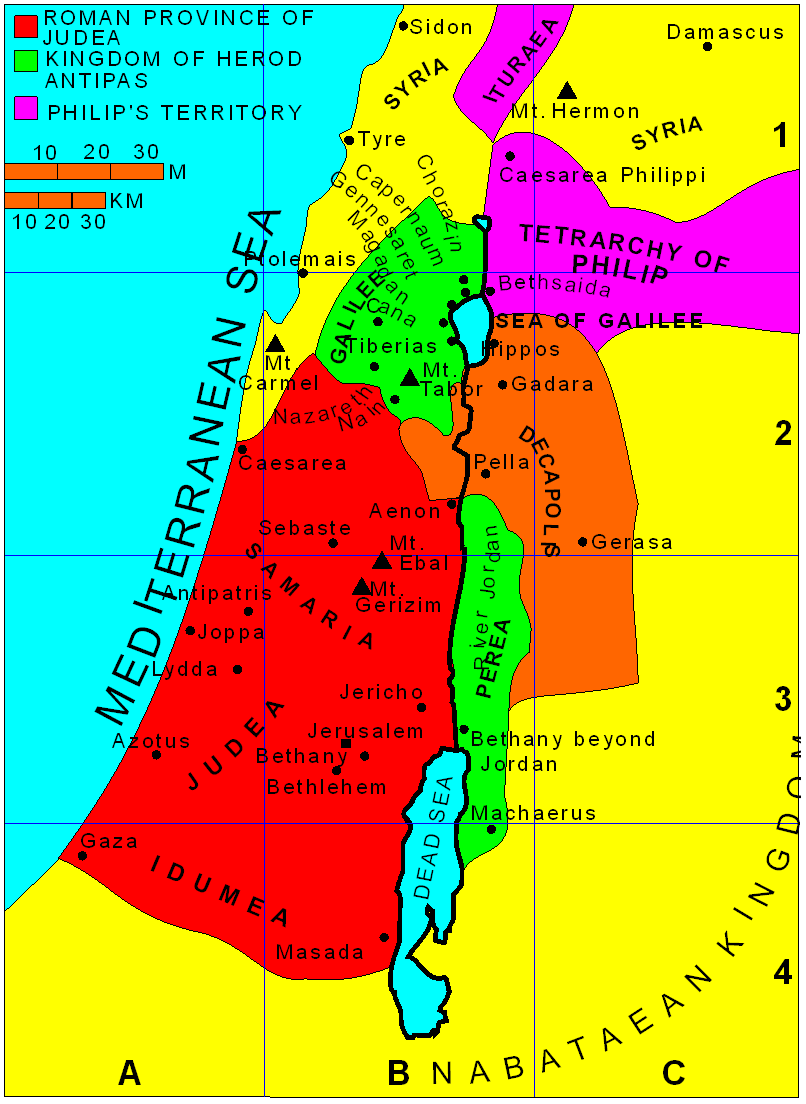
Before we continue, who exactly is Herod? The Herod of Mark 6 is more precisely named Herod Antipas, son of Herod the Great (the Herod whom the magi visited when Jesus was born) and tetrarch of Galilee and Perea (4 BC – AD 39). When Antipas’ father, Herod the Great, died in 4 BC, his kingdom was split into three parts by the Roman emperor. Antipas was given the portion of the kingdom that encompassed the regions of Galilee and Perea (see map below from Nelson’s 3-D Bible Mapbook).

map

Antipas married Aretas, the daughter of king of the Nabateans (region in yellow above). But while visiting Rome, Antipas became infatuated with the wife of his half-brother; her name was Herodias. He promptly divorced Aretas and married Herodias (who divorced her husband as well).

Stealing his half-brother’s wife was truly scandalous and the Jews in his kingdom were horrified. John the Baptist loudly criticized the marriage as an offense against God, citing passages such as Leviticus 18:16 and 20:21.

Antipas arrests John the Baptist and places him in prison at the fortress of Machaerus (in the southern portion of Perea). According to Mark, Antipas does this because of pressure from his wife, Herodias. She despises John and wants him executed, but Antipas is hesitant to do so because he sees John as a holy man.

That would change when Antipas throws a birthday party for himself at one of his fortresses, possibly Machaerus. During the festivities, Antipas invites his teenage step-daughter to dance for a room full of drunken men. The young girl is named Salome, and she is the daughter of Herodias and her former husband.

Antipas is so pleased with her performance that he rashly offers her whatever she wants, up to half his kingdom. Only the Romans could divide his kingdom, so he is making a drunken promise that he can’t even keep.

Salome goes to ask her mother what she should request, and Herodias tells her to ask for John the Baptist’s head. At this point, Antipas will be publicly embarrassed in front of the Galilean nobility and military commanders if he refuses her request, so he gives the order and John the Baptist is executed.

David Garland comments, in Matthew, Mark, Luke: Volume One (Zondervan Illustrated Bible Backgrounds Commentary):

The account reeks of gross impiety. Birthdays were pagan celebrations. Drunken revelry, a princess dancing at a stag party (she must leave to consult her mother), and execution without a trial all smack of rank paganism. The grisly detail of John’s head brought to them on a platter caps off a banquet already polluted by excess.

The Jewish historian, Josephus, confirms that John the Baptist was executed by Antipas at Machaerus. Josephus, however, stresses that John was killed for political reasons. Antipas saw John as a growing threat to his rule. Craig Evans writes:

Josephus confirms that Herod imprisoned and executed John the Baptist, but his details differ as to why exactly John was killed (Antiquities 18.116– 119). At most points the two accounts can be reconciled, and where they cannot be reconciled there is no good reason to give Josephus preference. Although Josephus chooses to emphasize the political dangers that John posed to Herod, and Mark chose to emphasize the moral dimension, the two accounts are in essential agreement. Herod’s disgraceful dismissal of his wife, the daughter of the king of the Nabateans, and his unlawful marriage to Herodias his sister-in-law prompted John’s condemnation. John’s condemnation focused on the immoral and unlawful aspects (which Mark mentions), while Herod’s fears focused on the political dangers (which Josephus narrates). Later, Josephus himself mentions the inappropriateness of Herod’s divorce and remarriage (Antiquities 18.136).

After John is executed, his disciples retrieve his body and give him a proper burial, a preview of Joseph of Arimathea’s burial of Jesus. John the Baptist is the forerunner of Jesus both in life and death.

Was It Right for Jesus to Conceal Spiritual Truths by Using Parables?

In Matthew 13 Jesus explains to his disciples that he is using parables to teach truths about the kingdom of heaven. However, because parables are allegorical or metaphorical in nature, they are often difficult to interpret without further explanation. Jesus is only willing to explain the parables to his followers, but not to the crowds that were assembling to hear him speak. Why would Jesus do this? Wasn’t he putting up unnecessary barriers? Shouldn’t he have explained the parables to the crowds?

Michael Wilkins, in The Gospels and Acts (The Holman Apologetics Commentary on the Bible), explains what Jesus was accomplishing by speaking in parables:

First, he tested the hearts of listeners. Parables act as a spiritual examination, prompting a response that indicates whether the listener’s heart is open to Jesus’ message, or whether it is hardened. If the listener is hardened to Jesus’ message, the parable stimulates confusion or outright rejection and prompts him to turn from Jesus and the truth (13: 11– 15). If the person’s heart is instead open, he will come to Jesus for further clarification about the parable’s meaning— as the disciples do (13: 10)— and eventually understand the truth embedded in the parables (13: 51).

Second, the parables give instruction to those who are responsive. The parables reveal and instruct Jesus’ disciples on the nature of the kingdom of heaven, showing how it operates in this world in a way very different from what the religious leaders and the crowds expected. By use of parables Jesus gives indications of the development of the kingdom (sower: 13: 18– 23, 36– 43; tares: 13: 24– 30; mustard seed: 13: 31– 32; leaven: 13: 33), the incomparable value of the kingdom (treasure: 13: 44; pearl: 13: 45– 46), membership in the kingdom (net: 13: 47– 50; cf. vineyard: 21: 43; two sons: 21: 28– 32), and service in the kingdom (teacher of the law: 13: 51– 52).

The positive response of the disciples is seen in their asking for further explanation (13: 10, 36), the reward of which is Jesus’ explanation of the parables (13: 18– 23, 37– 43) and parabolic teaching directed to them that reveals additional truth about the mysteries of the kingdom (13: 44– 52). While the disciples are not perfect in understanding, they possess the potential and desire to progress. Ultimately they will understand because they have been obedient to listen and hear (13: 51).

Jesus wasn’t excluding anyone who wanted to understand his teachings and follow him. He was, however, excluding those who were listening to him in order to confirm their own rejection of him. There is a volitional side to understanding. If you tell me something that I don’t like or that I don’t want to be true, then I will not attempt to understand nor embrace what you have to say.

Commentary on Matthew 13 (Parable of the Soils)

Jesus is teaching near the Sea of Galilee, but the crowds are so large that he climbs into a boat and moves out into the water. The crowds then gather on the beach to hear him. This takes place well into his ministry, possibly two years.

Unlike his previous teaching, he only communicates parables to the crowd. R. V. G. Tasker and I. H. Marshall explain the meaning in the New Bible Dictionary:

‘Parable’ is ultimately derived from Gk. parabolē, literally ‘putting things side by side.’ Etymologically it is thus close to ‘allegory,’ which by derivation means ‘saying things in a different way.’ Both parables and allegories have usually been regarded as forms of teaching which present the listener with interesting illustrations from which can be drawn moral and religious truths; ‘parable’ is the somewhat protracted simile or short descriptive story, usually designed to inculcate a single truth or answer a single question, while ‘allegory’ denotes the more elaborate tale in which all or most of the details have their counterparts in the application. Since ‘truth embodied in a tale shall enter in at lowly doors,’ the value of this method of instruction is obvious.

The first parable he teaches is known as the Parable of the Sower. The sower is scattering seeds on the ground to grow a crop. However, when the sower scatters the seeds, they fall on four different kinds of soil: soil along the path, soil on rocky ground, soil with thorns growing in it, and finally good soil. As most of Jesus’ listeners were familiar with scattering seeds, they would have understood the imagery Jesus is using to tell the parable. However, since we are two thousand years removed, here is some background from Michael J. Wilkins in Matthew, Mark, Luke: Volume One (Zondervan Illustrated Bible Backgrounds Commentary):

Seed was sown ‘broadcast’ style by scattering it in all directions by hand while walking up and down the field. The average rate of sowing wheat varies from twenty pounds per acre (22.5 kilograms per hectare) upward, which allowed for wasted seed. Fields were apparently plowed both before the seed was sown and after, plowing across the original furrows to cover the seeds with soil. . . . It was common for seed to be scattered on the hard paths that surrounded the fields. Birds would swoop down as the farmer walked on and eat the seed.

Conditions for farming in many areas of Israel were not favorable. The hardships that many people experienced included insufficient amounts of water and soil. The terrain in most cases was uneven and rocky, with only thin layers of soil covering the rock. Seed that landed on this shallow soil could begin to germinate, but it couldn’t put down deep roots to collect what little moisture was in that parched thin layer of earth. Sprouting seed would soon wither and die in the hot sun (13:6).

Sometimes thorns were also hidden in the soil, so the farmer could not see them to pull them out by the roots. Therefore, when seed was planted beside the thorns, the thorns would grow rapidly and crowd out the seeds.

With regard to the good soil, Craig Keener notes in The IVP Bible Background Commentary: New Testament:

Thirtyfold, sixtyfold and a hundredfold are tremendously good harvests from Galilean soil. The Jordan Valley normally yielded between ten- and a hundredfold, so a hundredfold need not be a miraculous harvest (Gen 26:12; cf. Amos 9:13). But for much of Palestine, the average yield was tenfold (meaning that 10 seeds were harvested for every seed sown), and all the figures Jesus reports here are very good yields.

Once Jesus has finished, his disciples pull him aside and ask why he has started teaching in parables. Jesus explains that only those who are truly following him (his disciples) will have the parables explained to them. The parables are revealing the secrets (mysteries) of the kingdom of heaven. Those who aren’t following Jesus will not hear the parables explained, and thus will remain ignorant about the secrets of the kingdom of heaven.

What does Jesus mean by the “secrets of the kingdom of heaven”? Up until Matthew 13, Jesus has been presenting himself to the Jews of Galilee and Judea as the Messiah, the long-predicted King of Israel. He has performed miracles, he has fulfilled prophecies, he has taught with authority, yet most Jews were rejecting his claims to be the Messiah. In fact, in Matthew 12, the Jewish leadership attributes his miracles to the power of Satan!

Given the rejection of Jesus as their King, Jesus will now start revealing to his disciples that the kingdom of God (heaven) that the OT predicted will be delayed until Jesus returns to the earth some time in the future. Until he comes back, however, the kingdom of God will exist, but in a different form than what the Jews would have expected. Jesus, then, is going to reveal to his disciples the characteristics of this new form of the kingdom which will exist between his first and second coming. This new form has never been revealed before, so that is why it is referred to as a “secret” or “mystery.”

Why would Jesus only want his closest followers to be told about the new form of the kingdom of God? Because the crowds that are coming to hear him speak are mostly composed of people who don’t accept his claim of being the Messiah and who don’t want to dedicate their lives to him.

Reflecting on verses 13-15, Craig Blomberg writes, in vol. 22, Matthew, The New American Commentary:

The hidden aspect of the parables’ message is thus both a cause of and a response to people’s unwillingness to follow Jesus. ‘Seeing’ and ‘hearing’ are each used in two different senses here, once for simple sensory perception and then for the kind of insight that leads to acceptance of the gospel and discipleship. ‘Understanding’ is a key word for Matthew in this chapter, especially in vv. 19 and 23, where he adds the term to his sources. The language of v. 13 is taken almost verbatim from Isa 6:9–10, LXX. Jesus declares that the words of Isaiah are now being fulfilled.

The word for ‘fulfill’ here (anaplēroō) is different from before, the only time in the New Testament this verb is used with reference to Scripture. Verse 14a probably means the prophecy of Isaiah applies to them—i.e., the pattern of behavior in Isaiah’s time is repeating itself and being completed in Jesus’ day among those who reject him. . . . Meanwhile v. 15 explains the current plight of those who reject Jesus. God confirms such people in their hard-heartedness in response to their freely chosen disobedience (as in the larger context of God’s call to Isaiah to prophesy to rebellious Israel; cf. also the sequence of events in Rom 1:18–32). Jesus sees his preaching in parables, in part at least, as a kind of judgment from God upon unbelieving Israel.

As for Jesus’ disciples, they are blessed. They will be taught the meaning of the parables, and thus the mysteries of the kingdom of heaven. They are learning things about the kingdom that not even the great prophets and saints in the OT were privileged to know.

In verses 18-23, Jesus explains the parable of the sower to his disciples. The seed represents Jesus’ teaching on the kingdom of heaven. The four soils represent four different kinds of responses to Jesus’ teaching.

The first kind of person (soil on the path) never understands Jesus’ words and Satan snatches away the words before any understanding does occur. This does not a represent a person who simply needs more instruction to understand. This person willfully rejects the message they are hearing and they are therefore culpable.

The second kind of person (soil on rocky ground) receives Jesus’ words, but as soon as he is troubled or persecuted for his beliefs, he abandons Jesus.

The third kind of person (soil with thorns) also receives Jesus’ words, but money and earthly distractions make him an unfruitful disciple.

The fourth kind of person (good soil) receives and understands Jesus’ words, and becomes extremely fruitful in the kingdom of heaven. This is the only kind of person whom Jesus commends. To be fruitful means to be obedient to God in everything you do. Michael Wilkins adds his thoughts about the crop produced in the life of the good soil:

Many think that this ‘crop’ refers to converts won to Christ through the believer. This no doubt is partially correct, but in this context it refers to something more fundamental—the transformation of a person who has encountered the kingdom of heaven. In the fourth soil the crop represents the outworking of the life of the divine seed (cf. 1 John 3:9), with special reference to the production of the fruit of the Spirit (cf. Gal. 5:22–23), and the outworking of the Spirit in the gifts of the Spirit in the believer’s life (1 Cor. 12). This results in personal characteristics produced by the Spirit (Gal. 5:22–23), the external creation of Spirit-produced righteousness and good works (e.g., Col. 1:10), and indeed, new converts won through the believer’s testimony (e.g., Rom. 1:13). The ‘crop’ produced is the outward evidence of the reality of inward life of the kingdom of heaven.

Even though it is depressing to learn that only one of the four soils actually succeeds as a member of the kingdom of heaven, it should also be noted that the fourth kind of person produces a new crop that is thirty, sixty, or a hundred-fold. Thus the fourth soil more than makes up for the other three soils and their failure to produce.

A final word about the parable. Although the parable primarily speaks of fruit-bearing, there is a sense in which Jesus is referring to entrance to the ultimate kingdom of heaven. In other words, he is speaking about what we commonly refer to as salvation, or being saved.

Most commentators agree that the first soil is not saved and the fourth one is. However, there is no consensus about the second and third soils. Some argue they are not saved and some argue they are. I do not know the answer to that question, but I will say that everyone agrees that the only soil Jesus commends in the parable is the fourth. So, any Christian who does not aspire to be like the fourth soil is completely missing the point of the parable. The first three soils don’t cut it in Jesus’ kingdom.

Are Christians Not to Judge?

Numerous people have read Matthew 7:1 out of context and come to the conclusion that Christians aren’t supposed to judge anybody’s behavior. David Croteau, in Urban Legends of the New Testament, writes an entire chapter to explain why this conclusion is incorrect. First, Croteau fleshes out the faulty position:

All forms of judging are commanded to cease. Don’t judge other people, believers or unbelievers, based on what you see them doing, on their lifestyle, on how they dress, or on what music they listen to. Jesus is calling us to a higher standard, to put aside our differences and live in unity with one another. Judging others disrupts unity; it divides the church. The world is looking at us wondering if we’ll ever be united, if we’ll ever demonstrate love for one another. The more we judge one another, the weaker our witness will be.

Croteau then explains, in detail, what Matthew 7:1 does not mean.

The Greek word translated ‘judge’ by virtually every Bible translation has a range of meanings. It can refer to making a selection (‘prefer’), passing judgment based on the correctness of something (‘discern’), or judging someone to be guilty (‘condemn’).  The prohibition in Matthew 7: 1 is against condemning other people. Jesus is commanding them not to be severely critical and judgmental. The Sermon on the Mount calls on Christians to judge others in the sense of being discerning.

Jesus’ illustration immediately following this prohibition is primarily intended to communicate the hypocritical penchant humans have for criticizing others while tolerating the same (or worse) behavior in themselves (Matt 7: 3– 5). Jesus concludes that illustration by saying that after the log is removed from your own eye, then you will be able to see clearly enough to help your friend by removing the speck from his eye. This means that you will have to see the speck, the ‘minor shortcoming,’ in order to remove it. This involves judging (in the sense of discernment) on some level.

In Matthew 7: 6, Jesus prohibits his followers from giving ‘what is holy to dogs’ or from tossing ‘your pearls before pigs.’ Obedience to Jesus’ words requires discerning the identity of the ‘dogs’ and of the ‘pigs.’

Finally, how are Jesus’ followers expected to watch out for ‘false prophets’ (Matt 7: 15) if they are prohibited from discerning who is false? From the larger context of Matthew’s Gospel, one passage in particular sticks out as relevant: Matthew 18: 15– 20. Jesus commands his followers to rebuke fellow followers when they sin. The process outlined in these verses involves much judging, again, in the sense of discernment. John Stott aptly concludes that ‘the command to judge not is not a requirement to be blind.’

In the context of the entire New Testament, a prohibition against discernment appears to fail as well. Jesus’ own teaching in John 7: 24 appears to contradict Matthew 7: 1 on the surface: ‘Stop judging according to outward appearances; rather judge according to righteous judgment.’ Here is an explicit command from Jesus to ‘judge,’ using the same word as in Matthew 7: 1. In the context Jesus is discussing how the Jews (or possibly the Jewish leaders) were passing judgment on Jesus (referring to discernment) regarding his actions on the Sabbath (see John 7: 23). So he commands them to cease discerning based on ‘mere appearances’ (NIV), a phrase that refers to a ‘superficial’ discernment. Instead of discerning superficially, they are commanded to discern based on a ‘righteous judgment.’ Jesus is explaining that a right or correct judgment of himself will lead them to conclude that he is actually fulfilling the laws of circumcision and Sabbath (cf. John 7: 22– 23).

Croteau goes on to provide other examples in the New Testament where Christians are commanded to judge. He concludes:

A strong case can be made that the overall teaching in the New Testament is for Christians to be discerning in areas including others’ sin and false teaching. Christians should diligently discern in at least both of these areas.

If Christians are to judge, then what is Jesus teaching in Matthew 7?

In contrast to interpreting Matthew 7: 1 as a prohibition against discernment, it is a prohibition against an overly judgmental attitude. Jesus’ disciples are to be committed to a righteous life, but he does not authorize them to have a judgmental attitude. The reason Jesus prohibits this is spelled out in the second half of 7: 1: ‘so that you won’t be judged.’ While this phrase could mean that by being censorious you invite others to be overly critical of yourself, it most likely means that when you are overly critical of others, God will judge you with those same standards. Being quick to condemn others is inviting the condemnation of God on your life.

People are incapable of knowing with any certainty another person’s heart, nor can we know their motives. Stott concludes: ‘To be censorious is to presume arrogantly to anticipate the day of judgment, to usurp the prerogative of the divine Judge, in fact to try to play God.’  Rather than requiring blindness, Matthew 7: 1 is ‘a plea to be generous.’  Augustine summarizes Jesus’ teaching this way: ‘We are taught nothing else, but that in the case of those actions respecting which it is doubtful with what intention they are done, we are to put the better construction on them.’ This is what some call giving ‘the charitable assumption.’

For further thoughts on Matthew 7, see the post entitled “Should Christians Judge?”

A Christian Apologetics Blog