Category Archives: Sunday School

Commentary on John 5 (Jesus Heals at the Pool of Bethesda)

At the beginning of John chapter five, Jesus travels from Galilee to Jerusalem to attend a Jewish festival. We are not told which festival, but some scholars believe it to be the Feast of Tabernacles.

While in Jerusalem, Jesus visits the pool of Bethesda (see model below). The pool is where blind, lame, and paralyzed people would go to seek healing. At the pool, Jesus finds a man who has been an invalid for thirty-eight years.
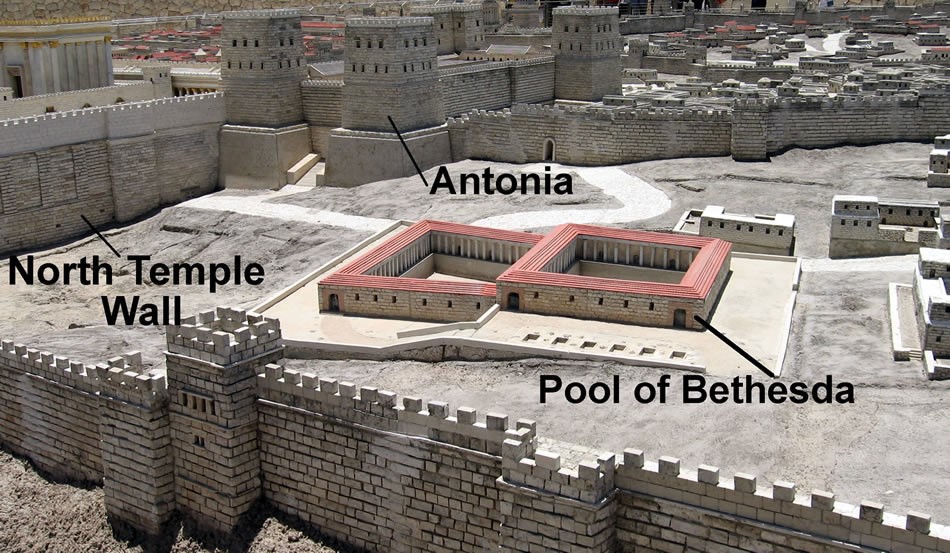
pool

Jesus asks the man if he wants to be healed and the man answers that he has nobody to help him get in the pool when the waters stir. The superstition surrounding the pool is that an angel would periodically stir up the waters and that the first one who entered the pool would be healed.

Ignoring the superstition, Jesus tells the man to get up off his mat, pick it up, and walk away with it. Miraculously healed by Jesus’s simple command, the man does indeed walk away with his mat.

As the man walks away with his mat, Jewish religious leaders (possibly members of the Sanhedrin) see the man and ask him why he is breaking the Sabbath rules about abstaining from work. D. A. Carson, in The Gospel According to John, The Pillar New Testament Commentary, explains:

The Old Testament had forbidden work on the Sabbath. But what is ‘work’? The assumption in the Scripture seems to be that ‘work’ refers to one’s customary employment; but judging by Mishnah (Shabbath 7:2; 10:5), dominant rabbinic opinion had analysed the prohibition into thirty-nine classes of work, including taking or carrying anything from one domain to another (except for cases of compassion, such as carrying a paralytic). By Old Testament standards, it is not clear the healed man was contravening the law, since he did not normally carry mats around for a living; according to the ‘tradition of the elders’ the man was breaking the law, since he was contravening one of the prohibited thirty-nine categories of work to which the law was understood to refer. It is not yet Jesus who is charged with breaking the law (e.g. for healing the man on a Sabbath, as in Mk. 3:1–6), though that will come (v. 18): for the moment, it is the healed man who must face the indignation of the Jews—here referring to the religious authorities in Jerusalem (cf. notes on 1:19).

The man answers that he was simply doing what he was told. When the Jewish leaders ask who told him to carry his mat, the healed man says he does not know.

Jesus finds the healed invalid soon afterward in the temple complex and commands him to sin no more lest something worse would happen to him. What could Jesus be referring to? Andreas Kostenberger, in John, Acts: Volume Two (Zondervan Illustrated Bible Backgrounds Commentary) argues:

The comment seems to imply that at least sometimes—including in the case of the invalid?—sickness may be a result of sin (e.g., 1 Kings 13:4; 2 Kings 1:4; 2 Chron. 16:12). Jesus’ Jewish contemporaries generally held that suffering was a direct result of sin (cf. John 9:2). Given expression already by the ‘miserable counselors’ in the book of Job, rabbinic literature states the principle succinctly: ‘There is no death without sin, and there is no suffering without iniquity’ (b. Šabb. 55a with reference to Ezek. 18:20; attributed to R. Ammi [c. A.D. 300]). However, the Old Testament features several instances where suffering is transparently not a result of sin (e.g., 2 Sam. 4:4; 1 Kings 14:4; 2 Kings 13:14). Jesus himself, likewise, rejects simple cause-and-effect explanations (cf. Luke 13:1-5; John 9:3). Nevertheless, Jesus acknowledges that sin may well lead to suffering. In the present instance, the ‘something worse’ he threatens probably does not refer to a worse physical condition but rather to eternal judgment for sin (cf. 5:22-30).

The healed invalid then reports to the Jewish leaders that it was Jesus who healed him. The Gospel author, John, then explains that the religious leaders start persecuting Jesus because “he was doing these things on the Sabbath.” Carson adds,

The Synoptic Gospels record a number of incidents in which Jesus’ activity on the Sabbath becomes the focus of controversy (Mk. 2:23–3:6; Lk. 13:10–17; 14:1–6; cf. Mt. 12:1–14). All the Gospels report that disputes between Jesus and the Jewish authorities over the Sabbath were so sharp that they figured prominently in the rising desire to kill Jesus.

Jesus responds to the religious leaders that if his Father, God, is working on the Sabbath, then Jesus, the Son, should likewise work on the Sabbath. Even though the Book of Genesis records that God rested on the seventh day, that rest has to do with the creation of the universe. God “works” to sustain the creation every day. Carson writes:

The consensus amongst the rabbis, too, was that God works on the Sabbath, for otherwise providence itself would weekly go into abeyance. About the end of the first century, four eminent rabbis (Rabban Gamaliel II, R. Joshua, R. Eleazar b. Azariah, and R. Akiba) discussed the point, and concluded that although God works constantly, he cannot rightly be charged with violating the Sabbath law, since (1) the entire universe is his domain (Is. 6:3), and therefore he never carries anything outside it; (2) otherwise put, God fills the whole world (Je. 23:24); and in any case (3) God lifts nothing to a height greater than his own stature (Exodus Rabbah 30:9; cf. Genesis Rabbah 11:10).

Jesus is saying that if God is excused from the ban of Sabbath work, then Jesus is likewise excused because the same rules that apply to God apply to Jesus, the Son. The Jewish leaders seek all the more to kill Jesus because he is not only commanding people to break Sabbath laws, he is making himself equal to God!

In verses 19-23, Jesus clarifies his relationship with God the Father. Let’s unpack each of these verses. In verse 19, we learn that Jesus only does what he sees the Father doing; he never does anything of his own accord. As Carson puts in, “The Father initiates, sends, commands, commissions, grants; the Son responds, obeys, performs his Father’s will, receives authority. In this sense, the Son is the Father’s agent (cf. Bühner), though, as John goes on to insist, much more than an agent.”

In verse 20, we learn that God the Father loves Jesus, His Son, and therefore shows Jesus everything He does. Carson writes, “The love of the Father for the Son is displayed in the continuous disclosure of all he does to the Son (here in v. 20); the love of the Son for the Father is displayed in the perfect obedience that issues in the cross (14:31).”

In verse 21, John writes that as the Father raises the dead and gives life, so too can Jesus give life to whomever he chooses. Carson reminds us:

The Old Testament writers presupposed that the raising of the dead was a prerogative belonging to God alone: ‘Am I God? Can I kill and bring back to life’ (2 Ki. 5:7). The same presupposition is amply attested in later Jewish tradition. Rabbi Johanan asserted that three keys remained in God’s hand and were not entrusted to representatives: the key of the rain cf. Dt. 28:12), the key of the womb (cf. Gn. 30:22), and the key of the resurrection of the dead (cf. Ezk. 37:13, SB 1. 523–524, 737, 895).

In verse 22, Jesus explains that he will also be given the prerogative to judge. Carson explains:

God had long been recognized as ‘the Judge of all the earth’ (Gn. 18:25). Throughout the pages of the Old Testament God had frequently exercised judgment in the lives of his covenant people and in the surrounding nations. But at the end of the age, there would be the last, great assize, when all would be judged, both small and great (cf. Rev. 20:11–15). Here, however, the Son insists that the office of judge, whether in the present or at the last day, has been entrusted to him. This does not mean Jesus will exercise judgment independently of the Father, for even the judgment he exercises is a reflection of his consistent determination to please the one who sent him (v. 30).

Finally, in verse 23, we learn the reason that the Father has entrusted all judgment to the Son. It is so that the Son will honored as the Father is honored. Carson summarizes how we should react to Jesus’s words:

Granted that the purpose of the Father is that all should honour the Son, it is but a small step to Jesus’ conclusion: He who does not honour the Son does not honour the Father, who sent him. In a theistic universe, such a statement belongs to one who is himself to be addressed as God (cf. 20:28), or to stark insanity. The one who utters such things is to be dismissed with pity or scorn, or worshipped as Lord. If with much current scholarship we retreat to seeing in such material less the claims of the Son than the beliefs and witness of the Evangelist and his church, the same options confront us. Either John is supremely deluded and must be dismissed as a fool, or his witness is true and Jesus is to be ascribed the honours due God alone. There is no rational middle ground.

Commentary on John 3 (Nicodemus Meets Jesus)

Jesus travels to Jerusalem for the annual Passover celebration and while he is there, he receives a visitor during the night. The visitor is a Pharisee named Nicodemus. Nicodemus is also a member of the Jewish Supreme Court, the Sanhedrin. Andreas Kostenberger, in John, Acts: Volume Two (Zondervan Illustrated Bible Backgrounds Commentary), explains that the Sanhedrin is

[h]eadquartered in Jerusalem, [and] it was composed of Pharisees and Sadducees. When Judea became a Roman province in A.D. 6, the Sanhedrin became even more autonomous in handling internal Jewish matters. As John’s Gospel progresses, the Sanhedrin turns out to be the driving force in the plot against Jesus.

Nicodemus introduces himself by acknowledging Jesus as Rabbi (or teacher) and claims that he, and presumably a few other members of the Sanhedrin, recognize that Jesus is sent by God because of the miraculous signs Jesus has been performing in Jerusalem. Although Nicodemus offers restrained respect for Jesus, he clearly does not know who Jesus really is.

Jesus jumps straight to the heart of Nicodemus’s misunderstanding. He does this by telling Nicodemus that anyone who wants to enter heaven (the kingdom of God inaugurated at the end of the age) must be “born again” or “born from above” (either translation is possible). In other words, a person must experience a spiritual rebirth.

Jews at that time had a particular understanding of the future kingdom of God. Kostenberger elaborates:

Jews expected a future kingdom ruled by the Son of David (Isa. 9:1-7; 11:1-5, 10-11; Ezek. 34:23-24; Zech. 9:9-10), the Lord’s Servant (Isa. 42:1 -7; 49:1-7), indeed, the Lord himself (Ezek. 34:11-16; 36:22-32; Zech. 14:9). While not everyone was to be included in this kingdom, Jews in Jesus’ day generally believed that all Israelites would have a share in the world to come, with the exception of those guilty of apostasy or some other blatant sin (m. Sanh. 10:1).

Nicodemus doesn’t understand what Jesus is saying, so Jesus explains again that no human being enters heaven because of biology. Fragile and finite human nature only begets more fragile and finite human nature. The only way for a mortal human to enter heaven is for a spiritual intervention from God Himself. The fact that Nicodemus was born a Jew as a descendant of Abraham and Jacob, and is a devout member of the Pharisees, has no bearing on whether he will enter heaven. The effects of God’s spirit, like the wind, can be seen, but not controlled by human beings.

Nicodemus is shocked at what Jesus is saying, so Jesus asks how it is that a scholar of the Scriptures, a supposed expert on the Hebrew Bible, does not know about the activities of God’s Spirit. Edwin A. Blum, in The Bible Knowledge Commentary, writes,

The Old Testament prophets spoke of the new Age with its working of the Spirit (Isa. 32:15; Ezek. 36:25–27; Joel 2:28–29). The nation’s outstanding teacher ought to understand how God by His sovereign grace can give someone a new heart (1 Sam. 10:6; Jer. 31:33).

Jesus rebukes Nicodemus for not trusting Jesus’s witness about the necessity of spiritual rebirth (earthly things). If Nicodemus does not believe what Jesus tells him about the elementary requirement for entering heaven, then there is no point in Jesus expanding on the grandeur and glory of heaven (heavenly things).

Jesus stresses to Nicodemus that Jesus (the Son of Man) is the only one to ever descend from heaven and then return. He is the only one uniquely qualified to tell Nicodemus about the things of heaven, because that is where Jesus is from. Kostenberger provides further background:

Jesus here contrasts himself, the ‘Son of Man’ (cf. Dan. 7:13), with other human figures who allegedly entered heaven, such as Enoch (Gen. 5:24; cf. Heb. 11:5), Elijah (2 Kings 2:1-12; cf. 2 Chron. 21:12-15), Moses (Ex. 24:9-11; 34:29-30), Isaiah (Isa. 6:1-3), or Ezekiel (Ezek. 1; 10). A whole cottage industry of intertestamental literature revolved around such figures and their heavenly exploits (e.g., 1 En.). While believers can expect to join Christ in heaven one day (cf. John 14:1-3; 17:24), only Jesus came down from heaven as well as ascended back up to heaven (cf. Luke 24:51; Acts 1:9; though note the similar ascent-descent pattern by angels in John 1:51).

Just as Moses lifted up a bronze snake to save the people of Israel from death (Numbers 21:4-9), Jesus will likewise be raised up (a reference to his future crucifixion and resurrection) and so that when people believe in him, they will enter heaven and have eternal life with God.

Verses 16-18 should be read as a unit. John explains, in verse 16, that God the Father loved the sinful world (not just Israel) so much that He sent His one and only Son, Jesus, to the cross, so that everyone who believes in him will go to heaven, and not perish. This verse should remind us of the Old Testament story of Abraham being asked by God to sacrifice his one and only son, Isaac.

Note that John 3:16 delineates both God’s and man’s role in salvation. Gerald Borchert, in vol. 25A, John 1–11, The New American Commentary, explains:

The full perspective is that God is the initiator and principal actor in salvation, and we should never think that salvation originated with us (cf. 1 John 4:9–10). God, however, has given humanity a sense of freedom and requires us to make a choice. Accordingly, people are responsible for their believing. It is unproductive theological speculation, therefore, to minimize either the role of God or of humanity in the salvation process. The Bible and John 3:16 recognize the roles of both.

Verse 17-18 make clear that God’s primary purpose in sending Jesus to the earth was to save people, not condemn them. We must remember that the entire world, because of the sin introduced by Adam and Eve, has been under a type of condemnation since the Fall. It’s not as if the world was morally neutral when Jesus arrived on the scene. This is why John stresses that whoever believes in Jesus is saved, but whoever rejects Jesus has already been condemned.

These verses do not settle the debate about what happens to those who never hear of Jesus, however, because John explicitly connects condemnation in this passage with the rejection of Jesus. But a person who has never heard of Jesus cannot reject Jesus. John is not concerned, in this passage, with those who never hear of Jesus; he is concerned about those who hear and turn away.

Why would anyone reject Jesus? In verses 19-21, John concludes that everyone who loves their sin (darkness) will shun Jesus (the light) because Jesus will expose their sins. They prefer to hide their sins in the dark. D. A. Carson, in The Gospel According to John, The Pillar New Testament Commentary, writes:

As the light of the world (8:12), Jesus is the revelation of God and the objectification of divine holiness and purity. But men loved darkness instead of light: they preferred to live without such knowledge of God, without such brilliant purity. The reason was fundamentally moral: their deeds were evil. They were not willing to live by the truth; they valued their pride more than their integrity, their prejudice more than contrite faith. Worse, anyone in this camp hates the light and refuses to come to it for fear that his deeds will be exposed (elengchthē). The verb suggests not only exposure but shame and conviction (cf. notes on 16:8ff.).

Commentary on John 1-2 (First Disciples, First Miracle)

The traditional view of the Gospel of John is that it was written by John the son of Zebedee and brother of James, the disciple “Jesus loved,” between AD 80-90. Some scholars have suggested that a different disciple named John wrote the Gospel, but thus far that theory has not gained majority acceptance.

John likely wrote the Gospel while he was living in Ephesus, toward the end of his life. The Gospel appears to be the first of five books he wrote, the next ones being the three NT letters that bear his name and the book of Revelation.

Andreas Kostenberger, in John, Acts: Volume Two of Zondervan Illustrated Bible Backgrounds Commentary, explains the purposes of John in writing his Gospel:

To demonstrate that Jesus is the Messiah, the Son of God, by presenting and commenting on seven selected messianic signs. To show that the Christian faith is universal, applying to Jews and non-Jews alike, and the only way to God. To equip believers for mission. To evangelize unbelievers by equipping believers to share the good news.

After Jesus is baptized by John the Baptist, his public ministry begins. In chapter one, verses 35-37, Jesus passes by John and John proclaims to two of his disciples that Jesus is the “Lamb of God.” John is likely referring to the messianic “lamb,” prophesied in Isaiah 53:7, who would take away the sins of the people. John is urging his disciples to follow Jesus and two of them do. The two are Andrew and an unnamed disciple. Most scholars believe that the unnamed disciple is John, the author of the Gospel.

As the two disciples approach Jesus, he asks them what they are seeking, and they, in turn, ask him where he is staying. The disciples follow Jesus to where he is staying and they remain with him the rest of the day. Gerald L. Borchert, in vol. 25A, John 1–11, The New American Commentary, explains:

Disciples, learners, or followers in the first century were quite literally people who followed (walked after) a teacher and learned from both the words and actions of their mentor. The fact that they asked Jesus where he was staying or abiding (meneis) confirmed their intention of becoming his disciples. As noted earlier (cf. 1:32), this theme of remaining or abiding is one of the key Johannine themes that in the mashal or parable of the vine and branches becomes a focal term for the evangelist in his enunciation of genuine qualities of discipleship (15:4–7).

Andrew immediately goes to find his brother Simon to tell him that he has found the Messiah (the Christ). When Simon comes to meet Jesus, Jesus gives him the nickname Peter, which means “rock.” Peter would, of course, become one of the most important disciples of Jesus. He would be the primary source for the Gospel of Mark and he would write two letters to the church that would be canonized (First and Second Peter).

The next day Jesus travels north to Galilee and finds Philip. Philip, who is from the same town as Andrew and Peter, becomes his fourth disciple. Philip goes to his friend Nathanael and tells him that he has found the one whom “Moses in the Law and also the prophets” wrote about. The “Law and Prophets” is an expression which means the entire Old Testament. He is referring to the messianic prophecies found throughout the OT being fulfilled in Jesus.

Nathanael is not mentioned in any of the other Gospels, but many scholars believe he is the disciple called Bartholomew in the other Gospels. Andreas Köstenberger, in The Gospels and Acts (The Holman Apologetics Commentary on the Bible), writes:

The Synoptics never mention Nathanael, though John refers to him here and again in 21: 2. It is likely that this was the personal name of Bartholomew (Bar-Tholomaios = son of Tholomaios). Not only is Bartholomew absent from John’s Gospel, he is linked with Philip in all three Synoptic apostolic lists (Matt 10: 3; Mark 3: 18; Luke 6: 14; though not in Acts 1: 13), which corresponds to Nathanael’s connection with Philip in John’s Gospel. Since Bartholomew was a patronymic (a personal name based on the name of one’s male ancestor), it is very plausible that this man was also known by another name (Morris 1995, 143; Hill 1997, 47; cf. Carson 1991, 159).

Nathanael, hearing that Jesus is from Nazareth, questions how the Messiah could come from such a lowly village. Nazareth had a population of less than two thousand people and was never mentioned anywhere in the Scriptures as part of messianic prophecies, so Nathanael is rightly perplexed. Philip’s answer to him is to just “come and see.” Notice how simple evangelism is with the disciples. Their method is to simply bring people to meet Jesus.

As Nathanael approaches, Jesus says to him, “Behold, an Israelite indeed, in whom there is no deceit!” Jesus is comparing Nathanael to the original Israelite, Jacob. Gerald Borchert writes:

Jesus designated Nathanael as a true or authentic (alēthōs, here used adjectivally) Israelite in whom there was no deceit or guile (dolos, John 1:47). In making this statement, Jesus contrasted Nathanael with his forefather Jacob, the usurper (Gen 25:26), who by duplicity or guile (dolou, Gen 27:35, LXX) deceived his father and cheated his brother out of the blessing, to say nothing of his dealings with his uncle Laban, who also was skilled in guile. At the same time the designation of being an authentic or worthy Israelite placed Nathanael within God’s great intention of transforming Jacob and his offspring.

Nathanael asks Jesus how he knows him, and Jesus tells Nathanael that he (supernaturally) saw him sitting under a fig tree before Philip approached him. Nathanael responds with amazement and declares Jesus to be the Son of God and King of Israel. Both of these are messianic titles based on OT prophecies (2 Sam 7: 14; Ps 2: 7). The title “Son of God” should not be understood in a divine or Trinitarian sense at this point in Jesus’s ministry. It is strictly a reference to Jesus’s messianic credentials. Jesus’s followers had not yet connected the Messiah with divinity at this early date.

Jesus commends Nathanael for recognizing who Jesus is, but he assures Nathanael that he hasn’t seen anything yet! He tells Nathanael, “Truly, truly, I say to you, you will see heaven opened, and the angels of God ascending and descending on the Son of Man.” Whenever Jesus prefaces a statement with “truly, truly” we need to pay close attention. He is preparing his audience for an important truth.

In this case, he refers to heaven opening up and angels descending and ascending on the Son of Man, which is a title Jesus often gives himself. What does he mean by this? Edwin A. Blum, in The Bible Knowledge Commentary, explains:

From 1:48, 51 it can be inferred that Nathanael was meditating on Jacob’s life, particularly on the incident recorded in Genesis 28:12. Jacob saw the angels going up and down a ladder. But Nathanael would see … the angels of God ascending and descending on the Son of Man. Just as Jacob saw angels from heaven communicating with earth, so Nathanael . . .  would see Jesus as the divine Communication from heaven to earth. The Son of Man, replacing the ladder, is God’s link with earth (cf. Dan. 7:13; Matt. 26:64). Perhaps Jesus was also indicating that He is the new ‘Bethel,’ God’s dwelling place (Gen. 28:17; John 1:14).

Why does Jesus use the title “Son of Man”? Gerald Borchert writes,

Within Jewish literature Son of Man terminology was employed in Ezekiel to refer primarily to the humanity of the person addressed (e.g., Ezek 3:1, 4; 4:1; 24:2; 37:3, 11; 38:2, 14). In Dan 7:13, however, the Son of Man takes on greater significance as an eschatological mediator between God (the Ancient of Days) and the world.

Thus Jesus, who is the fully human mediator between God and the world, appropriates this title for himself.

As chapter two begins, Jesus and his disciples are attending a wedding in Cana, a town about 10 miles from Nazareth. His mother, Mary, is also attending, which may indicate that it was the wedding of a relative or friend of the family.

Mary goes to Jesus and tells him that the host has run out of wine. Andreas Kostenberger, in John, Acts: Volume Two (Zondervan Illustrated Bible Backgrounds Commentary), explains the significance of wine at a Jewish wedding:

In Jewish thought, wine is a symbol of joy and celebration: “There is no rejoicing save with wine” (b. Pesah. 109a). In John, running out of wine at the Cana wedding may be symbolic of the barrenness of Judaism. Prophetic expectation cast the messianic age as a time when wine would flow freely. At a cultural level, running out of wine was considered to be a major social faux pas, since the host was responsible to provide the wedding guests with wine for seven days.

Mary is asking Jesus to intervene in a potentially embarrassing situation for the host. Craig S. Keener, in The IVP Bible Background Commentary: New Testament, provides further background:

The women’s quarters were near the place where the wine was stored; thus Mary learns of the shortage of wine before word reaches Jesus and the other men. Her words probably suggest that he should do something; guests were to help defray the expense of the wedding with their gifts, and it seems that their friend needs some extra gifts now.

Jesus answers his mother, “Woman, what does this have to do with me? My hour has not yet come.” How are we to interpret what Jesus is saying here? Keener offers the following insights:

’Woman’ was a respectful address (like ‘Ma’am’) but hardly customary for one’s mother. Jesus’ statement here establishes polite distance (though ‘What have I to do with you’ is usually a harsh, not a polite, expression in biblical language). Because Jesus’ ‘hour’ in John refers especially to the cross, here Jesus is saying, ‘Once I begin doing miracles, I begin the road to the cross.’

Gerald Borchert comments:

It is here quite unlikely that Jesus was expressing hostility to his mother, but the statement does seem to imply that he wanted to set straight the parameters of his public relationship with his mother. Thus family relationships were not to be the determining factors in Jesus’ life. As his brothers later could not force Jesus’ timing of his destiny (John 7:3–9), so his mother here was not to govern his activity (2:4; cf. the temple scene in Luke 2:48–50; also cf. Mark 4:31–35). Although a Jewish mother might normally be able to exercise pressure on her children, it was not to be the case with Jesus.

Jesus came to do the will of his Father in heaven, not the will of his family or friends or disciples. His mother, by asking him to intervene in some miraculous manner, was overstepping her authority. Mary, however, is undaunted and commands the servants to do whatever Jesus tells them. She is confident her son will intervene.

Jesus instructs the servants to fill six stone jars with water. Each jar could hold between twenty and thirty gallons. He then tells them to draw a small amount of the water and take it to the master of the feast. Keener explains that the master of the feast

was a position of honor (Ecclus 32:1–2); one of his primary duties was to regulate the distribution of wine to prevent excess that would (especially in a Jewish context) ruin the party. At least in Greek banquets, guests elected this person to preside over the entertainment and to control the level of dilution for the wine; thus some observers might have held him partly responsible for the host’s running out of wine prematurely.

The master of the feast tastes the water (which has miraculously turned into wine) and remarks to the bridegroom that he has evidently saved the best wine for last. Typically, the better wine is served at the beginning of the week and the more diluted wine is served during the latter days of the week.

Verse 11 records that this was Jesus’s first miraculous sign and that it caused his disciples to believe in him as the Messiah. Borchert explains, “In John a sign is more than just a wonder; it is a powerful act for the one who has eyes to see because it points to the reality of who Jesus is.” Edwin Blum summarizes:

The significance of the miracle was explained by John as a manifestation of Christ’s glory. In contrast with the ministry of Moses who turned water into blood as a sign of God’s judgment (Ex. 7:14–24), Jesus brings joy. His first miracle was a gracious indication of the joy which He provides by the Spirit. The sign points to Jesus as the Word in the flesh, who is the mighty Creator. Each year He turns water to wine in the agricultural and fermentation processes. Here He simply did the process immediately. The 120 gallons of fine wine were His gift to the young couple. The first miracle—a transformation—pointed to the kind of transforming ministry Jesus would have (cf. 2 Cor. 5:17).

Commentary on Matthew 3 (John Baptizes Jesus)

From the birth of Jesus to the beginning of Matthew 3, we skip about thirty years. John the Baptist’s ministry started between the years AD 26 and 28, so we would expect the events recorded in chapter three of Matthew to take place after John’s ministry had been established for a year or two.
John’s message is simple: turn away from your sins (repent) so that you are prepared for the inauguration of God’s kingdom on earth. Matthew quotes Isaiah 40:3 to show that John is the fulfillment of Isaiah’s prophecy. John is the voice crying out in the wilderness.

Verse 4 connects John to the ministry of Elijah, for John dresses as Elijah did. They are both wilderness prophets who are poor and humble. Michael Wilkins, in Matthew, Mark, Luke: Volume One of Zondervan Illustrated Bible Backgrounds Commentary, writes:

Locusts and wild honey were not an unusual diet for people living in the desert. The locust is the migratory phase of the grasshopper and was allowable food for the people of Israel to eat, as opposed to other kinds of crawling and flying insects (Lev. 11:20–23). They are an important food source in many areas of the world, especially as a source of protein, because even in the most desolate areas they are abundant. They are often collected, dried, and ground into flour. Protein and fat were derived from locusts, while sugar came from the honey of wild bees.

Verses 5-6 indicate that John is attracting large crowds to the Jordan River where he is preaching. The crowds would come to confess their sins and be baptized by John. Craig Blomberg, in vol. 22, Matthew, The New American Commentary, explains about baptism that

Jews seem regularly to have practiced water baptism by immersion for adult proselytes from pagan backgrounds as an initiation into Judaism. Qumran commanded ritual bathing daily to symbolize repeated cleansing from sin. But John’s call for a one-time-only baptism for those who had been born as Jews was unprecedented. John thus insisted that one’s ancestry was not adequate to ensure one’s relationship with God. As has often been put somewhat colloquially, ‘God has no grandchildren.’ Our parents’ religious affiliations afford no substitute for our own personal commitment (cf. v. 9).

The crowds coming to see John included members of two religio-political organizations, the Sadducees and Pharisees. Together, these two groups composed most of the membership of the Jewish Supreme Court, known as the Sanhedrin. Michael Wilkins provides some historical background on the identities of these two groups.

The name Pharisee is probably derived from the Hebrew/Aramaic perušim, the separated ones, alluding to both their origin and their characteristic practices. They tended to be politically conservative and religiously liberal and held the minority membership on the Sanhedrin.

They held to the supreme place of Torah, with a rigorous scribal interpretation of it. Their most pronounced characteristic was their adherence to the oral tradition, which they obeyed rigorously as an attempt to make the written law relevant to daily life. They had a well-developed belief in angelic beings. They had concrete messianic hopes, as they looked for the coming Davidic messianic kingdom. The Messiah would overthrow the Gentiles and restore the fortunes of Israel with Jerusalem as capital. They believed in the resurrection of the righteous when the messianic kingdom arrived, with the accompanying punishment of the wicked. They viewed Rome as an illegitimate force that was preventing Israel from experiencing its divinely ordained role in the outworking of the covenants. They held strongly to divine providence, yet viewed humans as having freedom of choice, which ensures their responsibility. As a lay fellowship or brotherhood connected with local synagogues, the Pharisees were popular with the common people.

The Sadducees were a small group with aristocratic and priestly influence, who derived their authority from the activities of the temple. They tended to be politically liberal and religiously conservative and held the majority membership on the Sanhedrin.

They held a conservative attitude toward the Scriptures, accepting nothing as authoritative except the written word, literally interpreted. They accepted only Torah (the five books of Moses) as authoritative, rejecting any beliefs not found there. For that reason they denied the resurrection from the dead, the reality of angels, and spirit life. They produced no literature of which we are aware. They had no expressed messianic expectation, which tended to make them satisfied with their wealth and political power. They were open to aspects of Hellenism and often collaborated with the Romans. They tended to be removed from the common people by economic and political status.

When John sees the Pharisees and Sadducees, he accuses them of being the offspring (brood) of poisonous snakes. They are shrewd and dangerous. Why does John accuse them of this? He perceives that they are only pretending to be interested in John’s message. In reality, they do not think they need to repent of anything.

In their way of thinking, they are descendants of Abraham, and therefore God automatically accepts them as His own. John corrects their faulty theology and forcefully asserts that God can make even stones His children if He so desires. The true children of God will repent of their sins and then lead lives of good works and righteousness. The people of Israel (the root of the trees), and especially the Jewish leadership, will be judged by God based on this criteria, not whether they are physical descendants of Abraham.

Starting in verse 11, John then speaks of the One who would do the judging. The One who is coming, the Messiah, is so mighty that John doesn’t even qualify to be His slave (slaves would carry the sandals of their masters). The Messiah, unlike John, will baptize with the Holy Spirit and with fire. Louis A. Barbieri, in The Bible Knowledge Commentary, writes:

Those hearing John’s words would have been reminded of two Old Testament prophecies: Joel 2:28–29 and Malachi 3:2–5. Joel had given the promise of the outpouring of the Holy Spirit on Israel. An actual outpouring of the Spirit did occur in Acts 2 on the day of Pentecost, but experientially Israel did not enter into the benefits of that event. She will yet experience the benefits of this accomplished work when she turns in repentance at the Lord’s Second Advent. The baptism ‘with fire’ referred to the judging and cleansing of those who would enter the kingdom, as prophesied in Malachi 3.

In verse 12, Blomberg explains, “John uses the image of a farmer separating valuable wheat from worthless chaff by throwing the grain into the air and allowing the two constituent elements to separate in the wind. The wheat, like believers, is preserved and safeguarded; the chaff, like unbelievers, is destroyed.”

In verses 13-17, Matthew records the official inauguration of the Kingdom of God on earth, the baptism of Jesus. Jesus travels south from Galilee to Judea to be baptized by John. John is confused by Jesus’s request because Jesus (the promised Messiah) should have no need of repentance and confession of sins, of which John’s baptism is symbolic.

Jesus insists that He be baptized by John because His baptism, firstly, authenticates John’s ministry as Jesus’s forerunner, and, secondly, officially marks the beginning of Jesus’s public ministry. After Jesus is baptized, the Holy Spirit descends on Jesus (John uses the metaphor of a dove) and God the Father speaks the following words: “This is my beloved Son, with whom I am well pleased.” Blomberg adds:

The heavenly voice cites excerpts of Ps 2:7 and Isa 42:1. Both texts were taken as messianic by important segments of pre-Christian Judaism (see 4QFlor 10–14 and Tg. Isa 42:1, respectively). Together they point out Jesus’ role as both divine Son and Suffering Servant, a crucial combination for interpreting Jesus’ self-understanding and mission.

Commentary on Luke 1-2 (Birth of Jesus)

The traditional view of the Gospel of Luke is that it was written by Luke, a physician, friend, and missionary companion of the apostle Paul between AD 50-60. The Gospel of Luke is part one of a two-part work, with the second part being the book of Acts. Luke-Acts appear to be the only works in the New Testament written by a Gentile.

Michael J. Wilkins, in Matthew, Mark, Luke: Volume One (Zondervan Illustrated Bible Backgrounds Commentary), explains that

Luke writes as a second-generation Christian, claiming not to have been an eyewitness of the events of Jesus’ ministry, but to have thoroughly investigated the events before composing his Gospel (Luke 1:1–4). He writes as both historian and theologian, seeking to provide an accurate and trustworthy account of the events, while confirming the profound spiritual significance of these events.

Wilkins highlights the following purposes for Luke’s Gospel:

Luke’s prologue identifies his general purpose as the confirmation of the gospel, seeking to confirm for Theophilus ‘the certainty of the things you have been taught’ (1:1–4). More specifically, Luke appears to be writing for a Christian community—probably predominantly Gentile, but with Jewish representation—struggling to legitimize its claim as the authentic people of God, the heirs of the promises made to Israel. In defending the identity of Christ, Luke seeks to show that Jesus is the Messiah promised in the Old Testament and that his death and resurrection were part of God’s purpose and plan. In defense of the increasingly Gentile church, he confirms that all along it was God’s plan to bring salvation to the Gentiles, and that Israel’s rejection of the gospel was predicted in Scripture and was part of her history as a stubborn and resistant people. The theme that holds these threads together is promise and fulfillment. The church made up of Jews and Gentiles is the true people of God because it is for her and through her God’s promises are being fulfilled.

The first twenty-five verses of chapter one of the Gospel of Luke describe an angelic visit to a priest named Zechariah. The angel Gabriel tells Zechariah that he and his barren, elderly wife, Elizabeth, will conceive a child. The child will be a great prophet of God who will prepare Israel for the coming of the Lord. They are to name the child John.

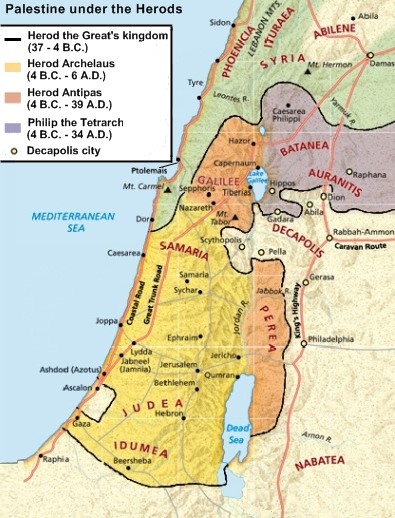
Starting in verse 26, the narrative describes another visit by Gabriel, but this time to a young virgin named Mary. Mary is a relative of Elizabeth, although we are unsure how they are related. Mary is engaged to be married to Joseph, who is a descendant of King David. They both live in a small town of less than two thousand people named Nazareth. Nazareth is located in the region of Galilee, which is part of the kingdom of Herod the Great (see map below). Herod is ruling greater Palestine under the authority of the Roman emperor Augustus.

maps of palestine

Jewish tradition prescribes two stages of marriage: engagement followed by the marriage itself. Robert H. Stein explains in vol. 24, Luke, The New American Commentary:

Engagement involved a formal agreement initiated by a father seeking a wife for his son. The next most important person involved was the father of the bride. A son’s opinion would be sought more often in the process than a daughter’s. Upon payment of a purchase price to the bride’s father (for he lost a daughter and helper whereas the son’s family gained one) and a written agreement and/or oath by the son, the couple was engaged. Although during this stage the couple in some instances cohabited, this was the exception. An engagement was legally binding, and any sexual contact by the daughter with another person was considered adultery. The engagement could not be broken save through divorce (Matt 1:19), and the parties during this period were considered husband and wife (Matt 1:19–20, 24). At this time Mary likely was no more than fifteen years old, probably closer to thirteen, which was the normal age for betrothal.

Gabriel visits Mary and tells her that God has chosen her for a very special role. She will conceive a son and she will call him Jesus. This son will be like no other child that was ever or will ever be born. Gabriel explains to Mary that Jesus “will be great and will be called the Son of the Most High. And the Lord God will give to him the throne of his father David, and he will reign over the house of Jacob forever, and of his kingdom there will be no end.”

Jesus will be the Son of God Himself, the promised Messiah, the promised descendant of David who will reign forever. Jesus will fulfill the prophecies found in 2 Sam 7:12–13, 16; Pss 89:4, 29; 132:12; Isa 9:7; and Dan 7:13–14.

Notice the contrasts between the birth announcement of John the Baptist and of Jesus. Stein writes:

John was ‘great in the sight of the Lord’ (1:15), but Jesus is ‘great’ (1:32), and his greatness is unqualified. Whereas John is later described as ‘a prophet of the Most High’ (1:76), Jesus is the ‘Son of the Most High’ (1:32). Whereas John’s birth was miraculous and had OT parallels, Jesus’ birth was even more miraculous. John’s conception, like that of Isaac, Samson, and Samuel, was miraculous; but Jesus’ conception was absolutely unique. It was not just quantitatively greater; it was qualitatively different. Whereas John’s task was to prepare for the Coming One (1:17, 76–79), Jesus is the Coming One who will reign forever (1:33); and whereas John was filled with the Spirit while still in the womb (1:15), Jesus’ very conception would be due to the Spirit’s miraculous activity in a virgin (1:35–37).

Mary asks Gabriel how she can become pregnant if she is still a virgin. Gabriel answers that the Holy Spirit will “overshadow” her and cause her to conceive. Gabriel does not explain how the Holy Spirit will cause her to conceive a child, but the clear implication is that the child will not have a human biological father. Jesus would be set apart for the service of God, thus he would be the “holy Son of God.”

Gabriel then tells Mary that her elderly relative Elizabeth is already miraculously six months pregnant. For God, nothing is impossible! Recall that this language is similar to what God told Abraham when Sarah laughed about conceiving a child in her old age (Gen 18:14). Mary, unlike Sarah, simply accepted the message from God and said “let it be to me according to your word.”

The remainder of chapter one records the birth of John the Baptist, the great prophet who would one day prepare the way for Jesus.

Chapter two, verses 1-21, present the famous Lukan birth narrative with which every Christian is familiar.

The Roman emperor Augustus Caesar frequently commissioned tax censuses to be taken in the various provinces of the Roman Empire. Evidently there is a census taking place around 4-6 BC. Joseph and Mary travel from their home in Nazareth to the town of Bethlehem, a distance of about ninety miles. Bethlehem is the birthplace of King David and we have already learned that Joseph is a descendant of David. It seems quite plausible that the reason Joseph travels to Bethlehem for the tax census is because he owns property there. Mary and Joseph may have been born in Bethlehem and moved to Nazareth later in life. With a tax census underway, they would need to return to their property so that it could be counted in the census.

After they had arrived in Bethlehem, Mary gives birth to Jesus. She wraps him in swaddling clothes and lays him in an animal feeding trough (manger) because there is no room in the inn. The circumstances of Jesus’ birth have been distorted over the millennia, so let’s take a closer look at what happened.

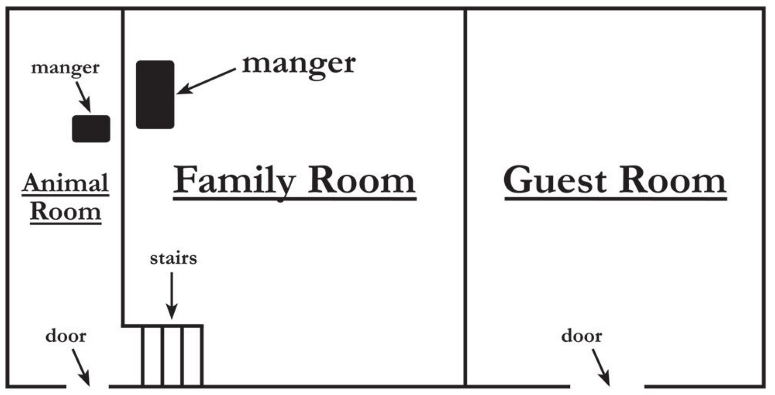
It is highly unlikely, given the importance of hospitality in first century Jewish culture, that Mary and Joseph would be unable to find a place to stay while they were in Bethlehem. It is much more probable that they were staying with family or friends. A typical house at this time consisted of a single story with two rooms, one being a guest room. Take a look at the floorplan below, taken from David A. Croteau’s Urban Legends of the New Testament.

floorplan

According to Croteau, the Greek word translated as “inn” in verse 7 is better translated as “guest room.” So verse 7 should read “She wrapped him in cloths and placed him in a manger, because there was no room for them in the guest room.”

The guest room in the house they were staying must have been occupied by other guests. Therefore Mary and Joseph were sleeping in the family room along with the household owners. Now why in the world are there animal troughs in the house?

It was very common at this time for domesticated animals to be kept in the house with the owners. Croteau explains the typical arrangement:

A first-century house in Israel would have a large family room where the family would eat, cook, sleep, and do general living. At the end of the room there would be some steps down to a lower level, going down only a couple of feet. That lower level would be the ‘animal room’ of the house. There was no wall separating the rooms, just one room with two parts: the family room and the animal room. They would construct it so it slanted slightly toward the animal area for easy cleaning because the exterior door would be in the animal area. On the raised surface in the family room would be a feeding trough for the larger animals carved out of the floor. The larger animals in the animal area, like a cow or a donkey, could walk over and eat out of this trough. The smaller animals, like sheep, would have a smaller manger that would be carved out of the floor in the animal room, or the family might have a wooden trough that could be brought inside.

Given these conditions, Croteau argues that the manger Jesus was laid in was most likely the large feeding trough in the family room.

Verses 8-20 record the famous story of the angelic visitation to the shepherds. The shepherds are tending sheep at night, in an area not too far from Bethlehem. Some scholars speculate that these shepherds are caring for the lambs that will be sacrificed at the temple in Jerusalem, but we can’t be sure. Since shepherds only tended sheep at night during warmer months, it is likely that this took place between the months of March and November.

The angel announces that he has good news for the nation of Israel (that is what Luke means when he says “all the people” in verse 10). The good news is that the promised Messiah is born in Bethlehem (city of David), just as the prophecies predicted. Recall that the events of the book of Ruth (she is an ancestor of David) took place in Bethlehem, and that David grew up in Bethlehem.  Michael J. Wilkins writes,

The announcement of good news (euangelizomai) is a common verb for Luke and has its roots in Isaiah’s announcement of end-time salvation (Isa. 52:7; 61:1). There is also an interesting parallel in an inscription found at Priene celebrating the birth of Augustus. The inscription calls him a ‘savior’ and says that ‘the birth date of our God has signaled the beginning of good news for the world.’ Both of these backgrounds could have had significance for Luke, who has just referred to Caesar Augustus (2:1) and for whom Isaiah’s portrait of salvation plays a leading role (2:32; 3:4–6; 4:18–19). Though Augustus is acclaimed by many as the world’s god and savior, Jesus is the true deliverer.

The shepherds are to go to nearby Bethlehem and search the houses until they find a newborn baby laying in a feeding trough. Given that Bethlehem is relatively small, the shepherds wouldn’t need long to find the baby. When they find this baby, they will know that the angelic visitor has spoken the truth.

The angel is then joined by a multitude of other angels who praise God for the birth of the child. Once the angelic chorus ends, the shepherds immediately hurry to Bethlehem to find the baby. They do indeed find Joseph, Mary, and the baby Jesus, and they proceed to spread the word about this miraculous child, the promised Messiah.

Why did God choose shepherds to be the first to hear the good news of Jesus’ birth? Many important biblical characters were shepherds, including Abraham, Moses, and David. In addition, God is often compared to a shepherd (e.g., Ps 23:1, Gen 49:24, Ps 80:1). It seems only fitting that shepherds would be the first witnesses to the birth of Jesus. Shepherds were also in a lower economic class, so God was demonstrating that the good news was for the poor and humble, not only for the rich.

Commentary on Matthew 1 (Genealogy of Jesus)

The traditional view of the Gospel of Matthew is that it was written by Matthew-Levi, the tax collector and disciple of Jesus, between AD 50-60. Although some scholars believe the Gospel of Matthew was the first Gospel written, a majority believe that it was written after the Gospel of Mark and borrowed heavily from that Gospel.

Michael J. Wilkins, in Matthew, Mark, Luke: Volume One of Zondervan Illustrated Bible Backgrounds Commentary, explains the purposes of Matthew in writing his Gospel:

It is a book that establishes Jesus’ identity as the Messiah, the heir to the promises of Israel’s throne through King David and to the promises of blessing to all the nations through the patriarch Abraham. Against the backdrop of a world increasingly hostile to Christianity, Matthew solidifies his church’s identity as God’s true people, who transcend ethnic, economic, and religious barriers to find oneness in their adherence to Jesus Messiah. His gospel becomes a manual on discipleship, as Jew and Gentile become disciples of Jesus who learn to obey all he commanded his original disciples.

The Gospel of Matthew chooses a different approach to introducing Jesus. Matthew’s strategy is to demonstrate that Jesus Christ is the rightful heir to Abraham and David. He accomplishes this by providing a genealogy that traces the legal lineage from Abraham to Joseph, Jesus’s legal (but not biological) father. Matthew divides the genealogy into three sections of fourteen generations: Abraham to David, David to Jechoniah, and finally Jechoniah to Jesus.

Scholars have noted that Matthew leaves out several names in the genealogy, effectively creating gaps. Why would Matthew do this? Craig Blomberg, in vol. 22, Matthew, The New American Commentary, explains that the key to the groups of 14 have to do with King David, who is the central figure in the genealogy.

When one adds up the numerical values of the Hebrew consonants in his name (DVD), one arrives at the number fourteen (4+6+4). This gematria, as ancient Hebrew numerical equivalents to words are termed, probably accounts for the centrality of the number fourteen in Matthew’s genealogy. Each of the three sections contains fourteen generations (v. 17), and David’s name itself is the fourteenth entry. The actual number of generations in the three parts to the genealogy are thirteen, fourteen, and thirteen, respectively; but ancient counting often alternated between inclusive and exclusive reckoning. Such variation was thus well within standard literary convention of the day.

How did Matthew construct his genealogy? Blomberg tells us the origins of Matthew’s data:

Abraham, Isaac, Jacob, and Judah figure prominently in Gen 12–50. The other male names in vv. 2–6a correspond to 1 Chr 2:3–15. Solomon through Josiah (vv. 6b–11) all appear in 1 Chr 3:10–14 (recalling that Azariah is the same individual as Uzziah—cf., e.g., 2 Kgs 15:1–2 with 2 Chr 26:3—and that there are omissions in Matthew’s list). In vv. 12–16 Jeconiah is a variant form of Jehoiachin, who with Shealtiel and Zerubbabel appear in 1 Chr 3:17–19. But there Zerubbabel is a nephew of Shealtiel, which may suggest that the latter died childless and that the line of succession passed to his brother’s family. In Ezra 3:2, Zerubbabel is legally considered a son of Shealtiel. The rest of the names from Abiud to Jacob are unparalleled, but ancient Jews tried scrupulously to preserve their genealogies; so it is not implausible that Matthew had access to sources that have since been lost.

Another interesting aspect of the genealogy is that Matthew mentions five women (Tamar, Rahab, Ruth, Bathsheba, and Mary), which is unusual in a Jewish genealogy. Why does he do this? With regard to the first four women, Blomberg writes:

Suggestions have included viewing them as examples of sinners Jesus came to save, representative Gentiles to whom the Christian mission would be extended, or women who had illicit marriages and/or illegitimate children. The only factor that clearly applies to all four is that suspicions of illegitimacy surrounded their sexual activity and childbearing. This suspicion of illegitimacy fits perfectly with that which surrounded Mary, which Matthew immediately takes pains to refute (vv. 18–25).

Matthew later explains that Jesus was born of Mary, but that Joseph was not involved in the conception of Jesus. He is his legal father, but not biological father. Blomberg explains that “in fact, the grammar of v. 16 makes clear that Joseph was not the human father of Jesus because the pronoun ‘whom’ is feminine and therefore can refer only to Mary as a human parent of the Christ child.”

Blomberg further explains why Matthew would have been so concerned with including these women in the genealogy when he wrote his Gospel 20-30 years after Jesus’s death and resurrection.

Within the Gospels, Jewish polemic hinted (John 8:48) and in the early centuries of the Christian era explicitly charged that Jesus was an illegitimate child. Matthew here strenuously denies the charge, but he also points out that key members of the messianic genealogy were haunted by similar suspicions (justified in at least the two cases of Tamar and Bathsheba and probably unjustified in the case of Ruth). Such suspicions, nevertheless, did not impugn the spiritual character of the individuals involved. In fact, Jesus comes to save precisely such people. Already here in the genealogy, Jesus is presented as the one who will ignore human labels of legitimacy and illegitimacy to offer his gospel of salvation to all, including the most despised and outcast of society. A question for the church to ask itself in any age is how well it is visibly representing this commitment to reach out to the oppressed and marginalized of society with the good news of salvation in Christ. At the same time, Matthew inherently honors the five women of his genealogy simply by his inclusion of them. So it is not enough merely to minister to the oppressed; we must find ways of exalting them and affirming their immense value in God’s eyes.

Commentary on John 1 (Pre-existence of Jesus)

The traditional view of the Gospel of John is that it was written by John the son of Zebedee and brother of James, the disciple “Jesus loved,” between AD 80-90. Some scholars have suggested that a different disciple named John wrote the Gospel, but thus far that theory has not gained majority acceptance.

John likely wrote the Gospel while he was living in Ephesus, toward the end of his life. The Gospel appears to be the first of five books he wrote, the next ones being the three NT letters that bear his name and the book of Revelation.

Andreas Kostenberger, in John, Acts: Volume Two of Zondervan Illustrated Bible Backgrounds Commentary, explains the purposes of John in writing his Gospel:

To demonstrate that Jesus is the Messiah, the Son of God, by presenting and commenting on seven selected messianic signs. To show that the Christian faith is universal, applying to Jews and non-Jews alike, and the only way to God. To equip believers for mission. To evangelize unbelievers by equipping believers to share the good news.

In chapter one of the Gospel of John, verse 1, the disciple John officially introduces the person of Jesus Christ to the world. John explains that Jesus is the “Word of God” who has always existed with God. As the Word of God, He is co-equal with God Himself.

Why does John use the phrase “Word of God” to describe Jesus? Because that phrase is firmly rooted in the Old Testament. Gerald L. Borchert, in vol. 25A, John 1–11, The New American Commentary, writes:

The phrase ‘the word [dabar] of the Lord’ expresses one of the fundamental ideas of the Hebrew Old Testament. Among the many contexts in which it appears, it was used (1) as the basis for the covenant with Abraham (e.g., Gen 15:1); (2) as the foundation for the establishment of Israel’s laws (e.g., Exod 24:3–4) and the giving of the Ten Commandments (e.g., Deut 5:5); (3) as a clue to the closeness of the relationship of Israel with God (e.g., 1 Sam 3:1); (4) as the stated source for the proclamations of the prophets (e.g., 1 Kgs 13:20; 18:1; Isa 1:10; Hos 1:1; Joel 1:1); (5) as the wise means for guidance (e.g., Ps 17:4); and (6) as the key or way to enlightenment (e.g., Ps 119:105). Yet the creation statement of Ps 33:6 reminds us that in Israel’s thinking the word of the Lord carries in it the concept of an active power. The speaking of God in Genesis 1 is not merely the verbalizing of rationality that is basic to the Greek meaning of logos or the English word ‘logic.’ When God spoke according to the Old Testament, his very speaking initiated the power to create or to order reality.

John packs a tremendous amount of theology into verse 1, which we must not miss. Borchert enumerates John’s teaching in this critical verse:

Verse 1 of the Prologue then is a foundational confession (1) that the Logos has an origin that supersedes the created order of time and space, (2) that this Logos has an identity distinct from the previously understood designations for God, and (3) that the Logos must also be understood as part of the unity of God. Community and unity are in Christian theology two compatible sides of the eternal God. Here then are the beginnings of Christian reflection on the mind-stretching concept that became known as the doctrine of the Trinity.

Verse 2 reiterates John’s statement that the Word (Jesus) has been with God Himself since the beginning. Jesus, therefore, can never be considered a creation of God. Verse 2 rules that out.

Continuing in verse 3, everything that was created in the cosmos was created by Jesus. There is literally nothing that has been created without His action. This verse ties Jesus directly to the creation account in the book of Genesis.

Verses 4-5 communicate that Jesus is the source of all human life, both physical and spiritual. He is also the embodiment or personification of light, and the forces of darkness are unable to overcome Him. Andreas Kostenberger, in John, Acts: Volume Two (Zondervan Illustrated Bible Backgrounds Commentary), elaborates:

Both ‘life’ and ‘light’ are universal religious terms, but John’s teaching is deeply rooted in the Old Testament. At creation, calling forth ‘light’ was God’s first creative act (Gen. 1:3-5). Later, God placed lights in the sky to separate between light and darkness (1:14-18). Light, in turn, makes it possible for ‘life’ to exist. Thus on the fifth and sixth days of creation, God makes animate life to populate both the waters and dry land, culminating in his creation of humankind (1:20-31; 2:7; 3:20).

Now, according to John, life was ‘in him,’ Jesus. Jesus is the source of life, including both physical and spiritual (‘eternal’) life. He also is the source of light, since only those who possess spiritual, eternal life have within themselves the capacity to ‘walk in the light,’ that is, to make moral decisions that are in accordance with the revealed will of God.

Kostenberger adds (commenting on verse 5):

Beneath this contrast between light and darkness lies a significant cluster of Old Testament passages. Most interesting in this regard are several instances in Isaiah that depict the coming Messiah as a light entering the darkness. In Isaiah 9:2, we read that ‘the people walking in darkness have seen a great light; on those living in the land of the shadow of death a light has dawned.’ In Isaiah 60:1-5, a time is envisioned when the nations will walk in God’s light and the glory of the Lord will shine brightly.

In verses 6-8, John takes a detour for a moment and introduces us to John the Baptist. There were followers of John the Baptist living in the 80’s and 90’s AD and the author of the Gospel wants to clarify, for them, who John the Baptist was. The Baptist’s purpose was to point people to Jesus, who is the true light. John the Baptist is not to be mistaken for the light himself.

Verses 9-13 tell us that Jesus was coming into the world, but sadly, even though Jesus made the world and was in the world, the world did not recognize Him. Jesus first went to the Jewish people, but they largely rejected Him. Recall that Isaiah had seven hundred years earlier prophesied this Jewish national unbelief: “Who has believed our message?” (Isa. 53:1).

However, those who do believe in the name of Jesus gain the right to become children of God. You don’t become a child of God based on your family ancestry, you become a child of God because of God’s supernatural intervention.

What does John mean when he says you must believe in Jesus’s name? Names carried much greater importance in Jewish tradition than they do now. A person’s name was to reflect his nature. So to believe in Jesus’s name is to believe in His nature. John has already explained that Jesus is God, that He has always existed, that He created everything (he will reveal more about His nature in verse 14). But what does the name “Jesus Christ” actually mean? Michael J. Wilkins, in Matthew, Mark, Luke: Volume One (Zondervan Illustrated Bible Backgrounds Commentary) explains:

’Jesus’ (Iesous) was the name normally used in the Gospels, derived from the Hebrew Yeshua, ‘Yahweh saves’ (Neh. 7:7), which is a shortened form of Joshua, ‘Yahweh is salvation’ (Ex. 24:13). ‘Christ’ is a title, the transliteration of the Greek Christos, which harks back to David as the anointed king of Israel. The term came to be associated with the promise of a Messiah or ‘anointed one’ who would be the hope for the people of Israel.

Verse 14 is something of a climax in the prologue. Let’s break the verse down. First, it says “And the Word became flesh.” Here John is introducing the doctrine of the incarnation. He is saying that the divine Word of God, who has always existed, added a human nature to His divine nature. Jesus is the God-man, fully God and fully man.

Next, John states that Jesus “dwelt among us.” The word translated “dwelt” actually means “tabernacled” or “tented.” Borchert notes that this “reminds us of Israel’s wilderness experience of God’s presence in the tabernacle or tent of meeting (cf. Exod 25:8–9; 35:7–16; 40:1–38).” God, in Jesus Christ, has come to take up residence among His people once again.

John continues, “[A]nd we have seen his glory, glory as of the only Son from the Father.” Edwin A. Blum, in The Bible Knowledge Commentary writes:

We have seen most naturally implies that the author was an eyewitness. His glory refers to the unique splendor and honor seen in Jesus’ life, miracles, death, and resurrection. The one and only Son (monogenous; cf. John 1:18; 3:16, 18; 1 John 4:9) means that Jesus is the Son of God in a sense totally different from a human who believes and becomes a child of God. Jesus’ sonship is unique for He is eternal and is of the same essence as the Father.

Finally, “full of grace and truth” carry the concepts of loving-kindness and faithfulness. Jesus manifests, in its fullness, the love, care, faithfulness, and fidelity of God.

Verse 15 reiterates John the Baptist’s role as the witness to Jesus’s mission to the world. Andreas Kostenberger explains,

In the context of John’s openings words (where Jesus is portrayed as having existed with God from eternity), the Baptist’s personal confession also points to Jesus’ eternal origin (John 1:14; cf. 8:58; 12:41) and thus his preeminence.

Verse 16 explains that the full blessings of God are bestowed on His children again and again, like waves crashing into the shore.

In verses 17-18 John explains that the Law was given as a gift to mankind through Moses, but the full embodiment of God’s loving-kindness and faithfulness to mankind was given in the person of Jesus Christ. Because Jesus came in the flesh, as a human being, mankind was finally able to see God Himself. Kostenberger adds:

The reason for humanity’s inability to see God is twofold: (1) God is spirit (John 4:24); (2) mankind fell into sin and was expelled from God’s presence (Gen. 3; Isa. 59:2). Jesus surmounted both obstacles: (1) He who is himself God became a human being so that others could see God in him (John 14:9-10); (2) he who was without sin died for us sinners, so that our sinfulness no longer keeps us from entering into fellowship with God (Rom. 5:1-2, 6-11).

Commentary on Nehemiah 1-6 (Rebuilding the Walls of Jerusalem)

The traditional view of the Book of Nehemiah is that it was written by Ezra the scribe as a sequel to the Book of Ezra. Nehemiah contains two main sections: the Nehemiah Memoir (chapters 1-7, 12-13) and the Ezra Memoir (chapters 8-10). These memoirs appear to be first-hand accounts of the activities of Ezra and Nehemiah during the years of 445 – 433 BC.

According to Barrett Duke in The Apologetics Study Bible, the Book of Nehemiah

relates the continuing efforts of the Jewish people who returned from 70 years of captivity in the Babylonian Empire to reestablish themselves in their homeland. The principal person in this part of the history is Nehemiah, a Jew who had attained the influential position of cupbearer in the court of the Persian King Artaxerxes. Nehemiah was the last in a succession of Jewish leaders in the biblical record to help the people achieve a stable and vibrant life in the Persian province known as Yehud, or Judah. Nehemiah followed Sheshbazzar (who led the first return), Zerubbabel (who led the temple rebuilding project), and Ezra the priest and scribe (who led the spiritual renewal of the people). Nehemiah’s principal contribution to the emerging community was the rebuilding of Jerusalem’s wall, which had been destroyed in 586 b.c. by the Babylonians.

Prior to the beginning of events recorded in the Book of Nehemiah, the Persian king Artaxerxes had ordered work on the walls of Jerusalem to be halted, citing the rebellious history of Jerusalem. However, he did allow Ezra, a prominent Jewish scholar, to lead another group of Jews back to Jerusalem from Babylon in 458 BC. The Chronological Study Bible (NKJV) explains the significance of Ezra:

Ezra’s focus and authority was Scripture, which at that time meant the Books of Moses. In the years before the Exile, Scripture had not been treated as particularly significant. Indeed, when a part of the Law of Moses was found and read during King Josiah’s reign, the king and people had evidently never heard such a message before (2 Kin. 22: 8– 13). Israelite worship had been concentrated on the temple, not the law. During the Exile, though, that changed. Without a temple, the Jews had to find a new center for their faith. They became the people of the Book. In this context, a new kind of religious leader arose. The Hebrew word for these leaders, usually translated ‘scribes,’ means in a sense ‘bookmen,’ learned men who were able to read and write. Ezra represents this new sort of leader. Although he is from the high priestly line of Aaron (Ezra 7: 1– 5), his true authority comes from his standing as ‘a skilled scribe in the Law of Moses’ (7: 6).

Ezra was more concerned with the spiritual condition of the returned exile community than repairs to Jerusalem itself. In fact, even though a new temple had been completed in 515 BC, the walls and gates protecting Jerusalem were still in disrepair due to Artaxerxes’ earlier decree. This brings us to the year 445 BC and the Book of Nehemiah.

In chapter one, verses 1-3, Nehemiah hears from his brother Hanani that the walls and gates of Jerusalem are still destroyed. Nehemiah is living in Susa, the winter capital of the Persian Empire. We soon learn that Nehemiah is one of the most trusted aides to Artaxerxes, king of Persia.

Upon hearing this news, Nehemiah mourns and prays to God. Nehemiah’s prayer consists of: 1) acknowledgment of and praise for who God is, 2) confession of his sins and the sins of Israel, 3) reminder of God’s promises to Israel if they will repent, and 4) a request to help Nehemiah when he approaches King Artaxerxes.

Mervin Breneman, in vol. 10, Ezra, Nehemiah, Esther, The New American Commentary, writes:

Nehemiah’s prayer was based on God’s Word. As Kidner notes, even though Nehemiah, like all of us, had to come before God empty-handed, with nothing deserving the Lord’s favor or even attention (indeed, just the opposite), he nevertheless did not come uninvited. Most of this prayer is based on Deuteronomy, many phrases of which are practically the same. Nehemiah realized that God justly punished Israel, but he reminded God that this very situation had been anticipated in Deut 4:25–31 and of his promise of mercy, faithfulness, and forgiveness.

Nehemiah realized that God had fulfilled much of Deut 30:1–10; but he was convinced that God’s promise included more than the situation in which the Jerusalem community found itself at that moment. Thus, Nehemiah’s prayer shows a profound understanding and faith in what God had promised in his Word. Nehemiah challenges us to prayer based on an understanding of God’s purpose and will as found in his Word. He also reminds us that we can always begin again in our relationship with God if we return to him in humility.

Approximately four months later, after much prayer and planning, Nehemiah is ready to speak to Artaxerxes. As Nehemiah is tasting wine and then giving it to Artaxerxes (his job was to taste everything before the king did so that the king could not be poisoned), the king notices a profound sadness in Nehemiah and asks him what is the matter. With great tact and humility, Nehemiah asks the king to allow him to return to rebuild the walls of Jerusalem. He also asks for letters to be given to the rulers of the provinces Nehemiah must travel through, as well as orders to provide timber from the forests under Artaxerxes’ control. The timber would be used to construct the walls of Jerusalem. Due to God’s intercession, Artaxerxes grants Nehemiah everything he requests! Artaxerxes’ permission to rebuild the city of Jerusalem fulfills the decree Daniel had prophesied 95 years earlier in 539 BC (see Dan 9:25).

About a month after Nehemiah is given permission to return to Jerusalem, he departs. The journey lasts 2-3 months, which puts Nehemiah in Jerusalem in the June-July timeframe. Immediately upon arrival he inspects the walls around Jerusalem, devises a plan to rebuild, and rallies the people of Judah to do the work.

In chapter four, verse 6, we learn that the wall has been rebuilt to almost half of its original height in just a few weeks! The progress on the wall has greatly upset the leaders of the provinces surrounding Judah. Sanballat is governor of Samaria, the province just north of Judah. Tobiah is likely the governor of Ammon, a province just east of Judah on the other side of the Jordan River.  The Arabians border Judah to the south and the province of Ashdod borders them on the west. The leaders of these provinces plot to attack Jerusalem, but first spread rumors about their plan in the hope that the Judahites will abandon their plans to complete the wall out of fear.

Nehemiah prays to God and then continues to rebuild the wall. In order to protect the people of Jerusalem, he institutes safety measures. To prevent their enemies from breaching and/or destroying the walls at night, he stations family units at low points in the wall to guard it. His reasoning is that family members will fight to protect each other more so than if family members are spread out around different portions of the wall. During the day, while construction is going on, he assigns half of the people to stand guard with weapons and the other half to build. Those who could work with only one hand would hold a weapon in their other hand.

Nehemiah reminds the people in verse 14, “Do not be afraid of them. Remember the Lord, who is great and awesome, and fight for your brothers, your sons, your daughters, your wives, and your homes.” Gene A. Getz, in The Bible Knowledge Commentary, writes,

After praying, Nehemiah and the Jews continued with the work. Some Christians pray and then wait for things to happen, but not Nehemiah! As in all his efforts, he blended the divine perspective with the human. He faced Sanballat’s opposition with both prayer and hard work. Once he committed the problem to the Lord, he trusted God to help them achieve their goal.

Finally, in chapter six, verses 15-16, we read that the wall is completed in just fifty-two days! Against all the odds, Nehemiah and the people of Judah rebuilt the walls of Jerusalem in a very short period of time. The text concludes that the surrounding provinces had to admit that God was with the Judahites, because there was no other way they could have accomplished such a feat.

Mervin Breneman writes,

Judah’s enemies tried to make Nehemiah and the Jews afraid; but in the end they were the ones who feared (cf. Deut 2:25; 1 Chr 14:17; Ps 126:2; Mal 1:11, 14) because they realized God had done something astonishing in this community. The phrase ‘and lost their self-confidence’ is literally ‘and they fell very much in their eyes,’ an unfamiliar idiom but one suggesting their pride had suddenly vanished (cf. Prov 16:18–19; 29:23). Though the enemies increased because of Sanballat, the result was that more people were impressed with God’s power (4:1, 7).

The historical narrative contained in the Old Testament ends in the Book of Nehemiah around 433 BC. Zondervan’s NIV, The Story, provides a quick summary of the events which occurred after 400 BC, leading up to the birth of the Messiah:

For 400 years after Malachi’s prophecies, no prophets or leaders rose to the level of inclusion in the record of Holy Scripture. For this reason, the period is sometimes referred to as the ‘silent years.’ In actuality, these years of social and political upheaval were anything but silent for the Jewish people.

The Maccabean revolt against the Seleucids during the second century BC was one of the most heroic eras of Jewish history. During these 400 years numerous significant writings were produced as well. The Qumran community copied the books of Isaiah, the Psalms, Deuteronomy and other sacred writings. These ancient manuscripts were discovered by a shepherd boy in AD 1947 near the Dead Sea and are known today as the ‘Dead Sea Scrolls.’

The Deuterocanonical books, or books of the Apocrypha, accepted as Holy Scripture by the Roman and Eastern churches, were written in the years between the Old and New Testament. The Septuagint, the Greek translation of the old Testament, was also an important product of the period. It became the Bible for Greek-speaking Jews outside Palestine and later for the early church.

But God’s story wasn’t finished. ‘When the set time had fully come,’ as the apostle Paul put it, God spoke again— this time in the person of Jesus the Messiah, the Son of God, whose birth, life, death and resurrection changed everything.”

The story continues!

Commentary on Ezra 1-6 (Return from Babylon)

The traditional view of the book of Ezra is that it was written by Ezra the scribe and completed around 400 BC. The Book of Ezra appears to be a continuation of 1 and 2 Chronicles, which leads some to posit that a single author composed both. In addition, many scholars agree that the author of Ezra is also the author of Nehemiah, so it is possible that a single author was responsible for all three books. There is more certainty, however, that Ezra and Nehemiah were composed by a single author.

The Book of Ezra is a history of the early days of the return of the Jewish people from their 70 years of captivity in Babylon. The book spans 538 BC to around 456 BC. Ezra 1-6 describes the return from Babylon under the leadership of Sheshbazzar and Zerubbabel, and the rebuilding of the Jerusalem temple. Ezra 7-10 is Ezra’s own account of his activities as priest and scribe to order the life of the returned Jewish community according to biblical standards.

The Medo-Persian King Cyrus conquers Babylon in 539 BC. The very next year Cyrus starts to overturn the policies of the Babylonians with regard to the exile communities living in their midst. In verses 1-4 of chapter one, Cyrus decrees that the Jews in Babylonian exile may return to their homeland in Judah and rebuild the temple. In addition, Cyrus would provide monetary assistance for the construction of the temple.

Why would Cyrus do this? The Chronological Study Bible explains:

Certainly Cyrus believed that his empire was built with the help of the god who ruled over the entire earth. In writing to various peoples, he called that deity by the name of the highest god of the people to whom he wrote. This might be a classic case of political propaganda, or Cyrus may have assumed that there was one god, who was called different names by different peoples. In either case, Cyrus both appealed to the gods to support his kingship and to the peoples of his new empire to accept him as rightful ruler.

John A. Martin, in The Bible Knowledge Commentary, adds that

Cyrus’ concern was to establish strong buffer states around his empire which would be loyal to him. Also by having his subject peoples resettled in their own countries he hoped to have the gods in various parts of his empire praying for him to his gods Bel and Nebo. The famous Cyrus Cylinder (538 B.C.), which records his capture of Babylon and his program of repatriating his subject peoples in their homelands, includes this statement: ‘May all the gods whom I have resettled in their sacred cities daily ask Bel and Nebo for a long life for me.’

Although Cyrus is the king who allows the Jews to return from exile, the author is careful to note that God is responsible for Cyrus’s decision. Both Jeremiah and Isaiah had prophesied that the Jews would be freed from Babylonian rule by Cyrus, with Jeremiah even predicting the date this would occur. God made sure these prophecies would come to pass. He is sovereign over all the affairs of the world.

Tens of thousands of Jews decide to take up Cyrus’s offer to return to Judah. Their Babylonian neighbors assist them with silver, gold, animals, and other goods that would help them get resettled in Judah (reminiscent of the Israelites leaving Egypt). Cyrus orders all of the treasures that were taken by Nebuchadnezzar from the temple to be returned to the Jews. The Jews begin their trek to their homeland under the command of Sheshbazzar.

As we move to verses 8-13 in chapter three, two new leaders have taken charge of the post-exilic community in Jerusalem: Zerubbabel and Jeshua. Zerubbabel has evidently succeeded Sheshbazzar as political leader of the community and Jeshua is acting as the religious leader, or high priest.

In the second year after their arrival, they begin to construct the foundations of the new temple. When the foundation is completed, there is a great celebration which is patterned after King David’s celebration of the Ark being brought to Jerusalem. After 70 years in exile, the people of Judah sing about God, “For he is good, for his steadfast love endures forever toward Israel.”

In the midst of shouting and praise, the older members of the community, who had seen Solomon’s temple before it was destroyed, are weeping because they realize that the new temple they are constructing is inferior to the grandeur of the original temple. The prophet Haggai, some years later, would reassure the people of Judah that the new temple would outshine the old.

“’The latter glory of this house shall be greater than the former, says the LORD of hosts. And in this place I will give peace, declares the LORD of hosts.’”

Why? Because the Son of God, the Messiah, Jesus Christ Himself would enter the new temple and bring it unparalleled glory because of His presence.

Even though construction of the new temple is started in 536 BC, the people of Judah would not finish until 515 BC, 21 years later. Why did it take so long? Ezra 4:1-5 provides one reason: the hostility of the people living around Jerusalem.

Who are these enemies and adversaries of post-exilic community? John Martin writes,

The enemies of Judah and Benjamin refer to the people living in Palestine since the time of the fall of the Northern Kingdom in 722 B.C. . . .

The ‘enemies’ (called ‘the peoples around them,’ Ezra 4:4) were the descendants of these mixed peoples and the forefathers of the New Testament Samaritans. These people in Ezra’s day claimed that they worshiped the same God, that is, Yahweh, the God of Israel. But they had a syncretistic form of worship; they worshiped both Yahweh and others (2 Kings 17:29, 32–34, 41). Therefore their statement (Ezra 4:2) was not fully accurate and was apparently made to mislead the leadership of the returned band.

The enemies of Judah request to participate in the construction project. They argue that since they worship the same god as Judah, then they should help build the temple. However, Zerubbabel and Jeshua refuse to let them build the temple. Why? Walter C. Kaiser, Jr., Peter H. Davids, F. F. Bruce and Manfred T. Brauch, in Hard Sayings of the Bible, write,

Zerubbabel’s refusal to accept help, then, must not be viewed as being sinfully separatistic or just plain mistaken. No doubt the leaders of the province of Samaria viewed the emergence of a new, aggressive presence in Judah, one that enjoyed the favor of the imperial government of Persia, as a threat. Hence their offer to help in sharing the costs and labor in building the temple would have entailed a certain amount of control in the temple itself. It would appear that the offer had more of the overtones of political power than of pure neighborliness. It was for this reason that Zerubbabel refused help from these who usually were their enemies.

When Zerubbabel and Jeshua refuse to allow them to participate, the enemies’ next move is to begin a campaign of harassment against the workers. This campaign likely consisted of threats of bodily harm and property damage. Mervin Breneman, in vol. 10, Ezra, Nehemiah, Esther, The New American Commentary, speculates that the counselors in verse 5 “may have been Persian officials bribed to obstruct the builders in every possible way.” The author notes that the harassment continued for decades.

Work on the temple stops from 535 BC to 520 BC. Two prophets, Haggai and Zechariah, encourage the people of Judah to start building again, and they succeed. John Martin reflects on the role of these two prophets:

They were vitally concerned with the building of the temple because they realized that their nation could never fulfill the obligations of the Mosaic Covenant till the temple worship was reinstated. Both of these prophets placed the blame for the hard times the nation experienced during this period on the people’s lack of obedience in not rebuilding the temple. However, Ezra did not deal with that question in his book. He stressed the outside opposition which was also a factor in slowing the work.

As soon as work resumes, however, a Persian governor, Tattenai, intervenes and writes a letter to King Darius about the temple construction. King Darius investigates and finds the original decree signed by Cyrus which gave the Jews permission to build the temple.

In chapter 6, verses 6-12, Darius writes back Tattenai and gives him instructions to not impede the Jews, and to instead help them finish the project with financial assistance. Anyone who disobeys the decree is to be impaled and have their house destroyed.

Tattenai dutifully obeys Darius and helps the Jews finish the temple. The construction is finally completed in 515 BC. Mervin Breneman summarizes this historic occasion:

This victory of God’s people clearly displays the providence of God at work through these pagan potentates. God in his providence works everything together to fulfill his plan. He used the prophets Haggai and Zechariah to inspire the people to work; he used the kings’ decrees to open doors and provide the means. The author displayed the holy enthusiasm all Christians should share when they realize they are part of God’s plan to fulfill his kingdom.

Commentary on Daniel 3 (Shadrach, Meshach, and Abednego Refuse to Bow)

The events of chapter three are hard to date, but it seems that they take place within a few years of Daniel’s interpretation of Nebuchadnezzar’s dream. Inspired by the statue in the dream, the king builds a statue which is 90 feet high, ten feet wide, and overlaid with gold. This is the height of a nine story building. The statue is built on an elevated plain outside of the ancient city of Babylon. Construction on the plain would make the statue easy to see from a long distance. J. Dwight Pentecost, in The Bible Knowledge Commentary, writes,

Archeologists have uncovered a large square made of brick some six miles southeast of Babylon, which may have been the base for this image. Since this base is in the center of a wide plain, the image’s height would have been impressive. Also its proximity to Babylon would have served as a suitable rallying point for the king’s officials.

It is unclear whether the statue is made to look like Nebuchadnezzar or one of the gods of the Babylonians. It may have even been a mixture of the two. In any case, the image carved into the statue was meant to be worshiped.

When the statue is finished, Nebuchadnezzar assembles Babylonian government officials from all over the empire. There are likely hundreds of these officials brought to dedicate the image. Pentecost explains who is in attendance.

The satraps were chief representatives of the king, the prefects were military commanders, and the governors were civil administrators. The advisers were counselors to those in governmental authority. The treasurers administered the funds of the kingdom, the judges were administrators of the law, and the magistrates passed judgment in keeping with the law. The other provincial officials were probably subordinates of the satraps. This list of officers probably included all who served in any official capacity under Nebuchadnezzar.

As they are standing in front of the statue, a herald announces that when the orchestra begins to play, everyone is to bow down and worship the image Nebuchadnezzar has built. Refusal to bow down to the statue will result in execution by furnace. The furnace that had likely been used to build the statue was now acting as a death chamber.

Why would Nebuchadnezzar build this giant gold statue and then command his government officials to bow down and worship the statue? His reasoning is likely that it would unite his new empire and consolidate his authority. Iain M. Duguid, in Daniel, Reformed Expository Commentary, notes that

this act of worship was designed to reverse the consequences of the original Tower of Babel by unifying the whole world in an act of submission to this statue. When the music of a cacophony of different instruments sounded, everyone was to bow down to the statue. Sure enough, when the music rang out, ‘all the peoples, nations and men of every language fell down and worshiped the image of gold that King Nebuchadnezzar had set up’ (3:7). For a moment, the whole world was united in bowing to Nebuchadnezzar’s statue. The curse of Babel had, it seemed, successfully been reversed.

When the orchestra begins, everyone bows down except for three men – Shadrach, Meshach, and Abednego. Unnamed officials, who are undoubtedly jealous of the powers given to the three Jewish men, inform Nebuchadnezzar that Shadrach, Meshach, and Abednego did not bow down as commanded. No mention is made of Daniel, so it seems that he was not required to attend the ceremony. He was perhaps left in the city of Babylon to administer while the rest of the government attended the dedication of the gold statue.

Nebuchadnezzar brings the three Jews before him and gives them one more chance to bow down to the statue. The three Jewish men refuse and express confidence that God will save them from the furnace, but even if He does not, they will still not worship the gods of Babylon. Duguid explains,

Shadrach, Meshach, and Abednego did not presume to predict what the outcome would be in their case. If God were our servant, or our accomplice, he would be predictable: he would always do our bidding. Shadrach, Meshach, and Abednego understood that since God is sovereign, however, it was his choice whether he opted to be glorified in their deaths or through their dramatic deliverance. Either way, it didn’t make a difference to their decision. Whether they were miraculously delivered or left to burn in the fire, Shadrach, Meshach, and Abednego would not compromise their commitment to the Lord. Live or die, they would be faithful to their God.

Nebuchadnezzar orders the furnace to be heated to maximum intensity. Soldiers tie up the Jews and carry them to the opening in the top of the furnace and drop them in. The fire is so intense that the soldiers carrying the Jews are killed by the flames shooting out the top.

As Nebuchadnezzar watches at a safe distance, he is shocked at what he sees. The furnace would have an opening on the side of it where fuel could be added and ashes could be removed. As the king peers into this opening, he sees four people walking around, apparently unharmed. The fourth person appears to be some sort of divine being. The identity of this divine being could be an angel or the pre-incarnate Jesus Christ Himself. It’s impossible to know from the text.

The king approaches the furnace and orders the three Jews to come out of the opening on the side. When they step out of the furnace, they are untouched by the fire. In fact, their clothes do not even smell from the fire of the furnace.

The king, who has clearly seen a miracle, praises the God of Shadrach, Meshach, and Abednego for saving their lives. He then decrees that anyone who speaks against the God of Shadrach, Meshach, and Abednego will be executed and have their property destroyed.

Although Nebuchadnezzar has just seen a miracle, he still does not pledge his personal allegiance to Yahweh. He merely expresses respect for the God of the Jews. Why is this? Duguid offers the following analysis:

Yet even great miracles don’t have the power in themselves to change people’s hearts. People will always find a way to explain them away. So too Nebuchadnezzar’s heart was not changed at a deep level by this experience. The God of whom he spoke was still ‘the God of Shadrach, Meshach, and Abednego,’ or ‘their God,’ not his own. He still would not fall down in the face of this revelation of the Lord’s power and confess, ‘My Lord and my God.’

Sadly, there are many who respond in exactly the same way to the message of the cross and resurrection of Christ, and other demonstrations of God’s mighty power. When you tell them what the Lord has done, they say, ‘I’m glad you’ve found something that works for you. I’m happy for you. But don’t ask me to submit to your God.’ Sooner or later, though, they will be forced to bow their knee before the Lord and confess his power and his glory. Such a confession on that day will save no one: it will be a bare recognition of the nature of reality. The confession that saves is the one that bows joyfully now before the Lord and confesses him, ‘My Lord and my God, my only hope in life and death.’