Category Archives: Books of the Bible

Commentary on Exodus 4 (Moses Returns to Egypt)

Post Author: Bill Pratt 

Chapter 4 of Exodus can be split into 3 sections: Miraculous Signs for Moses, Moses’ Return to Egypt, and the Reunion of Moses and Aaron.

The first section (Miraculous Signs for Moses) starts at verse 1 and goes through verse 17. In verse 1, Moses expresses, for the third time, his reluctance to go back to Egypt. Moses asks, “What if they do not believe me or listen to me and say, ‘The LORD did not appear to you’?”

God then provides three miraculous signs that are to be given to the Israelites to prove that Moses is a true messenger from God. First, his shepherd’s staff would turn into a serpent and then back into a staff. Second, Moses’ hand would become leprous, and then return to normal. Third, water from the Nile would be transformed into blood.

Each of these miracles were meaningful to the Israelites. The staff/serpent miracle represented God’s power over Pharaoh, as Pharaoh was represented by a serpent. The leprous hand miracle symbolized God saving Israel from their suffering. The Nile River-becoming-blood miracle indicated God’s power over all of the Egyptian gods.

Even after these assurances, though, Moses still protested, this time saying that he was not eloquent of speech. God reminds Moses that He is the creator of the human mouth and that He will teach Moses what to say, but Moses continues to protest, angering God.

Because Moses refuses to speak for Him to Pharaoh and the Israelites, God suggests that Moses take along his brother, Aaron, to speak for Moses. This situation is illustrative of what happens when a child of God refuses to do what God wants done. Instead of God being thwarted, He simply brings in another person to complete the tasks. Man’s refusal to obey God does not prevent God’s plans from being accomplished.

The second section of Exodus 4 takes place in verses 18-26. God tells Moses in verse 19 that it is safe for him to return to Egypt because all of the people who wanted him for murder are dead. Moses then starts back toward Egypt with his wife and two sons, Gershom and Eliezer.

In verses 21-23, God tells Moses what to say to Pharaoh. God also tells him how Pharaoh will react to his words, and what the consequences of his reaction will be. After Moses shows the miraculous signs to Pharaoh, his heart will be hardened. In other words, Pharaoh will become more and more stubborn and refuse to give in to Moses’s requests. God warns Moses that Pharaoh’s stubbornness will eventually lead to Pharaoh losing his firstborn son.

In verses 24-26, there is a brief episode where Moses’s wife, Zipporah, circumcises their son in order to save his life. Even though the NIV translates verse 24 as Moses being the one God would kill, there is reason to believe from the Hebrew text that it was his son that would be killed. These verses remind us that God will hold his people accountable for obeying him. Moses, as the future leader of Israel, was disobeying a clear command from God to have his sons circumcised. Fortunately his wife acted quickly to resolve the crisis.

In the third section of chapter 4, Moses and Aaron reunite and together go back to Egypt to meet with the elders of the Israelites. Aaron tells the elders everything God commanded Moses to say, and he performs the miraculous signs that would prove they were true messengers of God. The Israelites were convinced and bowed down to worship God.

Commentary on Exodus 3 (Moses and the Burning Bush)

Post Author: Bill Pratt 

Chapter 3 of Exodus recounts one of the most famous passages in all of Scripture, the story of Moses and the Burning Bush. Moses is tending his father-in-law’s flocks near a mountain called Horeb. Some scholars believe that this mountain is identical with Mount Sinai, where Moses would later receive the Ten Commandments.
At the mountain, Moses sees the angel of the Lord appearing as flames burning in a bush, but the bush is not consumed by the fire. In verses 4-6, God calls out from the bush (“angel of the Lord” and “God” are sometimes used synonymously) and identifies himself as the “God of your father, the God of Abraham, the God of Isaac and the God of Jacob.”

God gets straight to the point with Moses and tells him, in verses 7-10, that he is to go back to Egypt and bring the Israelites out of captivity, and then take them “into a good and spacious land, a land flowing with milk and honey.” This is the land that was promised to Abraham, Isaac, and Jacob, by God. After long years in Egypt, the descendants of Abraham would finally receive their inheritance.

Moses, however, had doubts about his own abilities, so he asks God exactly how He will get the people out of Egypt. God then reassures Moses over the next 10 verses by promising that He will be with him.

First, he assures Moses that the Israelites will be brought out of Egypt and travel back to this very mountain, to worship.

Second, God tells Moses to inform the elders of Israel that “I am who I am” is the God who sent Moses to them. This is the same God as the “God of your fathers—the God of Abraham, the God of Isaac and the God of Jacob.” This name of God (“I am who I am”) can be paraphrased as “It is I who am with you.” Recall that to the ancient Hebrews, names conveyed the essence of who a person was. So God is reminding the Israelites that the one who promised to be with them sent Moses.

God is also called Yahweh, which means “he who is present” or “he who has promised to be present with his people.”

Third, Moses, after having identified God, is to tell the elders of Israel that God has heard their cries and is going to bring them out of Egypt and “into the land of the Canaanites, Hittites, Amorites, Perizzites, Hivites and Jebusites—a land flowing with milk and honey,” or the Promised Land.

Fourth, God foretells that Moses will ask Pharaoh (king of the Egyptians) permission for the Israelites to go out into the desert and worship for three days, but Pharaoh will refuse. God will then strike the Egyptians with “wonders” and then Pharaoh will let them go.

Finally, God predicts that the Israelites will ask the Egyptians for “articles of silver and gold and for clothing,” and that they will give these things to them as the Israelites leave. Thus the Israelites will be paid back for the suffering they endured under Egyptian rule.

It is important to note that verses 18-22 are all predictions of what will happen in the future. The reader who studies the rest of the book of Exodus will see that all that God promised to Moses in Exodus 3 does come to pass. Again, the message to the reader is that God is in control. Nothing that Pharaoh can do will thwart God’s plans.

Commentary on Exodus 2 (Birth of Moses)

Post Author: Bill Pratt 

After Pharaoh’s previous failures, he tries yet another approach to break the will of the Hebrews. In verse 22 of chapter 1, he decrees that every male child of the Hebrews must be thrown into the Nile River.

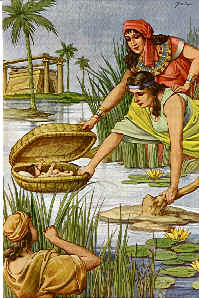
One boy, however, is not immediately thrown into the Nile, but is hidden by his parents. We know that these Hebrew parents are descended from Levi, one of Jacob’s twelve sons. Once the boy is old enough so that he can no longer be hidden (3 months), his mother places him in a papyrus basket and sets him among some reeds along the edge of the Nile. The boy’s older sister (we learn her name is Miriam from Ex 15:20) is told to watch what happens to him.

None other than Pharaoh’s own daughter spots the basket and discovers that it contains a Hebrew infant. The baby’s sister, having watched this play out, then offers assistance to the Pharaoh’s daughter. The baby’s own mother is paid by Pharaoh’s daughter to nurse the child! After he is done nursing (somewhere between 2 and 5 years later), the boy is returned to the Pharaoh’s daughter, and she names the child Moses.

There is great irony in this narrative because Moses’s mother places Moses in the Nile River, just as Pharaoh decreed, and Moses is rescued from the Nile by Pharaoh’s own daughter. No matter what Pharaoh plans, he is always thwarted by God. God is in control of events, not Pharaoh.

Starting in verse 11, the remainder of Exodus 2 records several significant events in Moses’ life.  Acts 7:22 claims that “Moses was instructed in all the wisdom of the Egyptians and was powerful in his words and deeds,” but his peaceful and privileged upbringing would soon come to a tumultuous end.

In verses 11-14, we learn that Moses killed an Egyptian who was beating a fellow Hebrew. According to Acts 7:23, this happened when Moses was approaching 40 years old. There is definite foreshadowing here, as Moses will deliver Israel from oppression just as he delivered the Hebrew from being beaten. Moses subsequently learns that his crime has been discovered and Pharaoh attempts to kill him for it.

In order to save his life, Moses flees Egypt to a place called Midian. He comes to the aid of some women at a well, and the father of these women invites Moses to marry into his family, taking his daughter Zipporah as a wife. Moses and Zipporah have a son and name him Gershom, which means “I have become an alien in a foreign land.”

According to John Hannah in The Bible Knowledge Commentary, “For 40 years (Acts 7:30) Moses undertook the toilsome life of a sheepherder in the Sinai area, thus gaining valuable knowledge of the topography of the Sinai Peninsula which later was helpful as he led the Israelites in that wilderness land.”

Verses 23-25 remind the reader that many years pass and the Pharaoh who tried to kill Moses dies. More significantly, “God heard their groaning and he remembered his covenant with Abraham, with Isaac and with Jacob.” God will not forget his promises to the Patriarchs.

Commentary on Exodus 1 (The Israelites Oppressed)

Post Author: Bill Pratt 

Verses 1-5 remind the reader that 70 people came down to settle in Goshen, which is a district of Egypt situated in the northeast corner of the nation. The twelve sons of Jacob (Israel) are listed and grouped according to their birth mothers. The numbering of 70 is a reference back to Gen 46:27 where all of the descendants of Jacob who entered Egypt are named.
In verses 6-7, we learn that after Joseph and all his brothers died, the Israelites experienced tremendous population growth. Note the similarity between Gen 1:28 and Ex 1:7. God had commanded Adam and Eve to be fruitful and multiply, and that is exactly what the Israelites have done.

Goshen was a land of great natural resources that allowed the Israelites to settle down and practice agriculture instead of being primarily nomadic, as their ancestors were. The stable food supply undoubtedly contributed greatly to their prosperity. Things were going so well for the Israelites, they had forgotten that they were strangers in a strange land. Their home was to be in Canaan, not Egypt.

Although the Israelites had lived in Goshen for hundreds of years, their life in Egypt was about to be massively disrupted.  Egypt, like any other nation, experienced political turmoil and changes in governance. The writer of Exodus announces that a new king (Pharaoh) came to power, and this king, evidently, either knew nothing or cared nothing about Joseph’s role in Egyptian history.

Some historians have speculated that the new king knew about Joseph, but because the king was bringing a new regime into power that was very different ethnically (non-Semitic) from the previous regimes, he no longer trusted the Hebrews (who were Semitic) to align themselves with his regime’s interests. Since Goshen bordered Canaan, where Egypt’s enemies were located, the Israelites could easily ally themselves with Canaanite nations who wanted an easy path into the heart of Egypt.

The new Pharaoh’s first plan to deal with the Israelites was to enslave them. They would be forced to build the store cities of Pithom and Rameses. However, contrary to his plans, the Israelites continued to increase in number. The clear message here is that the Gentile king of Egypt cannot thwart God’s plans for his people. The Pharaoh’s plans simply backfire on him.

Starting in verse 15, Pharaoh tries plan B to stop the multiplication of the Israelites. He calls two of the Hebrew midwives to him (they were probably leaders or representatives of a much larger number of midwives), and commands them to kill the boy babies when they are born. The midwives, Shiphrah and Puah, however, decline to obey Pharaoh, and let the boys live.

The reason given for the midwives disobeying Pharaoh is that they “feared God.” The message to the reader is that when a person in authority over us gives us a direct command that contradicts God’s unmistakable will, we are to disobey.

The midwives, when questioned by Pharaoh, tell him that Hebrew women give birth more quickly than Egyptian women, and so the midwives arrive too late to kill the baby boys. In the context of the narrative, the midwives are obviously lying to Pharaoh, but they are lying to save lives.

It is reasonable to assume that Pharaoh is counting on the midwives to surreptitiously kill the newborns without the mothers realizing what is going on. The plan counts on the skills and obedience of the midwives to carry it out. If the Hebrew mothers catch on, they will simply avoid using the midwives.

If Shiphrah and Puah refused to go along, it is reasonable to assume that Pharaoh would find other midwives to kill the Hebrew boys. By convincing Pharaoh that the plan simply won’t work because of how quickly Hebrew women gave birth, Pharoah abandoned the plan altogether instead of drafting more midwives.

Pharaoh’s plan B, to control the Israelites, backfires on him, just as his first plan did. The Israelites “became even more numerous” and because the midwives feared God and saved the lives of the baby boys, the midwives were also rewarded with families of their own.

Do the Genealogies Allow Us to Date the Events of Genesis 1-11?

Post Author: Bill Pratt 

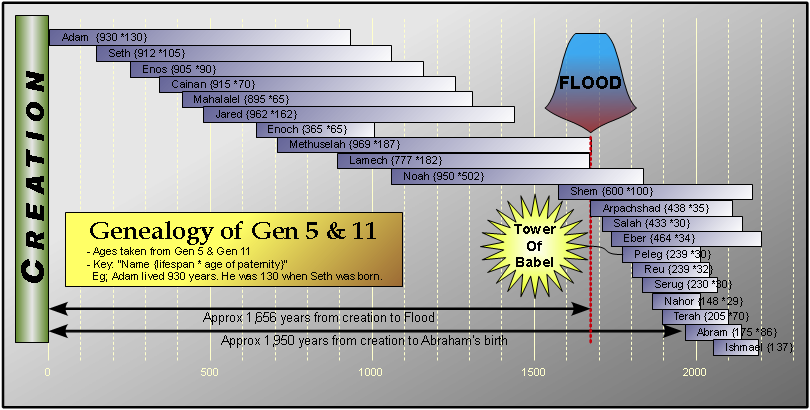
A few Christians have mistakenly supposed that they can use the genealogies in Genesis 5-11 to add up the number of years between Adam and Abraham.  By doing this math, they surmise that the world was created somewhere around 4000 BC.

Hebrew scholars, however, have pointed out that the genealogies are not meant to give exact lineages, such as one might find on ancestor.com.  They often would skip many generations, as they were focused on particular ancestors for particular reasons.

We know that the biblical authors did this.  For example, Matthew’s genealogy of Jesus consists in three sets of 14 generations.  The number 14 was important because 7 was thought to symbolize completion or perfection.  But we know that when Matthew says that “Joram fathered Uzziah,” he omits three generations (see 2 Ch 21:4-26:33) so as to accomplish the desired pattern of 14.  In Hebrew, to say someone “fathered” someone else can also mean that they are an ancestor or forefather of that person.  It does not always mean that they are the parent of the person.

The bottom line is that one has to be very careful with interpreting genealogies in the Bible.  They cannot be used to precisely date any event without other corroborating data.

Commentary on Genesis 44-45 (Joseph Reunites with His Family)

Post Author: Bill Pratt 

Background

In chapter 37, Joseph was sold into slavery by his brothers. When we pick up the story in chapter 44, 22 years have passed, so Joseph is now 39 years old (1876 BC). So what has transpired in the last 22 years?

While serving in Potiphar’s household, Joseph is falsely accused of the attempted rape of Potiphar’s wife, and is thrown into prison. While he is in prison, he meets two members of Pharaoh’s court (chief cupbearer and chief baker) who have also been put into prison. He correctly interprets dreams for both of them.

The chief cupbearer is released from prison and 2 years later, when the Pharaoh has 2 dreams that none of his servants can interpret, the cupbearer suggests that Pharaoh ask Joseph, who is still in prison, to interpret his dreams.

Joseph tells Pharaoh that his 2 dreams mean the same thing: there will be 7 years of plenty followed by 7 years of famine. Joseph’s advice is for Pharaoh to collect 1/5th of the food in the land during the 7 years of plenty so that it can be used during the following 7 years of famine.

Pharaoh, impressed that Joseph could interpret his dreams and propose a solution to the problem, exalts Joseph to second in command over all of Egypt. This happened when Joseph was 30 years old.

When the famine begins, 7 years later, Jacob sends his sons to Egypt to buy grain because of the famine. Obviously, Jacob and his sons have no idea that Joseph is 2nd in command in Egypt. When the brothers arrive in Egypt, Joseph recognizes them but they do not recognize him. Joseph decides to test his brothers to see whether they have repented of their evil ways.

For the final test, Joseph has his steward plant a silver cup in Benjamin’s traveling bag as the 11 brothers are leaving Egypt to go back to their father, Jacob, in Canaan. When the steward stops the brothers as they are leaving Egypt to accuse them of stealing the silver cup, the brothers deny that they stole the cup and say that if the cup is found in anyone’s bag, the thief will become a slave of Joseph. The steward finds the cup in Benjamin’s bag and that is where we pick up the story in chapter 44.

Commentary

Joseph demands that the brothers leave Benjamin as a slave because of his theft of the silver cup (which belonged to Joseph). In verse 18 of chapter 44, Judah, the fourth son of Leah and Jacob, steps forward to save Benjamin’s life. Recall that Judah was also the brother that suggested they sell Joseph into slavery instead of killing him in the pit.

In verses 19-29, Judah recounts to Joseph the events that have occurred up to now. A couple years before, Joseph had demanded that the brothers bring back Benjamin with them to Egypt when they returned for more grain, as they had not brought him on their first trip to Egypt. Judah explains how painful this was to their father.

According to Judah, Jacob said the following, “You know that my wife bore me two sons. One of them went away from me, and I said, ‘He has surely been torn to pieces.’ And I have not seen him since.  If you take this one from me too and harm comes to him, you will bring my gray head down to the grave in misery.” Jacob is, of course, referring to Joseph as the son who went away and was torn to pieces.

Judah tells Joseph that if they don’t bring Benjamin home with them, Jacob “will die. Your servants will bring the gray head of our father down to the grave in sorrow.” Judah then offers to stay in Benjamin’s place.

In verses 1-3 of chapter 45, Joseph finally reveals himself to his brothers. Why? Because they passed the test. Judah had been willing to give up his life for his brother, Benjamin. Rather than allow Benjamin to become a slave, as he had with Joseph, he intervened to save his life.

When Joseph reveals himself, the brothers are terrified, but Joseph reassures them that their sin was used by God to save the family. Verses 4-7 encapsulate the central theme of the Joseph narrative: “I am your brother Joseph, the one you sold into Egypt! And now, do not be distressed and do not be angry with yourselves for selling me here, because it was to save lives that God sent me ahead of you. For two years now there has been famine in the land, and for the next five years there will not be plowing and reaping. But God sent me ahead of you to preserve for you a remnant on earth and to save your lives by a great deliverance.”

God providentially turned the brothers’ evil act against Joseph into good. Joseph was now in a position to save their entire family from starvation and relocate them to Egypt where they could survive the famine. Joseph repeats the theme in Gen 50:20, “You intended to harm me, but God intended it for good to accomplish what is now being done, the saving of many lives.”

In verses 8-15, Joseph instructs his brothers to go back to their father, Jacob, and tell him to move the family to Egypt. They will be given a region called Goshen to inhabit.

Jacob does move his family to Egypt, and that is where the Israelites will reside for hundreds of years. Although the Israelites start out well in Egypt and multiply into great numbers, the situation will reverse in time, and that is where we will pick up in the book of Exodus.

Commentary on Genesis 37 (Joseph Sold into Slavery)

Post Author: Bill Pratt 

Background

As Jacob grew into adulthood, God re-confirmed to Jacob the covenant promises made to Abraham and then Isaac. Jacob married two sisters, Leah and Rachel.  He had originally intended to only marry Rachel, but was tricked into marrying Leah by their father. Jacob also took on their maidservants, Bilhah and Zilpah, as wives. Through these four women, Jacob fathered 12 sons. The sons that each wife bears are summarized in Genesis 36 as follows:

The sons of Leah: Reuben, Simeon, Levi, Judah, Issachar and Zebulun.

The sons of Rachel: Joseph and Benjamin.

The sons of Rachel’s maidservant Bilhah: Dan and Naphtali.

The sons of Leah’s maidservant Zilpah: Gad and Asher.

The descendants of these sons of Jacob, whose name God changed to Israel, would form the 12 tribes of Israel.

When chapter 37 begins, Jacob (Israel) has settled in Canaan where Abraham and Isaac had lived. Joseph, one of his two sons from Rachel, is seventeen years old. This places the date at roughly 1898 BC.

Commentary

Although verses 1 and 2 announce the account of Jacob, the primary actors of the following chapters are Jacob’s sons, especially Joseph. Recall that Joseph was the firstborn son of Jacob and Rachel, and that Rachel was Jacob’s most favored wife. These facts will play out in chapter 37.

In verses 2-10, we discover several reasons why Joseph’s half brothers would come to hate him. First, Joseph brings bad reports about his brothers to his father. We can imagine that Joseph was obedient and well-behaved, and did not excuse the behavior of his disobedient brothers.

Second, in verses 3-4, we learn that Jacob (Israel) openly favored Joseph over his brothers, and this fact was brought home when Israel gave Joseph, and not his brothers, a richly ornamented robe. This robe indicated that Joseph was to be given the double inheritance and receive the rights of the firstborn, even though he was not actually the firstborn son of Israel (that was Reuben).

Third, Joseph reports two dreams to his brothers. In the first dream, his brothers’ sheaves of grain bow down to his sheaf of grain. In the second dream, the sun, moon, and 11 stars bow down to him. The sun and moon represent his father and mother, and the 11 stars his 11 brothers. According to verse 8, his brothers “hated him all the more because of his dream and what he had said.”

These dreams indicated that Israel’s choice of Joseph as receiving the rights of the firstborn was confirmed by God. According to Allen P. Ross in The Bible Knowledge Commentary , “God’s sovereign choice of a leader often brings out the jealousy of those who must submit. Rather than recognize God’s choice, his brothers set on a course to destroy him. Their actions, though prompted by the belief that they should lead, shows why they should not have led.”

The story is now set up for what happens next. In verses 12-17, Jacob’s older sons leave to graze their flocks in a distant place called Dothan. Joseph is sent by Israel to find his brothers and report back to his father.

In verses 18-20, his brothers see him coming in the distance and plot against him. Their plan is to kill him, throw him in an empty cistern, and tell their father that he was killed by a wild animal. The oldest son, Reuben, however, steps in and convinces the brothers to throw him in the cistern and not kill him. Reuben’s plan is to come back later and get Joseph out of the cistern and save him.

At this point, it appears that Reuben leaves the brothers for a short time. When Joseph finally arrives, they strip him of his cloak and throw him into the cistern and sit to eat a meal. As they sit down to eat their meal, they see a caravan of Ishmaelite traders coming toward them; they are headed toward Egypt. Remember that Ishmael was the firstborn son of Abraham who was replaced by Isaac in the covenant promise.

Judah, Reuben’s younger brother, proposes that they sell Joseph to the Ishmaelites instead of killing him. The other brothers, except Reuben, agree and sell him. When Reuben returns, he sees what his brothers have done, and tears his clothes in sorrow. The brothers all agree to dip Joseph’s robe in goat’s blood, take it back to Jacob, and let their father believe that Joseph was killed by a wild animal.

At the end of the chapter, we see that Jacob is inconsolable for his loss, and we learn that Joseph has been sold by the Midianites (Ishmaelite and Midianite are used as synonyms) to “Potiphar, one of Pharaoh’s officials, the captain of the guard.”

Allen P. Ross concludes:

This is a story of hatred and deception. The brothers tried to improve their lot with their father by wicked means. Jacob himself had attempted something similar with his father. The brothers would have to learn, however, as did Jacob, that God does not continue to give His blessings to those who do such things. Their use of goat’s blood is ironic, for the skins of a goat were used by Jacob to deceive his father (27:16). Jacob’s sin of years before had come back to haunt him. The brothers’ attitude would also have to be changed by God, or there would be no nation. Here then is the beginning of the suffering of Joseph, the obedient servant. God would test his character through the things he suffered, so that he could then be exalted.

Commentary on Genesis 25 (Jacob and Esau)

Post Author: Bill Pratt 

God has promised Abraham that his descendants would be blessed with great numbers and with the promised land of Canaan. In turn, they would also be a blessing to all mankind. In previous chapters, we learned that Abraham’s son, Isaac, was the child of the promise. But now that Isaac has married Rebekah, we want to know who will receive the blessing from God after Isaac has died. Which child of Isaac will the covenant pass to?

In verses 19-21, we see that Rebekah, Isaac’s wife, is barren (just like Sarah was). She cannot conceive a child. Isaac prays for Rebekah and 20 years later she becomes pregnant. Barren wives becoming pregnant, is a repeating theme in the Bible. The biblical writers want us to understand that these births require the supernatural intervention of God. Without God, the plan of redemption could not occur. Remember that the Israelites are reading these words before they enter the promised land. They are being reminded that God intervenes and He is in control of the outcome.

In verse 22, we learn that Rebekah is having a rough pregnancy. It seems as if, first of all, there are multiple children in her womb, and second of all, that they are battling each other! The situation is so serious that Rebekah asks God to tell her what is happening.

In verse 23 God tells Rebekah that there are two children in her womb. Each child will be the father of a nation, but these nations will be separated from each other. They will be at war, in other words. One nation will be stronger than the other.

In the ancient near east, the oldest child always received a double portion of the inheritance, and thus the younger children were always expected to serve the oldest. But when God tells Rebekah about the twins inside of her, he flips this relationship completely around. In her case, the older child would serve the younger. God’s choice is not always man’s choice.

In verses 24-26, we learn that the first baby to come out is named Esau and the second to come out is named Jacob. The Israelites, who were reading these words 600 years after these events occurred, would have immediately known which two nations would come from Esau and Jacob. Esau’s descendants would become the nation of Edom, and Jacob’s descendants would become the nation of Israel. The father of the Israelites was Jacob, and the father of their enemies in Edom was Esau, Jacob’s brother.

Verses 27-28 tell us that Jacob and Esau were quite dissimilar. Because Esau was an outdoorsman, Isaac preferred him. Jacob, on the other hand, was more of a home-body, and his mother Rebekah preferred him.

In verses 29-34, a famous biblical incident occurs. Esau returns from an outdoor foray, and he is famished. Jacob has prepared a lentil soup and Esau desperately wants some. Taking advantage of the situation, Jacob demands that Esau give up his birthright in order to get some of the soup. Surprisingly, Esau agrees. The chapter ends with the following words: “So Esau despised his birthright.”

This incident is significant for a few reasons.  First, we learn how it is that Jacob, the second-born, is granted the status of being first-born, and how he thus inherits the double portion from Isaac. Second, since the firstborn would be the child of promise – the child that receives the covenant promises passed down from Abraham to Isaac – we see how Jacob becomes the father of God’s chosen people, the Israelites. Third, and tragically, we see that Esau did not seem to care about the covenant promises, and thus thought it nothing to give away his birthright.

Commentary on Genesis 22 (The Command to Sacrifice Isaac)

Post Author: Bill Pratt 

In Genesis 22 we read one of the most shocking passages in the entire Bible. In the preceding chapters, we learned that God had promised Abraham that he and Sarah would have a son, and through this son and his descendants, all people of the earth would be blessed. The descendants of this son would also receive the Promised Land as an inheritance from God. In Genesis 21, the son was born, and his name was Isaac.

As chapter 22 opens, the reader discovers that God is going to test Abraham. The fact that we are told that God is testing Abraham is a major clue that this passage is all about Abraham’s faith and obedience. We are stunned when we see what the test is: God tells Abraham, “Take your son, your only son, Isaac, whom you love, and go to the region of Moriah. Sacrifice him there as a burnt offering on one of the mountains I will tell you about.”

Abraham certainly remembers the covenant that God made with him. He knows that Isaac is the child through whom the promises will be fulfilled, so what does he do? The text says simply, “Early the next morning Abraham got up and saddled his donkey. He took with him two of his servants and his son Isaac.”

In verses 3-5, Abraham travels to Moriah with Isaac and some of his servants. Once he arrives in the vicinity, he instructs his servants to stay behind. Notice what he tells his servants, “We will worship and then we will come back to you.” Abraham assures the servants that both he and Isaac will return. This is a clue that Abraham is confident that God will somehow spare Isaac.

As Abraham and Isaac travel to the mountain, Isaac speaks up and asks where the lamb for the burnt offering is. Abraham answers that God will provide. Again, the reader sees a clue that Abraham knows that God will not break the covenant He made with Him.

The climax of the passage occurs when Abraham has bound up Isaac. Just as Abraham reaches for the knife, the angel of the Lord calls out to him, “Do not lay a hand on the boy. Do not do anything to him. Now I know that you fear God, because you have not withheld from me your son, your only son.”

Abraham looks up and sees a ram caught in a thicket. He sacrifices the ram instead of Isaac, and then names the place “The Lord will provide,” because He indeed did provide.

In verses 15-19, God reiterates the covenant He has made with Abraham. He reassures him that his descendants will be as numerous as the stars in the sky and as the sand on the seashore, that his descendants will take possession of the land promised to them, and that through his offspring all nations on earth will be blessed.

We would be remiss if we did not point out the foreshadowing in this story of the sacrifice of Jesus Christ. Many scholars believe that the mountain where Isaac was to be sacrificed is located where the temple would be built in the city of Jerusalem. This is where Jesus would be sentenced to die some 2000 years later. Just as Abraham did not withhold his one and only son, neither did God withhold his one and only son, Jesus.

Why Are Old Testament Sacrifices Incapable of Completely Dealing with Sin? Part 2

Post Author: Bill Pratt 

In part 1, we started to look at why animal sacrifices of the kind specified in the Old Testament Law are incapable of completely dealing with human sin once and for all. First, the sacrifices were limited in their moral efficacy, and second, the sacrifices were limited in scope to certain kinds of personal sins.

Biblical scholar Duane Lindsey, in The Bible Knowledge Commentaryprovides three more reasons why they weren’t completely effective.

Third, the sacrifices were limited in purpose to the covenant preservation and renewal of a redeemed people. The Levitical sacrifices were a part of the worship of a redeemed people in covenant relationship with their God. Corporately, and perhaps for the most part individually, the occasion of the slaying of the Passover lamb and the application of its blood to the doorposts in Egypt were outward expressions of inward faith that signaled the regeneration and justification of individual Israelites.

The subsequent sacrificial system dealt ideally with worship and covenant renewal, not initial salvation. It was comparable to the New Testament believer’s experience of 1 John 1:9, not to the sinner’s experience of John 3:16. . . .

Fourth, except for the Day of Atonement ritual, the sacrifices were limited in scope and duration to one sin per sacrifice. The forgiveness granted was real though temporary (in the sense that each sin required another sacrifice). Thus while God accepted the sacrifices for the removal of guilt in the case of the sin being dealt with, such temporary stays of divine wrath did not result in the permanent purging of a person’s conscience (Heb. 10:2).

Fifth, the efficacy of sacrifice was not inherent in the animals sacrificed or in any or all parts of the sacrificial ritual. God provided atonement and forgiveness in view of the all-sufficient sacrifice that Jesus Christ would offer on the cross. Christ’s death was “a sacrifice of atonement” by which God paid in full for the forgiveness which He had extended before the Cross (Rom. 3:25).

In other words, the Levitical sacrifices were validated in the mind of God on the basis of Christ’s death as the one truly efficacious Sacrifice for all sin, the Lamb of God who was slain from the foundation of the world (Rev. 13:8; cf. 1 Peter 1:19–20). The efficacious value of the sacrifices was therefore derivative rather than original. It is in this sense that the author of Hebrews asserts, “It is impossible for the blood of bulls and goats to take away sins” (Heb. 10:4). Nevertheless the benefits experienced by the Old Testament believers were just as real as the clothing which is worn by a 20th-century credit-card purchaser whose account has not yet been paid in full.

Lindsey summarizes, “The Levitical sacrifices were efficacious both for restoring the covenant relationship and (when offered in faith) for the actual forgiveness of particular sins, but this efficacy was derivative, needing to be validated by the one all-sufficient sacrifice of Christ on the cross.” Once Christ’s sacrifice occurred, the animal sacrifices were no longer needed.