Category Archives: Bible Interpretation

What Is the Age of Accountability?

In 2 Samuel 12:23, David speaks about his dead 7-day-old child, “But now that he is dead, why should I fast? Can I bring him back again? I will go to him, but he will not return to me.” This verse implies that David believes he will see his child again in the afterlife, in Heaven. But why does David have this confidence?

Many Christian theologians have argued for a concept called the age of accountability. The idea is that any person who dies before they are old enough to know the difference between right and wrong, good and evil, goes to Heaven. What biblical evidence do they give for the age of accountability? Norman Geisler and Tom Howe, in When Critics Ask: A Popular Handbook on Bible Difficulties, provide the scriptural basis:

First, Isaiah 7:16 speaks of an age before a child is morally accountable, namely, ‘before the child shall know to refuse the evil and choose the good.’ Second, David believed in life after death and the resurrection (Ps. 16:10–11), so when he spoke of going to be with his son who died after birth (2 Sam. 12:23), he implied that those who die in infancy go to heaven.

Third, Psalm 139 speaks of an unborn baby as a creation of God whose name is written down in God’s ‘book’ in heaven (vv. 14–16). Fourth, Jesus said, ‘Let the little children come to Me, and do not forbid them; for of such is the kingdom of God’ (Mark 10:14), thus indicating that even little children will be in heaven.

Fifth, some see support in Jesus’ affirmation that even ‘little ones’ (i.e., children) have a guardian angel ‘in heaven’ who watches over them (Matt. 18:10). Sixth, the fact that Christ’s death for all made little children savable, even before they believed (Rom. 5:18–19).

Finally, Jesus’ indication that those who did not know were not morally responsible (John 9:41) is used to support the belief that there is heaven for those who cannot yet believe, even though there is no heaven for those who are old enough and refuse to believe (John 3:36).

Commentary on 2 Samuel 11-12 (David and Bathsheba)

In previous chapters, Israel has been at war with the Ammonites, but they have not yet completely defeated them. As chapter 11 begins, David sends the army to finish off the Ammonites once and for all. They have retreated to a city named Rabbah, so David’s forces are besieging Rabbah.

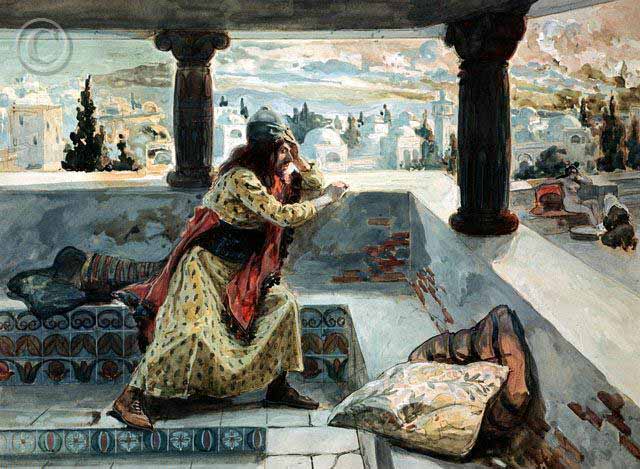
David, however, does not travel to the front lines and instead stays home during the siege. One evening, as David walks around the roof of his palace, he sees a beautiful woman bathing on another roof. He sends word for her to come to the palace, and then he has sex with her. She quickly learns that she is pregnant and tells David.

So who is this woman? Before David even sends for her, he learns that she is Bathsheba, “the daughter of Eliam and the wife of Uriah the Hittite.” Robert Bergen, in 1, 2 Samuel: An Exegetical and Theological Exposition of Holy Scripture (The New American Commentary), explains that “she was the daughter of one of David’s best fighters, the granddaughter of his most trusted counselor, and the wife of one of his inner circle of honored soldiers.” David is thus choosing to commit adultery and betray some of his most loyal followers.

Since Bathsheba is pregnant, the only way to hide the secret is for David to entice Uriah to sleep with Bathsheba immediately so that when the child is born everyone will think it belongs to Uriah. Since Uriah is off fighting the Ammonites, David summons him back to Jerusalem and encourages him to go to back to his house to rest and rejuvenate. Surely he will have intimate relations with his wife when he goes home.

Instead, Uriah sleeps at the palace with the servants. So David gives him alcohol and gets him intoxicated, assuming that his drunken stupor will cause him to go to his house and sleep with his wife. Again, Uriah refuses to go home.

Why does Uriah refuse to go home? Robert Bergen writes:

Uriah’s refusal to have sexual contact with his wife at this time was clearly an expression of his devotion to the Lord: all sanctioned military activity was a form of service to the Lord, and it required the Lord’s blessing for success. In order to maximize the probability of receiving that blessing in military endeavors, David seems to have required soldiers carrying out military assignments to keep themselves in a state of ritual purity, which necessarily meant refraining from all sexual contact (cf. 1 Sam 21:5; Exod 19:15). If Uriah had had sexual relations with Bathsheba, he would have rendered himself temporarily unfit for military service (cf. Lev 15:18) and thus unfit for service to the Lord.

Since Uriah refuses to sleep with Bathsheba, David concocts a new plan to murder Uriah, which will allow David to legally take Bathsheba into his household as her kinsman-redeemer. David sends a message, carried by Uriah, to his general, Joab. Joab is to mount a risky assault close to the walls of Rabbah, and make sure Uriah is part of the assault. When the soldiers come under attack, Joab is to withdraw the other soldiers so that Uriah is left alone and defenseless, to be killed by the enemy.

Joab does what David commands, but he loses several other soldiers in the assault, in addition to Uriah. The Ammonite archers of Rabbah slay the soldiers because they were so close to the city walls. Keep in mind that this assault was completely unnecessary as they had Rabbah surrounded. Given enough time, the city would have surrendered without this useless attack on the city wall.

So David has now committed adultery and murder. His commands to Joab are directly responsible for the death of Uriah, but indirectly responsible for the deaths of the other soldiers in the risky assault.

Upon hearing of Uriah’s death, Bathsheba mourns. After her mourning is over, she moves into the palace with David. How did David not arouse suspicion when he moved Bathsheba into the palace, married her, and then impregnated her? Robert Bergen offers a plausible explanation:

As perhaps in the case of Abigail, David may have been acting as a royal, surrogate kinsman-redeemer (Hb. gōʾēl). David might have claimed he was taking the gōʾēl responsibility on himself since Uriah was a foreigner who had no near kinsman living in Israel. As such, David would have assumed the lifelong responsibility of caring for the needs of Uriah’s widow and was obligated to father a child in order to raise up an offspring to preserve the family line of the deceased (cf. Gen 38:8; Deut 25:5–6; Ruth 4:5). Such a pretext would have made David’s actions toward Bathsheba following Uriah’s death seem truly noble and would have accounted nicely for the birth of the son.

Even though David may have fooled everyone else, he did not fool God. Chapter 11 ends on an ominous note for David: “But the thing David had done displeased the Lord.”

At the opening of chapter 12, the confrontation between God and David takes place through the prophet Nathan. Rather than accuse David of his sin, Nathan instead tells a story to incite David to accuse himself. Nathan tells the story of a rich man (he owns a large number of sheep and cattle) who steals the beloved lamb of a poor man (who owns no livestock except the lamb) in order to feed a traveler who has arrived at the rich man’s home.

Upon hearing the story, David exclaims, “As surely as the LORD lives, the man who did this deserves to die! He must pay for that lamb four times over, because he did such a thing and had no pity.” To which Nathan responds, “You are the man!”

Nathan then reveals the word of God that he received about David’s evil deeds. God reminds David that He gave him the throne of Israel, that He gave David everything that Saul had possessed, and that He was going to bless David even further. But David murdered Uriah and stole his wife from him.

The consequences that would follow are that David’s own household would suffer tremendously. His wives and concubines would be taken by a family member and this family member would publicly sleep with them. There would be public rebellion against the reign of David from within his own household. Robert Bergen elaborates:

Uriah had died because of David’s sin, but God decreed that death would enter David’s life as well: ‘the sword will never depart from your house’ (v. 10). This dark judgment presages fatal violence within David’s family and can be seen as the literary motivation for chaps. 13–19 as well as 1 Kings 1–2. All told, four of David’s sons would experience premature death—an unnamed son (cf. 12:18), Amnon (cf. 13:29), Absalom (cf. 18:14–15), and Adonijah (cf. 1 Kgs 2:25). Traditional Jewish and Christian interpretation of this passage has correlated the death of the four sons to be the ‘fourfold’ of v. 6. To remove all doubt about why this would occur, Yahweh restated the fundamental cause: ‘You despised me and took the wife of Uriah the Hittite to be your own.’

In verse 13, David, unlike Saul, when confronted with his sin simply states, “I have sinned against the Lord.” There are no excuses, no elaborate rationalizations, only heartfelt repentance. Note that even though David sinned against Uriah, his primary offense is sinning against God. By breaking God’s commands in the Torah, David despised God Himself.

The penalty for adultery and murder, as prescribed by the Torah, is capital punishment. Would the Lord take David’s life? Nathan reassures David that his life would be spared, but the life of his son would be taken instead. God strikes the child with an illness and David prays and fasts that God will change his mind and show mercy to his son. On the child’s seventh day of life, he dies. David, hearing of his son’s death, ceases his fasting, washes himself, puts on a change of clothes and eats a meal. His servants are confused at his actions, so he tells them his rationale:

While the child was still alive, I fasted and wept. I thought, ‘Who knows? The LORD may be gracious to me and let the child live.’ But now that he is dead, why should I fast? Can I bring him back again? I will go to him, but he will not return to me.

While the child was still alive, David prayed for God’s grace and mercy, even though he knew that God had already told him his son would die. Praying for a dead child is pointless as he knows he cannot bring the child back from the dead. David assures his servants that he will see his son again in the afterlife.

David and Bathsheba then conceive another child, and name him Solomon. Solomon is loved by God and given the Hebrew name Jedidiah, which means “loved by the Lord.”

If David is anointed by God, is a man after God’s heart, has been promised a dynasty, then how can we comprehend his heinous sins in chapter 11? Dale Ralph Davis, in 2 Samuel: Out of Every Adversity (Focus on the Bible Commentaries), puts it in perspective:

The unvarnished truth is that life for God’s people can be like that even in the supposed kingdom of God. That kingdom is not safe even in David’s hands. It is only safe when Jesus Christ rules and will rule with justice and righteousness. Yet until Jesus publicly enforces that just regime at his second coming, it will not be unusual for God’s people to suffer even within (what claims to be) the kingdom of God.

Commentary on 2 Samuel 7 (The Davidic Covenant)

Some time after David has placed the ark in Jerusalem, a palace has been built for him, and he has a period of rest from his enemies, he decides that he should build a temple to house the ark (God’s home on earth). David communicates his plans to Nathan, the prophet, and Nathan affirms his plans. However, that night Nathan hears from God about His plans for David, and they are not at all what Nathan expects!

The verses that follow contain some of the most important words in the entire Old Testament because they capture God’s promises to David. These promises are often referred to as the Davidic Covenant. The New Testament writers believed that the promises made to David in 2 Samuel 7 were fulfilled in Jesus Christ. In order to understand who Jesus thought He was and who His disciples thought he was, it is imperative to understand the Davidic Covenant.

In verses 5-7, God reminds Nathan that He has never requested that a permanent structure be built to house the ark. God has been content to travel with His people, Israel, wherever they have gone.

In verses 8-9, God reminds Nathan that it was God who took David from being a simple shepherd to ruler over Israel. It is God who has given David all of his military victories. The second half of verse 9 begins the Davidic Covenant, the promises God makes to David and his descendants.

First, God promises that He will make David’s “name great, like the names of the greatest men of the earth.” Second, God promises that He will give Israel the land He promised them, and give them peace from their enemies.

Third, God will build a house for David, not the other way around. What follows are the key verses of the Davidic Covenant:

“When your days are over and you rest with your fathers, I will raise up your offspring to succeed you, who will come from your own body, and I will establish his kingdom. He is the one who will build a house for my Name, and I will establish the throne of his kingdom forever. I will be his father, and he will be my son. When he does wrong, I will punish him with the rod of men, with floggings inflicted by men.  But my love will never be taken away from him, as I took it away from Saul, whom I removed from before you. Your house and your kingdom will endure forever before me; your throne will be established forever.”

These promises to David apply both to his son, Solomon, who would build the temple to house the ark, but also to all of David’s descendants. The greatest of David’s descendants would, of course, be Jesus Christ. Let’s look at each of the promises in order.

First, David’s house would not end with his death. God promises to “raise up” David’s offspring to succeed him. In fact, we learn that it is David’s son who will build a house for God. This promise is fulfilled in one sense when David’s son, Solomon, builds the temple between 966 and 959 BC. But in another sense, this promise must apply to another of David’s descendants, because Solomon’s throne is not established forever.

Second, the future descendants of David who rule Israel will be God’s sons. As the father of David’s descendants, He will manifest His love in two ways. First, He will discipline them when they sin by allowing their enemies to inflict harm on them. Second, even though they sin, His love will never be taken away from them. He will always love the descendants of David, regardless of their behavior.

Third, David’s house would endure forever. Time will not change God’s plans to establish the house of David.

How do these promises to David apply to Jesus Christ? According to Robert Bergen in 1, 2 Samuel: An Exegetical and Theological Exposition of Holy Scripture (The New American Commentary),

The divine declarations proclaimed here through the prophet Nathan are foundational for seven major New Testament teachings about Jesus: that he is (1) the son of David (cf. Matt 1:1; Acts 13:22–23; Rom 1:3; 2 Tim 2:8; Rev 22:16, etc.); (2) one who would rise from the dead (cf. Acts 2:30; 13:23); (3) the builder of the house for God (cf. John 2:19–22; Heb 3:3–4, etc.); (4) the possessor of a throne (cf. Heb 1:8; Rev 3:21, etc.); (5) the possessor of an eternal kingdom (cf. 1 Cor 15:24–25; Eph 5:5; Heb 1:8; 2 Pet 1:11, etc.); (6) the son of God (cf. Mark 1:1; John 20:31; Acts 9:20; Heb 4:14; Rev 2:18, etc.); and (7) the product of an immaculate conception, since he had God as his father (cf. Luke 1:32–35).

In verses 18-29, we read David’s response. He goes into the tent containing the ark and sits down and prays to God. David praises God from verses 18-24 and he petitions God from verses 25-29.

During his praise, David marvels over the fact that God has blessed him thus far, and then is further amazed that God has made this promise to establish his throne forever. David knows that God’s promises to David are a means to accomplish God’s will both for Israel and for all mankind. Remember that God’s original covenant with Abraham, upon which the Davidic Covenant is built, promised to bless the entire world through the descendants of Abraham.

David continues by proclaiming that God is one of a kind, that there is no other god except for Him. Likewise, the people of Israel are one of a kind because God chose them as the nation He would redeem. Their redemption demonstrated to all the people of the earth who God is.

In David’s petition to God, David boldly requests that God keep these promises He has made. David asks that God truly establish his house forever.  Dale Ralph Davis, in 2 Samuel: Out of Every Adversity (Focus on the Bible Commentaries), notes that David provides an example for us:

Here then is still the major task for prayer today: to take God’s promises and pray he will bring them to pass. We must, of course, be certain any promise is a promise that rightly applies to us. Certainly David’s promise does. For this is the promise we ask God to fulfill every time we pray that God’s name will be held sacred throughout the earth (see v. 26; cf. Ezek. 36:20–23), when we ask for God’s kingdom to come and his will to be done on earth. The final King of David’s dynasty has come, yet his kingship must yet be fully, publicly, and universally displayed. But since the promises are reliable (v. 28a: ‘And now, Lord Yahweh, you are the One who is God, and your words will prove true’) the petition is sure to be granted.

We are to pray that God will bring His promises to pass and we can be sure that our prayers will be granted.

Commentary on 2 Samuel 5-6 (David Becomes King over Israel)

Following the death of Saul in 1 Sam 31 (around 1010 BC), David is anointed king over the tribe of Judah. The other tribes, however, give their fealty to Saul’s remaining son, Ish-Bosheth. This is the situation for 7 years, until Ish-Bosheth is killed by two assassins. It is important to note that David has nothing to do with the assassination and he, in fact, has the assassins executed for their deed.

This brings us to chapter 5 in 2 Samuel. In verses 1-5, the leaders of the northern tribes agree to anoint David king over all Israel, citing both his military career and, more importantly, that God Himself had chosen David to rule Israel. David had ruled over Judah for 7 years and would rule over all Israel for 33 years.

After David becomes king over Israel, he decides to move the capitol to a neutral site between the northern and southern tribes of Israel, to Jerusalem. However, Jerusalem is still occupied by the Jebusites in a seemingly impregnable fortress. David and his commanders figure out how to get into Jerusalem, apparently, by climbing through tunnels that carry water to the interior of the fortress. The over-confident Jebusites are defeated and David renames the fortress the City of David. All of this success comes because God is with David.

David’s power and prestige grow so much that at some point during his reign, the king of Tyre, a distant city on the Mediterranean coast, sends a team of builders to construct a palace for David in Jerusalem! The only reason the king would do this is out of fear and respect for David.

Unfortunately we also learn that David followed the conventions of the day by taking numerous concubines and wives in order to secure treaties with neighboring rulers. Recall that Deut 17:17 forbade kings of Israel from taking many wives, a command that David is clearly disobeying and that will lead to great suffering during his rule.

Finally, in verses 17-25, David scores two major victories against Israel’s long-time enemy, the Philistines. In each case, David first inquires of God what he should do before making a move. God gives David specific instructions to defeat the Philistines and David exactly follows those instructions and meets with overwhelming success.

In the first battle, the Philistines are beaten so quickly that they leave behind their official idols which represented the gods they worshiped. How the tables have turned! It was the Israelites who were beaten badly years before by the Philistines (see 1 Sam 4:11), and who left behind the Ark of the Covenant.

Chapter 6 tells the story of how David brings the Ark of the Covenant to Jerusalem, the new religious and political capitol of Israel. Recall that after the Philistines returned the ark to Israel, it had been kept in a private residence, the house of Abinadab.

David decides to send a large military escort to move the ark, no doubt because he was afraid that the escort would be attacked. Remember that the ark contained the written contract between Israel and the Lord, was a place of divine revelation, and was the Lord’s throne. Robert Bergen, in 1, 2 Samuel, The New American Commentary, writes, “An object of such overwhelming significance would certainly make a valuable prize for the Philistines and was worthy of the massive protective force called up by David.”

Uzzah and Ahio, the sons of Abinadab, guide the ark along the road, as oxen pull the cart on which the ark rests. Tragically, in verses 6-7, Uzzah reaches out and touches the ark to keep it from falling when the oxen stumble. God strikes Uzzah dead because of his “irreverent act.” Why did God kill Uzzah for his seemingly good deed?

Dale Ralph Davis, in 2 Samuel: Out of Every Adversity, Focus on the Bible Commentary, writes:

We must recall that Yahweh had long ago given specific instructions to Moses and the priesthood about how the ark, among other items, was to be transported (see Num. 4:4–6, 15, 17–20; and 7:9). The rules were: no touch, no look, no cart. The priests were to cover the sacred furniture after which they would assign Levites of the Kohathite clan to carry such items (hence, implicitly, no carts). The Kohathites were not to touch or look upon the sacred items ‘lest they die’ (Num. 4:15, 20). Clearly, Yahweh did not want them to die; his kindness was written all over that warning. So it was not as though David and Uzzah and company had had no warning. Yahweh’s blow was scarcely arbitrary.

David, fearing God’s wrath, halts the parade and sends the ark to the house of a man named Obed-Edom for safe keeping until David can figure what went wrong. For three months the ark resides there and blesses the household.

When David hears of the blessing of Obed-Edom’s household, he assumes that the timing is right to move the ark again. Even though the text does not explicitly say, we are to assume that the ark is transported correctly this time.

Take note of David’s role in the moving of the ark. He wears a priestly ephod, he dances and rejoices in front of the ark, he places the ark in a specially made tent, he sacrifices burnt and fellowship offerings before the Lord, he blesses the people of Israel in the name of the Lord, and then he gives bread and cakes to everyone present at the celebration.

David’s actions portray him as both king and priest. Was he overstepping his authority? Dale Ralph Davis explains:

David is not arrogantly infringing on the priests’ office; clearly, he views himself as ‘the humble and serving priest of the true King.’ Nevertheless, we should not miss this glimpse of the king in a priestly role, for we will meet it again in prophecy (Ps. 110:1, 4, and Zech. 6:12–13), and yet again in person, in Jesus, David’s Descendant, our reigning king and interceding priest.

In verses 16, 20-23, we read about the reaction of Michal, Saul’s daughter and David’s wife, to his dancing in front of the ark. She accuses him of “disrobing in the sight of the slave girls” and acting in a manner unfit for a king. David reminds her that he was chosen by God, not her father, and that he was celebrating before the Lord, not before slave girls. Robert Bergen provides further commentary:

David rejected Michal’s slanderous accusations; ‘it was before the LORD’ (v. 21)—not the young women—that David was celebrating. Furthermore, his actions were appropriate for one who had been ‘appointed’ by the Lord as ‘ruler over the LORD’S people Israel.’ David’s celebratory acts earlier in the day expressed the king’s unbridled joy in having been selected by the Lord for such significant service. Besides, assuming he was dressed as a properly outfitted Yahwistic priest, David’s energetic dancing could not have exposed his nakedness and so violated the Torah’s requirements (cf. Exod 20:26) since he was wearing a linen undergarment. In rejecting David, Michal was also rejecting the Lord because it was he who ‘chose’ David in preference to Michal’s ‘father or anyone from his house’ to lead Israel. More probably, Michal’s rejection of David actually was symptomatic of an underlying problem in her relationship with God. . . .

As a result of this incident ‘Michal daughter of Saul had no children to the day of her death’ (v. 23). In the Torah a blessing associated with obedience to the Lord is a fruitful womb (cf. Exod 23:26; Deut 7:14; 28:11). To an audience knowledgeable of the Torah, Michal’s unproductive womb would have been interpreted as a curse sent against a disobedient wife—not as evidence of a husband’s neglect of a marital duty. Michal’s lack of faith would mean that the house of Saul would be forever separate from Israel’s eternal royal dynasty.

Commentary on 1 Samuel 30-31 (Death of Saul)

During the time covered in 1 Samuel 18-29, David built up a small army of 600 men from the outcasts of Israel, while Saul continued to hunt David down in order to kill him. When we finally get to chapters 30-31, David and Saul are both facing armed conflicts, but with separate enemies. The narrator places these conflicts one after another to contrast how different Saul and David, with respect to their relationships with God, truly are.

Chapter 30 opens with David and his army returning to their home base at the village of Ziklag (they had been away for some time). When they arrive, they discover that Israel’s ancient enemies, the Amalekites, have burnt down the village and taken everyone prisoner, including all of the wives and children of David’s army. David and his men are devastated at their loss, to the point that the men blame David and contemplate killing him for what has happened.

David, however, seeks God’s wisdom and asks the priest Abiathar to bring him the priestly ephod. He asks God whether he should pursue the Amalekites and God responds that he should. Note that David seeks God’s decision in the matter as prescribed by the Torah. David is consistently shown as obeying the commands of the Torah in contrast to Saul who seems to know nothing of the Torah.

David and 400 of his men pursue the Amalekites, without knowing exactly where they have gone. However, David happens across an Egyptian servant who was left behind by his Amalekite master because he was ill. He agrees to take David to the Amalekite camp if David will spare his life. The reader is meant to understand that finding the Egyptian is no accident. This is the hand of God ensuring David’s success in his mission.

David’s army finds the Amalekite camp where all the soldiers are intoxicated, celebrating their recent ill-gotten gains. His forces engage the Amalekites, who greatly outnumber him, and win decisively, with only 400 Amalekites escaping when the battle is over. Not only that, but all the women and children taken from Ziklag are rescued, along with all the possessions stolen by the Amalekites during their recent marauding campaign.

In stark contrast to David’s successful campaign, chapter 31 reveals the disaster that is Saul’s battle against the Philistines. Before we see what happens in chapter 31, let’s review chapter 28 briefly. Since Saul has no access to God (Samuel has died and God had rejected Saul’s reign as king years earlier), Saul instead seeks the guidance of a sorceress/medium, an activity which is clearly forbidden by the Torah. The medium summons the deceased Samuel who reminds Saul that God has rejected him and given the kingdom to David. She then ominously warns Saul that the Philistines will kill Saul and his sons the next day.

As we return to chapter 31, we learn that the Philistines have overtaken the Israelite army and pressed hard after Saul and his sons. Three of Saul’s sons are killed in battle, including Jonathan. Dale Ralph Davis, in 1 Samuel: Looking on the Heart, Focus on the Bible Commentary, writes:

Here then is Jonathan’s obituary. He remained a true friend to David and a faithful son of Saul. He surrendered his kingship to David (18:1–4); he sacrificed his life for Saul. In this hopeless fiasco Jonathan was nowhere else but in the place Yahweh had assigned to him—at the side of his father.

Saul is wounded by archers and asks his armor-bearer to kill him so that the Philistines will not have the opportunity to torture him. The armor-bearer refuses to kill him, so Saul commits suicide with his own sword. The armor-bearer then takes his own life. The results of this military defeat are disastrous for Israel. Several Israelite settlements near the Philistines are abandoned in haste because the army and their king has been defeated.

As if this isn’t bad enough, the Philistines remove the valuables from the bodies of Saul and his sons and then fasten their corpses on the wall of a city called Beth Shan. They also spread the word around their cities that Israel has been defeated. This defeat is profound. Here is how Dale Ralph Davis describes it:

Yahweh has been defeated. Saul’s armor is in the adversary’s temple; Yahweh could not protect his king. No question about how the media would construe it. If Yahweh’s king and people were trounced, so was their God. . . . The sadness of our text is due not merely to the fact that Israel is crushed. That is sad. But there is a deeper sadness in that Yahweh is mocked. Every true Israelite mourns over that. Worse than Israel’s defeat is Yahweh’s disgrace.

A daring nighttime mission by the Israelite soldiers of Jabesh Gilead reclaims the bodies of Saul and his sons, and they are cremated, except for their bones, which are buried.

How can we summarize the end of 1 Samuel? Robert Bergen, in 1, 2 Samuel, The New American Commentary, writes:

On the one hand, David was here fulfilling the mandate of the Torah regarding the Amalekites and receiving the resulting blessing of a restored family and the increase of possessions. On the other hand, at the very moment David was enjoying success and blessing, Saul was experiencing the full force of a Torah curse, including the loss of his family and possessions.

Both David and Saul were fighting traditional enemies of Israel in the events recorded in this section, and both men sought divine guidance in their respective undertakings. To the south, David consulted the only form of revelation sanctioned by the Torah before going forth to slaughter the Amalekites, who had temporarily dispossessed David and his men of their families and worldly goods during a lightning raid on Ziklag. To the north Saul sought insight from a medium, a revelatory means expressly forbidden by the Torah, before waging war against the Philistines. As a result of Saul’s sinful actions, the Lord used the Philistines as agents of divine judgment to bring down on Saul’s head the just punishment for his rejection of the Torah (cf. 1 Chr 10:13–14). When this pivotal series of events concludes, Saul and all his credible heirs to the throne are dead; David, on the other hand, is poised to become Israel’s king and to establish a dynasty as all of his heirs are restored to him.

How Did Tiny David Defeat Giant Goliath? Part 2

As David faces Goliath, what is his plan? How will he defeat Goliath? Malcolm Gladwell, in his book David and Goliath: Underdogs, Misfits, and the Art of Battling Giants, argues that David had no plans to fight Goliath in hand-to-hand combat, as this wouldn’t play to his strength. David is a projectile warrior, not an infantryman. Gladwell writes:

He runs toward Goliath, because without armor he has speed and maneuverability. He puts a rock into his sling, and whips it around and around, faster and faster at six or seven revolutions per second, aiming his projectile at Goliath’s forehead— the giant’s only point of vulnerability.

Eitan Hirsch, a ballistics expert with the Israeli Defense Forces, recently did a series of calculations showing that a typical-size stone hurled by an expert slinger at a distance of thirty-five meters would have hit Goliath’s head with a velocity of thirty-four meters per second— more than enough to penetrate his skull and render him unconscious or dead.

In terms of stopping power, that is equivalent to a fair-size modern handgun. ‘We find,’ Hirsch writes, ‘that David could have slung and hit Goliath in little more than one second— a time so brief that Goliath would not have been able to protect himself and during which he would be stationary for all practical purposes.’ . . .

Twice David mentions Goliath’s sword and spear, as if to emphasize how profoundly different his intentions are. Then he reaches into his shepherd’s bag for a stone, and at that point no one watching from the ridges on either side of the valley would have considered David’s victory improbable. David was a slinger, and slingers beat infantry, hands down. ‘Goliath had as much chance against David,’ the historian Robert Dohrenwend writes, ‘as any Bronze Age warrior with a sword would have had against an [opponent] armed with a .45 automatic pistol.’

After taking a closer look at David’s victory, we can see that it isn’t far-fetched at all. The true puzzle is why nobody else in Israel’s army realized what David realized! The text indicates that David’s faith in God and his devotion to God’s commands are what gave him his courage and his willingness to face the giant, when the rest of the army cowered in fear.

How Did Tiny David Defeat Giant Goliath? Part 1

Some critics have questioned how 5 feet tall David could have defeated 7 (or 10) feet tall Goliath. Isn’t this story a little far-fetched? A stone from a sling killing a giant of a man in a single blow? How can this be true?

The text of 1 Samuel 17 indicates that God is with David, but it does not indicate that God supernaturally intervened to perform a “slingshot miracle” to kill Goliath. Although David credits God with his victory, God’s assistance seems more providential than miraculous. God places the right man with the right heart with the right skills at the right place and the right time to do his bidding.

If there is no indication of a miracle, then we are left with the puzzle of how David was able to kill Goliath so easily. Malcolm Gladwell, in his book David and Goliath: Underdogs, Misfits, and the Art of Battling Giants, takes a close look at this famous battle and discovers that David’s victory was not at all a fluke, but something that could have been predicted. Gladwell explains:

Ancient armies had three kinds of warriors. The first was cavalry— armed men on horseback or in chariots. The second was infantry— foot soldiers wearing armor and carrying swords and shields. The third were projectile warriors, or what today would be called artillery: archers and, most important, slingers.

Slingers had a leather pouch attached on two sides by a long strand of rope. They would put a rock or a lead ball into the pouch, swing it around in increasingly wider and faster circles, and then release one end of the rope, hurling the rock forward. Slinging took an extraordinary amount of skill and practice. But in experienced hands, the sling was a devastating weapon.

Paintings from medieval times show slingers hitting birds in midflight. Irish slingers were said to be able to hit a coin from as far away as they could see it, and in the Old Testament Book of Judges, slingers are described as being accurate within a ‘hair’s breadth.’ An experienced slinger could kill or seriously injure a target at a distance of up to two hundred yards.  The Romans even had a special set of tongs made just to remove stones that had been embedded in some poor soldier’s body by a sling. Imagine standing in front of a Major League Baseball pitcher as he aims a baseball at your head. That’s what facing a slinger was like— only what was being thrown was not a ball of cork and leather but a solid rock.

Gladwell continues:

The historian Baruch Halpern argues that the sling was of such importance in ancient warfare that the three kinds of warriors balanced one another, like each gesture in the game of rock, paper, scissors. With their long pikes and armor, infantry could stand up to cavalry. Cavalry could, in turn, defeat projectile warriors, because the horses moved too quickly for artillery to take proper aim. And projectile warriors were deadly against infantry, because a big lumbering soldier, weighed down with armor, was a sitting duck for a slinger who was launching projectiles from a hundred yards away. . . .

Goliath is heavy infantry. He thinks that he is going to be engaged in a duel with another heavy-infantryman . . .  When he says, ‘Come to me, that I may give your flesh to the birds of the heavens and the beasts of the field,’ the key phrase is ‘come to me.’ He means come right up to me so that we can fight at close quarters. When Saul tries to dress David in armor and give him a sword, he is operating under the same assumption. He assumes David is going to fight Goliath hand to hand.

In part 2, we’ll continue with Gladwell’s analysis of this famous Bible narrative.

Commentary on 1 Samuel 17-18 (David and Goliath)

The events of chapter 17 occur several years after David is invited to stay at King Saul’s residence. It appears that at some point, Saul’s condition must have improved and David was allowed to go back and help his father with his sheep.

In verses 1-3, we learn that the Philistines have assembled an army only 15 miles west of Bethlehem. The Israelites respond by amassing an army to confront the Philistines, and they both encamp facing each other across a valley, atop two ridges.

Rather than initiating a full-on assault of Israel, the Philistines elect to send their mightiest warrior, Goliath, down to the valley to invite a champion from Israel to face him in combat to the death. The losing side would surrender to the winning side and the battle would be avoided. This form of representative combat was not unknown in the ancient near east, although the Israelites rarely, if ever, practiced it. Goliath seems to have to explain to the Israelites how it will work in verses 8-11, which implies the Philistines were familiar with the concept and had even put it to use before.

Goliath is described as being almost 10 feet tall in some ancient manuscripts, and almost 7 feet tall in other manuscripts. Regardless of which is correct, the average Israelite soldier would have been about 5 feet tall, so Goliath would have seemed like a giant at either height. Goliath is dressed in the armor and weaponry of a heavy infantryman. Robert Bergen, in 1, 2 Samuel: An Exegetical and Theological Exposition of Holy Scripture (The New American Commentary), describes Goliath:

Protecting his trunk was ‘a coat of scale armor weighing five thousand shekels’ (= 126 pounds). Completing his body armor were ‘bronze greaves’ (v. 6) or knee and shin protectors. A covering of this weight and composition would have drastically reduced Goliath’s ability to respond with quickness and agility in close combat and suggests that he did not expect a skirmish involving hand-to-hand combat.

Goliath’s weaponry was as overwhelming in appearance as his height and armor. He had ‘a bronze scimitar’ (Hb. kîdôn; NIV, ‘javelin’), a curved sword, ‘slung on his back.’ In addition, he had a spear whose ‘shaft was like a weaver’s rod.’ This description may relate to the size and weight of the spear’s shaft or, more probably, to the fact that it had a loop of cord attached to it. At the head of Goliath’s spear was a massive ‘iron point’ that weighed ‘six hundred shekels’ (= 15.1 lbs.). Iron was the preferred metal for implements of warfare because it was strong, nonmalleable, and could retain a sharp edge much better than bronze. A weapon of this massive weight, while intimidating in appearance, would have been quite awkward to use; it was apparently designed mainly to intimidate.

For forty days, the Israelites, led by King Saul, do not send a representative forward because they are scared and intimidated by Goliath. Meanwhile, young David, who is under the age of 20 and unable to serve in the military, is bringing supplies to his three brothers and their unit since Jesse’s home is only 15 miles away. When David arrives at the front lines with his supplies, he asks his brothers what is happening. They explain to him the situation and he is greatly upset that Goliath has been allowed to insult the God of Israel.

Due to his outspoken anger, David is invited to see King Saul, and he offers to fight Goliath himself. Saul counters that David is only a boy, but David explains that since God has been with him, he has been able to kill a lion and a bear who attacked his sheep. Saul relents and allows David to fight Goliath, hoping that God is still with David.

Rather than fight with Saul’s armor and sword, David decides to only bring his shepherd staff and a sling to the battle with Goliath. As David descends into the valley and approaches Goliath, Goliath mocks him and curses David in the name of David’s gods. Here is David’s response:

You come against me with sword and spear and javelin, but I come against you in the name of the LORD Almighty, the God of the armies of Israel, whom you have defied. This day the LORD will hand you over to me, and I’ll strike you down and cut off your head. Today I will give the carcasses of the Philistine army to the birds of the air and the beasts of the earth, and the whole world will know that there is a God in Israel. All those gathered here will know that it is not by sword or spear that the LORD saves; for the battle is the LORD’s, and he will give all of you into our hands.

For David, this is not just a military engagement, but a solemn religious duty. Leviticus 24:16 commands the death penalty for anyone who blasphemes God. Goliath had repeatedly blasphemed against God for 40 days, and did it yet again when David came to face him. This demonstrates one way is which David is a man after God’s heart, because he takes the words of the Torah (the Law) so seriously. In David’s mind, God Himself would help David carry out the commands of the Law.

In verses 48-51, we witness one of the quickest battles in the history of combat. As Goliath lumbers toward David, David runs toward Goliath, places a stone in his sling and whips it at Goliath’s head. The stone hits his forehead, breaking Goliath’s skull, and he drops dead. David takes Goliath’s own sword and decapitates him, making it clear to the Philistines that Goliath is dead.

Instead of honoring the deal they had made with Israel, the Philistine army turned and fled. The Israelites followed after them, chasing them back to their fortresses at Gath and Ekron. The Israelites then came back and plundered the camp that was abandoned by the Philistine army.

What happened to David after this great victory? Saul invited him to his home permanently, whereupon David and Saul’s oldest son, Jonathan became best friends. In fact, Jonathan symbolically cedes his right to the throne of Israel by giving David his robe, tunic, sword, bow, and belt.

Saul gives David a high rank in the army and whenever David goes out to fight, he is successful against his enemies. In fact, he is so successful that the women of Israel would chant, “Saul has slain his thousands, and David his tens of thousands.”

Saul becomes extremely jealous of David and in one episode at Saul’s house, Saul enters an ecstatic state and twice throws a spear at David with the intent to kill him. Both times he misses, however. From then on, Saul is constantly plotting how to ruin David. He sends him on numerous military campaigns, hoping he will die in battle, but David is always successful and is never harmed. For the next 10 chapters of 1 Samuel, Saul would plot to kill David and David would always escape.

The contrast between David, a man indwelt by the Spirit of God, and Saul, a man rejected by God, is illustrated over and over during the remainder of 1 Samuel. David wins battle after battle and Saul descends into madness as each day goes by.

Did Saul Kill All of the Amalekites?

In 1 Samuel 15:3, Samuel commands Saul, “Now go, attack the Amalekites and totally destroy everything that belongs to them. Do not spare them; put to death men and women, children and infants, cattle and sheep, camels and donkeys.” As we read the rest of the chapter, Saul tells Samuel, after the battle, “I have carried out the LORD’s instructions” and “I completely destroyed the Amalekites.”

Samuel’s only disagreement with Saul is that Saul kept some of the livestock for himself, a clear violation of God’s command. Saul was not to have financial gain from this battle, which was intended to be an execution of divine justice against an exceedingly vicious group of people.  Samuel seems to agree that Saul totally destroyed everyone, “men and women, children and infants,” just as God commanded. But how should we understand this command to “put to death men and women, children and infants,” coupled with Saul’s claim that he did indeed kill every Amalekite?

Did Saul literally wipe out every living Amalekite or is this command hyperbolic in nature, referring to a decisive military victory? We know that other ancient near eastern cultures used the same kinds of descriptions of military victories, such as “totally destroying” the enemy, or killing “every man, woman, and child.” But these are figures of speech which literally mean “we won a decisive military victory against our enemy.” What about in this case?

The easiest way to decide whether Saul literally killed every living Amalekite is to see whether the Amalekites are ever mentioned in the biblical record again. When we do that, we see that the Amalekites lived on!

In 1 Sam 27:8, we see that David fights Amalekites, so at least some of them are alive and well. Paul Copan and Matt Flannagan write in Did God Really Command Genocide?: Coming to Terms with the Justice of God:

This text affirms not only that the Amalekites still existed, but the reference to Egypt and Shur states that they existed in the very same area where Saul ‘utterly destroyed’ every single one of them (15: 8, 20). What’s more, David took sheep and cattle as plunder. Clearly, in terms of what the narrative says, the Amalekites were not all destroyed— nor were all the animals finally destroyed in Gilgal in chapter 15. Instead, many people and livestock from the region had survived Saul’s attack.

In 1 Sam 30, the Amalekites show up again! This time they attack the Israelite settlement of Ziklag, burn it to the ground, and carry off everyone as prisoners. Copan and Flannagan write:

So even though Saul ‘utterly destroyed’ the Amalekites (15: 8, 20), the text makes clear that many Amalekites remained so that David would not only— once again!— fight against them so that ‘not a man of them escaped,’ but after this battle, four hundred Amalekites fled on camels (30: 17 NASB).

Amalekites continue to be mentioned in the Bible:

Even beyond this, the Amalekites continue to remain, and we come across another Amalekite in 2 Samuel 1: 8, a passage where one of them takes credit for killing Saul— presumably a tall task if Saul had ‘utterly destroyed all the people’ of Amalek. And in 1 Chronicles 4: 43, the nation of Amalek is still around during the reign of Hezekiah. And then in the book of Esther, we encounter a descendant of the Amalekite king, Agag— Haman ‘the Agagite’ (8: 3), also called ‘the son of Hammedatha the Agagite’ (3: 1)— who was determined to wipe out the Jewish people. Amalekites were around well after both Saul and David.

It seems clear that Saul did not totally destroy all of the Amalekites, men, women, and children. Yet Samuel, and presumably God, were satisfied that Saul obeyed God’s commands, except for keeping alive livestock and the king of Amalek. Therefore, it seems that we should take Saul’s claim that he “completely destroyed the Amalekites” as a hyperbolic statement that would literally mean, “I won the decisive military victory that God commanded me to win.”

Commentary on 1 Samuel 15-16 (God Rejects Saul and Anoints David)

Between chapters 8 and 15 in 1 Samuel, Israel has received the king she requested in the person of Saul. From the beginning, we know that Saul was not a man “after God’s heart” and although Saul has some military successes against Israel’s enemies, especially the Philistines, his disobedience of God’s commands would eventually cause him to lose his kingship.

Chapter 15 is where this finally occurs. Samuel, the prophet who speaks for God, commands Saul to launch a military campaign against the Amalekites, the long-time enemy of Israel who attacked Israel as she left the slavery of Egypt (see Exodus 17). God had previously promised that the Amalekites would be punished for their wicked actions against Israel. We know that the Amalekites attacked Israel when she was weary from the trek out of Egypt. But even worse, they came up behind the Israelites and massacred the weakest members of Israel who were bringing up the rear of the Israelite caravan. Amalekite aggression against Israel continued for hundreds of years, right up to the present day.

Given that the attack on the Amalekites was to execute divine judgment, Saul was instructed to kill everyone in the battle and to kill all of the livestock. The Israelites were not to get any financial gain from this attack as they were merely the instruments of God’s justice.

Unfortunately Saul disobeys God in two ways: he keeps Agag, the king of Amalek, alive, and he keeps the best livestock from Amalek alive. God grieves over Saul’s blatant disobedience and He instructs Samuel to confront Saul. When Samuel asks Saul why the best livestock were kept alive, Saul blames the soldiers and then adds that the livestock will be used to sacrifice to God, hoping this will get him off the hook.

Samuel then utters profound words to Saul in verse 22:

“Does the LORD delight in burnt offerings and sacrifices as much as in obeying the voice of the LORD? To obey is better than sacrifice, and to heed is better than the fat of rams.”

Even if Saul was planning on sacrificing the livestock, which is debatable since it appears to be an excuse, God wants obedience first. Sacrifice without obedience is pointless. A person who follows the rituals of worship, but flagrantly disobeys God’s other commands, does not please God. The consequence of Saul’s sin is that God rejects him as king. Saul begs for Samuel to change his mind, but God has made His decision.

In a sad epilogue, Samuel must kill King Agag himself, since Saul failed to do so. Afterwards, he returns to his home, never to see Saul again. From that day on, God’s prophet will never again counsel Saul, as God has turned His back on Saul’s reign over Israel.

Chapter 16 opens with God telling Samuel to stop grieving Saul, as He is ready to select a new king. The king will be a son of Jesse of Bethlehem. In order to prevent Saul from realizing what is going on, Samuel takes a cow with him and tells the elders of Bethlehem that he is there to perform a sacrifice. Samuel also invites Jesse and seven of his sons to the sacrifice.

Before the sacrifice occurs, Samuel has each of Jesse’s sons stand before him to see which one God will anoint as the new king of Israel. Each of Jesse’s seven sons parade in front of Samuel, but God doesn’t choose any of them.

Samuel is surprised that God doesn’t select the oldest son of Jesse, Eliab, because he is both tall and handsome, and seemingly perfect for the role of king. God responds to Samuel, “Do not consider his appearance or his height, for I have rejected him. The LORD does not look at the things man looks at. Man looks at the outward appearance, but the LORD looks at the heart.”

This verse is the very heart of 1 and 2 Samuel and one of the most instructive verses in the entire Bible. Robert Bergen, in 1, 2 Samuel: An Exegetical and Theological Exposition of Holy Scripture (The New American Commentary), writes, “The Lord alone has the capacity to observe and judge a person’s ‘heart’ (Hb. lēb), that is, one’s thoughts, emotions, and intents. On God’s scales these matters outweigh all other aspects of a human life.”

After having dismissed seven of Jesse’s sons, Samuel asks if he has another son, and Jesse informs him that he does, but that he is the youngest and is tending sheep. They send for him and God tells Samuel that this boy, the youngest of eight sons, is to be anointed the new king of Israel. The boy’s name is David. In verse 13, we learn that the Spirit of the Lord immediately came upon David “in power.”

Verses 14-23 end the chapter with the story of how David comes to be an armor-bearer for King Saul, the very king he would some day replace. God has sent an angel of judgment to Saul because of his disobedience, and this angel torments Saul. Saul’s servants suggest to him that finding someone who can play the harp when Saul is tormented will make him feel better.

Saul agrees and the servants recommend David. One servant describes what he knows of David, “I have seen a son of Jesse of Bethlehem who knows how to play the harp. He is a brave man and a warrior. He speaks well and is a fine-looking man. And the LORD is with him.” Thus David is brought into the royal household and becomes a trusted member of King Saul’s entourage.

Why was this young shepherd-boy chosen by God to be king some day? He wasn’t as tall or as good-looking as his older brothers. We know that God’s choices do not always line up with man’s choices, because God sees the heart and we do not. Think about David’s descendant, Jesus of Nazareth. He was an unlikely candidate as well. Dale Ralph Davis, in 1 Samuel: Looking on the Heart (Focus on the Bible Commentaries) writes:

Perhaps at no time did the living God disclose a more flabbergasting choice than in the case of David’s greater Descendant. The vote was in. The folks at home said, “He’s just one of us” (Mark 6:3). Others complained, “He has too much fun” (Matt. 11:18–19), and still others objected, “He’s not from the right place” (John 7:41–42). But the clincher for many was: “Messiahs don’t suffer” (Matt. 27:42–43). And what clout did this opinion pack? None. “The stone which the builders rejected has become the head of the corner” (Ps. 118:22; see 1 Pet. 2:4). What should we deduce from that? We should realize Yahweh made his choice (Ps. 118:23a), and we should relish it (Ps. 118:23b). There is a delight we should have over Yahweh’s unusual, unguessable ways. It honors him when we revel in his surprises.