All posts by Bill Pratt

Does the Scientific Method Preclude the Existence of Miracles?

Post Author: Bill Pratt

This is a familiar theme for long-time readers of the blog.  I am deeply interested in where the scientific method can shed light and where its light begins to fade.  For mankind, to know everything is to know all that really exists.  If you think of everything that exists as falling inside a giant circle, the question that fascinates me is, “How much of the area of that circle can the scientific method enlighten?”  Is it the whole circle?  Is it half?  Is it a tiny fraction of the circle?

The question asks us to take a position on the supernatural and spiritual.  If you believe that there is a vast supernatural world out there, a world where God, angels, and demons exist, then you will probably say that the scientific method can only illuminate a small fraction of the circle of all things that exist.  The scientific method can only tell us about things or events that occur inside the four dimensions of space-time.

If, however, you believe that the four dimensions of space-time are all that exists and that the supernatural is imaginary, then the entire circle of all that exists can eventually be filled out by the scientific method.  In my discussions with skeptics over the years, there are those who fall in this latter group, but there are also those who remain open to the existence of the supernatural.

Those who maintain that the scientific method will eventually fill in the entire circle sometimes go on to make the following claim: “The scientific method forces us to conclude that miracles cannot occur.”  To me, this is a deeply confused statement.  It is true that miracles, in their totality, entail a supernatural element.  It is true that science cannot directly observe that which is supernatural, as the supernatural does not exist in space-time where science can operate.  But to say that the scientific method absolutely precludes miracles from existing is false.

The scientific method is one tool we have to fill in the giant circle of all that exists, but there are other tools (e.g., philosophy, logic, mathematics, spiritual disciplines).  Think of the scientific method as analogous to a screwdriver.  The screwdriver is a truly useful tool that we use all the time in construction.  In fact, any time we need to attach two objects with a screw, we use a screwdriver.  But we would find it very odd if screwdriver enthusiasts one day started running an ad campaign with the following slogan: “If you don’t use a screwdriver, you’re not constructing anything!”

Philosopher Alvin Plantinga has another way to answer those who say that science precludes miracles.

[This] argument…is like the drunk who insisted on looking for his lost car keys only under the streetlight on the grounds that the light was better there. In fact, it would go the drunk one better: it would insist that because the keys would be hard to find in the dark, they must be under the light.

Science is tremendously useful and the benefits of modern technology are hard to overstate, but let us never forget the limits.  There may very well be a supernatural world out there (in fact, most of us believe that).  Those who flatly say there is not are making a statement of faith that is not based on the scientific method, but based on their metaphysical worldview.

Is Fundamentalism Bad?

Post Author: Bill Pratt

There are fewer words that are more loaded with a negative connotation than fundamentalism.  Generally when we hear that word, we have been trained by the media to react with either fear or disdain, or both.  After all, fundamentalists are supposed to be ignorant and violent.

To be a fundamentalist used to mean that a person believed in the fundamentals of their religious system or worldview.  They were people who stuck to the core beliefs, that did not stray away from them.  At some point, this meaning morphed into something else more sinister.

Can we save this word and return it to mean what it used to mean?  Maybe not, but I would like to challenge the idea that fundamentalists of all worldviews or religious systems are all ignorant and/or prone to violence.  There are fundamentalists who are ignorant and violent, but there are many fundamentalists who are not ignorant and not violent (me being one of them).

Whenever we approach a person who claims to believe in the fundamentals of their religious system, we should first ask, “What are the fundamentals you believe in?”  Their specific beliefs are far more relevant than the fact that they hold core beliefs at all.  We shouldn’t fear people who have fundamental beliefs, but we possibly should fear the fundamental beliefs that some people have.

Tim Keller addresses the issue of fundamentalism with the following:

It is common to say that “fundamentalism” leads to violence, yet as we have seen, all of us have fundamental, unprovable faith-commitments that we think are superior to those of others. The real question, then, is which fundamentals will lead their believers to be the most loving and receptive to those with whom they differ? Which set of unavoidably exclusive beliefs will lead us to humble, peace-loving behavior?

Of course, the prime example in the history of the world of humility and love was Jesus Christ.  Here is a man whose last act as he died on a Roman cross was to ask God to forgive his enemies.  Here is a man who sacrificed his own body for the rest of mankind.

When you see what the fundamentals of Christianity are, you realize that the true Christian fundamentalist is not someone to be feared at all.  In fact, imagine what the world would be like if everyone totally embraced Jesus as their model to live by.  If you’ve dedicated your life to Christ, one day in the future you won’t have to imagine, because it will become a reality.

Are You Muslim Because You Were Born in Morocco?

Post Author: Bill Pratt

A couple months ago I attended a debate between a Christian scholar and an atheist scholar at a local university.  At the conclusion of the debate there was a Q and A session and one of the atheist students stood up and asked something like the following to the Christian scholar: “How do you explain the fact that where a person is born is highly predictive of what religion they will believe?”
When I’ve heard this question before, the inquirer is usually making the point that religious belief is merely the result of cultural conditioning.  You don’t come to your beliefs through thought or reason; your religion is merely a reflection of where you were raised and what you were taught as a child.  Similar to your speaking accent, you “pick up” your religion through your parents and friends.

First, I must say that there are certainly people who merely inherit their religious beliefs from their culture.  There is no doubt about that, but what conclusion can we draw from this data?  Can we conclude that all religious believers are merely socially conditioned, that they don’t have any good reasons for what they believe?

Timothy Keller, in his book The Reason for God, quotes Christian philosopher Alvin Plantinga as he answers those who claim religious beliefs are merely culturally conditioned.  Speaking of Plantinga, Keller says:

People often say to him, “If you were born in Morocco, you wouldn’t even be a Christian, but rather a Muslim.” [Plantinga] responds:  ‘Suppose we concede that if I had been born of Muslim parents in Morocco rather than Christian parents in Michigan, my beliefs would have been quite different.

Plantinga then points out that the same goes for the person making the charge.  For example, if the atheist student had been born in Morocco, then he probably would be a Muslim, not an atheist!   Does it follow that his atheist beliefs are merely conditioned by his parents or peers?  Keller concludes, “You can’t say, ‘All claims about religions are historically conditioned except the one I am making right now.'”

The atheist wants to claim that he is exempt from the cultural conditioning that everyone else is subject to, but this won’t fly because even he is influenced by his upbringing.  Even so, he would never want to say that his atheism is merely the result of cultural conditioning.   If the atheist can escape his culture, then so can everyone else.  Just look around.  There are people who hold minority religious views all over the world.

Once I go down the road of claiming that those who disagree with me only believe what they believe because of their culture or upbringing, I have ceased giving their position any respect.  I am simply patronizing them and fruitful discussion ends.

Does Each Religion See Only Part of the Truth?

Post Author: Bill Pratt

The vast majority of us believe in some kind of supernatural realm, but more and more people are uncomfortable saying that one religion possesses more truth about the supernatural than others.  We are becoming, in the US, a nation of religious pluralists.  A popular mantra of the religious pluralist, according to pastor and author Timothy Keller is: “Each religion sees part of spiritual truth, but none can see the whole truth.”

One of the most popular and enduring illustrations used to convey this mantra is recounted by Pastor Keller:

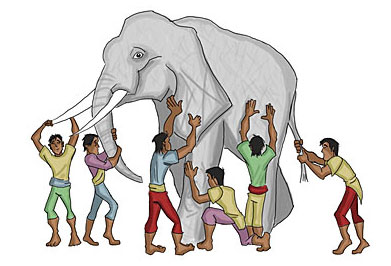
Several blind men were walking along and came upon an elephant that allowed them to touch and feel it. “This creature is long and flexible like a snake” said the first blind man, holding the elephant’s trunk. “Not at all—it is thick and round like a tree trunk,” said the second blind man, feeling the elephant’s leg. “No, it is large and flat,” said the third blind man, touching the elephant’s side. Each blind man could feel only part of the elephant—none could envision the entire elephant. In the same way, it is argued, the religions of the world each have a grasp on part of the truth about spiritual reality, but none can see the whole elephant or claim to have a comprehensive vision of the truth.

Christians see only their slice of supernatural reality, but all the other religions likewise see their slices of supernatural reality.  It is foolish to align oneself with a single religion, to make a commitment to one religion and deny the truths taught by others.  They are all grasping only part of the elephant and none can claim to know the entire elephant (i.e., supernatural reality).

Does the elephant and blind men illustration prove its point?  Not at all.  Keller explains, “This illustration backfires on its users. The story is told from the point of view of someone who is not blind. How could you know that each blind man only sees part of the elephant unless you claim to be able to see the whole elephant?”

The person giving the illustration (the religious pluralist) is claiming to know what the blind men (followers of single religions) do not know.  The religious pluralist knows that there is an elephant, even while saying that followers of single religions are blind.  But how does the religious pluralist have complete knowledge of the supernatural (the elephant)  if none of the followers of single religions do?  Why is he able to see and they are blind?

This is a case of false humility.  Every religion thinks it knows the truth about supernatural reality.  All the religious pluralist does is claim that every religion is blind and that only he can see! That, my friends, is not humility at all.  The pluralist should, instead of trying to convince everyone that he is above the fray, come down off his high horse (or elephant) and engage in the debate with the rest of us.  All religions are making the case for their beliefs and the religious pluralist needs to do the same.

*Note: If you want to hear from one of the preeminent religious pluralists yourself, then listen to this Unbelievable? podcast featuring John Hick from Feb 2011.

Is Religion Temporary?

Post Author: Bill Pratt

For some secular, non-religious people, their hope is that religious people will some day be the minority, that mankind will finally grow out of this unfortunate phase of history.  Religion may have helped our distant ancestors to explain where we came from, why we are here, why we have moral feelings, why we are unhappy, and where we are headed after we die.  The answers that religion provided gave aid and comfort in the face of a hostile world.

But, the secularist may argue, we don’t need religion any more.  The scientific method has served to successfully explain many aspects of the world that our ancestors did not understand.  Religion is on the way out.

Are the secularists right?  Will mankind move beyond religious answers?  Will the deepest desires of man be fulfilled without religion?

I do not see this happening any time soon, if ever.  The worship of God seems like a permanent need built in mankind, not something temporary that will disappear in the near future.  Pastor and author Timothy Keller has the following to say about man and religion in his book The Reason for God:

Religion is not just a temporary thing that helped us adapt to our environment.  Rather it is a permanent and central aspect of the human condition.  This is a bitter pill for secular, nonreligious people to swallow.  Everyone wants to think that they are in the mainstream, that they are not extremists.  But robust religious beliefs dominate the world.  There is no reason to expect that to change.

For the foreseeable future, those who deny the existence of the supernatural will remain in the small minority, as they always have.  It is always possible that they are right and the religious are wrong, but the entire history of man is the history of belief in the supernatural, not just by a few, but by the many.  Humans seek the supernatural – that’s who we are.

The Distance Between Man and Everything Else

Post Author: Bill Pratt

One of the most striking evidences for the Christian God is the uniqueness of man among all of the animals.  God exalts in The Book of Genesis, “Let us make man in our image, in our likeness, and let them rule over the fish of the sea and the birds of the air, over the livestock, over all the earth, and over all the creatures that move along the ground.”  The Bible dramatically lifts man over the remainder of creation.

G. K. Chesterton, in his book  The Everlasting Man, wonders what the world would be like if other animals reached the heights of man in this passage:

If there was ever a moment when man was only an animal, we can if we choose make a fancy picture of his career transferred to some other animal. An entertaining fantasia might be made in which elephants built in elephantine architecture, with towers and turrets like tusks and trunks, cities beyond the scale of any colossus. A pleasant fable might be conceived in which a cow had developed a costume, and put on four boots and two pairs of trousers. We could imagine a Supermonkey more marvellous than any Superman, a quadrumanous creature carving and painting with his hands and cooking and carpentering with his feet. But if we are considering what did happen, we shall certainly decide that man has distanced everything else with a distance like that of the astronomical spaces and a speed like that of the still thunderbolt of the light.

Nobody says things quite like Chesterton does.

Are Atheism and Socialism a Package Deal?

Post Author: Bill Pratt

I am not a political science expert, so I can’t say for sure how strong the link between socialism and atheism is.  I’m sure some of you can think of examples of people you know who are atheist and not socialist or socialist and not atheist.

For Fyodor Dostoyevsky, writing in the late 1800’s, the linkage was clear.  In his book The Brothers Karamazov, considered to be a literary classic, Dostoyevsky’s narrator has the following to say about the main character, Alyosha, a strong Christian:

In the same way, if he had decided that God and immortality did not exist, he would at once have become an atheist and a socialist. For socialism is not merely the labor question, it is before all things the atheistic question, the question of the form taken by atheism to-day, the question of the tower of Babel built without God, not to mount to heaven from earth but to set up heaven on earth.

Any ideology which has as its goal to set up a completely human-constructed utopia on earth is certainly not derived from Christian theology or from any other religious theology that I can think of.  Most religions envision a heavenly paradise, but not one created by man alone.

If socialism is truly characterized by this aim, to create heaven on earth by man pulling himself up by his own bootstraps, then Dostoyevsky’s point holds – atheism and socialism are bedfellows.  There may be socialists who disavow this aim and would declare allegiance with theists.  Any socialists out there who want to speak up?

Do We Believe in Miracles Due to the Evidence or Due to Our Desire to Believe?

Post Author: Bill Pratt

We’re back to the recurring question of the role of faith, the will, and evidence.  Those who believe in miracles frequently will point to evidence of specific miracles and say, “This is why I believe.”  Those who disbelieve miracles will claim that there is no evidence and that they won’t believe until they see irrefutable proof.

Fyodor Dostoyevsky, in his classic The Brothers Karamazov, questions both of these claims.  The narrator in the book argues that for most people, their mind is made up about miracles long before they ever see the evidence.  It is their beliefs and their desires which win out, not a sober look at the evidence.  Here is the passage:

The genuine realist, if he is an unbeliever, will always find strength and ability to disbelieve in the miraculous, and if he is confronted with a miracle as an irrefutable fact he would rather disbelieve his own senses than admit the fact. Even if he admits it, he admits it as a fact of nature till then unrecognized by him.

Faith does not, in the realist, spring from the miracle but the miracle from faith. If the realist once believes, then he is bound by his very realism to admit the miraculous also. The Apostle Thomas said that he would not believe till he saw, but when he did see he said, “My Lord and my God!” Was it the miracle forced him to believe? Most likely not, but he believed solely because he desired to believe and possibly he fully believed in his secret heart even when he said, “I do not believe till I see.”

There is no doubt that our will, our desire to believe or not believe plays a very strong role in our assessment of the supernatural.  This sword cuts both ways, for neither the believer nor the non-believer can claim a dispassionate and unbiased approach.  As much as we’d like to believe that only the facts should sway our decisions, we are unable to do so.  Our challenge is to be aware of the bias and to minimize it the best we can.  Easier said than done.

Does God Love You Just the Way You Are?

Post Author: Bill Pratt

In one sense God loves you just the way you are, but it’s a bit more complicated than that.  Let’s unpack this statement.

God loves each of his children unconditionally, wherever we are, whoever we are.  Even if we are sinning, living a dissolute life, He still loves us.  But what does love mean?  The classic definition of love is to desire the good of another.  God most definitely desires the good for all his children regardless of who they are.  As human parents, we strive to love our children in the same way.  Even though they are behaving badly, we still desire their good – we still love them.

The implication of the person who says that God loves them just as they are is often that they do not need to change anything about themselves; God will be perfectly content for them to be the same forever.  Here is where they are making a serious error.

The very fact that God loves you, that He desires your good, entails that He will not be satisfied with you until you are perfect, until you become the perfect creature He had in mind when he created you.  The current version of you that lives today is nowhere near what God planned for you when He conceived your existence in His divine mind.

Your body is decaying, you suffer physically and emotionally, your thoughts are wicked, you behave selfishly, you make immoral choices every day, you neglect to think about God, you don’t pray to Him – you have a long way to go!

When God creates the new heaven and new earth, all of your flaws will be history.  You will have an imperishable body, your suffering will end, your thoughts will be good, you will put others before yourself, you will make all moral choices, you will think about God all the time, and you will commune with Him unceasingly.  At this time, God will be completely satisfied with you, but not a moment before.

God certainly does love you just as you are, but He wants so much more for you and He will not be satisfied with you until you are perfected.  Never use the fact that God loves you as an excuse for maintaining your evil thoughts and behavior.  The good that God desires for you is far beyond where you are today; it is past the horizon that you can immediately see.  There is no higher love.

Should Anyone Be Punished?

Post Author: Bill Pratt

Recently I met a woman in her thirties who had grown up Christian, but over several years, starting in her late teens/early twenties, she grew away from her faith and now considers herself agnostic (we’ll call her Judy).  She doesn’t know that God doesn’t exist, but she finds it very unlikely.

A couple of us in the discussion group asked her what some of the issues were that caused her to stop believing in Christianity.  One of the things she mentioned that most pushed her away from faith was the existence of hell.  She said that the concept of hell is so cruel that she simply cannot believe that a God exists who would allow hell to exist.

Here’s where it gets really interesting.  As we questioned her about why hell was so repulsive to her, Judy eventually revealed a critical belief which she holds: nobody should be punished.  Her view is that any person who commits a crime should be rehabilitated, not punished.  They should be given psychiatric treatment, medication, training, education, whatever it takes, to make them stop behaving in a criminal way.  As soon as they are “fixed” they should be released back into society.

The idea of punishing a person, without rehabilitation, was nothing but cruelty to Judy.  So, the idea of a place where people are punished for their crimes in the afterlife is simply a non-starter.  Since hell does not rehabilitate, but only punishes, she cannot accept it.

What I find so interesting about Judy is that her belief that nobody should be punished was foundational to her; it was one of her core beliefs.  Other people in our discussion group gave her scenarios where rapists or murderers were convicted of heinous crimes, and she stood firmly behind her beliefs.  Even murderers and rapists should not be punished, but rehabilitated.

We never had time to dig into how she came to hold this belief, but one thing was for sure: her belief that nobody should be punished was clearly more foundational to her than the existence of God.

As this was the first time I had ever heard someone give this reason for not believing in God, I wanted to pass it along.  What would you say to Judy?