Tag Archives: God

Christians and Obama

Many of my evangelical friends have fretted over how Obama received support from Christians in the recent election.  One of our blog readers, Kay, has mentioned her dismay about this many times and asked how we, as Christians, should respond.

Before I say just a few words about our response, I wanted to give you the facts about how religious groups voted in the previous election.  This chart comes from an article in  a March 2009 First Things magazine, written by John C. Green.
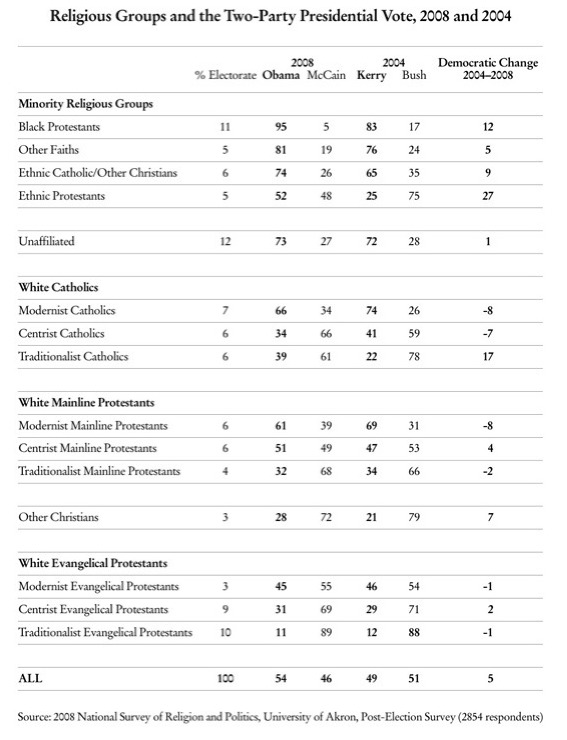
Election Chart

After a quick perusal of the chart, you can see which groups shifted support to the Democrat, Obama.  Evangelicals, as a whole did not support Obama, and there was no significant move from the 2004 election.  The two groups that registered significant changes from the 2004 election were conservative Catholics, who swung 17 points from 2004, and ethnic Protestants (primarily Hispanics) who swung 27 points from 2004.

Read the First Things article for some insight into these shifts, but conservative Catholics and Hispanic Protestants were the two major changes from the 2004 election.  They helped Obama win the election.

Now, how should we respond?  I believe we are to respect the office of the President and we are to love and pray for the President.  God has placed him in authority over our nation, and as Christians, we are to respect the authority of those placed over us.

However, where he promotes ideas that are clearly unbiblical, we are to oppose him.  The ultimate authority to whom we answer is God, and where Obama disagrees with God’s word in the Bible, we are to align with God, not Obama.  I fear that the many Christians who voted for the pro-abortion Obama will have some serious explaining to do when they face God.

Our disagreements with Obama must be carried out within the current legal system.  The only time Christians should actually break laws in civil disobedience is when the following four criteria are met:

  1. When the laws are clearly counter to God’s word
  2. When the laws command us to do evil
  3. When the laws negate freedom
  4. When the laws are religiously oppressive

When we engage in civil disobedience, we must refuse to obey the law in a nonviolent way and we must accept the consequences of our disobedience.

Now, not all Christians agree with this viewpoint on civil disobedience, but I think that the Bible supports this position.  If you have a differing viewpoint, let us know, and we can discuss.

Is the Natural World Part of God?

Post Author: Bill Pratt 

Sometimes Christians say things like, “When I see a beautiful flower, I see God.”  It is a common experience, when witnessing a thing of great beauty, to comment that it reminds one of God.  In fact, this sense of God’s presence is part of the blessing of being a Christian.

However, Christians need to be careful about what we mean when we wax eloquently about God and nature.  The Bible teaches that God created the world and is distinct from the world.  God is not identified with the world.

Pantheists (e.g., Hindus and New Age believers) believe that God and the world are actually one and the same.  God is the world.  The world is God.  The whole world is composed of God, so God is not distinct from the world.

Christians reject this idea of God being identified with the world, because we believe he transcends the world.  He is above, beyond, other than, and more than the world.  If God is identical to the world, then he cannot be infinite in being because he would be limited by space, time, and matter – the things that constitute the world.

Although we believe that God is intimately related to the world and present to all parts of the world equally, we reject the idea that God is the world.  This idea is completely foreign to Scripture.

Why Should We Trust God?

Post Author: Bill Pratt 

There are many passages in the Bible that speak to this issue, but I want to explain it in simple theological terms.

First, God is omnibenevolent (all-good).  That means that he desires our highest welfare.

Second, he is omniscient (all-knowing).  That means he knows everything that is possible to know.  He has all the information he needs about us – our past, present, and future.

Third, he is omnisapient (all-wise).  Wisdom refers to God’s unerring ability to choose the best means to accomplish the best ends in our lives.  He makes no mistakes.

Fourth, he is omnipotent (all-powerful).  He has the power to accomplish the best ends for your life by the best means for your life.

With these four attributes, you, as a believer, can completely trust in God.  He desires your best, he knows what you need, he knows the best way to accomplish it, and he has the power to make sure it happens!

Rest assured in God, because there is nobody else like him.

Did Jesus Claim to be God? Part 7

Post Author: Bill Pratt 

There are at least six ways that Jesus claimed to be God.  The sixth way is that Jesus Claimed to Be God by Requesting Prayer in His Name. Again, I will draw heavily from Norman Geisler’s Volume 2 of his Systematic Theology series.

Nobody before Jesus, among Hebrew prophets, ever insisted that people pray in his name.  But that would all change when Jesus entered the scene in ancient Judea and Galilee.

Jesus not only asked people to believe in Him and obey His commandments, but He also asked them to pray in His name: “And I will do whatever you ask in my name.… You may ask me for anything in my name, and I will do it” (John 14:13–14). “If you remain in me and my words remain in you, ask whatever you wish, and it will be given you” (John 15:7). Jesus even insisted, “No one comes to the Father except through me” (John 14:6).

The disciples responded by doing just what Jesus told them.

The disciples not only prayed in Jesus’ name (1 Cor. 5:4) but also prayed to Christ (Acts 7:59). Jesus certainly intended that His name be invoked both before God and as God in prayer.

This ends the series of evidences for Jesus claiming both directly and indirectly to be God.  We have yet to cover all of the words of his apostles about his deity.  That will follow in another series of posts.

But before going there, it is fitting to end this series with some words from C. S. Lewis about Jesus’ deity.

Among these Jews there suddenly turns up a man who goes about talking as if He was God.  He claims to forgive sins.  He says He has always existed.  He says He is coming to judge the world at the end of time.  Now let us get this clear.  Among Pantheists, like the Indians, anyone might say that he was a part of God, or one with God: there would be nothing very odd about it.  But this man, since He was a Jew, could not mean that kind of God.  God, in their language, meant the Being outside the world Who made it and was infinitely different from anything else.  And when you have grasped that, you will see that what this man said was, quite simply, the most shocking thing that has ever been uttered by human lips.

You either believe Jesus or you don’t, but please don’t think that you don’t have to make a choice about him.  If he really is God, then you owe him your very life.

Are There Things God Does Not Know?

Post Author: Bill Pratt 

Christians believe that God is omniscient, which means that God knows everything—past, present, and future.  In addition, he knows the actual and the possible; only the impossible (the contradictory) is unknown to God, as the logically contradictory is unknowable to anyone.

But there are passages in the Bible that seem to indicate that God is ignorant of certain facts and that he needs to discover them.  One of the best examples is in Gen. 18:20-33, where Abraham bargains with God to save people in Sodom.  God says that he “will go down and see if what they have done is as bad as the outcry that has reached [him]” (Gen. 18:21).  If this verse is taken in a strictly literal sense, it indicates that God does not know how bad is Sodom without first visiting himself.

So how do we deal with passages like this?  The answer is that we must always interpret any passage in light of all the other texts in the Bible.  They must all integrate together and they cannot contradict each other.

Reading the rest of the Bible, we discover a multitude of verses that speak of God’s unlimited knowledge.  Consider Job 37:16, which says,  “Do you know how the clouds hang poised, those wonders of him who is perfect in knowledge?”  In Ps. 139, David speaks of God’s knowing everything about him, even his words before he speaks them.  In Psalm 147, the writer proclaims that God’s “understanding has not limit.”

God announces things to men before they ever occur (Is. 42:9).  Jesus teaches that God knows every person’s needs before they ever ask (Matt. 6:8).  Every hair on your head is numbered (Matt. 10:30).  Paul proclaims the “depth of the riches of the wisdom and knowledge of God” (Rom. 11:33).  The writer of Hebrews reminds us that “nothing in all creation is hidden from God’s sight” (Heb. 4:13).

There is a strong theme of God’s unlimited knowledge running throughout the Bible.  So, if we understand the Genesis 18 passage to be teaching that God does not know what is happening in Sodom, we run head-long into contradiction.  How can the God who knows every hair on every person’s head not know what’s going on in Sodom?

The answer is fairly simple.  Students of the Bible have traditionally understood passages like Genesis 18 to be anthropomorphic in nature.  This means that the passage is written from a human perspective, rather than a divine perspective.  God already knows how many wicked people are in Sodom, but he wants to teach Abraham something about the wickedness of the people.  God must speak to human beings in terms they can understand, so he sometimes asks questions and expresses uncertainty to elicit appropriate human responses.

Recognizing anthropomorphisms in the Bible is extremely important.  The person who claims that passages like Genesis 18 must be taken literally is knocking an infinite God down to a finite creature.  In addition, once you deny the presence of anthropomorphic language in the Bible, you must admit that God has wings, arms, and eyes; that he repents and forgets things.  The list could go on.  The Bible, like any other literature, employs figurative and metaphorical language.  Failure to recognize this leads a reader into all kinds of serious problems.

Did Jesus Claim to be God? Part 6

Post Author: Bill Pratt 

There are at least six ways that Jesus claimed to be God.  The fifth way is that Jesus Claimed to Have Equal Authority with God. Again, I will draw heavily from Norman Geisler’s Volume 2 of his Systematic Theology series.

In the New Testament, Jesus places his words on an equal footing with God’s.  Following are several examples:

“You have heard that it was said to the people long ago … But I tell you” (Matt. 5:21–22) is repeated over and over again. “All authority in heaven and on earth has been given to me. Therefore go and make disciples of all nations” (Matt. 28:18–19). God had given the Ten Commandments to Moses, but Jesus said, “A new commandment I give you: Love one another” (John 13:34). Jesus promised, “Until heaven and earth disappear, not the smallest letter, not the least stroke of a pen, will by any means disappear from the Law” (Matt. 5:18), while later Jesus said of His words, “Heaven and earth will pass away, but my words will never pass away” (Matt. 24:35). Speaking of those who reject Him, Jesus confirmed, “That very word which I spoke will condemn him at the last day” (John 12:48).

Taken as a whole, there is no question that Jesus  understood his own words to have authority equal to the words spoken by God in the Old Testament.

Put yourselves in the place of the people who heard Jesus speak these words in first century Palestine.  It was shocking and inconceivable for  a Jew to say these things.  Think of all the times that Jesus’ opponents tried to kill him before they finally succeeded.  This mere man, in their mind, continuously equated himself with God, in a way that had no precedent.

You may not believe Jesus is God, but you should be able to understand why his followers and his opponents thought that he was claiming to be.

There is one more line of evidence in this series to consider.  Stay tuned…

Did Jesus Claim to be God? Part 5

Post Author: Bill Pratt 

There are at least six ways that Jesus claimed to be God.  The fourth way is that Jesus Claimed to Be God by Accepting Worship.  Again, I will draw heavily from Norman Geisler’s Volume 2 of his Systematic Theology series.

The Old Testament clearly forbids worship of anyone except God (Ex. 20:1–5; Deut. 5:6–9).  The New Testament likewise reiterates this fundamental teaching of Scripture (Acts 14:13-15; Rev. 22:8-9).

But in direct defiance of this command, Jesus accepted worship on several occasions.  Why would he do this?  The obvious answer is that he considered himself equal to God.

A leper worshiped Him before he was healed (Matt. 8:2), and a ruler knelt before Him with a request (Matt. 9:18). After He stilled the storm, “Those who were in the boat worshiped him, saying, ‘Truly you are the Son of God’ ” (Matt. 14:33). A Canaanite woman (Matt. 15:25), the mother of James and John (Matt. 20:20), and the Gerasene demoniac (Mark 5:6) all bowed before Jesus without one word of rebuke. A blind man said, “ ‘Lord, I believe,’ and he worshiped Him” (John 9:38). Thomas saw the risen Christ and cried out, “My Lord and my God!” (John 20:28).

Did Jesus rebuke Thomas and correct him?  Did he deny that he was Lord and God?  No, he did not.  The message he was sending was clear.  Only someone who considered himself God would accept worship like Jesus did.

What Does Eternity Mean?

Post Author: Bill Pratt 

Christians refer to eternity all of the time, but rarely stop to think about what it means.  Many think that eternity means “a really long time” or “endless time.”  These concepts are helpful to some, but they are not really accurate descriptions of eternity.

The difficulty we have is that we are time-bound creatures trying to describe a timeless God.  Our words cannot comprehend eternity, but we can make claims about what eternity is not.

Eternity literally means “timelessness” or “nontemporality.”  It refers to the nonexistence of time.  God lives outside of time  and is not limited by time.  Although the universe he created is in time, God is not.

A. W. Tozer comments, “Time marks the beginning of created existence, and because God never began to exist it can have no application to him.”  He continues, “Time is known to us by a succession of events.  It is the way we account for consecutive changes in the universe.”

God does not experience anything as a sequence of events.  He does not think or act or terms of step 1, then step 2, then step 3.  He experiences everything as one eternal Now.  He sees our entire earthly existence in one eternal “instant.”

An interesting footnote to this issue of eternity.  Modern science claims that time, space, and matter are co-relative, meaning they exist in relation to each other.  If God is in time, then he must also be made of matter and take up space.  This would necessarily entail a God who is limited by time, space, and matter – hardly the God described in the Bible.

Did Jesus Claim to be God? Part 4

Post Author: Bill Pratt 

There are at least six ways that Jesus claimed to be God.  The third way is that Jesus Claimed to Be Messiah-God.  Again, I will draw heavily from Norman Geisler’s Volume 2 of his Systematic Theology series.

There are indications in the Old Testament that the prophesied Messiah would be divine.  When Jesus, therefore, confirmed that he was the Messiah, he was also equating himself to God.

Even the Qur’an recognizes that Jesus was the Messiah (Sura 5:17, 75). The Old Testament teaches that the coming Messiah would be God Himself, so when Jesus claimed to be that Messiah, He was also claiming to be God. For example, the prophet Isaiah (in 9:6) calls the Messiah “Mighty God.” The psalmist wrote of the Messiah, “Your throne, O God, will last for ever and ever” (Ps. 45:6; cf. Heb. 1:8). Psalm 110:1 records a conversation between the Father and the Son: “The Lord says to my Lord [adonai]: ‘Sit at my right hand.’ ” Jesus applied this passage to Himself in Matthew 22:43–44.

But there is even further evidence of the connection between Jesus, Messiah, and God.

In the great messianic prophecy of Daniel 7, the Son of Man is called the “Ancient of Days” (7:22), a term used twice in the same passage of God the Father (Dan 7:9, Dan 13). Jesus also said He was the Messiah at His trial before the high priest. When asked, “ ‘Are you the Christ [christos, Greek for “Messiah”], the Son of the Blessed One?’ ” Jesus said, “ ‘I am … And you will see the Son of Man sitting at the right hand of the Mighty One and coming on the clouds of heaven.’ The high priest tore his clothes. ‘Why do we need any more witnesses? … You have heard the blasphemy’ ” (Mark 14:61–64). There was no doubt that in claiming to be Messiah (see also Luke 24:27; Matt. 26:56), Jesus also claimed to be God.

There are three more ways that Jesus claimed to God:

  1. Jesus Claimed to Be God by Accepting Worship.
  2. Jesus Claimed to Have Equal Authority with God.
  3. Jesus Claimed to Be God by Requesting Prayer in His Name.

We will cover these in the next few posts.

Did Jesus Claim to be God? Part 3

Post Author: Bill Pratt 

There are at least six ways that Jesus claimed to be God.  The second way is that Jesus Claimed to Be Equal with God. Again, I will draw heavily from Norman Geisler’s Volume 2 of his Systematic Theology series.

Jesus claimed the prerogatives of God several times in the gospels.

He said to a paralytic, “Son, your sins are forgiven” (Mark 2:5ff.). The scribes correctly responded, “Who can forgive sins but God alone?” So to prove that His claim was not an empty boast, He healed the man, offering direct proof that what He had said about forgiving sins was true also.

Jesus also claimed the prerogative to raise the dead and to judge the dead, things that only God could do, according to the Old Testament.
“I tell you the truth, a time is coming and has now come when the dead will hear the voice of the Son of God and those who hear will live … and come out—those who have done good will rise to live, and those who have done evil will rise to be condemned” (John 5:25, 29). He removed all doubt about His meaning when He added, “For just as the Father raises the dead and gives them life, even so the Son gives life to whom he is pleased to give it” (John 5:21). The Old Testament clearly teaches that only God is the Giver of life (1 Sam. 2:6; Deut. 32:39) and the one to raise the dead (Ps. 2:7) and the only Judge (Joel 3:12; Deut. 32:36). Jesus boldly assumed for Himself powers that only God has.
Jesus also claimed that he should be honored as God.
He said that all men should “honor the Son just as they honor the Father. He who does not honor the Son does not honor the Father, who sent him” (John 5:23). The Jews listening knew that no one should claim to be equal with God in this way, and again they wanted to kill Him (John 5:18).
We continue to build the case for the deity of Jesus.  We have four more lines of evidence to present, so please stick with us.