Why Are the Books in the Bible, in the Bible?

Post Author: Bill Pratt

The collection of 66 books, which constitute the Christian Bible, are recognized by Roman Catholics, Protestants, and Eastern Orthodox as being inspired by God, and therefore belonging to the canon of Scripture.  Roman Catholics and Eastern Orthodox recognize an additional dozen or so books (depending on how you count them), which are called the deuterocanonical (second canon) books, but Protestants do not recognize those books (neither do Jews).  I do not intend to treat the deuterocanonical books in this post, however, as that is a subject for another day.

One of the most fundamental questions we can ask about these books is why they are in the Bible.  Why are they canonical?  The first thing we need to distinguish is the difference between what determines a book to be canonical versus how a book is recognized as canonical.

Norman Geisler and William Nix explain the difference in their volume A General Introduction to the Bible:

Canonicity is determined by God –  Actually, a canonical book is valuable and true because God inspired it. That is, canonicity is determined or fixed conclusively by authority, and authority was given to the individual books by God through inspiration. The real question is not where a book received its divine authority, for that can only come from God; but how did men recognize that authority?

Canonicity is recognized by men of God –  Inspiration determines canonicity. If a book was authoritative, it was so because God breathed it and made it so. How a book received authority, then, is determined by God. How men recognize that authority is another matter altogether.  As J. I. Packer notes, “The Church no more gave us the New Testament canon than Sir Isaac Newton gave us the force of gravity. God gave us gravity, by His work of creation, and similarly He gave us the New Testament canon, by inspiring the individual books that make it up.”

How did ancient Jews and Christians, then, recognize that a book was inspired by God?  In the simplest terms, a book was recognized as inspired by God if it was written by a prophet of God.  Note that this is a necessary, but not sufficient condition; at a minimum, propheticity of a book is needed.  Geisler and Nix explain:

In brief, a book is canonical if it is prophetic, that is, if it was written by a prophet of God. In other words, propheticity determines canonicity. Of course one did not have to belong to the school of the prophets begun by Samuel (1 Sam. 19:20) or to be a disciple (“son”) of a prophet (2 Kings 2:3). All one needed was a prophetic gift as Amos (7:14) or Daniel (7:1) possessed. A prophet was a mouthpiece of God. He was one to whom God spoke in visions, dreams, and sundry ways. Even kings such as David (2 Sam. 23:1–2) and Solomon (1 Kings 9:2) were prophets in this sense. It was necessary to have prophetic gifts in order to write canonical Scripture, because all inspired writing is “prophetic” (Heb. 1:1; 2 Pet. 1:19–20).

Again, God determines canonicity by inspiring a book to be written by a prophet of God.  The people of God’s job was to recognize whether a true prophet of God actually wrote the book.
Why Should You Go to Church?

Post Author: Bill Pratt

I am speaking to the born-again Christian.  Why should you go to church?  Unfortunately, there are many of you out there who have decided that you no longer need to attend church, for whatever reason.  You worship in your home, you read your Bible, you pray, so why do you need to get out of bed on Sunday mornings and go to church?

There are many good reasons for going to church, but I want to talk about one reason in particular.  Here it is: your salvation may stall out, or, at least, fail to mature as quickly.  Yes, your salvation.  I know some of you are screaming, “Once saved, always saved!  Going to church has nothing to do with my salvation!”

You have forgotten that salvation consists of three parts: justification, sanctification, and glorification.  It is true that your justification is a one-time event, but your sanctification is a process that occurs over the remainder of your life.  The New Testament actually spends far more time talking about your sanctification than your justification!

Sanctification is the process by which you cooperate with the Holy Spirit to become more Christ-like.  To become more Christ-like is to obey God’s will, to strive every day, with the Holy Spirit’s help, to do as the Father commands.  If you are a Christian who does not want to do what the Father commands more and more every day, you have completely missed the plain message of the Bible.

So why might your sanctification stall out when you are not in church?  Because you are not hearing God’s commands preached, in person, at all.  How can you follow God’s commands for your life if you never hear them?

Some of you are again arguing with me.  “But I read the Bible, I listen to podcast sermons, I watch preachers on TV.  So, I am hearing God’s will for my life.  I am hearing his commands.”  Yes, that is true.  Doing those things are certainly better than doing nothing, and you certainly sanctify your life by doing those things, but not nearly as effectively and as powerfully as hearing the Word of God preached, in person, face to face.

Why do people pay crazy amounts of money to go see rock concerts, to see comedians perform on-stage, to attend NFL games?  After all, you can hear rock music for free, you can hear comedians for free, and you can watch NFL games for free.  Why pay for these things?  Because attending a live event is so much more powerful an experience.

I have attended a couple of NFL playoff games, and you cannot imagine the electricity in the stadium.  The crowd is cheering, the stands are thundering – you can feel the excitement.  It sticks with you and you don’t forget it.  Why?  Because it’s live!

Like it or not, human beings were designed by God to react more strongly, more powerfully, to other people when they are live and in person.  A powerful sermon will absolutely stick with you for a longer period of time if you hear it in person; it will have a greater impact on your life.  God’s commands will resonate more deeply in your soul when you hear it coming from your pastor standing 40 feet from you than when you see a preacher say the exact same thing on TV.

Nothing can replace the experience of hearing the Word of God in person every week.  I listen to hours of Christian messages in the car every week driving back and forth from work, but when I sit in my seat on Sunday morning and my pastor starts preaching the Word of God, it hits me in the chest like a podcast rarely does.  If you’re laying in bed Sunday mornings, you are robbing yourself of sanctification.  How sad.  Don’t you want to grow?  Don’t you want to hear “Well done, good and faithful servant?”

Why Should Christians Study Philosophy?

Post Author: Bill Pratt

In some Christian circles, there is great distrust of philosophy.  Of course, this is not just a Christian issue, as there are many non-Christians who also dismiss philosophy as a waste of time, at best, and dangerous, at worst.  Those who think it is a waste of time sometimes claim that the vast majority of people know nothing about philosophies or philosophers, and that philosophy, therefore, has a negligible effect on society.

Is that true?  Historian Jonathan Israel, an expert on the European Enlightenment, disagrees.  Read what Israel has to say about the role of philosophy in the Enlightenment:

[T]hose who inveighed most obsessively against new ideas before and after 1789 also insisted that most people then, as now, neither knew nor cared anything about ‘philosophy.’  Yet practically all late eighteenth- and early nineteenth-century commentators were convinced, and with some reason, that while most failed to see how philosophy impinged on their lives, and altered the circumstances of their time, they had all the same been ruinously led astray by ‘philosophy’; it was philosophers who were chiefly responsible for propagating the concepts of toleration, equality, democracy, republicanism, individual freedom, and liberty of expression and the press, the batch of ideas identified as the principal cause of the near overthrow of authority, tradition, monarchy, faith, and privilege.  Hence, philosophers specifically had caused the revolution.

Throne, altar, aristocracy, and imperial sway, according to spokesmen of the Counter-Enlightenment, had been brought to the verge of extinction by ideas which most people know absolutely nothing about. Most of those who had supported what conservative and middle-of-the road observers considered corrosive and pernicious democratic concepts had allegedly done so unwittingly, or without fully grasping the real nature of the ideas on which the ringing slogans and political rhetoric of the age rested. Yet if very few grasped or engaged intellectually with the core ideas in question this did not alter the fact that fundamentally new ideas had shaped, nurtured, and propagated the newly insurgent popular rhetoric used in speeches and newspapers to arouse the people against tradition and authority. Indeed, it seemed obvious that it was ‘philosophy’ which had generated the revolutionary slogans, maxims, and ideologies of the pamphleteers, journalists, demagogues, elected deputies, and malcontent army officers who, in the American, French, Dutch, and Italian revolutions of the 1770s, 1780s, and 1790s, as well as the other revolutions which followed proclaimed and justified a fundamental break with the past.  

According to Israel, the philosophers supplied the ideas that provoked the revolutions of the Enlightenment.  Those who did not listen to what the philosophers were saying were ultimately overrun by their ideas anyway.  Is this still the case today?  Professor Thomas Howe would say “yes”: 

The significance of these observations for our study is that the same is true today. The influence of philosophy on the day-to-day lives of the people is by far not negligible, and this is even more true for Christians. . . . For the Christian, philosophy is communicated to the congregation through the pulpit. Pastors read and study and attempt to keep up on current events.  But it is precisely in the books, journals, and magazines they read that philosophy is communicated to them and through them to their congregations—and this happens today, as it did leading up to the Enlightenment, without any realization that it is going on. In terms of a basic principle we might say, the less familiar we are with philosophy, the more likely it is to influence us without our being aware.

Should all Christians rush out and take philosophy classes?  Probably not, but some of us should, and probably many more than currently are.  Those who have no interest in philosophy should, at a minimum, be supportive of those Christians who do have interest.  They are watchmen on the tower, and we need them.

Are the Synoptic Gospels Interdependent? Part 2

Post Author: Bill Pratt

In part 1 we looked at Professor of New Testament Daniel Wallace’s first two arguments for the interdependence of the synoptic gospels (the first three gospels).  Now we pick up with his third and fourth arguments.

The third argument is the agreement in parenthetical material.  Wallace quotes Robert H. Stein, who wrote, “One of the most persuasive arguments for the literary interdependence of the synoptic Gospels is the presence of identical parenthetical material, for it is highly unlikely that two or three writers would by coincidence insert into their accounts exactly the same editorial comment at exactly the same place.”

Wallace gives examples of these parenthetical statements:

One of the most striking of these demonstrates, beyond the shadow of a doubt, the use of written documents: “When you see the desolating sacrilege . . . (let the reader understand) . . . ” (Matt 24:15/Mark 13:14).  It is obvious that this editorial comment could not be due to a common oral heritage, for it does not say, “let the hearer understand.” Compare also Matt 9:6/Mark 2:10/Luke 5:24; Matt 27:18/Mark 15:10.

The fourth argument is Luke’s preface:

Luke begins his gospel in a manner similar to ancient historians: “Inasmuch as many have undertaken to compile a narrative . . . it seemed good to me also . . . to write an orderly account for you . . . .”  In the least this implies two things: (1) Luke was aware of written (and oral) sources based on eyewitness accounts; (2) Luke used some of these sources in the composition of his gospel.

Wallace again quotes Robert Stein to summarize what conclusions come from these four arguments:

We shall see later that before the Gospels were written there did exist a period in which the gospel materials were passed on orally, and it is clear that this oral tradition influenced not only the first of our synoptic Gospels but the subsequent ones as well.  As an explanation for the general agreement between Matthew-Mark-Luke, however, such an explanation is quite inadequate. There are several reasons for this.

For one the exactness of the wording between the synoptic Gospels is better explained by the use of written sources than oral ones.  Second, the parenthetical comments that these Gospels have in common are hardly explainable by means of oral tradition.  This is especially true of Matthew 24:15 and Mark 13:14, which addresses the readers of these works! Third and most important, the extensive agreement in the memorization of the gospel traditions by both missionary preachers and laypeople is conceded by all, it is most doubtful that this involved the memorization of a whole gospel account in a specific order.  Memorizing individual pericopes, parables, and sayings, and even small collections of such material, is one thing, but memorizing a whole Gospel of such material is something else. The large extensive agreement in order between the synoptic Gospels is best explained by the use of a common literary source.  Finally, as has already been pointed out, whereas Luke 1:2 does refer to an oral period in which the gospel materials were transmitted, Luke explicitly mentions his own investigation of written sources.

Are the Synoptic Gospels Interdependent? Part 1

Post Author: Bill Pratt

It seems clear that the first three Gospels – Matthew, Mark, and Luke – are interdependent.  That is, they share common literary and oral sources.  Daniel Wallace, Professor of New Testament Studies, lays out the case for this interdependence in an article called “The Synoptic Problem.”  Most Christians have given this very little thought, but I think that the more we know about the process God used to give us the gospels, the better we can understand them.

Wallace presents four arguments for the interdependence of the synoptic gospels.  First, there is the agreement in wording.  According to Wallace, “The remarkable verbal agreement between the gospels suggests some kind of interdependence.”  Wallace notes that many laypeople reject this idea and argue that the Holy Spirit inspired each of the synoptic authors to write identical words in many cases, that the gospels are all independent of each other.  But does this make sense?  Wallace thinks not.

First, it cannot explain the differences among the writers—unless it is assumed that verbal differences indicate different events.  In that case, one would have to say that Jesus was tempted by the devil twice, that the Lord’s Supper was offered twice, and that Peter denied the Lord six to nine times! In fact, one might have to say that Christ was raised from the dead more than once if this were pressed!

Second, if Jesus spoke and taught in Aramaic (at least sometimes, if not usually), then why are these verbal agreements preserved for us in Greek?  It is doubtful that each writer would have translated Jesus’ sayings in exactly the same way so often.

Third, even if Jesus spoke in Greek exclusively, how is it that not only his words but his deeds are recorded in verbal identity?  There is a material difference between remembering the verbiage of what one heard and recording what one saw in identical verbiage.

Fourth, when one compares the synoptic materials with John’s Gospel, why are there so few verbal similarities?  On an independent hypothesis, either John or the synoptics are wrong, or else John does not record the same events at all in the life of Jesus.

Wallace’s second argument for interdependence is agreement in order.  “Although there is a great deal of disagreement in the order of the pericopae [story units] among the synoptic gospels, there is an even greater amount of agreement.”  In other words, there is a lot of commonality in the way the three synoptic writers ordered the stories about Jesus.

A counter-argument here may be that the reason the order of the stories are the same is because they are in chronological order.  Wallace, however, notes that the gospel pericopae are not all in strictly chronological order.  Why is that?

First, there is occasional disagreement in the order.  For example, many of Matthew’s parables in chapter 13 are found in Luke 8 or Luke 13. The scribe who approached Jesus about the great commandment is placed in the Passion Week in Matthew and Mark, and vaguely arranged elsewhere in Luke.

Second, it is evident that quite a bit of material is grouped topically in the gospels—e.g., after the Sermon on the Mount in Matthew come several miracles by Jesus.  Indeed, “Matthew has furthermore arranged his entire Gospel so that collections of narratives alternate with collections of sayings.”

Third, the early patristic writers (e.g., Papias) recognized that the gospel writers did not follow a strict chronological arrangement.

Fourth, there is a studied reserve in the gospels from pinpointing the dates of the various incidents.  Introductory comments such as, “immediately,” “after this,” “on another occasion,” “one day,” etc. are the norm.  In other words, there seems to be no intent on the part of the evangelists to present a strict chronological sequence of events.

In part 2 of this series, we will look at the final two arguments that Wallace gives for the interdependence of the synoptic gospels.

Should We Calculate Prior Probabilities to Determine if Jesus Was Resurrected?

Post Author: Bill Pratt

I am aware that there are philosophers who employ Bayesian analysis to determine probabilities that historical events occurred, but I am becoming skeptical of the value of these analyses.  A Bayesian analysis requires a calculation of the prior probability that a historical event occurred, without considering any of the evidence we have that the event occurred.  But how we do calculate prior probabilities for a historical event?

I think the problem was clearly illustrated in a debate between Greg Cavin and Mike Licona.  Cavin mounted an attack on the resurrection of Jesus by arguing against the prior probability of it.  Remember that prior probability calculations ignore the actual evidence for the event.  Here is Licona’s summary of Cavin’s argument (note: Greg Cavin has contacted me and denied that he made the argument presented below, so I have edited the comments below to represent a generic argument made by a generic atheist named Bob; even if Cavin did not make this argument, I have heard arguments like it made plenty of other times by other atheists):

[Bob’s] first argument is the probability that Jesus rose is astronomically low, since, even if God exists, he doesn’t have a tendency to raise people from the dead. In support he said that, of the estimated 100 billion people who have lived and died on the Earth, the historical evidence is inadequate to suggest that any have been raised from the dead. So, even if the historical evidence for Jesus’ resurrection were good, there would still be only a 1 chance in 100 billion that Jesus was raised.
Bob argues that the prior probability of Jesus rising from the dead is 1 in 100 billion.  Given this low prior probability, there is no need to even look at the evidence for the resurrection of Jesus.  The evidence doesn’t matter because it can never overcome 1 in 100 billion odds.  Here is Licona’s response:
I replied that historians don’t use prior probabilities in historical inquiry.  One cannot calculate the prior probability that the U.S. would drop nuclear bombs on Japan during WWII, since in all of human history no nation had dropped a nuclear bomb on another before or since WWII.  Moreover, I’ll be 51 in two weeks.  That’s a lot of days in my life. Yet Sunday was the first day I had ever spent in Temecula, California. Given my “tendency” not to go to Temecula, one should conclude that I wasn’t there that evening.  Historians examine a historical report then look at the evidence for the event occurring.  Thus, prior probabilities are the wrong tool for historical inquiry.  It’s like using a calculator for an archaeological dig.
I think Licona’s response is compelling.  You cannot determine whether a historical event occurred without actually examining the evidence for it.  Calculating prior probabilities may be an interesting exercise, but I doubt that it is the best way to approach historical inquiry.  It just doesn’t matter that resurrections are rare.  In fact, even Christians claim that resurrections are rare in history.  But that fact just has no bearing on whether Jesus rose from the dead.

How Did Mormonism Originate? Part 2

Post Author: Bill Pratt

In part 1, we reviewed Grant Palmer’s conclusions about the true origins of the Book of Mormon.  There are three more foundational experiences of Mormonism that Palmer analyzes: the first vision, the angel Moroni, and priesthood restoration.  Again, if you would like to read more about these experiences, pick up Palmer’s book An Insider’s View of Mormon Origins.

Palmer explains, about these three experiences, that they

appear to have developed from relatively simple experiences into more impressive spiritual manifestations, from metaphysical to physical events.  Joseph added new elements to his later narratives that are not hinted at in his earlier ones.  His first vision evolved from a forgiveness epiphany to a call from God the Father and Jesus Christ to restore the true order of things.  His original golden plates story was largely borrowed from his environment and then altered, becoming more religious and Christianized.  His form-changing archivist [a character in a literary work by which Smith was likely inspired] became a resurrected angel named Moroni who dispensed heavenly wisdom and quoted liberally from the Bible.  Likewise, Joseph’s accounts of priesthood restoration developed from spiritual promptings into multiple, physical ordinations by resurrected angels.

Palmer revisits the origins of the Book of Mormon and the witnesses’ testimony:

The witnesses to the Book of Mormon reportedly saw both secular and spiritual treasure guardians by “second sight” or through “the eyes of our understanding.” Their testimony of the Book of Mormon was not of a secular event. Their emphasis was on seeing an angel and handling plates of gold, which was impressive for its metaphysical aspects.

Where has the Mormon church gone wrong, then, in its accounts of these foundational experiences?

Today we see the witnesses as empirical, rational, twenty-first-century men instead of the nineteenth-century men they were. We have ignored the peculiarities of their world view, and by so doing, we misunderstand their experiences. Over time, we have reinterpreted their testimony so that, like with the other foundation stones, it appears to be a rational, impressive, and unique story in the history of religion.

The foundation events were rewritten by Joseph and Oliver and early church officials so the church could survive and grow.  This reworking made the stories more useful for missionary work and for fellowshipping purposes. But is this acceptable? Should we continue to tell these historically inaccurate versions today? It seems that, among the many implications that could be considered, we should ask ourselves what results have accrued from teaching an unequivocal, materialistic, and idealized narrative of our church’s founding. The first question would be whether it has brought us closer to Christ. Has it made us more humble and teachable or more secure in our exclusivity and condescending toward others? Has it made us reliant on the expectation of infallible guidance and therefore, to a degree, gullible? It is appropriate to tell simplified, faith-inspiring stories to children, but is it right to tell religious allegories to adults as if they were literal history?

Palmers’ answer to this question is “no.”  He concludes his book with an appeal to his Mormon brothers and sisters to return to what he believes to be the true core of Mormonism, Jesus Christ.  For Palmer’s conclusions, he was disfellowshipped from the Mormon Church two years after he wrote this book.

How Did Mormonism Originate? Part 1

Post Author: Bill Pratt

Fourth generation Mormon Grant Palmer collected a mountain of historical scholarship on the origins of Mormonism and wrote a book about it in 2002: An Insider’s View of Mormon Origins.  Palmer’s goal was to communicate to Mormon laypeople the progress that had been made over the previous 30 years toward an accurate and historical understanding of Mormon origins.

If you want a great overview of Mormon origins, I commend this book to you.  With the possible future president of the United States being a Mormon, it is extremely important for all Americans to understand this faith tradition.  Below I have excerpted some of Palmer’s conclusions.  Obviously, you will have to read the complete book to get the details.

Palmer first writes about the origins of the Book of Mormon and the golden plates.  Recall that Mormon tradition claims that Smith discovered some golden plates which contained engravings of an ancient Reformed Egyptian language.  Smith claimed to be able to translate these engravings, and the result of his translation was the Book of Mormon.  Here is Palmer’s answer to the question of the golden plates and the Book of Mormon:

That Joseph Smith literally translated ancient documents is problematic.  He mistranslated portions of the Bible, as well as the Book of Joseph, the Book of Abraham, the Kinderhook plates, and a Greek psalter.  There is no evidence that he ever translated a document as we would understand that phrase.

Furthermore, there are three obstacles to accepting the golden plates as the source of the Book of Mormon.  First, although these records were said to have been preserved for generations by Nephite prophets, Joseph Smith never used them in dictating the Book of Mormon.  If we accept the idea that he dug up a real, physical record, then we must account for the fact that he never used it in the translation process.

Second, much of the Book of Mormon reflects the intellectual and cultural environment of Joseph’s own time and place.  We find strands of American antiquities and folklore, the King James Bible, and evangelical Protestantism woven into the fabric of the doctrines and setting.  A few people want to maintain that something like the Protestant Reformation occurred 2,500 years ago in America.  It is more reasonable to accept that the evolving doctrines and practices of Protestantism down to Joseph Smith’s time influenced the Book of Mormon.  There is also an interesting syncretism in the Book of Mormon that shows the work of Joseph’s creative mind.  He draws from these major sources and fashions a message that was especially relevant to nineteenth-century America.

Third, the only other conceivable reason for preserving the gold plates would have been to show the witnesses a tangible artifact that would verify the antiquity of the translation.  Yet, the eleven witnesses gazed on and handled the golden plates the same way they saw spectral treasure guardians and handled their elusive treasures, in the spirit, not in the flesh.

Notice some of the key points that Palmer’s research unearthed.  Smith did not use the golden plates to translate the Book of Mormon.  Instead the Book of Mormon is demonstrably a compilation of KJV Bible passages, commentary on those Bible passages, identifiable American folklore that was popular in Smith’s day, and evangelical Protestant influences where Smith grew up.

In addition, the eleven witnesses who supposedly saw the golden plates merely saw them with their “spiritual” eyes.  In other words, they, at best, had visions of the plates.  One particularly powerful piece of evidence for this claim is that, according to Palmer, “On 25 March 1838, Martin Harris [one of the witnesses who allegedly saw the golden plates] testified publicly that none of the signatories to the Book of Mormon saw or handled the physical records.”  Palmer recounts additional confessions by other witnesses as to the real nature of their visions.

In part 2 of this series, we will consider Palmer’s remaining thoughts about the origins of Mormonism.

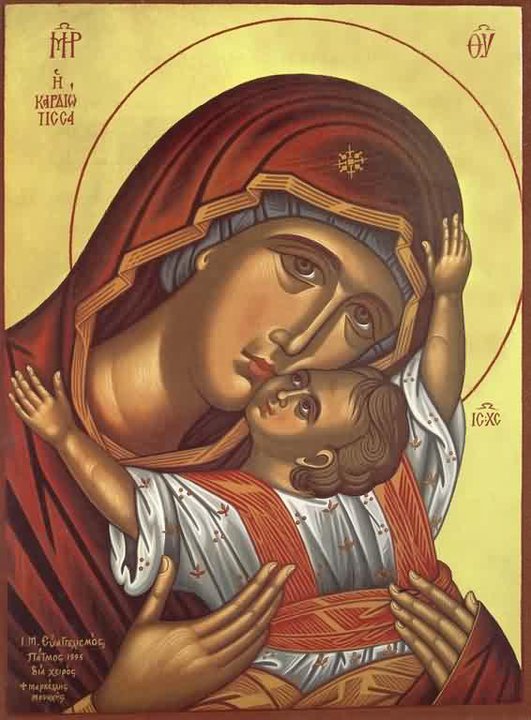
Was Mary the Mother of God?

I recently had a conversation with a Christian on Facebook regarding some of the passages in the Bible that refer to Mary.  During the conversation, I referred to Mary as The Mother of God (Theotokos).  This brought a rather stern reaction from him.  He stated, “Mary isn’t the Mother of God.  God is not born or created.  That’s heresy. Mary is the mother of Jesus’ flesh of his human body, not of His Divinity, which already existed before Mary was born.”  While I can understand his concerns, I wonder if this gentleman realizes that his position was thoroughly discussed, analyzed, and subsequently rejected by the Church roughly 1600 years ago.

During the first 500 years of Christianity, the Church dealt with the rise of several Christological heresies that necessitated the formulation of a clear theological expression of Christ’s Person and Nature.  In the early fifth century, one of these heresies questioned how Christ’s two natures, that of God and Man, related to one another. Following the teachings of Theodore of Mopsuestia, Nestorius, Patriarch of Constantinople, taught that Christ’s nature as God was utterly separate from His nature as man.  In this understanding, Christ’s early life was that of a human being in contact with God.  God foresaw that Christ would lead a virtuous life and chose Him to be a vessel of divinity.  At Christ’s birth, his contact with divinity was incomplete, becoming so later in His life.  Nestorius preferred the term Christotokos (Mother of Christ) to that already accepted as part of Holy Tradition, Theotokos (Mother of God), for He believed that Mary’s baby was not fully divine.

This teaching, which came to be known as Nestorianism, led to the calling of the Third Ecumenical Council in 431 AD.  In this Council, the Fathers of the Church upheld the teaching that in Christ the dual natures of divinity and humanity do not merely come in contact with one another, but that they are, rather, in union.  At the Incarnation, the Second Person of the Trinity, Christ, took on human nature, adding it to His Person, while at the same time retaining the fullness of His Divinity.  At the birth of Christ, Mary gave birth to a baby who was both God and human, each in the fullest sense of the word.  As a result, to deny that Mary was the Mother of God is to deny the full reality of the Incarnation and its resulting efficacy in our salvation.

In a letter to John of Antioch in 433 AD, Saint Cyril summed up this aspect of Christology very well.

Thus we confess that our Lord Jesus Christ, the only-begotten Son of God, is perfect God and perfect man, consisting of a rational soul and body, that he was begotten from the Father before all ages according to the Divinity, and that in these latter times was begotten for us and for our salvation from the Virgin Mary; that he is consubstantial with the Father in his Divinity and consubstantial with us in his humanity, for in him there was accomplished the unity of two natures.  Therefore we acknowledge one Christ, one Son, one Lord.  On the basis of this union without confusion, we confess the Most Holy Virgin to be the Mother of God because God the Word was incarnate and became man and in the conception itself united with himself the temple received from her. . . God the Word came down from heaven and, taking the form of a servant, emptied himself, and was called the Son of man, remaining that which he is – God.

The title Mother of God is a confession about Christ.  As I have heard said in the past, it says more about Him than it does about Mary.

How Do the Witnesses of the Gold Plates Compare to the Witnesses of the Resurrection? Part 4

Post Author: Bill Pratt

In this final post in the series, we will review apologist Rob Bowman’s final thoughts on Joseph Smith’s golden plates.  Bowman writes:

Whereas the resurrection of Jesus and his appearances were obviously miraculous, supernatural occurrences, there is nothing supernatural or miraculous about a set of metal plates with engravings on them.  Showing skeptics the metal plates should not have been any more problematic than showing skeptics the Great Isaiah Scroll today is.  Joseph had no hesitation or reluctance to show people the Egyptian papyri on which he claimed were the writings of Abraham and Joseph, even to complete strangers. Yet someone could be in a room with Joseph, with the plates supposedly sitting right there on the table under wraps, and Joseph would not allow them to look at the plates.  If we’re going to compare the Resurrection appearances with the gold plates, it’s a bit like Peter telling Thomas, “Jesus is right behind that wall over there—Hi, Lord!—but I’m sorry Tom, you’re not allowed to see him now.”

So what are we to make of the golden plates?  Were they real or were they fake?  According to Bowman,

It isn’t clear how many people actually saw the plates or closely inspected them.  The three witnesses say they saw the plates, but give no details, and evidently did not even touch them.  The testimony of the eight witnesses appears to have been written out for them to sign; it claims they handled the plates and saw the engravings, but there are reasons to find this claim dubious.

The simplest explanation for Joseph’s behavior is that he had something, perhaps metal plates of some kind, but not gold plates with modified Egyptian characters.  I don’t think we have enough information to determine if Joseph found the plates somewhere or if he made them, or what. But the best explanation for why he didn’t show the plates openly was that they weren’t what he claimed they were.  That explains why the only people who testified to seeing the plates were a small group—people in his family and a few others, people who were either invested in the project in some way or were easy to manipulate or convince or both—such as Martin Harris.

Here are some additional thoughts I have about the resurrection vs. the golden plates.  As Bowman suggests, coming up with a plausible natural explanation of the golden plates is trivial.  Smith could have made the plates, bought the plates, or even found the plates.  There is nothing supernatural about golden plates.

None of the witnesses of the plates appeared to be in a position to understand the Reformed Egyptian language allegedly engraved on the plates, including Smith himself.  None of the witnesses saw an angel telling Smith where the plates were.  Nobody was with Smith when he allegedly found the plates.  Nobody can know if Smith correctly translated the Book of Mormon from the plates.  In fact, Mormon historians have carefully documented that the plates were rarely even around when Smith was dictating the Book of Mormon.  Much of the material in the Book of Mormon can be directly traced from the King James Bible and contemporary sources that Smith borrowed from – hardly miraculous.

By contrast, the public execution and subsequent resurrection of Jesus, who was then seen by both friends and enemies, over many days, in many different places, screams for a supernatural explanation, especially because Jesus predicted, before he died, that these things would happen.  Skeptics have attempted for 2,000 years to explain what happened without invoking the supernatural, and have utterly failed.

There is simply no comparison between the resurrection of Jesus and the golden plates of Joseph Smith.  Any attempts to claim that they are similar, are, in my opinion, foolish.  My special thanks to Rob Bowman for making his comments available to me.  I think you would all agree that they were quite helpful!

A Christian Apologetics Blog