What Is the Gospel of Peter?

Post Author: Bill Pratt 
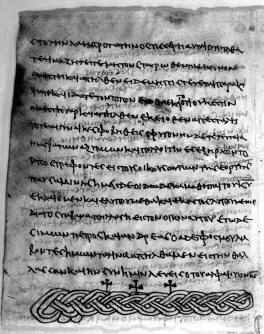
During the second through ninth centuries, a large body of Christian literature was produced that claimed (falsely) to be produced by apostles of Jesus or those close to the apostles. These works, rejected by the Church as authentic, came to be known as the New Testament Apocrypha.

One of the most famous of these documents is the Gospel of Peter.  Biblical scholar Robert Van Voorst, in his book Jesus Outside the New Testament: An Introduction to the Ancient Evidence, describes how this document was found.

In 1886, a French archaeological team excavating the necropolis of an ancient Pachomian monastery about 250 miles south of Cairo found a small book in a monk’s grave. Pages two through ten of this book, which was dated to the seventh to ninth centuries, contain an account of the death and resurrection of Jesus which scholars soon concluded was part of the Gospel of Peter mentioned by early Church Fathers from the beginning of the third century. (No other parts of the Gospel of Peter were found.)

How was the Gospel of Peter received by scholars?

Scholarship at first paid close attention to the Gospel of Peter, but when the consensus developed that it was a popularizing and docetic adaptation of the canonical Gospels, especially Matthew, disinterest soon marginalized it. . . .

Although scholarship at first branded the Gospel of Peter docetic, recent study has seen it as equally at home in what came to be orthodox Christianity. The Gospel of Peter does indeed share several characteristics of orthodox Christian literature of the second century. It popularizes the traditions with which it works, as can be seen in both its style (the somewhat crude parataxis) and its content.

It emphasizes the miraculous more than the canonical Gospels do, making miracles into seemingly incontrovertible proofs of the faith. It has some strong connections (oral and written) with the canonical Gospels. Like the Acts of Pilate, the other main passion narrative of the time, the Gospel of Peter has a strong anti-Jewish polemic. This may be connected with its location in popular circles, where anti-Judaism was probably stronger than in official circles. Finally, the Gospel of Peter has a pronounced devotional element, especially seen in its consistent use of “the Lord” rather than “Jesus.”

A closer examination of the Gospel of Peter, though, also reveals the influence of gnosticism, a heterodox strain of Christianity present in the second century.

[T]he Gospel of Peter can also be read as at least incipiently Gnostic and as having an appeal to Gnostic Christians. The phrase “as though he had no pain” (4:10) would appeal to Gnostic Christians who downplayed or denied the suffering of Christ. The cry of dereliction, “My power, O power, you have forsaken me” (5:19), would also appeal to Gnostics who held that the divine element of Jesus left him shortly before the crucifixion. That the Gospel of Peter could appeal to and be used by both orthodox and Gnostic Christians should not surprise us; after all, both groups also used the Gospel of John and the letters of Paul.

Van Voorst then explains the controversy that currently surrounds the Gospel of Peter among biblical scholars.

The most controversial issue in current scholarship on the Gospel of Peter centers on whether an earlier form of its passion narrative was also the source of the passion narrative in the canonical Gospels. Helmut Koester and John Dominic Crossan are the two leading advocates of this position, but they have failed to convince the majority of scholars.

Crossan’s major statement of his hypothesis, in his book The Cross That Spoke; lacks the sort of detailed source-critical analysis that many scholars demand. Unless and until those who promote such a source hypothesis for the Gospel of Peter match the source-critical arguments of those who oppose it (e.g., Joel B. Green, Raymond E. Brown, Alan Kirk, and Susan B. Schaeffer), this fascinating hypothesis will continue to hold a minority position. The passion narrative of the Gospel of Peter fits well in the second century, and the argument against its containing a precanonical passion source seems at present much stronger than the argument in its favor.

If you would like to read the Gospel of Peter for yourself, you can find it at this link.

What Are the Protevangelium of James and the Infancy Story of Thomas?

Post Author: Bill Pratt 

During the second through ninth centuries, a large body of Christian literature was produced that claimed (falsely) to be produced by apostles of Jesus or those close to the apostles. These works, rejected by the Church as authentic, came to be known as the New Testament Apocrypha.

One of the most interesting genres of the Apocrypha is the “infancy gospel.” Biblical scholar Robert Van Voorst, in his book Jesus Outside the New Testament: An Introduction to the Ancient Evidence, describes two of the most studied “infancy gospels,” the Protevangelium of James and the Infancy Story of Thomas.

The Protevangelium of James, better known in the ancient world by the more accurate title “The Birth of Mary,” is a second century work by a Gentile Christian author. Widely popular in ancient and medieval Christianity for its piety and literary beauty, it survives in many manuscripts in the original Greek and subsequent versions in eight different languages.

It tells the story of Mary the mother of Jesus: her parents Joachim and Anne, her miraculous (but not yet “immaculate”) conception and birth, her childhood upbringing in the temple, her betrothal by lot to the aging widower Joseph and her continuing virginity, and finally her bearing of Jesus. The Protevangelium of James uses the infancy narratives of Matthew and Luke, extending and supplementing them for its own purposes.

The main theme of this work is the praise of virginity, important in the rising ascetic and monastic movements in Christianity. Because it focuses on the Virgin Mary, using legendary embellishments to tell her story, and draws what it says about the birth of Jesus from the canonical Gospels and popular legend, it has little or no significance for our study of the historical Jesus (emphasis added).

What about the Infancy Story of Thomas?

The Infancy Story of Thomas originated in the late second century, and relates the miracles of the child Jesus between the ages of five and twelve as told by Jesus’ disciple Thomas. It exists today in a Greek original and five other language versions.

Not as literarily or theologically sophisticated as the Protevangelium of James, the Infancy Story of Thomas features a crude emphasis on miracles. Jesus possesses even as a boy an omniscience and omnipotence that the canonical Gospels do not attribute to the adult Jesus during his ministry.

The boy Jesus does some good with his miraculous power, but he often uses it cruelly, as for example when he kills another boy who knocked against his shoulder (4:12), causes those who accuse him to go blind (5:1), and even issues a veiled threat to Joseph when he disciplines him (5:2). The contents of this document are so oriented to later popular piety that they offer no glimpse into first-century traditions about Jesus (emphasis added).

As Van Voorst notes, although these works may give us insight into what some second century Christians were thinking about, they are virtually worthless for telling us anything about the historical Jesus. They were written far too long after Jesus and his disciples lived.

What Are the Infancy Gospels?

Post Author: Bill Pratt 

During the second through ninth centuries, a large body of Christian literature was produced that claimed (falsely) to be produced by apostles of Jesus or those close to the apostles. These works, rejected by the Church as authentic, came to be known as the New Testament Apocrypha.

One of the most interesting genres of the Apocrypha is the “infancy gospel.” Biblical scholar Robert Van Voorst, in his book Jesus Outside the New Testament: An Introduction to the Ancient Evidence, explains just what these “infancy gospels” are.

The “Infancy Gospels” are so-called because they are stories of Jesus, albeit only of his early years. In the canonical Gospels, Mark has nothing about Jesus’ birth, Matthew and Luke each have two chapters as a prologue to Jesus’ ministry, but John also does not write about Jesus’ birth. To judge from these writings, and both orthodox-Christian and gnostic-Christian writings outside the NT, Christians were primarily interested in the words and deeds of the adult Jesus.

As time went on, beginning from the first century, many ancient Christians developed a stronger interest in Jesus’ birth and early years. Oral traditions arose to supplement Matthew and Luke, mostly with popular Christian imagination and with Greco-Roman and Indian legends about the birth of supernatural children.

Just what was the aim of these infancy gospels? Why did this genre develop during the centuries following Jesus’s life and death?

The aim of the infancy gospels was not just to fill in a gap in the Gospels. They have a wider doctrinal and apologetic motive: to define the Davidic descent of Jesus by way of Mary’s supposed Davidic descent, and to defend against rising Jewish attacks on the legitimacy of Jesus’ birth. The Infancy Gospels at their oral and written stages drew on Matthew and Luke, but went far beyond them. As Oscar Cullmann stated, “The tendency to draw upon extraneous legends, already discernible in the infancy narratives of Matthew and Luke, is greatly increased.”

In our next blog post, we’ll look at the two most well-known infancy gospels.

A Response to George A. Wells’ Claim that Jesus Never Existed – Part 2

Post Author: Bill Pratt 

According to biblical scholar Robert Van Voorst, in his book Jesus Outside the New Testament: An Introduction to the Ancient Evidence, George A. Wells is the “most prolific and persistent contemporary critic of the historicity of Jesus.”

In part 1, we reviewed Wells’ arguments. In part 2, we’ll look at Van Voorst’s summary of the response that scholarship has given to Wells’ hypotheses.

First, Wells misinterprets Paul’s relative silence about some details in the life of Jesus: the exact time of his life, the exact places of his ministry, that Pontius Pilate condemned him, and so forth. As every good student of history knows, it is wrong to suppose that what is unmentioned or undetailed did not exist. Arguments from silence about ancient times, here about the supposed lack of biblical or extrabiblical references to Jesus, are especially perilous. Moreover, we should not expect to find exact historical references in early Christian literature, which was not written for primarily historical purposes. Almost all readers of Paul assume on good evidence that Paul regards Jesus as a historical figure, not a mythical or mystical one.

Second, Wells argues that Christians invented the figure of Jesus when they wrote gospels outside Palestine around 100. Not only is this dating far too late for Mark (which was probably written around the year 70), Matthew, and Luke (both of which probably date to the 80s), it cannot explain why the Gospel references to details about Palestine are so plentiful and mostly accurate.

Third, Wells claims that the development of the Gospel traditions and historical difficulties within them show that Jesus did not exist. However, development does not necessarily mean wholesale invention, and difficulties do not prove nonexistence. (Some of Wells’s readers may get the impression that if there were no inconsistencies in the Gospels, he would seize on that as evidence of their falsehood!)

Fourth, Wells cannot explain to the satisfaction of historians why, if Christians invented the historical Jesus around the year 100, no pagans and Jews who opposed Christianity denied Jesus’ historicity or even questioned it.

Fifth, Wells and his predecessors have been far too skeptical about the value of non-Christian witnesses to Jesus, especially Tacitus and Josephus. They point to well-known text-critical and source-critical problems in these witnesses and argue that these problems rule out the entire value of these passages, ignoring the strong consensus that most of these passages are basically trustworthy.

Sixth, Wells and others seem to have advanced the nonhistoricity hypothesis not for objective reasons, but for highly tendentious, antireligious purposes. It has been a weapon of those who oppose the Christian faith in almost any form, from radical Deists, to Freethought advocates, to radical secular humanists and activist atheists like Madalyn Murray O’Hair. They have correctly assumed that to prove this hypothesis would sound the death knell of Christianity as we know it, but the theory remains unproven.

Finally, Wells and his predecessors have failed to advance other, credible hypotheses to account for the birth of Christianity and the fashioning of a historical Christ. The hypotheses they have advanced, based on an idiosyncratic understanding of mythology, have little independent corroborative evidence to commend them to others.

After this analysis of the grave weaknesses in Wells’ arguments, VanVoorst concludes with the following:

The nonhistoricity thesis has always been controversial, and it has consistently failed to convince scholars of many disciplines and religious creeds. Moreover, it has also consistently failed to convince many who for reasons of religious skepticism might have been expected to entertain it, from Voltaire to Bertrand Russell. Biblical scholars and classical historians now regard it as effectively refuted.

A Response to George A. Wells’ Arguments that Jesus Never Existed – Part 1

Post Author: Bill Pratt 

According to biblical scholar Robert Van Voorst, in his book Jesus Outside the New Testament: An Introduction to the Ancient Evidence, George A. Wells is the “most prolific and persistent contemporary critic of the historicity of Jesus.”

Van Voorst first lays out Wells’ arguments and then provides summarized responses from biblical scholars. What is Wells’ approach, then?

Wells draws ammunition from much recent Gospel scholarship, which has concluded that the Gospels were written more than forty years after Jesus by unknown authors who were not eyewitnesses to him. Wells argues that the Gospels contain much that is demonstrably legendary, and they are directed by theological (not historical) purposes.

Earlier parts of the New Testament, notably Paul’s authentic letters, presuppose that Jesus existed, but provide no detailed evidence that would make his existence credible. Therefore, Wells argues, we need independent corroboration from other, “objective” sources to affirm his existence.

He minutely examines these proposed other sources, from Tacitus to Talmud, and finds that they contain no independent traditions about Jesus. Therefore, they are not admissible, and the likelihood increases that Jesus did not exist. Wells explains Jesus as a mythical figure arising from Paul’s mysticism, for whom other late first-century Christians had to fabricate a life story.

What has been the reaction from other scholars to Wells?

R. Joseph Hoffmann is correct to call Wells “the most articulate contemporary defender of the non-historicity thesis.” Wells does write in a calm, scholarly tone, in contrast to many others who have advanced this hypothesis. However, Richard France’s conclusion on his method is also correct: “[Wells] always selects from the range of New Testament studies those extreme positions which best suit his thesis, and then weaves them together into a total account with which none of those from whom he quoted would agree.”

Van Voorst continues:

France’s conclusion is widely shared, as most New Testament scholars do not address Wells’s arguments at all, and those who do address them do not go into much depth. Although Wells has been probably the most able advocate of the nonhistoricity theory, he has not been persuasive and is now almost a lone voice for it. The theory of Jesus’ nonexistence is now effectively dead as a scholarly question.

Why has scholarship abandoned the questions that Wells has raised? What are the specific problems with his conclusions? That will be covered in part 2 of this series.

Why Is the God of the Old Testament Worthy of Worship? His Mercy

Post Author: Bill Pratt 

Skeptics of Christianity love to point out all the difficult passages in the Bible, especially in the Old Testament. By noting these difficult passages, skeptics explicitly or implicitly imply that Christians are foolish (or even deranged) for worshiping the God described in the Old Testament.

My problem with this implication is that the number of difficult passages are dwarfed by the number of passages that clearly describe the greatness of God. These passages come in a wide variety and they are found all over the Old Testament. The skeptic’s approach is, therefore, totally unbalanced – it does not take into consideration the totality of Scripture.

So, to the skeptics who question why I worship the God described in the Old Testament, it’s not only his wisdom, his majesty, his beauty, his holiness, his moral perfection, his truthfulness, and his love, but his mercy.

The Old Testament affirms in many places that God is merciful.  In fact, contrary to skeptics, God’s mercy is mentioned far more in the OT than most other of God’s attributes.

According to Norman Geisler in his Systematic Theology, Volume Two: God, Creation, the mercy of God is exhibited in numerous ways, as seen below.

How does the Old Testament connect God with mercy?

God’s Mercy Is Rooted in His Goodness and Love

“[He is] maintaining love to thousands, and forgiving wickedness, rebellion and sin. Yet he does not leave the guilty unpunished” (Ex. 34:7).

“The LORD is slow to anger, abounding in love and forgiving sin and rebellion. Yet he does not leave the guilty unpunished.… In accordance with your great love, forgive the sin of these people, just as you have pardoned them from the time they left Egypt until now” (Num. 14:18–19).

“Give thanks to the LORD, for he is good” (1 Chron. 16:34).

“They raised their voices in praise to the LORD and sang: ‘He is good’ ” (2 Chron. 5:13).

God’s Mercy Is Great

“Your servant has found favor in your eyes, and you have shown great kindness to me in sparing my life” (Gen. 19:19).

“In accordance with your great love, forgive the sin of these people, just as you have pardoned them from the time they left Egypt until now” (Num. 14:19).

“Solomon answered, ‘You have shown great kindness to your servant, my father David, because he was faithful to you and righteous and upright in heart. You have continued this great kindness to him and have given him a son to sit on his throne this very day’ ” (1 Kings 3:6).

“Remember me for this also, O my God, and show mercy to me according to your great love” (Neh. 13:22).

“Then I commanded the Levites to purify themselves and go and guard the gates in order to keep the Sabbath day holy. Remember me for this also, O my God, and show mercy to me according to your great love” (Neh. 13:22).

God’s Mercy Is Everlasting

“Know therefore that the LORD your God is God; he is the faithful God, keeping his covenant of love to a thousand generations of those who love him and keep his commands” (Deut. 7:9).

“He gives his king great victories; he shows unfailing kindness to his anointed, to David and his descendants forever” (2 Sam. 22:51).

“Give thanks to the LORD, for he is good; his love endures forever” (1 Chron. 16:34).

“They raised their voices in praise to the Lord and sang, ‘He is good; his love endures forever.’ Then the temple of the LORD was filled with a cloud” (2 Chron. 5:13).

“Who is a God like you, who pardons sin and forgives the transgression of the remnant of his inheritance? You do not stay angry forever but delight to show mercy” (Micah 7:18).

God’s Mercy Is Faithful

“If you pay attention to these laws and are careful to follow them, then the LORD your God will keep his covenant of love with you, as he swore to your forefathers” (Deut. 7:12).

“O LORD, God of Israel, there is no God like you in heaven above or on earth below—you who keep your covenant of love with your servants who continue wholeheartedly in your way” (1 Kings 8:23).

“Then I said, ‘O LORD, God of heaven, the great and awesome God, who keeps his covenant of love with those who love him and obey his commands’ ” (Neh. 1:5).

“Now therefore, O our God, the great, mighty and awesome God, who keeps his covenant of love, do not let all this hardship seem trifling in your eyes” (Neh. 9:32).

Why Is the God of the Old Testament Worthy of Worship? His Love

Post Author: Bill Pratt 

Skeptics of Christianity love to point out all the difficult passages in the Bible, especially in the Old Testament. By noting these difficult passages, skeptics explicitly or implicitly imply that Christians are foolish (or even deranged) for worshiping the God described in the Old Testament.

My problem with this implication is that the number of difficult passages are dwarfed by the number of passages that clearly describe the greatness of God. These passages come in a wide variety and they are found all over the Old Testament. The skeptic’s approach is, therefore, totally unbalanced – it does not take into consideration the totality of Scripture.

So, to the skeptics who question why I worship the God described in the Old Testament, it’s not only his wisdom, his majesty, his beauty, his holiness, his moral perfection, and his truthfulness, but his love.

The Old Testament affirms in many places that God is loving.  According to Norman Geisler in his Systematic Theology, Volume Two: God, Creation, “If ‘love’ is defined as ‘willing the good of its object,’ then for all practical purposes ‘love’ and ‘goodness’ can be treated synonymously. Literally, the word omnibenevolent means ‘all-good.’ . . .  Theologically, God’s omnibenevolence refers to His infinite or unlimited goodness.”

How does the Old Testament connect God with love?

God Is Love

“Yet the Lord set his affection on your forefathers and loved them, and he chose you, their descendants, above all the nations, as it is today” (Deut. 10:15).

“For I, the LORD, love justice; I hate robbery and iniquity” (Isa. 61:8).

“In all their distress he too was distressed, and the angel of his presence saved them. In his love and mercy he redeemed them” (Isa. 63:9).

“The LORD appeared to us in the past, saying: ‘I have loved you with an everlasting love; I have drawn you with loving-kindness’ ” (Jer. 31:3).

“The LORD said to me, ‘Go, show your love to your wife again, though she is loved by another and is an adulteress. Love her as the LORD loves the Israelites’ ” (Hosea 3:1).

“I led them with cords of human kindness, with ties of love; I lifted the yoke from their neck and bent down to feed them” (Hosea 11:4).

“The LORD your God is with you, he is mighty to save. He will take great delight in you, he will quiet you with his love, he will rejoice over you with singing” (Zeph. 3:17).

Why Is the God of the Old Testament Worthy of Worship? His Truthfulness

Post Author: Bill Pratt 

Skeptics of Christianity love to point out all the difficult passages in the Bible, especially in the Old Testament. By noting these difficult passages, skeptics explicitly or implicitly imply that Christians are foolish (or even deranged) for worshiping the God described in the Old Testament.

My problem with this implication is that the number of difficult passages are dwarfed by the number of passages that clearly describe the greatness of God. These passages come in a wide variety and they are found all over the Old Testament. The skeptic’s approach is, therefore, totally unbalanced – it does not take into consideration the totality of Scripture.

So, to the skeptics who question why I worship the God described in the Old Testament, it’s not only his wisdom, his majesty, his beauty, his holiness, and his moral perfection, but his truthfulness.

The Old Testament affirms in many places that God is truthful.  According to Norman Geisler in his Systematic Theology, Volume Two: God, Creation, “The term ‘truth,’ as used in Scripture, means that which, because it corresponds to reality (the facts, the original), is reliable, faithful, and stable. Used of words, truth is telling it like it is. True statements are those that correspond to reality and, hence, are dependable.”

How does the Old Testament connect God with truthfulness?

God Is Truth

“He is the Rock, his work is perfect: for all his ways are judgment: a God of truth and without iniquity, just and right is he” (Deut. 32:4).

“God is not a man, that he should lie, nor a son of man, that he should change his mind. Does he speak and then not act? Does he promise and not fulfill?” (Num. 23:19).

“He who is the Glory of Israel does not lie or change his mind; for he is not a man, that he should change his mind” (1 Sam. 15:29).

“Into your hands I commit my spirit; redeem me, O LORD, the God of truth” (Ps. 31:5).

“For the word of the LORD is right and true; he is faithful in all he does” (Ps. 33:4).

Why Is the God of the Old Testament Worthy of Worship? His Moral Perfection

Post Author: Bill Pratt 

Skeptics of Christianity love to point out all the difficult passages in the Bible, especially in the Old Testament. By noting these difficult passages, skeptics explicitly or implicitly imply that Christians are foolish (or even deranged) for worshiping the God described in the Old Testament.

My problem with this implication is that the number of difficult passages are dwarfed by the number of passages that clearly describe the greatness of God. These passages come in a wide variety and they are found all over the Old Testament. The skeptic’s approach is, therefore, totally unbalanced – it does not take into consideration the totality of Scripture.

So, to the skeptics who question why I worship the God described in the Old Testament, it’s not only his wisdom, his majesty, his beauty, and his holiness, but his moral perfection.

The Old Testament affirms in many places that God is morally perfect.  According to Norman Geisler in his Systematic Theology, Volume Two: God, Creation, holiness, “Another attribute of God is that of absolute moral perfection. God is morally impeccable: He is not simply an infinite Being; He is an infinitely perfect Being.”

How does the Old Testament connect God with moral perfection?

God Is Morally Perfect

“He is the Rock, his works are perfect, and all his ways are just. A faithful God who does no wrong, upright and just is he” (Deut. 32:4).

“As for God, his way is perfect” (2 Sam. 22:31).

“It is God who arms me with strength and makes my way perfect” (2 Sam. 22:33).

“Do you know how the clouds hang poised, those wonders of him who is perfect in knowledge?” (Job 37:16).

“As for God, his way is perfect; the word of the LORD is flawless” (Ps. 18:30).

“The law of the LORD is perfect, reviving the soul” (Ps. 19:7).

“The LORD will fulfill [perfect] his purpose for me; your love, O LORD, endures forever—do not abandon the works of your hands” (Ps. 138:8).

“O LORD, you are my God; I will exalt you and praise your name, for in perfect faithfulness you have done marvelous things, things planned long ago” (Isa. 25:1).


Why Is the God of the Old Testament Worthy of Worship? His Holiness

Post Author: Bill Pratt 

Skeptics of Christianity love to point out all the difficult passages in the Bible, especially in the Old Testament. By noting these difficult passages, skeptics explicitly or implicitly imply that Christians are foolish (or even deranged) for worshiping the God described in the Old Testament.

My problem with this implication is that the number of difficult passages are dwarfed by the number of passages that clearly describe the greatness of God. These passages come in a wide variety and they are found all over the Old Testament. The skeptic’s approach is, therefore, totally unbalanced – it does not take into consideration the totality of Scripture.

So, to the skeptics who question why I worship the God described in the Old Testament, it’s not only his wisdom, his majesty, and his beauty, but his holiness.

The Old Testament manifestly proclaims that God is holy.  According to Norman Geisler in his Systematic Theology, Volume Two: God, Creation, holiness “refers to [God’s] absolute moral uniqueness as well as His total separateness from all creatures.”

How does the Old Testament connect God with holiness?

God Is Holy

“Who among the gods is like you, O LORD? Who is like you—majestic in holiness, awesome in glory, working wonders” (Exodus 15:11)?

“I am the LORD your God; consecrate yourselves and be holy, because I am holy. Do not make yourselves unclean by any creature that moves about on the ground. I am the LORD who brought you up out of Egypt to be your God; therefore be holy, because I am holy” (Leviticus 11:44-45).

“Speak to the entire assembly of Israel and say to them: ‘Be holy because I, the LORD your God, am holy’ ” (Leviticus 19:2).

“You are not able to serve the LORD. He is a holy God; he is a jealous God. He will not forgive your rebellion and your sins” (Joshua 24:19).

“There is no one holy like the LORD; there is no one besides you [God]; there is no Rock like our God” (1 Samuel 2:2).

“Ascribe to the LORD the glory due to his name. Bring an offering and come before him; worship the LORD in the splendor of his holiness” (1 Chronicles 16:29).

“Exalt the Lord our God and worship at his footstool; he is holy” (Psalm 99:5).

“The LORD Almighty will be exalted by his justice, and the holy God will show himself holy by his righteousness” (Isaiah 5:16).

“When they see among them their children, the work of my hands, they will keep my name holy; they will acknowledge the holiness of the Holy One of Jacob, and will stand in awe of the God of Israel” (Isaiah 29:23).

Geisler reminds us that “numerous biblical passages speak of God as ‘the Holy One’ (Ps. 71:22; Ps. 78:41; Isa. 5:19; 29:23; 43:3; cf. 48:17; 54:5; 55:5; 60:9; Jer. 51:5; Hosea 11:9, 12; Hab. 1:12; 3:3; Mark 1:24; Luke 1:35; 4:34; John 6:69).”

In subsequent blog posts, I will look at yet more reasons to worship the God of the Old Testament.

A Christian Apologetics Blog