What Is the Pantheist Answer to Evil?

The universal human experience of evil is a problem for all worldviews, not just Christianity. Philosopher Norm Geisler, in his book If God, Why Evil?: A New Way to Think About the Questionexplains that there are three main views on evil that come from the “big three” worldviews of pantheism, atheism, theism.

Pantheism affirms God and denies evil.

Atheism affirms evil and denies God.

Theism affirms both God and evil.

In a previous blog post, I explained why the existence of objective evil is a devastating problem for the atheist worldview, but why is the pantheist answer to evil also problematic? Geisler explains:

In general, pantheists believe God exists but deny the existence of evil. They believe God is good, God is All, and hence there is no evil. Mary Baker Eddy, founder of Christian Science, held this view, maintaining that “evil is an error of [the] moral mind.”

Most people, however, find it difficult to accept this answer. The old limerick summarizes their conundrum well:

“There was a Faith Healer of deal

Who said ‘Although pain isn’t real,

If I sit upon a pin,

And it punctures my skin,

I dislike what I fancy I feel!'”

So why is this a problem for the pantheist view?

In short, if evil is not real, then why does it hurt so badly? If pain, suffering, and death are not real, then how do we explain where the illusion came from? And why does everyone have it? Further, why is the illusion so persistent? Why can’t we make it go away?

When we wonder whether we are dreaming or awake, we can pinch ourselves. We know we have been dreaming because we wake up. But we don’t wake up from suffering, which always surrounds us and often invades us. We can tell an illusion because there is always a backdrop of reality by which we know it is an illusion. But evil is part of the backdrop of life itself. How then can it be illusory?

The pantheist is then left with claiming that the pervasive, universal phenomena of human suffering is unreal, an illusion. Rather than explaining what evil is, the pantheist has simply denied its existence. On top of that, I can guarantee that every person that claims evil and suffering are illusions, act every day as if they are real. The pantheist view of evil is simply unlivable and incoherent.

Why Don’t Christians Sacrifice Animals to Atone for Sins?

There are many commands given by God to the Israelites at Mount Sinai that Christians do not obey, animal sacrifice being one of them. Aren’t we disobeying God by not following his commands? Skeptics of Christianity love to read through the Book of Leviticus and point out how inconsistent we are in obeying God’s commands. How do we explain this?

In general terms, Christians are told by New Testament writers that we are under a new covenant and that the old covenant given to Moses at Mount Sinai (often called “the Law”) is obsolete (see Heb 8:13 and Rom 7:6, for example). Therefore, there is no obligation for Christians to obey any commands in Leviticus without further consideration about how those commands should be applied by New Testament believers.

More specifically, the New Testament teaches that Jesus Christ is the all-sufficient sacrifice for all of mankind’s sins, so further sacrifices are unnecessary. Jesus said he came “to give his life as a ransom for many” (Mark 10:45). Paul said, “Walk in love as Christ loved us and gave himself up for us, a fragrant offering and sacrifice to God” (Eph. 5:2). Peter said, “You were ransomed . . . with the precious blood of Christ, like that of a lamb without blemish or spot” (1 Pet. 1:18–19). And finally, Heb. 7:27 mentions the daily sacrifices the Levite priests offered, but Christ offered one sacrifice “once for all when he offered up himself.”

Commentary on Leviticus 1 (Sacrifices)

The book of Leviticus opens with God calling to Moses from the Tent of Meeting. God wants Moses to instruct the Israelites how to bring offerings to Him, now that the tabernacle complex (God’s home among the Israelites) has been constructed. Remember that offerings had been made to God as early as Abraham, so it wasn’t that God was introducing new kinds of offerings to the people, but He was instead teaching them how to do these offerings now that there is a new covenant between them (represented by the stone tablets containing the Ten Commandments).

There are five kinds of offerings that are regulated in Leviticus: burnt, grain, fellowship, sin, and guilt. We will only dig into the burnt offering, as it is the most important and the first to be regulated.

The person who wants to give a burnt offering to God may choose between 3 kinds of domesticated animals: 1) cattle, 2) sheep or goats, or 3) doves and pigeons. Cattle were worth more than sheep and goats, but sheep and goats were worth more than doves and pigeons. Which animal was offered depended on the relative wealth of the person giving the burnt offering. In each case, however, the offering was a significant economic sacrifice. These domesticated animals provided food, clothing, and many other essential things for people living at this time. To give up one of these animals was painful.

In verses 3-9, the instructions for the sacrifice of cattle is given. These verses teach us important truths about the process. First, in verse 3, we see that the cow must be a male without defect. Male cattle (bull) were more valuable than female and a bull without defect was worth more than a bull with defects. Only the best was allowed for the burnt offering to God.

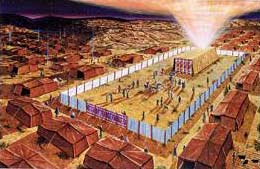
Continuing in verse 3, the person making the sacrifice is to bring it to the entrance of the tabernacle courtyard (“entrance curtain” in this illustration – http://www.karbelmultimedia.com/portfolio/the-tabernacle/).

In verse 5, the person offering the bull must place his hands on the head of the bull so that the bull’s sacrifice can make atonement for the offerer. What does atonement refer to here? According to Gordon J. Wenham in The Book of Leviticus (The New International Commentary on the Old Testament), “The worshipper acknowledged his guilt and responsibility for his sins by pressing his hand on the animal’s head and confessing his sin. The lamb [or bull or bird] was accepted as the ransom price for the guilty man.”

Verses 5-9 dictate that the person giving the burnt offering must kill the bull himself, skin the bull, cut the bull into pieces, and then wash the parts of the bull in water. The Levite priests will capture dripping blood from the animal and sprinkle the blood on the brazen altar (see illustration above). After the offerer has completed the above steps, the priests will arrange the pieces of the bull on the brazen altar and burn all of it.

Gordon Wenham explains the significance of the ritual to those participating:

Using a little imagination every reader of the OT soon realizes that these ancient sacrifices were very moving occasions. They make modern church services seem tame and dull by comparison. The ancient worshipper did not just listen to the minister and sing a few hymns. He was actively involved in the worship. He had to choose an unblemished animal from his own flock, bring it to the sanctuary, kill it and dismember it with his own hands, then watch it go up in smoke before his very eyes. He was convinced that something very significant was achieved through these acts and knew that his relationship with God was profoundly affected by this sacrifice.

The rest of Leviticus 1 explains similar processes for the offering of goats, sheep, doves, and pigeons. The only difference for the birds is that because they are so small, the priests end up performing most of the ceremony.

So what is the overall purpose of the burnt offering? Wenham summarizes for us:

The burnt offering was the commonest of all the OT sacrifices. Its main function was to atone for man’s sin by propitiating God’s wrath. In the immolation of the animal, most commonly a lamb, God’s judgment against human sin was symbolized and the animal suffered in man’s place. The worshipper acknowledged his guilt and responsibility for his sins by pressing his hand on the animal’s head and confessing his sin. The lamb was accepted as the ransom price for the guilty man.

The daily use of the sacrifice in the worship of the temple and tabernacle was a constant reminder of man’s sinfulness and God’s holiness. So were its occasional usages after sickness, childbirth, and vows. In bringing a sacrifice a man acknowledged his sinfulness and guilt. He also publicly confessed his faith in the Lord, his thankfulness for past blessing, and his resolve to live according to God’s holy will all the days of his life.

What Are the Limits of Physics?

Contrary to the disciples of scientism, physics has limits. Philosopher Ed Feser gives a quick run-down which is worth passing along. Feser writes,

As I have emphasized many times, what physics gives us is a description of the mathematical structure of physical reality.  It abstracts from any aspect of reality which cannot be captured via its exclusively quantitative methods. (emphasis added)

Let’s stop here because this is important. What Feser is saying is that when the methods of physics are applied to any object, any event, any piece of the world around us, the method only addresses the parts of that object, event, or piece of the world that can be mathematically quantified. Physics ignores any parts of the world that cannot be mathematically quantified.

One reason that this is crucial to keep in mind is that from the fact that something doesn’t show up in the description physics gives us, it doesn’t follow that it isn’t there in the physical world.  This is like concluding from the fact that color doesn’t show up in a black and white pen and ink drawing of a banana that bananas must not really be yellow.

In both cases the absence is an artifact of the method employed, and has nothing whatsoever to do with the reality the method is being used to represent.  The method of representing an object using black ink on white paper will necessarily leave out color even if it is there, and the method of representing physical reality using exclusively mathematical language will necessarily leave out any aspect of physical reality which is not reducible to the quantitative, even if such aspects are there.

But maybe all of reality is just composed of mathematical structure. Feser argues that this cannot be the case, that other aspects of reality must be there.

The quantitative description physics gives us is essentially a description of mathematical structure.  But mathematical structure by itself is a mere abstraction.  It cannot be all there is, because structure presupposes something concrete which has the structure.  Indeed, physics itself tells us that the abstraction cannot be all there is, since it tells us that some abstract mathematical structures do not fit the actual, concrete material world.

For example, Einstein is commonly taken to have shown that our world is not really Euclidean.  This could only be true if there is some concrete reality that instantiates a non-Euclidean abstract structure rather than a Euclidean abstract structure.  So, physics itself implies that there must be more to the world than the abstract structure it captures in its purely mathematical description, but it does not and cannot tell us exactly what this concrete reality is like.

Physics is one tool, a powerful one certainly, in our toolbox for describing reality. But to think that it is the only tool in the toolbox is just silly.

Commentary on Exodus 35-40 (Construction of the Tabernacle)

After the Golden Calf incident in chapter 32, God renewed his covenant with Israel and again wrote the covenant on two stone tablets. Most likely the two tablets were identical, as there would be one tablet for each party in the covenant (God and Israel).

In order for Israel to worship God properly, God gives Moses detailed instructions on the construction of the tabernacle, a sanctuary where God will dwell among the people of Israel. In verses 4-9 of Exodus 35, Moses begins the process of constructing the tabernacle (sometimes called the Tent of Meeting) by asking for the raw materials to be donated by the people.

The materials can be grouped in metals, fabrics, skins and wood, lamp oil, the anointing oil ingredients and incense ingredients, and gemstones. Each of the materials serves a specific purpose in the construction of the tabernacle. It should be noted that the raw materials are valuable, so that a great voluntary sacrifice of material wealth will have to be given by the Israelites. Once the materials for construction are collected, the people are commanded to build the tabernacle and everything that goes along with it.

In verses 10-19, Moses lists what must be built: the tabernacle with its tent and its covering, clasps, frames, crossbars, posts and bases; the ark of the covenant; the table on which the bread of the Presence will sit; the lampstand; the altar of incense; the curtain for the doorway at the entrance to the tabernacle; the altar of burnt offering; the bronze basin; the curtains of the courtyard; the tent pegs for the tabernacle and courtyard; and the woven garments worn for ministering in the sanctuary.

What is the purpose of the tabernacle and all of its contents? Let’s take them one by one. The significance of the entire tabernacle itself is that it is to represent God’s presence among his people. The Israelites were to place the tabernacle (where God is present) at the center of their camp. We know from the Book of Hebrews that the tabernacle was also be an earthly representation of Heaven, a pointer to the place where all of God’s people will forever be in His presence.

What about the ark? There appear to be two purposes for it. First, it would contain the two stone tablets of the Ten Commandments as a symbol of the covenant agreement. Second, the lid of the ark would serve as the “mercy seat,” a pure gold sculpture that symbolized a place for God to stand as a contact point for God and the Israelites. Here God would reveal divine truth to his people.

The purpose of the table in the outer room was to hold the bread of Presence. Since the tabernacle was to symbolize God’s house, the table was to symbolize where God would eat. A special group of Levites would bake twelve loaves each week, let them sit on the table, and then the priests would eat them at the end of the week, and start the process over again.

The lampstand (menorah) was to signify that God was “home” in the tabernacle. All of the Israelite tents used lamp light at night to allow them to see, so God’s house also needed lamp light. The seven lamps of this impressive lampstand would have burned extremely bright in the middle of the Israelite camp.

The purpose of the altar of incense in the outer room of the tabernacle was to represent the prayers of the people of Israel to God. In the ancient world, burning incense symbolized prayer, and that is why this altar is located right in front of the curtain that separates the outer room of the tabernacle from the inner room (Holy of Holies). The incense would travel directly to the ark behind the curtain, where God met with the people.

Since the tabernacle was God’s earthly home, the curtain at the entrance to the tabernacle could be thought of as the front door to his house. The curtain at the entrance was often kept open so that people could see into the tabernacle front room which contained the lampstand, altar of incense, and table.

The next objects to be built were outside of the tabernacle, in the large courtyard that surrounded the tabernacle. The courtyard was to serve as a community worship space right outside of God’s house, the tabernacle. The most important component of the courtyard was the altar of burnt offering. Douglas Stuart describes the purpose of the altar of burnt offerings:

In various ways during Old Covenant times, God taught his people the basic principle of salvation from sin: something that God considers a substitute must die in my place so that I may live. Altar sacrifice was the primary way for this substitution to happen. In preparation for Christ’s death on the cross, which was the ultimate sacrifice to which all others pointed, animal sacrifice was required of all Israelites.

Since it is dangerous to eat raw animal meat, God required that it be cooked, and to accomplish this a large outdoor grill was required. By killing an animal, then cooking it on that grill in God’s presence (i.e., in front of the entrance to the tabernacle), and then eating it in God’s presence (symbolically sharing the meal with him), the Israelite worshiper learned over and over again the concept of substitutionary atonement and of covenant renewal. The sacrificial meal always included a portion of a formerly living thing (sacrificial animal) that had been put to death in the place of the worshiper. It was prepared and cooked at God’s house . . . , and it renewed the worshiper’s commitment to his or her covenant with Yahweh each time it was eaten.

The purpose of the bronze basin in the courtyard was simple, but important: the priests must wash their hands and feet each time they prepared to offer a sacrifice and each time they entered the tabernacle. This washing not only symbolized the purity that God demands, but was also important for sanitary reasons.

The curtains of the courtyard were there to mark off the courtyard enclosure where the sacrifices to God were to be made. The tent pegs were used to secure the curtains of the courtyard and tabernacle.

Moses’ brother, Aaron, and his sons were to be set apart from the rest of Israel as priests to God. They were to wear special garments that included a breastpiece, an ephod, a robe, a woven tunic, a turban and a sash. God instructs them to be made out of “gold, and blue, purple and scarlet yarn, and fine linen.”

As we skip ahead to chapter 40, God commands Moses, in verse 1, to set up the tabernacle, the courtyard, and all of its contents on the first day of the first month of their second year at Mount Sinai (this would have been mid-March to mid-April, or the end of winter). The next 32 verses record the faithful consecration and anointing of God’s earthly home. It is interesting to note that the tabernacle was portable enough that it could be assembled in a single day, most likely in a few hours.

In verses 34-38, we see that once the tabernacle was assembled and consecrated for the first time, a cloud representing God’s presence descended on the tabernacle. God had taken up residence in his earthly home. From that day forward, God, in the form of the cloud, would rise to indicate that Israel was to move camp.

Will Human Culture Disappear in Heaven?

Some Christians are under the impression that in Heaven everything will revert back to a primitive paradise, like what Adam and Eve experienced. They reason that the achievements of mankind are worthless, and in most cases, an affront to God’s plan.

Did God plan, though, for Adam and Eve, and all mankind, to remain in a state of “nature,” to never invent architecture, music, literature, technology? What about the sciences or even athletics?

Randy Alcorn, author of the book Heaven, thinks not. Alcorn argues that at least parts of human culture will be retained, and even improved in Heaven. Alcorn writes,

Earth exists for the same reason that mankind and everything else exists: to glorify God. God is glorified when we take our rightful, intended place in his creation and exercise the dominion that he bestowed on us. God appointed human beings to rule the earth: “Then God said, ‘Let Us make man in Our image, according to Our likeness; let them have dominion over the fish of the sea, over the birds of the air, and over the cattle, over all the earth and over every creeping thing that creeps on the earth.’ So God created man in His own image; in the image of God He created him; male and female He created them. Then God blessed them, and God said to them, ‘Be fruitful and multiply; fill the earth and subdue it; have dominion over the fish of the sea, over the birds of the air, and over every living thing that moves on the earth’ ” (Genesis 1: 26-28, NKJV).

God’s intention for humans was that we would occupy the whole Earth and reign over it. This dominion would produce God-exalting societies in which we would exercise the creativity, imagination, intellect, and skills befitting beings created in God’s image, thereby manifesting his attributes. To be made in God’s image involves a communicative mandate: that through our creative industry as God’s subcreators, we should together make the invisible God visible, thus glorifying him in the sight of all creation.

Alcorn quotes theologian Erich Sauer writing about the phrase in Genesis 1: 26 “let them have dominion”:

These words plainly declare the vocation of the human race to rule. They also call him to progressive growth in culture. Far from being something in conflict with God, cultural achievements are an essential attribute of the nobility of man as he possessed it in Paradise. Inventions and discoveries, the sciences and the arts, refinement and ennobling, in short, the advance of the human mind, are throughout the will of God. They are the taking possession of the earth by the royal human race (Genesis 1:28), the performance of a commission, imposed by the Creator, by God’s ennobled servants, a God-appointed ruler’s service for the blessing of this earthly realm.

Let’s pause for a moment. A thoughtful Christian might reply, “What about those verses in the Bible that say we should avoid the world and its ways. How can Heaven contain human culture when we’re warned that human culture is to be avoided?”

Alcorn explains,

We need to think carefully when we read Scriptures that talk about ‘the world.’ I recommend adding the words as it is now, under the Curse, to keep the biblical distinctions clear in our minds:

Friendship with the world [as it is now, under the Curse] is hatred toward God. (James 4:4)

Do not be conformed to this world [as it is now, under the Curse]. (Romans 12: 2, NKJV)

The wisdom of this world [as it is now, under the Curse] is foolishness with God. (1 Corinthians 3: 19, NKJV)

The world as it was, and the world as it will be, is exceedingly good. The world as it is now, inhabited by humanity as we are now, is twisted. But this is a temporary condition, with an eternal remedy: Christ’s redemptive work.

Yes, human culture has been horribly tainted by sin, but that doesn’t mean that everything humans have created will be tossed in the garbage. There are elements of human culture that glorify God, and why shouldn’t those elements continue on with the creation of the New Heaven and New Earth?

Will Worship Be Boring in Heaven?

If you really believe that worship could be boring in Heaven, you have no idea of who God is. Randy Alcorn slams this point home in his book Heaven.

Some subjects become less interesting over time. Others become more fascinating. Nothing is more fascinating than God. The deeper we probe into his being, the more we want to know. One song puts it this way: “As eternity unfolds, the thrill of knowing Him will grow.”

We’ll never lose our fascination for God as we get to know him better. The thrill of knowing him will never subside. The desire to know him better will motivate everything we do. To imagine that worshiping God could be boring is to impose on Heaven our bad experiences of so-called worship. Satan is determined to make church boring, and when it is, we assume Heaven will be also. But church can be exciting, and worship exhilarating. That’s what it will be in Heaven. We will see God and understand why the angels and other living creatures delight to worship him.

Have you known people who couldn’t be boring if they tried? Some people are just fascinating. It seems I could listen to them forever. But not really. Eventually, I’d feel as if I’d gotten enough . But we can never get enough of God. There’s no end to what he knows, no end to what he can do, no end to who he is. He is mesmerizing to the depths of his being, and those depths will never be exhausted . No wonder those in Heaven always redirect their eyes to him— they don’t want to miss anything.

Did God Change His Mind Because of Moses’ Intercession?

In verses 11-14 of Exodus 32, Moses seems to present an argument to God which changes God’s mind. Verse 14 says, “Then the Lord relented and did not bring on his people the disaster he had threatened.” Is God actually changing his mind, the way human beings do, because Moses presented information to God which God did not know about?

This cannot be the case, because we know from many other verses in the Bible that God is omniscient (all-knowing), that God knows the past, present, and future. Therefore it is impossible that Moses taught God something. Nobody can teach God anything.

So how should we interpret God’s relenting in this passage? John Frame, in The Apologetics Study Bible explains:

For one thing, God states as a general policy in Jeremiah 18: 5-10 that if He announces judgment and people repent, He will relent; He will do the same if He pronounces blessing and people do evil. In other words, relenting is part of God’s unchanging plan, not a change forced on Him by His ignorance.

Further, God is not only transcendent (beyond our experience) but also immanent (involved in our experience). He has dwelled on earth in the tabernacle and temple, in Christ, and in His general omnipresence (Ps 139: 7-12). When God interacts with people in time, He does one thing, then another. He curses, then He blesses. His actions are in temporal sequence and are therefore, in one sense, changing. But these changes are the outworking of God’s eternal plan, which does not change. It is important, then, to see God as working from both above and below, in eternity and in time. (emphasis added)

Commentary on Exodus 32 (Golden Calf)

As chapter 32 begins, Moses has been up on Mount Sinai for weeks (40 days) receiving instructions from God. This is the longest period of time, so far, that Moses has been away from the camp of Israel at the base of Mount Sinai. The outcome of Moses’ communion with God will be the two tablets of the Testimony, which are engraved by God himself.

The people of Israel, however, are anxious because Moses has been absent so long. In verse 1 of Exodus 32, some of the Israelites go to Aaron (who has been left in charge while Moses is gone) and ask him to make an idol that will represent Yahweh, the God who brought them out of Egypt.

There is some confusion here because of translation of a Hebrew word for “god(s).” The NIV translates verse 1 to say “Come, make us gods who will go before us,” while other translations render the Hebrew word in the singular: “Come, make us a god who will go before us.” It seems that the better translation is the singular, which means that the sin of the Israelites is not polytheism (worshipping more than one god), but idolatry (worshiping an image of God).

So, the Israelites are not looking to replace Yahweh with other gods, they are wanting to worship images of him. Remember that they had already agreed to the Ten Commandments, which includes the command to not commit idolatry, back in chapter 24. At that time, before Moses went back up the mountain to receive further instructions from God, the people had made a covenant with God, based on the Ten Commandments. Here we are just a month or so later, and they have already broken one of the most important commandments!

Aaron, instead of refusing the request of the people, makes an idol, in the shape of a calf, out of the gold earrings that they had received from the Egyptians. In addition, Aaron builds an altar in front of the golden calf and then announces a festival will be held to make offerings to the calf.

Why make an idol in the form of a calf? In both Egypt and Canaan, there were many gods that were worshiped in the form of a bull.  According to The Chronological Study Bible: New King James Version,

Cattle were common images for deities in the ancient Near East. In Egypt, Hathor , a very popular goddess, was represented as a cow, as a woman with cow horns or ears or both, and as a human with a cow’s head. The usual manner of depicting a male deity in Syria-Palestine was to represent him either as a bull or with some features of a bull usually horns. In Babylon the bull images of Hadad lined the main processional street.

The Israelites were reverting back to the pagan religious practices they learned from the Egyptians and surrounding nations.

In verses 7-8, God tells Moses to go back down the mountain because God sees the grave sins of the people. In verses 9-10, God threatens to destroy Israel since they have already broken his covenant, offering to start over with Moses as the father of a new covenant people.

Over the next four verses, Moses intercedes for the Israelites and begs God to relent. He reminds God about the promises God made to Abraham, Isaac, and Jacob (Israel), that he would make their descendants “as numerous as the stars in the sky and . . . give [their] descendants all this land [he] promised them, and it will be their inheritance forever.” God does indeed relent and does not destroy the people of Israel.

Verses 15-18 describe Moses’ journey back down to the base of the mountain with the two stone tablets of the Testimony. At some point along the way, he meets up with Joshua, who was probably waiting half way down the mountain for Moses. They hear the shouting of the Israelites at the bottom of the mountain. Joshua thinks they are at war, but Moses knows better.

Moses throws the tablets to the ground, breaking them. This symbolizes that the covenant is broken, the covenant that the people made With God just weeks before. Douglas Stuart, in Exodus: An Exegetical and Theological Exposition of Holy Scripture (The New American Commentary), explains that the

tablets were not divided among the commandments, but each tablet contained all ten, so that one tablet represented the suzerain’s copy and one the vassal’s, in accordance with standard ancient Near Eastern document preservation practices. These two tablets were the most valuable material thing on earth at that time, as the reader is now informed clearly, so that later when Moses breaks them, the reader can appreciate the severity of the sin that would have caused him to do something so destructive to something so precious.

Moses then destroys the calf and confronts Aaron, asking “What did these people do to you, that you led them into such great sin?” Aaron’s response, in verses 22-24, is to blame the Israelites and not take responsibility for his part in the golden calf episode.

At this point, seeing the chaos of pagan worship running rampant among the Israelites, Moses asks all those who are for the Lord to come to him. Evidently, the tribe that rallied to Moses was made up primarily of Levites (which is the tribe of Moses and Aaron). Moses, in order to stamp out the idolatry, and in order to execute divine judgment on the nation of Israel, instructs the Levites to kill those Israelites committed to idol worship, men who are their brothers, friends, and neighbors.

In verse 30, Moses reminds the people of their great sin and he offers to go to the Lord and make atonement. When Moses speaks to God, he offers to have his name removed from the book (Book of Life) God has written, along with the rest of the Israelites, even though Moses did not sin.

Instead, God refuses to remove Moses from the Book of Life, but promises to remove those names of the people who did sin against God. God also promises to strike Israel with a plague as punishment for their sin, and so he does.

What more can be said about the Book of Life? Douglas Stuart provides a helpful overview:

First, the Book of Life is a record of those going on to eternal life as opposed to those who by their own decisions have rejected God and his salvation (cf. John 3:19–20). To have one’s name in the Book of Life is to have persevered in faith and obedience to God until the final judgment of the earth. To have one’s name blotted out is to have offended God by lack of faith and, accordingly, by disobedience so that one cannot continue to live, that is, have eternal life.

Moreover, important for understanding God’s purposes in judgment is to appreciate that everyone starts out in the Book of Life. It is a book of the living, and all who are born originally appear in it. God does not arbitrarily put some names in it and not others. All who come into the world have the potential for eternal life, according to God’s will (1 Tim 2:3–4; 2 Pet 3:9) but most ignore, reject, disdain, put off, or otherwise forfeit that potential—and so their names are eventually blotted out of the Book of Life. When they appear at the judgment and the books are opened (Dan 7:10; Rev 20:12), their names will not appear in the Lamb’s Book of Life because they chose a different direction during their lives on earth from the direction God prescribed. Their rejection of him eventually earns them rejection from being listed among the living. Their fate is then destruction, the second death (Rev 2:11; 20:6, 14; 21:18).

How Should We Enjoy God? Part 2

From part 1, we saw that we can enjoy God through the gifts he gives us. Randy Alcorn, in his book Heaven, explains how these gifts are secondary, or derivative ways of enjoying God.

All secondary joys are derivative in nature. They cannot be separated from God. Flowers are beautiful for one reason—God is beautiful. Rainbows are stunning because God is stunning. Puppies are delightful because God is delightful. Sports are fun because God is fun. Study is rewarding because God is rewarding. Work is fulfilling because God is fulfilling.

There is an important corollary to the derivative nature of these goods. I am often asked, by non-believers, why it is that people can’t lead perfectly happy and fulfilled lives without acknowledging God. They see no connection between all that is good about the world, and God. They want to set the God question to the side and go on living their lives.

The problem with this approach is that every good thing comes from God. God is, therefore, the highest good.  To use an analogy, they are like the man who is content to stare at beautiful drawings of waterfalls cascading over moss-covered rocks, but who doesn’t want to go outside and look at the real thing.

On the opposite pole from the unbeliever above is the person who believes it is unspiritual to enjoy the good things God has provided. Alcorn addresses this person:

Ironically, some people who are the most determined to avoid the sacrilege of putting things before God miss a thousand daily opportunities to thank him, praise him, and draw near to him, because they imagine they shouldn’t enjoy the very things he made to help us know him and love him.

God is a lavish giver. “He who did not spare his own Son, but gave him up for us all— how will he not also, along with him, graciously give us all things?” (Romans 8: 32). The God who gave us his Son delights to graciously give us “all things.” These “all things ” are in addition to Christ, but they are never instead of him— they come, Scripture tells us, “along with him.” If we didn’t have Christ, we would have nothing. But because we have Christ, we have everything. Hence, we can enjoy the people and things God has made, and in the process enjoy the God who designed and provided them for his pleasure and ours.

So, it is wrong to enjoy God’s gifts without acknowledging who gave them to us, and it is wrong to refuse to enjoy God’s gifts out of fear that we are offending God somehow. Alcorn concludes:

God welcomes prayers of thanksgiving for meals, warm fires, games, books, relationships , and every other good thing. When we fail to acknowledge God as the source of all good things, we fail to give him the recognition and glory he deserves. We separate joy from God, which is like trying to separate heat from fire or wetness from rain.

The movie Babette’s Feast depicts a conservative Christian sect that scrupulously avoids “worldly” distractions until a woman’s creation of a great feast opens their eyes to the richness of God’s provision. Babette’s Feast beautifully illustrates that we shouldn’t ignore or minimize God’s lavish, creative gifts, but we should enjoy them and express heartfelt gratitude to God for all of life’s joys.

When we do this, instead of these things drawing us from God, they draw us to God. That’s precisely what all things and all beings in Heaven will do— draw us to God, never away from him. Every day we should see God in his creation: in the food we eat, the air we breathe , the friendships we enjoy, and the pleasures of family, work , and hobbies.

Yes, we must sometimes forgo secondary pleasures, and we should never let them eclipse God. And we should avoid opulence and waste when others are needy. But we should thank God for all of life’s joys, large and small, and allow them to draw us to him. That’s exactly what we’ll do in Heaven . . . so why not start now?

A Christian Apologetics Blog