Post Author: Bill Pratt
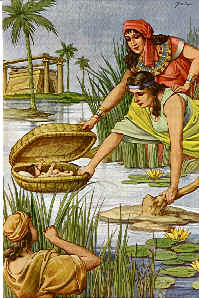 After Pharaoh’s previous failures, he tries yet another approach to break the will of the Hebrews. In verse 22 of chapter 1, he decrees that every male child of the Hebrews must be thrown into the Nile River.
One boy, however, is not immediately thrown into the Nile, but is hidden by his parents. We know that these Hebrew parents are descended from Levi, one of Jacob’s twelve sons. Once the boy is old enough so that he can no longer be hidden (3 months), his mother places him in a papyrus basket and sets him among some reeds along the edge of the Nile. The boy’s older sister (we learn her name is Miriam from Ex 15:20) is told to watch what happens to him.
None other than Pharaoh’s own daughter spots the basket and discovers that it contains a Hebrew infant. The baby’s sister, having watched this play out, then offers assistance to the Pharaoh’s daughter. The baby’s own mother is paid by Pharaoh’s daughter to nurse the child! After he is done nursing (somewhere between 2 and 5 years later), the boy is returned to the Pharaoh’s daughter, and she names the child Moses.
There is great irony in this narrative because Moses’s mother places Moses in the Nile River, just as Pharaoh decreed, and Moses is rescued from the Nile by Pharaoh’s own daughter. No matter what Pharaoh plans, he is always thwarted by God. God is in control of events, not Pharaoh.
Starting in verse 11, the remainder of Exodus 2 records several significant events in Moses’ life. Acts 7:22 claims that “Moses was instructed in all the wisdom of the Egyptians and was powerful in his words and deeds,” but his peaceful and privileged upbringing would soon come to a tumultuous end.
In verses 11-14, we learn that Moses killed an Egyptian who was beating a fellow Hebrew. According to Acts 7:23, this happened when Moses was approaching 40 years old. There is definite foreshadowing here, as Moses will deliver Israel from oppression just as he delivered the Hebrew from being beaten. Moses subsequently learns that his crime has been discovered and Pharaoh attempts to kill him for it.
In order to save his life, Moses flees Egypt to a place called Midian. He comes to the aid of some women at a well, and the father of these women invites Moses to marry into his family, taking his daughter Zipporah as a wife. Moses and Zipporah have a son and name him Gershom, which means “I have become an alien in a foreign land.”
According to John Hannah in The Bible Knowledge Commentary, “For 40 years (Acts 7:30) Moses undertook the toilsome life of a sheepherder in the Sinai area, thus gaining valuable knowledge of the topography of the Sinai Peninsula which later was helpful as he led the Israelites in that wilderness land.”
Verses 23-25 remind the reader that many years pass and the Pharaoh who tried to kill Moses dies. More significantly, “God heard their groaning and he remembered his covenant with Abraham, with Isaac and with Jacob.” God will not forget his promises to the Patriarchs.
 Verses 1-5 remind the reader that 70 people came down to settle in Goshen, which is a district of Egypt situated in the northeast corner of the nation. The twelve sons of Jacob (Israel) are listed and grouped according to their birth mothers. The numbering of 70 is a reference back to Gen 46:27 where all of the descendants of Jacob who entered Egypt are named.
 Background
 Background
 , “God’s sovereign choice of a leader often brings out the jealousy of those who must submit. Rather than recognize God’s choice, his brothers set on a course to destroy him. Their actions, though prompted by the belief that they should lead, shows why they should not have led.”
 God has promised Abraham that his descendants would be blessed with great numbers and with the promised land of Canaan. In turn, they would also be a blessing to all mankind. In previous chapters, we learned that Abraham’s son, Isaac, was the child of the promise. But now that Isaac has married Rebekah, we want to know who will receive the blessing from God after Isaac has died. Which child of Isaac will the covenant pass to?
 In verses 1-6 in Genesis 15, Abraham has an incredibly important conversation with God. First, in verse 1 God reassures Abraham that he should not be afraid, that God is his reward. In verses 2-3, however, Abraham questions God about the promise God made to Abraham previously. Recall that God promised Abraham that his descendants would become a great nation in Genesis 12.