Category Archives: Bible Interpretation

Should We Execute Non-Christians?

During King Asa’s reformation in Judah, he convenes a covenant ceremony during the Feast of Pentecost where all of Judah is called to seek after the God of Israel, the one true God who rescued them from Egyptian slavery centuries before. During this ceremony, they are also reminded that “all who would not seek the LORD, the God of Israel, were to be put to death, whether small or great, man or woman.”

Two questions immediately arise: Where did this command originate and does it apply to us today?

To answer the first question, we must go back to the Torah, or the first five books of the Old Testament. The book of Exodus teaches Israel to not worship other gods in the Ten Commandments (Exodus 20). “I am the LORD your God, who brought you out of the land of Egypt, out of the house of slavery; you shall have no other gods before me.” Chapter 22 then spells out the punishment for worship of other gods: “Whoever sacrifices to any god, other than the LORD alone, shall be devoted to destruction.”

In the book of Leviticus, chapter 20 prescribes capital punishment for particular religious violations. Any person who gives their child to Molech, a pagan god, was to be executed. Likewise, any person who was a medium or spiritist was to be put to death.

Finally, the book of Deuteronomy reiterates the teachings of Exodus and Leviticus in chapters 13 and 17. False prophets were to be put to death and anyone in the community who was participating in or promoting worship of pagan gods was also to be executed. Therefore, there is clear precedent for the command in 2 Chron 15:13.

Does the command to execute anyone who is worshiping false gods still apply today? No. These commands were only applicable to ancient Israel who was in a unique covenant relationship with God. As Christians living today, we live under a different covenant with God.

The NT clearly states in several places that the Law (embodying the covenant with ancient Israel) was fulfilled by Jesus and no longer applies to Christians. Here are a few passages proving the point:

“By calling this covenant ‘new,’ he has made the first one [the Law] obsolete; and what is obsolete and outdated will soon disappear.” (Heb 8:13)

“We who are Jews by birth and not sinful Gentiles know that a person is not justified by the works of the law, but by faith in Jesus Christ. So we, too, have put our faith in Christ Jesus that we may be justified by faith in Christ and not by the works of the law, because by the works of the law no one will be justified.” (Gal 2:15-16)

“Before the coming of this faith, we were held in custody under the law, locked up until the faith that was to come would be revealed.  So the law was our guardian until Christ came that we might be justified by faith.  Now that this faith has come, we are no longer under a guardian [the Law].” (Gal 3:23-25)

“But now, by dying to what once bound us, we have been released from the law so that we serve in the new way of the Spirit, and not in the old way of the written code [the Law].” (Rom 7:6)

These verses and others clearly state that Christians are not under any obligation to follow the divine commands given to the Israelites as they left Egyptian slavery and journeyed toward the Promised Land. As my seminary professor used to tell us, the Old Testament was written for us, but not to us. It was written to ancient Israel.
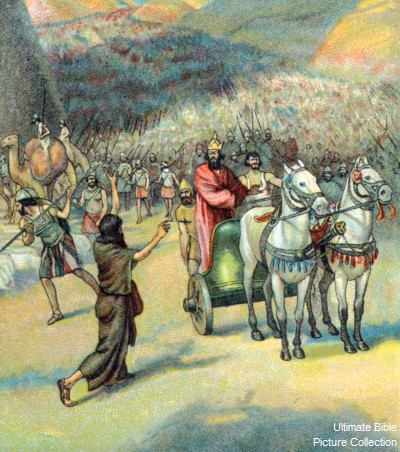
Commentary on 2 Chronicles 14-15 (Reign of Asa)

Following Rehoboam’s death, his son Abijah occupies the throne of Judah until 911 BC. Abijah did not seek after God, but his son Asa would. Asa became king in 911 BC and remained in command until 870 BC. Chapters 14 and 15 of 2 Chronicles describe Asa’s reign.

Verses 1-8 of chapter 14 record Asa’s deeds during the first decade of his reign. Asa collects idols and destroys them. He also dismantles pagan worship centers and altars all over Judah. Because he obeys God, Asa is rewarded with a prolonged period of peace.

The peace enables Asa to mount a construction campaign where he fortifies the cities of Judah to protect against foreign attack. He also trains and equips a large army consisting of hundreds of thousands of soldiers.

Again, Asa clearly attributes the peace to his obedience toward God. He explains to Judah, “The land is still ours, because we have sought the LORD our God; we sought him and he has given us rest on every side.”

In fact, there are nine mentions of Asa seeking the Lord in chapters 14-16 of 2 Chronicles. The clear implication is that seeking the Lord (obeying His commands) leads to prosperity for Asa and for any other person who does likewise. Obviously, this principle is not to be carried too far. Even in Asa’s life, there are problems and we know that godly people in the Bible faced hardship, but the general principle still holds. Those who seek after God will generally experience greater prosperity than those who don’t.

At the end of ten years, a massive army threatens Judah, led by a man known as Zerah the Cushite. Most scholars believe that Zerah is a general under the command of the Egyptian Pharaoh, Orsokon, but there are others who argue that Zerah is operating on his own and has nothing to do with Egypt.

In any case, Zerah’s army advances all the way through Judah until they are a mere 25 miles southwest of Jerusalem, at a place called Mareshah. Instead of first leading an assault on Zerah, Asa prays to God for His favor in the upcoming battle, just as his ancestors David and Solomon prayed.

“LORD, there is no one like you to help the powerless against the mighty. Help us, O LORD our God, for we rely on you, and in your name we have come against this vast army. O LORD, you are our God; do not let man prevail against you.”

God indeed answers Asa’s prayer and causes the Cushites to flee. Asa chases them 20 miles further southwest and gathers plunder, including large numbers of livestock, from the land the Cushites previously occupied.

After Asa and his army return to Jerusalem, the capital of Judah, a prophet called Azariah meets with Asa and delivers a brief, but powerful prophecy. The most important words of the prophecy proclaim, “The LORD is with you when you are with him. If you seek him, he will be found by you, but if you forsake him, he will forsake you.”

Azariah reminds Asa of the period of the Judges, where the people of Israel did not seek the Lord. It was a time of great turmoil and distress, with never-ending wars. Azariah promises Asa that if he will continue his religious reforms, God will reward Asa and the kingdom of Judah.

Asa is encouraged by the prophet and continues his reforms. He gathers the livestock plundered in the battle against Zerah and prepares a covenant renewal ceremony during the Pentecost feast in the 15th year of his reign. The author of Chronicles notes that Israelites from the tribes of Ephraim, Manasseh and Simeon had emigrated to Judah because of Asa’s obedience to God. They too participate in the covenant renewal

J. A. Thompson, in The New American Commentary Volume 9 – 1, 2 Chronicleswrites:

The Davidic kings showed an inclusive concern for the whole of Israel. This appears repeatedly from 1 Chr 13:1–5 onward. A special point is made of the inclusion of people from the north (cf. 11:13–17). These northerners came in large numbers from Israel to Jerusalem when they saw that Asa’s God was with him.

The author of Chronicles describes the covenant ceremony:

At that time they sacrificed to the LORD seven hundred head of cattle and seven thousand sheep and goats from the plunder they had brought back. They entered into a covenant to seek the LORD, the God of their fathers, with all their heart and soul. . .. They took an oath to the LORD with loud acclamation, with shouting and with trumpets and horns.

Asa was so zealous for the Lord that he went as far as removing his own grandmother from her office as queen mother because she was worshipping Asherah, the pagan mistress of God. Asa destroyed the pole she was using in her worship, and burned it in the valley that divides Jerusalem and the Mount of Olives. Because of Asa’s action, he was rewarded with relative peace for most of his reign.

Who Is Responsible for the Division of Israel?

In 1 Kings 12, Rehoboam foolishly decides to threaten the northern tribes rather than agree to lighten their tax burden. This leads to the division of united Israel into the northern kingdom, called Israel, and the southern kingdom, called Judah.

In verse 24, the prophet Shemaiah tells Rehoboam that the division of the kingdom is God’s doing, so don’t we have a contradiction here? Whose fault is the division? Rehoboam, who spoke foolish words, or God?

The truth is that both God and Rehoboam are responsible for the division.  There is absolutely nothing contradictory about an infinite God being in control of every little electron in the universe, but creating creatures in that same universe who have a special power of free will.  God can accomplish everything he wants to accomplish in human affairs through human free will.

While He commands volcanoes to erupt and water to flow as inanimate objects, He commands humans as free creatures.  He works in coordination with human freedom, not without it or against it.

Philosophers refer to this as primary and secondary causation.  God is the primary cause of all activity in the universe, but He uses the secondary cause of free will to accomplish his purposes with human beings.

Some say that this concept of human free will takes away from the glory of God, but claiming that God cannot create free creatures and still bring his plans to fruition is really the position that takes away from God’s glory.

Commentary on 1 Kings 12 (Division of the Kingdom)

Solomon has died, so now his son Rehoboam is going to take over as king of all Israel in 931 BC. Rehoboam travels to a place called Shechem to meet with the leaders of the 10 northern tribes, where he presumes that he will be coronated king (Judah and Benjamin are the other 2 tribes in the south).

Recall that Shechem has a lot of history with the people of Israel. Thomas L. Constable, in The Bible Knowledge Commentary (Old Testament:), writes,

Shechem afforded a fitting site for the coronation of a king of Israel. At Shechem Yahweh first appeared to Abraham in the land and promised to give him all of Canaan (Gen. 12:6–7). Jacob later settled there (Gen. 33:18–20) and Joseph was buried there (Josh. 24:32). After they had entered the Promised Land the Israelites, at Shechem in the valley between Mount Ebal and Mount Gerizim, dedicated themselves to keep the Mosaic Law (Josh. 24:1–27). This sacred spot now reminded the Israelites of their divinely revealed destiny as a nation and of God’s faithfulness.

Unfortunately for Rehoboam, a surprise awaits him at Shechem. The northern 10 tribes select a former administrator under Solomon, Jeroboam, to speak for them. Jeroboam complains to Rehoboam that Solomon placed a heavy tax burden on the northern tribes, including forced labor for construction in Jerusalem and other places in the territory of Judah. David and Solomon were from the tribe of Judah, and so Rehoboam is continuing their dynasty. The northern tribes demand that Rehoboam lighten the burden before they will accept him as king.

In verses 6-11, Rehoboam consults for three days with two different groups of advisors. The older advisors, who served under Solomon, advise that he tell the northern tribes that he will lighten their tax burden. The younger advisors, who are contemporaries of Rehoboam, advise the opposite. They want him to tell the northern tribes that his tax burden will be far heavier than his father’s. Their idea is to instill fear into the northern tribes so that they will back down.

Rehoboam unwisely follows the advice of the younger generation. Instead of the northern tribes being cowed, they rebel against Rehoboam and declare their independence from the tribe of Judah and from the dynasty of David. Rehoboam sends one of his labor administrators to meet with the rebellious leadership, but he is stoned to death and Rehoboam has to flee Shechem to avoid the same fate. The author of 1 Kings notes that “Israel has been in rebellion against the house of David to this day.”

Jeroboam is made king over the 10 northern tribes, which comes to be called Israel, and Rehoboam is made king over the two southern tribes (Judah and Benjamin), which comes to be called Judah. Rehoboam gathers an army to attack Israel immediately after his return to Jerusalem, but the prophet Shemaiah tells Rehoboam that he should not attack Israel, for the rebellion of Israel was God’s doing. Recall that God had promised to split the kingdom in two because of Solomon’s idolatry.

In verses 25-33, we learn that Jeroboam builds shrines and altars throughout Israel so that he can prevent his people going to the temple in Jerusalem to worship. He is afraid that if they go to Jerusalem, they will want the two kingdoms to reunite, with Rehoboam in command. Two of the shrines, placed in Bethel and Dan, feature golden calves. The calves, themselves, are probably not meant to be worshipped, because the invisible God is supposed to “stand” upon the backs of the calves, but this distinction is quickly lost on the people of Israel, who start worshiping the calves themselves.

In addition, Jeroboam replaces the Levite priests with illegitimate priests from other tribes, and even commissions new religious festivals for Israel. The Levites would eventually leave Israel and migrate down to Judah because of Jeroboam’s actions.

The splitting of the kingdom leads to serious consequences that would unfold over the next several centuries. First, neither Israel nor Judah would ever gain the prestige of the united kingdom. They would both be attacked by neighboring nations and suffer through numerous wars.

Second, the religious reforms instituted by Jeroboam would lead Israel further and further from obedience to the Law. As the decades went by, the true lovers of Yahweh would stream out of Israel down to Judah to worship and live. Israel’s kings are noted again and again for their disobedience to God’s laws.

Third, the prophetic movement gained importance. God would appoint prophets over the next several hundred years to challenge the rulers of Israel and Judah to follow the Law. This would cause many of the prophets to be hated by the kings and people of Israel and Judah, who did not want to hear about their sins.

See this chart to understand the succession of kings and prophets from 930 BC to 586 BC in both kingdoms. Israel is conquered and destroyed as a nation in 722 BC, while Judah suffers the same fate in 586 BC.

Go to this link to see a map of ancient Israel and Judah.

Does Ecclesiastes Teach That There Is No Afterlife?

Several passages in the book of Ecclesiastes seem to indicate that the inspired author does not believe that there is an afterlife. The Jehovah’s Witnesses regularly quote from Ecclesiastes to prove that there is no afterlife immediately following death. They teach that a person’s soul ceases to exist upon death, and that God will recreate that person later on when all the dead are resurrected. But does Ecclesiastes really teach that there is no immediate afterlife?

Although there are several passages that mention death and the afterlife in the book, the key passages normally cited are verses 19-21 in chapter 3.

Man’s fate is like that of the animals; the same fate awaits them both: As one dies, so dies the other. All have the same breath; man has no advantage over the animal. Everything is meaningless. All go to the same place; all come from dust, and to dust all return. Who knows if the spirit of man rises upward and if the spirit of the animal goes down into the earth?

If we look at the first 3 sentences, it seems clear that Solomon, the traditional author of Ecclesiastes, is speaking about the physical body of a human being. It is true that human bodies die and decompose, just like other animals.

The final sentence, though, does not explicitly state that the human spirit also dies, but it asks the question of where the spirit goes after death. In effect, Solomon is saying, “Some people believe that a person’s spirit goes to heaven, but nobody really knows for sure.” Solomon, in effect, is saying that he just doesn’t know much about what happens after a person dies, so he is advising his readers to live their lives on earth in light of that fact. He is teaching that death is a real enemy to human beings.

The question then arises: Why doesn’t Solomon know about the afterlife? To answer this question, we need to introduce the concept of progressive revelation. Progressive revelation refers to the fact that God, in the Scriptures, progressively reveals more and more of Himself over time. God’s ultimate revelation of Himself was in the person of Jesus Christ. Jesus’s disciples completed the revelation of God when they wrote the books of the New Testament (NT).

Solomon lived more than 900 years before Jesus, so he wasn’t alive for the writing of the NT, nor the writing of much of the Old Testament (OT). The concept of an afterlife was taught more fully after Solomon lived.

There are glimpses of the afterlife in OT passages such as Ps 16:9-11; 49:15; 73:23-26; Is 26:19; Dan 12:2, and so forth. But the doctrine was not really brought to full light until the NT, where there are numerous passages (e.g., Rev 6:9-10; Phil 1:23; 2 Cor 5:6-8).

Another point to consider is that Solomon may have been specifically refuting the afterlife teachings of surrounding nations, such as Egypt. Duane Garrett, in the Apologetics Study Bible, explains:

What the author was questioning, however, may have been the materialistic notions of afterlife that predominated in ancient Egypt, where people thought that after death a powerful man could continue to enjoy his possessions, his women, and the services of his slaves. In short, this theology did not take seriously the finality of physical death (the great pyramids of the pharaohs were expressions of this view).

If we look at the Bible in its totality, what is its teaching on death and the afterlife? Duane Garrett answers in Proverbs, Ecclesiastes, Song of Songs (New American Commentary):

In biblical Christianity, however, death is consistently described as a curse and an enemy (1 Cor 15:26, 54–55; Rev 20:14). The resurrection of Christ, moreover, has conquered death and has opened the way for the resurrection. The whole person, body and soul, enters immortality. This immortality, however, is dependent on the power of God and the resurrection.

Ecclesiastes does not deny afterlife but does force the reader to take death seriously. In this the book echoes the psalmist’s prayer that he be taught to number his days (Ps 90:10–12). It is not the biblical believer who denies the power of death but the unbeliever.

Since humans are truly mortal, two conclusions follow. First, neither possessions nor accomplishments are eternal, and we should properly use and enjoy them while we still see the light of day. Second, because we are by nature dependent and contingent, our hope of eternal life must be founded in God and not ourselves (Eccl 12:7, 13–14). For the Christian this means that immortality is in the risen Christ (1 Cor 15:12–19).

The bottom line is that Ecclesiastes is not meant to be the final biblical word on the afterlife. Solomon simply did not know what would happen after a person died because God had not revealed that information to him. Given his ignorance on the topic, he nevertheless taught us how live to our lives on earth: Fear God and keep His commandments.

Commentary on Ecclesiastes 11-12 (Wisdom from the Preacher)

Chapter 11, verses 1-6, give financial and investment advice. In verses 1-2, Solomon is recommending that the reader spread out her investments over 7 or even 8 different areas. The phrase “cast your bread upon the waters” refers specifically to maritime trade. Solomon’s reign was characterized by extensive sea trade with other nations. By spreading out your investments, you will reduce your risk when catastrophes occur.

Verses 3-6 admonish the reader to get to work and stop waiting on perfect timing. A person who is a farmer, for example, cannot predict when the rain will fall, when storms will fall trees, where winds will carry seeds. We cannot even understand how God breathes life into a fetus, which is fundamental to human existence. We simply cannot understand all of God’s plans. The wise person is industrious and productive all the time, not waiting around to figure out what the future will bring.

In verses 7-10, Solomon reminds us that life is short. Death is rapidly approaching and we must take advantage of the days of our youth while it is still possible. He specifically advises, “Follow the ways of your heart and whatever your eyes see, but know that for all these things God will bring you to judgment.”

What are we to make of this advice? Donald R. Glenn, in The Bible Knowledge Commentary (Old Testament:), explains:

Solomon reiterated his advice to enjoy life (cf. v. 8), emphasizing that a person should do so in his youth. Elsewhere Solomon had said that enjoying life consists of eating and drinking (2:24; 3:13; 8:15; 9:7), wearing nice clothes and pleasant lotions (9:8), enjoying marital bliss (9:9), and finding satisfaction in one’s work (2:24; 3:22; 5:18). Now Solomon encouraged his readers to do whatever their hearts desired (‘follow the impulses of your heart and the desires of your eyes,’ 11:9; NASB). However, those desires should be tempered with an awareness that God will judge.

What wonderful freedom these verses give the Christian! Do what you want to do, within the confines of God’s law. Enjoy the good things God has provided you and seek after what interests you, but always remember that God judges your heart.

Chapter 12, verses 1-8, command the reader to “Remember your Creator in the days of your youth.” This command, according to Glenn, “means to revere God, to keep His laws faithfully, to serve Him responsibly, remembering that because He created people, everyone owes Him his life.”

What awaits all of us in old age is not pleasant, and Solomon vividly depicts the arrival of old age with several metaphors in verses 1-5. Duane A. Garrett, in Proverbs, Ecclesiastes, Song of Songs (New American Commentary), provides the following interpretations.

Verse 2 refers, likely, to an eye condition such as glaucoma. The elderly will slowly lose their eyesight.

The “keepers of the house,” in verse 3, probably refer to the hands, which tremble in old age.

The “strong men,” says Garrett, “are the major muscle groups of the legs and back.”

“The ‘grinders’ are teeth, which have ceased to chew food because they are few. Those who look out of windows are again the eyes, although growing ‘dim’ may refer to a lack of sparkle in the eye rather than inability to see well.”

In verse 4, “the shutting of doors refers to the ears, as people shut doors when they want to exclude outside noise. Deafness is meant, as indicated by the sounds of grinding and singing fading out. But rising up at the sound of birds alludes to a cruel paradox of old age: one cannot hear well, but one sleeps so lightly that the slightest disturbance is sufficient to take away sleep.”

In verse 5, “fear of heights and danger in the street means that the feebleness of the body takes away accustomed manliness. The metaphor of a declining household is abandoned here. The blossoming of the almond tree is the turning of the hair to white.

The reference to the grasshopper is obscure, but probably it should be rendered, ‘And the grasshopper becomes heavy,’ a hyperbole meaning that even something as light as a grasshopper seems too heavy to lift.”

“And desire no longer is stirred” refers to loss of appetites, likely sexual desire.

In the end, a man dies and goes to his eternal home. Verses 6-7 again command the reader to remember God before death arrives. Every activity of a human being is meaningless because of death, so how does Solomon advise us all to deal with this reality?

Verses 9-14 conclude his treatise. Solomon reminds us of his authority. His words are wise, knowledgeable, and true. He carefully thought about what he should write. Ultimately, his advice comes from the Shepherd, or God Himself. He warns the reader that there are plenty of other books written to impart wisdom, but chasing after these teachings is wearisome.

Garrett writes about verse 12, “A more probable translation is: ‘Beyond all this, my son, be advised: Of making many books there is no end.’ The contrast is not between the study of canonical versus noncanonical wisdom but between failure to appreciate wisdom on the one hand and excessive zeal for study on the other.”

Solomon’s conclusion: “Now all has been heard; here is the conclusion of the matter: Fear God and keep his commandments, for this is the whole duty of man. For God will bring every deed into judgment, including every hidden thing, whether it is good or evil.”

Garrett summarizes the lessons to be taken from the book of Ecclesiastes:

For us the ‘meaninglessness’ of life which the Teacher so ruthlessly exposes would seem to lead to despair or nihilism; for him it is an incitement to true piety. The insignificance of all that is done under the sun leaves him awestruck and silent before God. His inability to control or predict the future provokes him to dependence on God. The futility of attempting to secure his future through wisdom or acts of religion (e.g., making vows) leads him not to impiety but to an understanding of the true nature of obedient trust.

Seen in this light, to ‘keep his commandments’ is not to behave with the self-satisfied arrogance of religious presumption, nor is it a nod to piety from an otherwise impious book. Rather, it is the deepest expression of humble acceptance of what it means to be a human before God. Solomon as the Teacher, in his address to his aristocratic colleagues, has anticipated perhaps the deepest mystery of the gospel: The just shall live by faith (Hab 2:4; Rom 1:16–17; Gal 3:11; Heb 10:38).

Commentary on Ecclesiastes 2-3 (Wisdom from the Preacher)

The English title, Ecclesiastes, comes from the Septuagint. The Greek word means “preacher” and translates the Hebrew title, which apparently referred to the office of a preacher or teacher. It is derived from the Hebrew word Qohelet, meaning “to assemble.”

The Book of Ecclesiastes is an advanced wisdom text intended for adults. The Hebrews did not include it in the wisdom works used to educate their children because of its contents.

The traditional view of authorship is that King Solomon wrote the book late in his life, around 940 BC. However, many scholars, perhaps the majority, believe that Ecclesiastes was not written by Solomon, but by an anonymous author as late as 200 BC.

Biblical scholar Tom Howe summarizes the theme of Ecclesiastes:

Although the tone of the book as a whole seems to be pessimistic, Qohelet is not a pessimist. Rather, his goal is to demonstrate that life is meaningless, unless one lives it in the fear of God, keeping His commandments and enjoying life as a gift from Him. Ultimately, Qohelet is urging the reader not to trust in anything in this life to provide meaning and value. Rather, one should trust only and always in God, and live life before Him.

In chapter 2, verses 1-11, Solomon writes about his experiments with pleasure. His goal was to see if the meaning of life consisted in earthly pleasures. Solomon attempted to laugh as much as possible, but he didn’t find meaning in laughter. He drank wine and became intoxicated, but didn’t find meaning in that either.

He built houses, gardens, vineyards, parks, water reservoirs. He bought numerous slaves and livestock. He amassed gold and silver. He brought hundreds of beautiful women into his household so that he could have sex with them. He reports that he denied himself no pleasure that he desired.

After denying himself no pleasure, did he finally find the meaning of life? He answers, “Yet when I surveyed all that my hands had done and what I had toiled to achieve, everything was meaningless, a chasing after the wind; nothing was gained under the sun.”

Solomon, it should be noted, is not saying that laughter, wine, building projects, wealth, etc., are all bad. There is a time and place for all these things. The point is that none of them can provide a person a meaningful life by themselves. Something is missing.

In verses 18-26, Solomon then considers his labors from another perspective. What would become of all the wealth that he had amassed, all of the building projects, all of the work that he had accomplished during his life?

The truth is that everything Solomon built will be left to his children, to those who live after he dies. His children, who did not work for what he gives them, may be fools who squander all of the work which Solomon completed. Three times in these verses Solomon laments that “this too is meaningless.” If all of a man’s labor merely gets passed on to those who had nothing to do with it, then what is the point of all this labor? What is the point in working hard in this life?

In verses 24-26, we get to a central theme of Ecclesiastes. Solomon’s answer to the question of the meaning of life is the following:

“A man can do nothing better than to eat and drink and find satisfaction in his work. This too, I see, is from the hand of God, for without him, who can eat or find enjoyment?”

Is Solomon teaching that we should all just eat, drink, and be merry? Is that all there is to life? Not at all. Duane A. Garrett, in Proverbs, Ecclesiastes, Song of Songs (New American Commentary)writes:

We should not understand ‘nothing is better than’ in a rigidly literal sense, as if the Teacher were saying that enjoyment of food and possessions is the goal of life. In context he is talking about how one should view life with respect to labor and the fruit of labor. He is not, therefore, negating the worth of higher values. But he insists that people should learn how to enjoy the return they get on their labor. Indeed, the ability to enjoy and use the good things of life (i.e., material things) is itself a gift of God. Those who belong to God should above all others have a capacity to enjoy life.

In chapter 3, verses 1-11, Solomon teaches his readers that there is a time for everything. The verses move back and forth between desirable and undesirable aspects of life. They are meant to represent the totality of human existence.

Duane Garrett expresses the meaning of these verses:

Life is composed of joy and sorrow, building and destroying, and living and dying. Each comes at the proper time. This reminds us that we are creatures of time and not yet able to partake of the joys of eternity. No one can be happy who has not come to grips with the reality that life is full of changes and sorrows as well as continuity and joy. We must accept that we are mortal and governed by time.

Donald R. Glenn, in The Bible Knowledge Commentary (Old Testament:), adds:

(1) Solomon observed that God … has made everything beautiful (or, ‘appropriate’; the same word is trans. ‘proper’ in 5:18) in its time, that is, God in His providential plans and control has an appropriate time for every activity. (2) Solomon observed that God has put eternity in the hearts of men. People have a longing or desire to know the extratemporal significance of themselves and their deeds or activities. (3) Solomon added that people cannot know the works of God … from beginning to end, that is, they cannot know the sovereign, eternal plan of God. Human labor is without profit because people are ignorant of God’s eternal plan, the basis by which He evaluates the appropriateness and eternal significance of all their activities. Because of this ignorance there is an uncertainty and latent temporality to the value of all one’s labor.

So how is mankind supposed to cope with the tension of a temporal life and a desire for immortality?

Verses 12-13 repeat the theme of the book: “I know that there is nothing better for men than to be happy and do good while they live. That everyone may eat and drink, and find satisfaction in all his toil—this is the gift of God.”

Commentary on Proverbs 3 (Wisdom from Solomon)

Proverbs 3 begins by reminding the reader that the words of wisdom contained in these proverbs will prolong life and yield prosperity. In addition, the reader is commanded to live a life characterized by love and faithfulness.

Verses 5-8 are well-known verses that appear on the walls of many Christian homes. Duane A. Garrett, in The New American Commentary Volume 14 – Proverbs, Ecclesiastes, Song of Songs, explains what these famous verses mean.

The command to trust God ‘with all your heart’ means that the total personality is to be committed to God’s care, although it emphasizes the mind and volition. The prohibitions against depending on one’s own understanding and against intellectual pride (vv. 5b, 7a) implicitly reject a ‘secular’ search for wisdom and look back to the thesis of the book (1:7).

Although this passage certainly condemns any academic arrogance, it does not indulge in anti-intellectualism. The commitment of the heart to God means that all the beliefs and decisions of life are to be submitted to Yahweh. Even very practical decisions are in view here, and not just matters of academic pursuit. But the text is no more opposed to academic research per se than to any normal activity of life. Also, ‘understanding’ implies not just intellectual capacity but one’s own moral standards. One’s private vision of right and wrong must be submitted to God.

Solomon then instructs his son to honor God with his material wealth. If he does, God will reward him with overflowing barns and vats full of wine. But, Sid S. Buzzell reminds us in The Bible Knowledge Commentary (Old Testament:), “In general it is true that godliness results in gain, that piety brings prosperity (cf. v. 2; Deut. 28:1–14; Matt. 6:33). But this kind of generalization, common in Proverbs, does not disallow God from making exceptions. Otherwise God is invested in, rather than honored.”

Verses 11-12 balance out verses 9-10 by reminding the young man that God disciplines as well. The young man should not resent discipline, because that is what a loving father does.

Verses 13-20 are a hymn to wisdom. There are several points made about wisdom. First, wisdom is more valuable than wealth. The church father, Thomas Aquinas, famously ranked the top 8 goods for human beings and wealth came in last place. Solomon, in fact, personifies wisdom as a woman who holds wealth in her left hand. The left hand was considered to be the inferior, or weaker hand, in the ancient world.

Second, wisdom gives long life. Third, wisdom gives peace. Fourth, wisdom holds the keys to immortality, for that is what the “tree of life” refers to in the Book of Genesis. The readers of this proverb would surely make the connection that wisdom leads to the defeat of death itself.

Fifth, and finally, God Himself employed wisdom and knowledge to create the earth and the heavens above. If God embraces wisdom, then surely we, His creatures, should as well.

Verses 21-26 are another appeal from Solomon to his son to embrace wisdom. Why? Because the wise person will live a life characterized by security and safety compared to the fool who rejects wisdom. Duane Garrett reminds us that “verse 23 is a general promise; it is not an absolute guarantee that the wise will never have occasion to stumble. Compared to the unwise, however, they will experience tranquility.”

Verses 27-35 contain maxims on how to be a good neighbor. These are very practical pieces of wisdom that Solomon renders in a rapid-fire sequence.

First, don’t withhold good things from other people. Garrett writes, “’Those who deserve good’ may be laborers who have earned their pay, the poor who rightly plead for help, or suppliants at the city gates who call for justice. On the other hand, they could be those who have loaned money and deserve to be repaid.”

Second, “do not plot harm against your neighbor.” He lives near you and trusts you. Third, do not falsely accuse your neighbor. Fourth, do not envy a violent man. God curses the man of violence, but blesses the man of righteousness. Verse 34 is quoted in both James 4:6 and 1 Peter 5:5, as “God opposes the proud, but gives grace to the humble.” Sid Buzzell, commenting on verses 27-35, writes, “These verses show that the words ‘upright,’ ‘righteous,’ ‘the humble,’ and ‘the wise’ are basically synonymous in the Book of Proverbs.”

How Do We Interpret the Proverbs?

Some readers of the Book of Proverbs have raised objections to its contents. First, some proverbs seem to command a certain behavior, but then others command a different, incompatible behavior. Second, some proverbs appear to make promises that other parts of the Bible seem to contradict. Third, some proverbs make what appear to be comprehensive statements that seem to be contradicted by the realities of life.

Edward Curtis, in the Apologetics Study Bible, offers the following guidance on how to read and interpret the Book of Proverbs in light of the objections above.

The types of sayings found in Proverbs reflect a way of thinking and teaching that has been largely abandoned in modern Western culture. Proverbs are general statements of truth rather than invariable promises or laws, and an individual proverb normally captures a tiny cross-section of truth rather than making a comprehensive statement about a topic.

For example, ‘A gentle answer turns away anger’ (15: 1) constitutes one component of the broader topics of using words wisely and dealing with angry people. This single principle is one small piece of a much larger mosaic, and the task of the student is not only to put together the broader mosaic piece by piece but also to learn to apply these principles skillfully to the complexities that one encounters in life.

The goal of the wisdom in Proverbs is to develop skill in living according to the order that is embedded in God’s creation. Most proverbs state a single general truth with little attempt to note exceptions and qualifications. Such an approach effectively emphasizes the principle taught by avoiding the distraction of qualifications.

The authors of proverbs also emphasized the points they wanted to make through the use of idealized examples and hyperbole. While the sluggard, for example, is a real character, he is described in exaggerated terms that set his basic characteristics in clear relief. One would probably never find someone who perfectly fits the descriptions of a sluggard, because the person whose picture emerges from putting together the various pieces of the sluggard mosaic in the book is a stereotypical character. The same is also true for the excellent woman in Proverbs 31 and for the wise man and for the fool described throughout the book.

When a pair of proverbs seems conflicting or even contradictory, the first proverb moves the reader in a certain direction, then the contrasting proverb provides a balancing principle to point the reader toward another dimension of the skill of living in a complex world.

For example, Proverbs 26: 4 says, ‘Don’t answer a fool according to his foolishness or you’ll be like him yourself,’ while the next verse says, ‘Answer a fool according to his foolishness, or he’ll become wise in his own eyes.’ The student of wisdom recognizes that encounters with a fool require responses appropriate to that particular situation. The student also recognizes that a variety of other approaches between those extremes may be the wise response, and the student’s goal is to become the kind of wisdom craftsman who can frame the appropriate response no matter the situation he faces.

Likewise, the ambiguity that often characterizes proverbs reflects the same pedagogy and goals. The student of wisdom is challenged by the ambiguity to explore the possibilities for understanding the proverb along with the variety of situations in which the principle appropriately applies. The ambiguity also promotes ongoing reflection as to the legitimate limits for applying the principle.

While the book addresses a wide variety of issues, it gives considerable attention to matters such as the contrast between the wise person and the fool, the importance of virtues such as diligence and self-control, the importance of using words wisely, warnings about sexual immorality, the responsible use of money, priorities, and advice about proper behavior in a variety of social settings. Most proverbs deal with the general and the typical, but their goal is to equip people with the skills to apply wisdom to the particular experiences of life.

Commentary on Proverbs 1 (Wisdom from Solomon)

The book of Proverbs is a collection of collections on the subject of wisdom. There are several compilations in the book, including “the proverbs of Solomon son of David, king of Israel” (Pr 1– 24), “more proverbs of Solomon, copied by the men of Hezekiah king of Judah” (chs. 25– 29), “the sayings of Agur son of Jakeh” (ch. 30) and “the sayings of King Lemuel— an oracle his mother taught him” (ch. 31).

Solomon’s proverbs were written between 970 and 930 BC, while Hezekiah’s scribes compiled additional, “unpublished” Solomonic proverbs between 729 and 686 BC. Nothing is known of Agur and King Lemuel, so the dates of composition of their contributions are unknown.

The goal of the wisdom in Proverbs is to develop skill in living according to the order that is embedded in God’s creation. Most proverbs state a single general truth with little attempt to note exceptions and qualifications. Such an approach effectively emphasizes the principle taught by avoiding the distraction of qualifications.

Solomon is credited with writing three collected works of wisdom – Song of Songs in his youth, Proverbs during his middle years, and Ecclesiastes during his elder years. The Book of Proverbs contains Solomon’s advice to young people who are not yet old enough to have sufficient life experience to make good decisions. This is the stated purpose of Proverbs 1, which we will study in this lesson.

Verses 2-7 inform the reader immediately why he should read the proverbs that Solomon has written. It is to obtain wisdom, but Solomon describes several kinds of wisdom here. According to Duane Garrett, in Proverbs, Ecclesiastes, Song of Songs (New American Commentary), these verses outline four characteristics of wisdom.

First, it is practical. ‘Wisdom’ includes the idea of ‘common sense’ and the ability to cope with daily problems and can also refer to occupational skills (Exod 28:3; Ps 107:27). Second, it is intellectual. This is implied in words like ‘understanding’ and ‘knowledge.’ Solomon’s own fascination with natural history illustrates this (1 Kgs 4:33). Third, it is moral and involves self-control. This is indicated in words like ‘right and fair’ and ‘discipline.’ Fourth, Proverbs draws the reader into the mysteries of life. This is implied in terms like ‘parables’ and ‘riddles.’ The ancients were intrigued at riddles (Judg 14:12–19), but more is involved here than casual entertainment. Biblical wisdom seeks to resolve or at least adjust to the ambiguities of life. It seeks the reality behind the appearances. Not only that, it affirms that the believer can understand mysteries that outsiders cannot and so may couch its teaching in enigma (Matt 13:10–17).

Verse 7 gives the foundation of all wisdom, the fear of the Lord. Nobody can claim to be truly wise unless they have grounded their lives in the revelation of God. Only fools reject wisdom and God.

The wisdom taught by Solomon is grounded in God, but applies to worldly living. K. T. Aitken, in Proverbs (OT Daily Study Bible Series), explains,

The truly wise man of the world will be a man of faith. Equally, of course, a foundation is for building on. So the man of faith ought also to be a man of the world. The ‘fool’ who despises wisdom can therefore either be the man of the world who has no time for God, or the man of God who has no time for the world—or as we might say, either people who are so earthly minded as to be of no heavenly use; or people who are so heavenly minded as to be of no earthly use.

Solomon records his first specific exhortation to wisdom in verses 8-19. Verses 8-9 introduce a theme repeated throughout the book of Proverbs, which is that children are blessed when they heed the counsel of their parents. Parents have numerous life experiences to draw upon to make wise decisions, and children do not, thus children are advised to listen to their parents.

Verse 10-14 warn against peer pressure, in particular the pressure to join a gang who robs and kills innocent travelers. In the ancient world, like today, there was a constant enticement for young men to become members of violent gangs who would commit criminal acts to enrich themselves. The Crips and Bloods have been around for 3,000 years!

Solomon implores the young man to steer clear of these gangs. What these gang members don’t realize is that their violence is ultimately going to kill them. They are on a self-destructive path that will lead them to the grave.

Verse 17 has caused translators a lot of problems, as its meaning in the original Hebrew is unclear. We know that in the ancient world, hunters would lay nets on the ground with grain on them. Birds would land on the net to eat the grain, and the hunters would close the net around the birds, capturing them. Given these facts, Duane Garrett offers this interpretation of verse 17:

The line is best rendered, ‘In the eyes of a bird, the net is strewn [with grain] for no reason.’ In other words, the bird does not see any connection between the net and what is scattered on it; he just sees food that is free for the taking. In the process he is trapped and killed. In the same way, the gang cannot see the connection between their acts of robbery and the fate that entraps them.

Verses 20-33 personify wisdom as a woman. She calls out to anyone who will listen to her, but in particular simple ones, mockers, and fools. K. T. Aitken describes these three types of people to whom wisdom calls:

(1) The ‘simple’ is the inexperienced and gullible youth we met in 1:4. (2) The ‘scoffer’ is the person who is arrogant and self-opinionated, and always ready to debunk the views and beliefs of others. In Ps. 1:1 he takes his seat in company with the wicked and sinners. (3) The ‘fool’ (Hebrew kesil) is a downright stupid person. He mistakes his folly for wisdom and seems quite insensible to what is good, right and proper.

If these people reject the teachings of Wisdom, there are consequences. The woman Wisdom describes her reaction if she is rejected. “I in turn will laugh at your disaster; I will mock when calamity overtakes you— when calamity overtakes you like a storm, when disaster sweeps over you like a whirlwind, when distress and trouble overwhelm you.”

The fools who reject wisdom will inevitably get themselves into trouble and they will call on Wisdom to rescue them, but it will be too late. Wisdom will not answer and will not be found. The fool will suffer the consequences for his stupidity, possibly causing his own death.

Aitken compares Wisdom to the prophets of Israel, saying,

the accusation in these verses strikes the same note as the prophets’ indictment of Israel for spurning God: ‘they refuse to know me’ (Jer. 9:6), ‘they have not given heed to my words’ (Jer. 6:19), ‘they are not willing to listen to me’ (Ezek. 3:7, ‘[they] hate the good’ (Mic. 3:2), ‘[they] chose what I did not delight in’ (Isa. 65:12), ‘they have despised the Holy One of Israel’ (Isa. 1:4).

For Lady Wisdom, the fools’ response spelled rejection. That is often the way of God’s man or woman in the world. His spokespeople are seldom popular figures. The prophets were not, and neither was Jesus. For the fools themselves it spelled a wasted opportunity—and more!

Verse 33 offers the alternative to those who do listen. “But whoever listens to me will live in safety and be at ease, without fear of harm.”