The Comfy Cocoon of Knowing You’re Right

Post Author: Bill Pratt

Imagine a man named Charles. Charles is dogmatic about his beliefs concerning the origin of the universe, the existence of God, right and wrong. Charles is an evangelist who loves telling people about his beliefs. He writes a lot of blog posts and sometimes he comments on other people’s blog posts. Whenever he gets an opportunity to explain to people why his views are correct, he jumps at it.

Charles converted to his views as an adult after spending many years on the other side. He has an inside view of the other side and knows all of their weaknesses. He feels sorry for those still on the other side, as he knows they are wrong about reality, wrong about the big questions of life.

Charles has surrounded himself with those who think like him. He congregates with them, buys books written by them, votes like they vote. Charles has found a community that affirms what he believes.

Charles no longer feels a need to consider the evidence the other side provides for their viewpoint. He looked at it briefly in the past, but it is so obviously wrong that he didn’t have to spend much time before he moved on to other things. Now, when he interacts with the other side, he just does so to shake them out of their ignorance. He knows their arguments are weak, so he doesn’t really pay much attention to them.

Charles, more recently, has grown less patient with the other side and has started calling them names and insulting them, mostly anonymously or through social media. He just wishes they would snap out of their uninformed beliefs. When he encounters the other side these days, he sees them as the enemy. They represent what is wrong with the world.

Charles doesn’t feel too bad any more when people on the other side are demonized or mocked by his friends. I guess he’s just used to it. The other side is, after all, irrational and deluded.

Charles now lives in a very comfortable cocoon, a safe place he has constructed for himself. He knows he is right. He knows his friends are right. He knows the other side is evil, deluded, even hateful. If the other side would just go away, the world would be so much better off. In the mean time, though, the cocoon is pretty nice.

He is protected from having to actually think about the other side most of the time. What’s the point? He already thought about it a while back. No need to dig it all up again. No need to leave the cocoon.

Do the Genealogies Allow Us to Date the Events of Genesis 1-11?

Post Author: Bill Pratt 

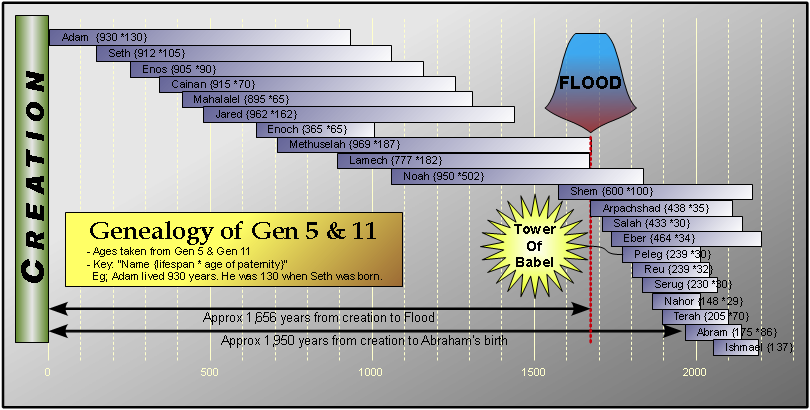
A few Christians have mistakenly supposed that they can use the genealogies in Genesis 5-11 to add up the number of years between Adam and Abraham.  By doing this math, they surmise that the world was created somewhere around 4000 BC.

Hebrew scholars, however, have pointed out that the genealogies are not meant to give exact lineages, such as one might find on ancestor.com.  They often would skip many generations, as they were focused on particular ancestors for particular reasons.

We know that the biblical authors did this.  For example, Matthew’s genealogy of Jesus consists in three sets of 14 generations.  The number 14 was important because 7 was thought to symbolize completion or perfection.  But we know that when Matthew says that “Joram fathered Uzziah,” he omits three generations (see 2 Ch 21:4-26:33) so as to accomplish the desired pattern of 14.  In Hebrew, to say someone “fathered” someone else can also mean that they are an ancestor or forefather of that person.  It does not always mean that they are the parent of the person.

The bottom line is that one has to be very careful with interpreting genealogies in the Bible.  They cannot be used to precisely date any event without other corroborating data.

Why Is There Human Pain and Suffering?

Post Author: Bill Pratt 

Why is there so much pain and suffering in the world?  Some people blame God, or they claim that because there is so much pain and suffering, God must not exist.  The Bible, however, disagrees.

Genesis 3 makes it clear that mankind was to live in perfect peace in paradise on earth.  It was the disobedience of Adam and Eve, the representatives of the human race, which introduced pain and suffering.  Without their sinful act, the world would still be paradise.

It is not God’s fault that humans suffer.  He gave our ancestors a clear choice and they chose poorly.

Who Made God? (Again)

Post Author: Bill Pratt 

If God created everything, then who created God?

The Christian answer to this question is that nobody created God because He is the one self-existent, uncaused, uncreated, eternal Being. Only things that come into existence need a cause, but God never came into existence. He has always existed and will always exist.

It is impossible for God not to exist.  While the universe and everything in it came into existence, and therefore all need a cause, God is the only Being that exists necessarily and eternally.

To ask a Christian who made God, then, is to ask who made the un-made or who created the un-created. It’s a nonsense question.

What Is the Age of the Earth?

Post Author: Bill Pratt 

There is much debate among Christians about whether the universe was created in six literal days about 10,000 years ago, or whether the universe came into existence about 13.5 billion years ago, and the earth about 4.5 billion years ago, through the creative acts of God. Who is right?

We just don’t know. Here are some important facts to remember. Bible-believing, orthodox Christians hold both views. Both sides read the Bible using the same historical-grammatical interpretive method. There are good theological arguments on both sides. The one important difference between the two views is that the old earth view is affirmed by most relevant scientific disciplines, whereas the young earth view is not.

Since this issue is not a matter of primary doctrinal importance, both sides are legitimate Christian viewpoints.  What is important to affirm is that God created the universe out of nothing. Both sides agree on that. They just disagree about how God created and when God created.

Can God Use Evil?

Post Author: Bill Pratt 

Although God is not the author of evil, he certainly allows it. Humans routinely commit evil acts against each other. We have been sinning against God and our fellow men ever since Cain killed Abel. Given all this evil, what does God do about it?

Because of His omniscience (all-knowingness) and omnipotence (all-powerfulness), God can take the evil deeds of human beings and produce a greater good. That is exactly what he did with Joseph in the Book of Genesis. Even though Joseph’s brothers committed the evil act of selling him into slavery, God used their evil to ultimately save their family from starvation and thus preserve the promises made to Abraham, Isaac, and Jacob.

The ultimate example of God taking evil and producing good is the death and resurrection of Jesus. No greater evil has ever been perpetrated than the murder of God’s innocent Son on the cross. Yet, no greater good has ever been produced than Jesus’s atoning sacrifice for the sins of mankind.

Can God use evil? Yes, he can and he does. In both the story of Joseph and the death and resurrection of Jesus, we see God bringing a greater good out of the evil deeds of human beings.

Commentary on Genesis 44-45 (Joseph Reunites with His Family)

Post Author: Bill Pratt 

Background

In chapter 37, Joseph was sold into slavery by his brothers. When we pick up the story in chapter 44, 22 years have passed, so Joseph is now 39 years old (1876 BC). So what has transpired in the last 22 years?

While serving in Potiphar’s household, Joseph is falsely accused of the attempted rape of Potiphar’s wife, and is thrown into prison. While he is in prison, he meets two members of Pharaoh’s court (chief cupbearer and chief baker) who have also been put into prison. He correctly interprets dreams for both of them.

The chief cupbearer is released from prison and 2 years later, when the Pharaoh has 2 dreams that none of his servants can interpret, the cupbearer suggests that Pharaoh ask Joseph, who is still in prison, to interpret his dreams.

Joseph tells Pharaoh that his 2 dreams mean the same thing: there will be 7 years of plenty followed by 7 years of famine. Joseph’s advice is for Pharaoh to collect 1/5th of the food in the land during the 7 years of plenty so that it can be used during the following 7 years of famine.

Pharaoh, impressed that Joseph could interpret his dreams and propose a solution to the problem, exalts Joseph to second in command over all of Egypt. This happened when Joseph was 30 years old.

When the famine begins, 7 years later, Jacob sends his sons to Egypt to buy grain because of the famine. Obviously, Jacob and his sons have no idea that Joseph is 2nd in command in Egypt. When the brothers arrive in Egypt, Joseph recognizes them but they do not recognize him. Joseph decides to test his brothers to see whether they have repented of their evil ways.

For the final test, Joseph has his steward plant a silver cup in Benjamin’s traveling bag as the 11 brothers are leaving Egypt to go back to their father, Jacob, in Canaan. When the steward stops the brothers as they are leaving Egypt to accuse them of stealing the silver cup, the brothers deny that they stole the cup and say that if the cup is found in anyone’s bag, the thief will become a slave of Joseph. The steward finds the cup in Benjamin’s bag and that is where we pick up the story in chapter 44.

Commentary

Joseph demands that the brothers leave Benjamin as a slave because of his theft of the silver cup (which belonged to Joseph). In verse 18 of chapter 44, Judah, the fourth son of Leah and Jacob, steps forward to save Benjamin’s life. Recall that Judah was also the brother that suggested they sell Joseph into slavery instead of killing him in the pit.

In verses 19-29, Judah recounts to Joseph the events that have occurred up to now. A couple years before, Joseph had demanded that the brothers bring back Benjamin with them to Egypt when they returned for more grain, as they had not brought him on their first trip to Egypt. Judah explains how painful this was to their father.

According to Judah, Jacob said the following, “You know that my wife bore me two sons. One of them went away from me, and I said, ‘He has surely been torn to pieces.’ And I have not seen him since.  If you take this one from me too and harm comes to him, you will bring my gray head down to the grave in misery.” Jacob is, of course, referring to Joseph as the son who went away and was torn to pieces.

Judah tells Joseph that if they don’t bring Benjamin home with them, Jacob “will die. Your servants will bring the gray head of our father down to the grave in sorrow.” Judah then offers to stay in Benjamin’s place.

In verses 1-3 of chapter 45, Joseph finally reveals himself to his brothers. Why? Because they passed the test. Judah had been willing to give up his life for his brother, Benjamin. Rather than allow Benjamin to become a slave, as he had with Joseph, he intervened to save his life.

When Joseph reveals himself, the brothers are terrified, but Joseph reassures them that their sin was used by God to save the family. Verses 4-7 encapsulate the central theme of the Joseph narrative: “I am your brother Joseph, the one you sold into Egypt! And now, do not be distressed and do not be angry with yourselves for selling me here, because it was to save lives that God sent me ahead of you. For two years now there has been famine in the land, and for the next five years there will not be plowing and reaping. But God sent me ahead of you to preserve for you a remnant on earth and to save your lives by a great deliverance.”

God providentially turned the brothers’ evil act against Joseph into good. Joseph was now in a position to save their entire family from starvation and relocate them to Egypt where they could survive the famine. Joseph repeats the theme in Gen 50:20, “You intended to harm me, but God intended it for good to accomplish what is now being done, the saving of many lives.”

In verses 8-15, Joseph instructs his brothers to go back to their father, Jacob, and tell him to move the family to Egypt. They will be given a region called Goshen to inhabit.

Jacob does move his family to Egypt, and that is where the Israelites will reside for hundreds of years. Although the Israelites start out well in Egypt and multiply into great numbers, the situation will reverse in time, and that is where we will pick up in the book of Exodus.

Are We Just Meat Robots?

Post Author: Bill Pratt 

I have an interest in psychology and behavioral economics research. That’s why I write posts on books like Predictably Irrational and Thinking, Fast and Slow. But as I read these kinds of books, I am always keeping an eye on the big question.

Will the author say that human beings are completely irrational in our  thoughts and behavior, completely rational in our thoughts and behavior, or a combination of the two? By rational I mean the use of reason, evidence, and logic to draw true conclusions about reality.

There are atheist thinkers such as Alex Rosenberg who argue that humans are completely irrational, that we are meat robots whose thoughts and behavior are 100% determined by physics. Physics knows nothing of reason, evidence, and logic. Rosenberg says that once you take science seriously, there is no other possible conclusion.

The problem with Rosenberg’s position is that it is hopelessly self-contradictory. He is saying, in essence, “I know rationally that nobody knows anything rationally.” If he knows that rationally, then his statement is false. If he doesn’t know anything rationally, then his statement is irrational and can be safely ignored.

In the world of psychological and economics literature, though, I see flirtation with Rosenberg’s position. Let’s look at two examples.

Michael Sliwinski, an entrepreneur and creator of the software application Nozbe, said this about the latest online magazine  issue of Productivity:

Reading this issue provoked deep reflection within myself, and I hope it will do the same for you, too. Practically every article shows the well-known and scientifically proved (but often forgotten) fact that psychological mechanisms—usually unconscious—rule the human world.

Sliwinski says it is a fact that “psychological mechanisms—usually unconscious—rule the human world.” Is he taking Rosenberg’s position? Probably not, but he’s leaning in that direction. If he said that only psychological mechanisms rule the human world, his position would be self-contradictory as well. There is enough ambiguity to avoid the charge of Rosenberg-ism.

Dan Ariely concludes his book Predictably Irrational:

IF I WERE to distill one main lesson from the research described in this book, it is that we are pawns in a game whose forces we largely fail to comprehend. We usually think of ourselves as sitting in the driver’s seat, with ultimate control over the decisions we make and the direction our life takes; but, alas, this perception has more to do with our desires— with how we want to view ourselves— than with reality.

Let’s stop here. Ariely is skating on the edge of self-contradiction. He says that we are pawns without ultimate control over our decisions. But clearly Ariely believes that he was not a pawn when he wrote this sentence or the rest of his book. He believes that he did have control over the decisions he made to write about predictable irrationality, did he not? If he was able to pull this off, then why can’t we?

He continues:

The point is that our visual and decision environments are filtered to us courtesy of our eyes, our ears, our senses of smell and touch, and the master of it all, our brain. By the time we comprehend and digest information, it is not necessarily a true reflection of reality. Instead, it is our representation of reality, and this is the input we base our decisions on. In essence we are limited to the tools nature has given us, and the natural way in which we make decisions is limited by the quality and accuracy of these tools.

Ariely almost goes Rosenberg on us again. He says that when we comprehend and digest information, “it is our representation of reality” and not “necessarily a true reflection of reality.” If he is saying that every time we digest information, we are not getting at true reality, then how is it that Ariely has managed to bypass this problem and get at true reality?

It is helpful to re-write his statement in the following way: “By digesting information, I have arrived at the true reality that nobody who digests information can arrive at true reality.” If his statement is true, then it is false, unless he doesn’t want to include himself in the population of all human beings.

In closing, consider the following:

  • If we are irrational meat robots, then we can’t know rationally that we are meat robots.
  • If unconscious psychological mechanisms control our every thought, then we can’t consciously (or rationally) think that unconscious psychological mechanisms control our every thought.
  • If we have no control over our decisions, then we can’t control the decision to think that we have no control over our decisions.
  • If we can’t comprehend true reality, then we can’t comprehend that true reality is incomprehensible.

Rosenberg self-contradiction syndrome is always lurking. We have to be careful not to stretch the findings of psychology and behavioral economics beyond where they should go. If you ever want to make any claim about reality that you think is true, then you cannot hold that we are merely meat robots. That, my friend, is a flagrant contradiction.

Why Don’t We Trust Atheists?

Post Author: Bill Pratt 


Atheists often complain that they experience prejudice directed at them by theists. Theists, they claim, accuse atheists of being immoral because atheists have no transcendent standard of morality. There is a level of distrust, at least for some theists, that exists.

So why do some theists worry about the ethics of atheists? Is this worry warranted?

Recently I finished a book written by Dan Ariely called Predictably Irrational: The Hidden Forces That Shape Our Decisions. In this book, Ariely chronicles numerous psychological studies intended to discover how human beings react to a wide range of situations (very similar to Thinking, Fast and Slow).

Ariely is very interested in business ethics and he reports on several experiments that shed some light on human dishonesty. Based on these studies, Ariely concludes that “when we are removed from any benchmarks of ethical thought, we tend to stray into dishonesty. But if we are reminded of morality at the moment we are tempted, then we are much more likely to be honest.”

He goes on to recommend that the ethical crisis he sees in America can be turned around by people regularly reading the holy books which codify their moral values. This is because his research shows that those people who are reminded of their moral values frequently act more ethically.

There is nothing new here that hasn’t been recommended by great thinkers for thousands of years. Moral virtue is a practice. You don’t just wake up every day and act with high moral integrity. It takes effort.

Herein lies why I think atheists are not trusted. Theists wonder, “When is the atheist reading his holy book?” Never, because he doesn’t believe in holy books. Is the atheist regularly being reminded by a pastor how he is supposed to behave? Is he studying the words and deeds of moral saints? No and no. These things usually happen in religious gatherings which most atheists avoid.

Speaking personally, I don’t go more than a week without reading or hearing about moral duties and virtues because I am reading the Bible and listening to godly men and women teach the moral precepts found in the Bible. I am also watching men and women of great moral character at my church every week. I am soaking it up.

Now, before I get a bunch of nasty comments, let me say that I know many atheists who are decent, law-abiding citizens. I even know some atheists who go above and beyond to help other people. So this is not meant as some kind of blanket indictment.

But, I am asking some hard questions of atheists. If you are an atheist, when are you soaking up moral teaching? How are you learning to be virtuous? Who is challenging you, week after week, to act with the highest integrity and morality? These are important questions for you to answer. The Christian who goes to church and reads her Bible regularly has a real advantage over you.

Does the Bible Approve Polygamy?

Post Author: Bill Pratt 

Some critics argue that the Bible approves polygamy because the Patriarchs (Abraham, Isaac, and Jacob) had multiple wives and the biblical text does not seem to condemn their actions. This, however, is a gross misunderstanding of the Bible. Just because the Bible reports certain behaviors does not mean it approves of it.

Polygamy is clearly prohibited by God in many ways. First, we know that monogamy is the correct pattern of marriage because it was established in Genesis 1 and 2. Second, we know that this pattern was followed until the sin of Lamech in Genesis 4:23 is reported. The first polygamous husband in the Bible is a murderer! Third, the Law of Moses clearly commands, “You shall not multiply wives” (Deut. 17:17).

Finally, it is obvious from the stories of Abraham, Isaac, and Jacob, that polygamy is the cause of much family conflict. This is especially evident with Jacob, who has 4 wives. Because of the favoritism of Jacob toward one of his wives, Rachel, his sons end up selling one of their half-brothers into slavery! Clearly polygamy is not portrayed in a positive light in these narratives.