Top Ten Posts of 2011

As we close out 2011, we will re-publish the top ten posts of 2011.  These are the posts written during 2011 that garnered the most page views during the year.  Over the next 2 weeks, we will count down from number ten to number one, finishing out the year.

I hope you will enjoy these posts if you have not seen them before.  There are many new email and RSS subscribers who have joined during 2011, and I am betting that many of these posts were missed by our new subscribers.

In 2012, we will start anew!  Please have a Christ-filled Christmas, remembering always what is important about this time of year.

God bless, Bill and Darrell.

What Happens When the Church Is Married to Nationalism? Part 4

Post Author: Bill Pratt

The heretical German Christians, in 1933, galvanized Dietrich Bonhoeffer and another German pastor, Martin Niemoller, into action.  They produced a statement that spelled out their grievances with the German Christians.

The statement contained the following four points:

First, it declared that its signers would rededicate themselves to the Scriptures and to the previous doctrinal confessions of the church. Second, they would work to protect the church’s fidelity to Scripture and to the confessions. Third, they would lend financial aid to those being persecuted by the new laws or by any kind of violence. And fourth, they would firmly reject the Aryan Paragraph.

The Aryan Paragraph was legislation that “would prevent pastors of Jewish background who had already been ordained from serving as ministers.”  In other words, nobody who was ethnically Jewish, but who had become a Christian, could serve in the church.

This statement was circulated to all the pastors in the German church, and by the end of 1933, six thousand pastors had signed it.  The pastors who signed the statement became an organization known as the Pastors’ Emergency League.  According to Metaxas, “This was a major first step toward what would soon come to be known as the Confessing Church.”

As the situation with the German Christians continued to worsen, the leaders of the Pastors’ Emergency League decided a complete split was necessary.  Metaxas describes what occurred:

On the last three days of May 1934, the leaders of the Pastors’ Emergency League held a synod in Barmen. It was there, on the Wupper River, that they wrote the famous Barmen Declaration, from which emerged what came to be known as the Confessing Church.  The purpose of the Barmen Declaration was to state what the German church had always believed, to ground it in the Scriptures, and to differentiate it from the bastardized theology that had been coming from the German Christians. It made clear that the German church was not under the authority of the state; it repudiated the anti-Semitism and other heresies of the German Christians and their “official” church led by Müller. 

The Declaration details all of the reasons for why the German Church had apostasized and why the declaration of the Confessing Church was necessary.  Below is an excerpt:

The Confessional Synod of the German Evangelical Church met in Barmen, May 29–31, 1934. Here representatives from all the German Confessional Churches met with one accord in a confession of the one Lord of the one, holy, apostolic Church. In fidelity to their Confession of Faith, members of Lutheran, Reformed, and United Churches sought a common message for the need and temptation of the Church in our day. . . . It was not their intention to found a new Church or to form a union. . . . Their intention was, rather, to withstand in faith and unanimity the destruction of the Confession of Faith, and thus of the Evangelical Church in Germany. In opposition to attempts to establish the unity of the German Evangelical Church by means of false doctrine, by the use of force and insincere practices, the Confessional Synod insists that the unity of the Evangelical Churches in Germany can come only from the Word of God in faith through the Holy Spirit. Thus alone is the Church renewed.

The Barmen Declaration was subsequently published, in its entirety, in the London Times.  Metaxas explains the impact:

It was incendiary, announcing to the world that a group of Christians in Germany had officially and publicly declared their independence from the Nazified Reichskirche. When one read it, it was easy to understand why they had done so. As Bonhoeffer took great pains to make clear, the Barmen Declaration did not constitute a secession from the “official” German church because calling it a secession would give an appearance of legitimacy to that “official” German church. It was not the Confessing Church that had broken away, but the Reichskirche. The Barmen Declaration signaled that a group of pastors and churches acknowledged, repudiated, and officially distanced themselves from that de facto secession. It reclarified what it—the legitimate and actual German Church—actually believed and stood for.

By making a public stand, many of the leaders and members of the Confessing Church, including Dietrich Bonhoeffer and Martin Niemoller, would be arrested and executed by the Nazis.  Their courage and faith are truly inspirational, and I pray that we, as followers of Jesus Christ, would stand up again when the time comes.

What Happens When the Church Is Married to Nationalism? Part 3

Post Author: Bill Pratt

In part 2 we discovered the “German Christian” movement, a group that wanted to conform Christianity to German nationalism.  In part 3, we complete our survey of this heretical campaign.  Again, we draw heavily from Eric Metaxas’s biography of Dietrich Bonhoeffer.

Recall that the German Christians sought to radically reinterpret and edit vast tracts of the Bible.  The radical Scripture twisting brought some German Christians to the realization that the Bible itself must be tossed aside.  Metaxas records their next move:

As they bent themselves into pretzels, some German Christians realized it was a losing battle. So in 1937, a group of them stated that the written word of Scripture was the problem. “Whereas the Jews were the first to write out their faith,” they said, “Jesus never did so.” True “German” Christianity must therefore move beyond written words. “A demon always resides in the written word,” they added.

And what about the sacraments of the church?  How could they be coopted to the German nationalistic cause?

German Christians sometimes spoke of baptism as a baptism not into the body of Christ but into “the community of the Volk” and into the Weltanschauung of the Führer. Communion presented other difficulties. One pastor spoke of the bread symbolizing “the body of the earth that, firm and strong, remains true to the German soil,” and the wine was “the blood of the earth.” The paganism of it all escaped them.

Metaxas rightly proclaims that the German Christians were not merely tinkering around the edges of Christian doctrine.  Theirs was a complete demolition project.

Ludwig Müller, the man whom Hitler would put forward as his choice to lead a “united German church”—in the new position of Reichsbischof—declared that the “love” of the German Christians had a “hard, warrior-like face. It hates everything soft and weak because it knows that all life can only then remain healthy and fit for life when everything antagonistic to life, the rotten and the indecent, is cleared out of the way and destroyed.” This was not Christianity, but Nietzschean social Darwinism.

How could so many Germans become so hopelessly confused about the difference between Christianity and German nationalism?  Metaxas offers the following explanation:

For many Germans, their national identity had become so melted together with whatever Lutheran Christian faith they had that it was impossible to see either clearly. After four hundred years of taking for granted that all Germans were Lutheran Christians, no one really knew what Christianity was anymore. In the end, the German Christians would realize that they were living in Barth’s abyss after all. True Christians viewed them as confused, nationalistic heretics, and they could never satisfy the staunch anti-Semites on the Nazi side of the abyss.

Did the entire German Lutheran Church apostasize?  No.  Even though they were outnumbered and under constant siege, a significant remnant of Christians stayed faithful to Jesus Christ during the Nazi reign.  They would organize themselves and go by the name of “The Confessing Church.”  We will hear about them next.

What Happens When the Church Is Married to Nationalism? Part 2

Post Author: Bill Pratt

In part 1 we saw the plans that the National Socialists had for the German Lutheran Church during the 1930’s and 1940’s.  In parts 2 and 3 we will review how the church reacted to the attempted Nazification of their doctrines and beliefs.  Again, we draw heavily from Eric Metaxas’s excellent biography of Dietrich Bonhoeffer.

Metaxas begins:

The most serious Christians in Germany recognized the incompatibility of Christianity and Nazi philosophy. Karl Barth said Christianity was separated “as by an abyss from the inherent godlessness of National Socialism.” But someplace in the deep and wide abyss betwixt these two existed a strange group who did not think there was an abyss, and who wished to create a seamless connection between National Socialism and Christianity. They saw no theological problem with this project, and during much of the 1930s, they constituted a powerful force in Germany. 

This group called themselves the Deutsche Christens, “German Christians.”  But were they Christian in any meaningful sense of that word?  History answers with a thunderous “no.”  The German Christians were far more interested in molding their beliefs to fit German nationalism than upholding the historic teachings of the Christian church.

Metaxas chronicles the bizarre direction the German Christians headed:

In her book, Twisted Cross: The German Christian Movement in the Third Reich, Doris Bergen wrote that “the ‘German Christians’ preached Christianity as the polar opposite of Judaism, Jesus as the arch anti-semite, and the cross as the symbol of war against Jews.” Fusing the German Volk (people) with the German Kirche (church) meant stretching and twisting the definitions of both. Step one was to define Germanness as inherently in opposition to Jewishness. To make Christianity one with Germanness meant purging it of everything Jewish. It was an absurd project.

Just how absurd was this project?  Here was their attitude toward the Old Testament:

For starters, they decided the Old Testament must go. It was obviously too Jewish. At one German Christians’ gathering in Bavaria, the speaker ridiculed the Old Testament as a saga of racial defilement. His remark that “Moses in his old age had married a Negro woman” drew boisterous laughter and enthusiastic applause. As late as 1939, they founded “the Institute for Research into and Elimination of Jewish Influence in German Church Life.”

Like the famous Jefferson Bible that omitted anything not to Jefferson’s liking, this institute took a cut-and-paste attitude toward the Bible, excising anything that seemed Jewish or un-German. One of the leaders, Georg Schneider, called the whole Old Testament “a cunning Jewish conspiracy.” He went on: “Into the oven, with the part of the Bible that glorifies the Jews, so eternal flames will consume that which threatens our people.”

How did they handle the New Testament?  Metaxas explains:

As for the New Testament, the German Christians quoted scriptures out of context and twisted the meaning to suit their anti-Semitic agenda. They used John 8:44 to great effect . . . . Of course Jesus and all of his disciples were Jewish, and the Jews whom Jesus addresses here are religious leaders. It was only with them that he took such a harsh tone.

The passage in which Jesus throws the money changers out of the temple was also popular with the German Christians. But to hone its barbed point, the phrase “den of thieves” was replaced with the German Kaufhaus (department store), most of which were then owned by Jews. The German Christians always painted Jesus as a non-Jew and often as a cruel anti-Semite. As Hitler had called him “our greatest Aryan hero,” this was not much of a leap. Before the German Christians were through with him, the Nazarene rabbi would be a goose-stepping, strudel-loving son of the Reich.

 The insanity does not stop here.  In part 3 of the series, we will hear more about the “German Christian” project.

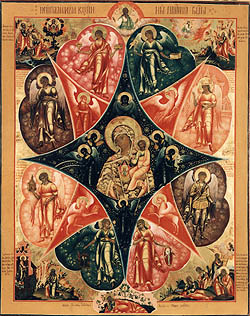
What Does The Burning Bush Symbolize?

Post Author:  Darrell

I have long cherished the story of the Lord’s appearance to Moses in the Burning Bush from Exodus Chapter 3.  I am sure you know the story. Moses left Egypt and set up his home in Midian.  The Lord appeared to him in the midst of the burning bush in an effort to get his attention and call him back into His service to free the Children of Israel from the Egyptians.  At first glance, the use of a burning bush appears to be nothing more than a tool to get Moses’ attention.  It seems to be a way of saying, “Hey you!  Pay attention!  This is not just your run-of-the-mill conversation.  I am serious!”  However, I have to admit that in the back of my mind I have often wondered if there is a deeper meaning in the Lord’s choice of a bush that burns with fire yet remains unconsumed.  It seems to be a very specific choice.  So why did He choose it?

As some of you know, my wife and I have become catechumens in the Eastern Orthodox Church.  As a result, I have spent some time this Christmas season reading the hymns of the Church as they relate to the birth of Christ, and I have come across an interpretation of the Burning Bush that has really intrigued me.

The Orthodox Church makes heavy use of typology, a method of exegesis that views older biblical events, places, and things as a foreshadow or prefiguration of later biblical events, places, and things.  There is an ancient teaching that the burning bush is a Type of the Virgin Mary and the Church.  The reasoning goes like this:

  1. God is referred to numerous times in the Bible as the Consuming Fire, e.g., Exodus 24:17, Deuteronomy 4:24, Deuteronomy 9:3, and Hebrews 12:29.
  2. Jesus and the Holy Spirit are both Fully God.
  3. The Burning Bush, despite the presence of the Lord, remained unconsumed.
  4. Mary, despite bearing Jesus in her womb, remained unconsumed.
  5. The Church, despite the indwelling of the Holy Spirit, also remains unconsumed.

 I must admit that I never noticed this relationship before, but coming across it and pondering it has really touched my heart.  Mary carried the All-Consuming fire in her womb, yet God condescended Himself enough so as not to consume her.  Mary is, in many ways, the Unburnt Bush (this is a title given to her in Orthodox Tradition).  Today, the Church has the All-Consuming fire living within it.  God condescends Himself enough to take up residence in our hearts, yet we, like Mary, remain unconsumed.  How glorious this is!

You showed Moses, O Christ God,
An image of your most pure Mother
In the bush that burned yet was not consumed,
For she herself was not consumed,
When she received in her womb the fire of divinity!
She remained incorrupt after her pure childbearing!
By her prayers, O greatly merciful One,
Deliver us from the flame of passions,
And preserve your people from all harm!
(Orthodox Kontakion Hymn)

Glory to Jesus Christ!

What Happens When the Church Is Married to Nationalism? Part 1

Post Author: Bill Pratt

One of the most important historical facts about the life of Dietrich Bonhoeffer was his reaction to the Nazi take-over of the Lutheran state church in Germany in the 1930’s.  Eric Metaxas, in his magnificent biography of Bonhoeffer, devotes an entire chapter to Nazi theology.  The program developed by the Nazis to coopt religion in Germany is of seminal importance to Christians today and in the future.

Metaxas starts by describing Hitler’s approach to Christianity:

One sometimes hears that Hitler was a Christian. He was certainly not, but neither was he openly anti-Christian, as most of his top lieutenants were. What helped him aggrandize power, he approved of, and what prevented it, he did not. He was utterly pragmatic. In public he often made comments that made him sound pro-church or pro-Christian, but there can be no question that he said these things cynically, for political gain. In private, he possessed an unblemished record of statements against Christianity and Christians.

According to Hitler, Christianity preached “meekness and flabbiness,” and this was simply not useful to the National Socialist ideology, which preached “ruthlessness and strength.” In time, he felt that the churches would change their ideology. He would see to it.

But Hitler’s lieutenants were far more anti-Christian than he was.  Metaxas traces the plans of Hitler’s henchmen:

Since Hitler had no religion other than himself, his opposition to Christianity and the church was less ideological than practical. That was not the case for many leaders of the Third Reich. Alfred Rosenberg, Martin Bormann, Heinrich Himmler, Reinhard Heydrich, and others were bitterly anti-Christian and were ideologically opposed to Christianity, and wanted to replace it with a religion of their own devising. Under their leadership, said Shirer, “the Nazi regime intended eventually to destroy Christianity in Germany, if it could, and substitute the old paganism of the early tribal Germanic gods and the new paganism of the Nazi extremists.”

Metaxas singles out Himmler as particularly hateful of Christianity:

Himmler was the head of the SS and was aggressively anti-Christian. Very early on, he barred clergy from serving in the SS. In 1935 he ordered every SS member to resign leadership in religious organizations. The next year he forbade SS musicians to participate in religious services, even out of uniform. Soon afterward he forbade SS members to attend church services. For Himmler, the SS was itself a religion, and its members, postulants in its priesthood. Many SS rituals were occultic in nature. Himmler was deeply involved in the occult and in astrology, and much of what the SS perpetrated in the death camps bore Himmler’s saurian stamp.

Heydrich, another of Hitler’s top officials, famously said, “Just you wait. You’ll see the day, ten years from now, when Adolf Hitler will occupy precisely the same position in Germany that Jesus Christ has now.”

Rosenberg, another important figure in the Nationalist Socialists, was tasked with putting together a thiry-point program for the future National Church of the Third Reich.  According to Metaxas, “Rosenberg’s plan is some of the clearest proof that exists of the Nazis’ ultimate plans for the churches.”  Below are some excerpts from that plan:

13. The National Church demands immediate cessation of the publishing and dissemination of the Bible in Germany. . . .     

14. The National Church declares that to it, and therefore to the German nation, it has been decided that the Fuehrer’s Mein Kampf is the greatest of all documents. It . . . not only contains the greatest but it embodies the purest and truest ethics for the present and future life of our nation. 

18. The National Church will clear away from its altars all crucifixes, Bibles and pictures of saints.     

19. On the altars there must be nothing but Mein Kampf (to the German nation and therefore to God the most sacred book) and to the left of the altar a sword.     

30. On the day of its foundation, the Christian Cross must be removed from all churches, cathedrals and chapels . . . and it must be superseded by the only unconquerable symbol, the swastika.

Those were the plans of the Nazis, but an interesting question to answer is, “How did the Lutheran church in Germany react to the attempted Nazification of their church?”  In part 2 of this post series, we will look at that question.
Should the Word of God Be Preached in Church?

Post Author: Bill Pratt

Well, yes, of course, but that’s not the view of all pastors who call themselves Christian.   I just finished Eric Metaxas’ brilliant biography of Dietrich Bonhoeffer, and I was struck by Bonhoeffer’s view of the liberal churches in Manhattan during the early 1930’s.  In a fascinating season of Bonhoeffer’s life, he visited New York City to study at Union Theological Seminary.  What he found at the liberal seminary and the liberal churches around the seminary profoundly shocked him.

During this period in America, the battle between the Christian fundamentalists and the liberals was in full swing, and Manhattan was the epicenter of the struggle.  As Bonhoeffer became familiar with the students at the staunchly liberal Union Theological Seminary, here is what he found:

There is no theology here. . . . They talk a blue streak without the slightest substantive foundation and with no evidence of any criteria. The students—on the average twenty-five to thirty years old—are completely clueless with respect to what dogmatics is really about. They are unfamiliar with even the most basic questions. They become intoxicated with liberal and humanistic phrases, laugh at the fundamentalists, and yet basically are not even up to their level.

If this was the condition of the seminary, the nearby churches were just as bad.  

Things are not much different in the church. The sermon has been reduced to parenthetical church remarks about newspaper events. As long as I’ve been here, I have heard only one sermon in which you could hear something like a genuine proclamation, . . .  One big question continually attracting my attention in view of these facts is whether one here really can still speak about Christianity, . . . There’s no sense to expect the fruits where the Word really is no longer being preached. But then what becomes of Christianity per se?

Bonhoeffer continues:

In New York they preach about virtually everything; only one thing is not addressed, or is addressed so rarely that I have as yet been unable to hear it, namely, the gospel of Jesus Christ, the cross, sin and forgiveness, death and life.

If the Word of God is not preached in a church, then what is?  In Manhattan during the 1930’s, here is what you could expect:

So what stands in place of the Christian message? An ethical and social idealism borne by a faith in progress that—who knows how—claims the right to call itself “Christian.” And in the place of the church as the congregation of believers in Christ there stands the church as a social corporation.

Sadly, there are still “churches” that are stuck in the liberal mode of the 1930’s.  Just as Dietrich Bonhoeffer was repulsed by these churches in the early twentieth century, so should we be in the early twenty-first century.

His words ring true.  What we need to hear from our pulpits is the “gospel of Jesus Christ, the cross, sin and forgiveness, death and life.”  My wife and I thank God that he led us to a church 14 years ago where our pastor, Dr. Rick Byrd, has consistently preached the Word of God, week in and week out.  If you cannot say the same about your pastor, it may be time for you to move on.  You are being starved of the bread of life.

How Should You Evaluate Someone’s Claims?

Post Author: Bill Pratt

In the internet world we live in, there are literally hundreds of millions of people making claims about every subject under the sun.  In the past, when the internet did not exist, there were far fewer voices making claims in a public fashion.  A person wanting to make public claims had to be published, get on the radio, get on TV, or make a movie.  None of these were easy to do, and so few people did.

Since there were far fewer voices before the internet age, we thought we could better ascertain their credentials to decide whether we could trust what they were saying.  Many of us assumed (incorrectly) that if somebody was published or was featured on a TV program, then what they said was most likely true.  After all, there had to be some kind of vetting process, right?  This was an easy way to evaluate their claims without doing any work.

Since there are now millions of people making their viewpoints publicly known, we can no longer be so lazy.  Since anyone can say anything, and expose it to everyone through the internet, we have to figure out how to evaluate whether someone’s claims are true, not based on the person making the claim, but based on their actual words.

So how do we go about doing this?  Brian Auten, at Apologetics 315, wrote a nice introduction to critical thinking called 15 Ways to Detect Nonsense.  Please take a look at his post and get started on the road to thinking critically.