Why Is Scientism Self-Refuting?

Post Author: Bill Pratt

More times than I can count we have skeptics comment on the blog who insist that science is the only means of attaining knowledge.  If you don’t believe me, just read the comments underneath last week’s blog posts.  I have covered this topic numerous times, but it seems to surface over and over again, which tells me that we are touching upon a fundamental disagreement between two worldviews.  In other words, this is a pivotal issue for everyone to understand.

So, I call back to the stand again Professor Edward Feser and his book, The Last Superstition.  When confronted with the assertion that only scientific reasoning gives knowledge (justified true belief), how shall we respond?

There are two problems with this view (which is known as “scientism” or “positivism”).  First, if they want to take this position, they will need to defend it and not simply assert it; otherwise they’ll be begging the question against their opponents and indulging in just the sort of dogmatism they claim to oppose. 

Feser makes an important point here.  It is not enough to merely say, as skeptics sometimes do, that scientific reasoning is the only way to know things, and then just leave it at that.  This viewpoint may be fashionable among atheists and skeptics, but among the rest of the populace, it just doesn’t fly.  The vast majority of thinkers from pre-Socratic Greece to today reject the assertion that scientific reasoning is the only way to know anything.  Given that fact, we expect an argument to be made.

Second, the moment they attempt to defend it, they will have effectively refuted it, for scientism or positivism is itself a metaphysical position that could only be justified by using metaphysical arguments. 

How so?  Why can’t science argue for science without employing metaphysical arguments?

Of  its very nature, scientific investigation takes for granted such assumptions as that: there is a physical world existing independently of our minds; this world is characterized by various objective patterns and regularities; our senses are at least partially reliable sources of information about this world; there are objective laws of logic and mathematics that apply to the objective world outside our minds; our cognitive powers – of concept-formation, reasoning from premises to a conclusion, and so forth – afford us a grasp of these laws and can reliably take us from evidence derived from the senses to conclusions about the physical world; the language we use can adequately express truths about these laws and about the external world; and so on and so on.

Notice that none of these are claims of science, are they?  As Feser explains, “Every one of these claims embodies a metaphysical assumption, and science, since its very method presupposes them, could not possibly defend them without arguing in a circle.  Their defense is instead a task for metaphysics, and for philosophy more generally; and scientism is shown thereby to be incoherent.”

Feser ends this section with a brilliant quote of philosopher E. A. Burtt:

Even the attempt to escape metaphysics is no sooner put in the form of a proposition than it is seen to involve highly significant metaphysical postulates.  For this reason there is an exceedingly subtle and insidious danger in positivism.  If you cannot avoid metaphysics, what kind of metaphysics are you likely to cherish when you sturdily suppose yourself to be free from the abomination?  Of course it goes without saying that in this case your metaphysics will be held uncritically because it is unconscious; moreover, it will be passed on to others far more readily than your other notions inasmuch as it will be propagated by insinuation rather than by direct argument. . . . Now the history of mind reveals pretty clearly that the thinker who decries metaphysics . . . if he be a man engaged in any important inquiry, he must have a method, and he will be under a strong and constant temptation to make a metaphysics out of his method, that is, to suppose the universe ultimately of such a sort that his method must be appropriate and successful. . . . But inasmuch as the positivist mind has failed to school itself in careful metaphysical thinking, its ventures as such points will be apt to appear pitiful, inadequate, or even fantastic.

Is There a War Between Religion and Science?

Post Author: Bill Pratt

This canard has been repeated so often that it is now part of 21st century folklore.  Contrary to this popular myth, philosopher Edward Feser, in his book  The Last Superstition, correctly points out that the “so-called ‘war between science and religion’ is really a war between two rival philosophical worldviews, and not at bottom a scientific or theological dispute at all” (emphasis in original).

On one side is the worldview derived from the “classical philosophical vision of Plato, Aristotle, Augustine, and Aquinas.”  The other side, that of materialistic secularism, derives its premises from the likes of Hobbes, Hume, Descartes, Locke, and Kant.

Feser presents candid comments from several modern scientists and philosophers who admit as much.

The physicist Paul Davies tells us that “science takes as its starting point the assumption that life wasn’t made by a god or a supernatural being.”  Feser further quotes Davies as saying that partially out of fear of  “open[ing] the door to religious fundamentalists . . . many investigators feel uneasy about stating in public that the origin of life is a mystery, even though behind closed doors they freely admit that they are baffled.”

Feser continues by quoting prominent contemporary philosophers.

Tyler Burge opines that “materialism is not established, or even clearly supported, by science” and that its hold over his peers is analogous to that of a “political or religious ideology”; John Searle tells us that “materialism is the religion of our time,” that “like more traditional religions, it is accepted without question and . . . provides the framework within which other questions can be posed, addressed, and answered,” and that “materialists are convinced, with a quasi-religious faith, that their view must be right”; and William Lycan admits, in what he himself calls “an uncharacteristic exercise in intellectual honesty,” that the arguments for materialism are no better than the arguments against it, that his “own faith in materialism is based on science-worship,” and that “we also always hold our opponents to higher standards of argumentation than we obey ourselves.”

One of the most famous admissions from a scientist about the war of worldviews comes from the materialist biologist Richard Lewontin.  Writing in a book review, Lewontin admits:

Our willingness to accept scientific claims that are against common sense is the key to an understanding of the real struggle between science and the supernatural. We take the side of science in spite of the patent absurdity of some of its constructs, in spite of its failure to fulfill many of its extravagant promises of health and life, in spite of the tolerance of the scientific community for unsubstantiated just-so stories, because we have a prior commitment, a commitment to materialism. It is not that the methods and institutions of science somehow compel us to accept a material explanation of the phenomenal world, but, on the contrary, that we are forced by our a priori adherence to material causes to create an apparatus of investigation and a set of concepts that produce material explanations, no matter how counter-intuitive, no matter how mystifying to the uninitiated. Moreover, that materialism is absolute, for we cannot allow a Divine Foot in the door.

All of this points to the need for the public conversation to include philosophy and worldviews.  The secularist who claims that science, in and of itself, disproves God has merely smuggled in atheism from the start.  Science, in and of itself, does not disprove God.  Only when it is built on a foundation of materialism can it do that kind of work.

Are the Healing Miracles of Vespasian Believable?

Post Author: Bill Pratt

Let’s briefly cover some historical background.  The Roman emperor Vespasian ruled from A.D. 69 -79; his reign ended with his death.  Writing about Vespasian some 25 years later, the Roman historian Tacitus reported a famous incident where Vespasian is said to have miraculously healed two men – one blind and one lame.

This miracle account is important because it has been frequently compared to the miracles of Jesus, and in particular, to his miraculous resurrection from the dead.  The argument that skeptics make goes something like this: “The accounts of Vespasian’s healing miracles are as well evidenced as the resurrection of Jesus.  People of the ancient world were credulous enough to believe both Vespasian’s miracles and Jesus’s miracles.  However, sophisticated modern people do not believe that Vespasian actually healed the two men.  Therefore, since the evidence for his miracles is at least as good as the evidence for Jesus’s reported resurrection, a sophisticated modern person should also not believe Jesus’s miraculous resurrection.”

The most famous skeptic to put forward the miracles of Vespasian as a defeater to the resurrection of Jesus was the 18th century philosopher David Hume.  In his book, An Enquiry Concerning Human Understanding, Hume claims, “One of the best attested miracles in all profane history, is that which Tacitus reports of Vespasian, who cured a blind man in Alexandria, by means of his spittle, and a lame man by the mere touch of his foot; . . .” 

Hume goes on to report that Tacitus is known for his “candour and veracity” and that his sources for the miracle report were also of “established character for judgement and veracity.”  Hume concludes with the following: “If we add the public nature of the facts, as related, it will appear, that no evidence can well be supposed stronger for so gross and so palpable a falsehood.”

In other words, as far as ancient reports of miracles go, the miracles of Vespasian are as well evidenced as you can get, yet we know today that the whole affair was a fraud.

But has Hume accurately reported the circumstances around this miracle account?  Has he properly understood Tacitus’s account?  It seems the answer is a resounding “no.”

Timothy and Lydia McGrew, in their essay “The Argument from Miracles” in The Blackwell Companion to Natural Theology, respond to Hume:

Hume’s presentation here is so careless that it struck his opponents as disingenuous. The “candour and veracity” of the historian are beside the point, since the manner in which Tacitus introduces the story indicates plainly that he disbelieved it. Hume’s characterization of the persons on whose authority Tacitus relied in relating the miracle as “of established character for judgement and veracity, as we may presume” drew special scorn from Campbell, for Tacitus says nothing of the sort.

Scholars who study Tacitus’s works consider his account of Vespasian’s miracles to contain numerous “ironical and sarcastic” elements, a point that Hume seems to have completely missed.  According to Glenn Miller of the Christian Thinktank, “This  account [of Tacitus’s] has so many tongue-in-cheek elements in it — even for a court historian — it is hard to be ‘impressed’ by Vespasian’s performance.”  Miller also explains, “Tacitus uses this miracle story to paint a VERY unflattering portrait of Vespasian, all couched in conventional forms.”  

The McGrew’s continue:

The entire affair bears on its face the marks of obvious imposture. It was conducted in Alexandria, the first major city to declare in favor of Vespasian’s imperial aspirations, and it was done in honor both of the emperor, for whom a divine sign would be most convenient, and of the local deity.  At Vespasian’s request, physicians examined the two men who claimed to have received visions in the night telling them to appeal to Vespasian to be cured; the physicians reported that the blind man was not totally blind, nor the lame man totally lame, and added that any glory for a successful cure would redound to Vespasian himself, while any blame for a failure would fall back upon the two supplicants for having fraudulently represented the oracle of Serapis.

Vespasian, when presented with these two men, wanted a physician to confirm that the men could be healed before he would attempt it.  In case the healing didn’t work, according to Tacitus, the “the onus of failure would belong to the poor beseechers.”  This was a win-win for Vespasian, because if he succeeded, he would get the credit, and if he failed the men would be blamed! 

W. Adams, a contemporary of Hume, notes, “Where then is the wonder that two men should be instructed to act the part of lame and blind, when they were sure of succeeding in the fraud, and of being well rewarded (as we may well suppose) for their pains?”

The McGrew’s add:

As for Tacitus’s reference to living witnesses, there is no mystery here. If the fraud was perpetrated publicly as described, there were doubtless many people who saw the two men leap up and claim to have been healed. There is no need to suggest that the witnesses were liars; it suffices that they were at most somewhat credulous. There was no need for them to inquire too closely since – unlike the apostles – they had absolutely nothing to lose in maintaining their account of what they had seen. “No evidence,” Douglas concludes drily, inverting Hume’s claim, “can well be supposed weaker.”

The McGrew’s conclude by assessing the Vespasian miracle story in comparison to the resurrection of Jesus.

At every point, the case of Vespasian differs critically from that of the resurrection. Indeed, from a Bayesian point of view, the wonder would be if, under the circumstances, some story of a miraculous demonstration in favor of Vespasian were not forthcoming. Given our background knowledge, the Bayes factor for the testimony is so close to 1 as to give us virtually no epistemic traction: the report was almost as strongly to be expected if the two men had been parties to the deceit as if they had genuinely been healed. It is absurd to suggest that the evidence for these miracles bears comparison with the evidence for the resurrection.

A newly appointed emperor in a city taking sides in an imperial political contest needs a miracle as a stamp of divine approval.  Two men willingly come forward to provide the “miracle” needed.  They have nothing to lose and everything to gain.  Even the ancient Roman historian who reports this miracle doesn’t believe it, his account dripping with sarcasm and irony.  Are we to seriously believe that Vespasian’s “miracles” rival the resurrection of Jesus?  No truly objective person could possibly think so.

Does the Anthropic Principle Explain the Fine Tuning of the Universe?

Post Author: Bill Pratt

One of the most fascinating discoveries of modern science has been that the universe is finely tuned to support human life.  Philosopher of science John Lennox, in his book God’s Undertaker, notes that “this perception on the part of scientists, that the universe has to be very precisely structured in order to support life, has been called the anthropic principle.”

Christian theists argue that this fine tuning calls for an intelligent creator of the universe as an explanation.  How do non-theists respond to the fine tuning of the universe?

Lennox explains:

Some scientists and philosophers maintain that we ought not to be surprised at the order and fine-tuning we see in the universe around us, since if it did not exist then carbon-based life would be impossible, and we would not be there to observe the fine-tuning.  In other words they use the anthropic principle against the inference of design.  In fact, Richard Dawkins in The God Delusion tells us that the anthropic principle and God function as alternative explanations.

One response, then, to fine tuning, is to say that we should not be surprised at fine tuning because if there were no fine tuning to explain the origin of intelligent observers, then we would not be alive, as intelligent observers, to observe the fine tuning.  Does this really explain anything, though?  This explanation seems like a sleight of hand, or no explanation at all.  Lennox reveals why we feel this way:

All the anthropic principle does is to tell us that for life to exist, certain necessary conditions must be fulfilled.  But what it does not tell us is why those necessary conditions are fulfilled, nor how, granted they are fulfilled, life arose.  Dawkins is making the elementary mistake of thinking that necessary conditions are sufficient.  But they are not: in order to get a first class degree at Oxford it is necessary to get into the University; but, as many students know, it is certainly not sufficient.  The anthropic principle, far from giving an explanation for the origin of life, is an observation that gives rise to the need for such an explanation.

One of the easiest ways to see that the anthropic principle, by itself, is not a sufficient explanation, is by reviewing an illustration given by philosopher John Leslie.  He says that using the anthropic principle against the design hypothesis

sounds like arguing that if you faced a firing squad with fifty guns trained on you, you should not be surprised to find that you were alive after they had fired.  After all, that is the only outcome you could possibly have observed – if one bullet had hit you, you would be dead.  However, you might still feel that there is something which very much needs explanation; namely why did they all miss?  Was it by deliberate design?  For there is no inconsistency in not being surprised that you do not observe that you are dead, and being surprised to observe that you are still alive.

Rather than give an explanation of the fine tuning of the universe, the anthropic principle merely invites us to ask for a real explanation.  I think we would all like to know why all 50 people in the firing squad missed us.

Are You a Romantic?

Post Author: Bill Pratt

I don’t mean in the sense of displaying strong affection toward your spouse.  I mean in the sense of the nineteenth century movement of Romanticism.  I think the romantics still have something to say to us today, and I’m wondering how many of you can relate to their ideas.
According to William Lawhead, in his The Voyage of Discovery,  “Romanticism was a quasi-philosophical literary and artistic movement that reacted against the Enlightenment picture of the universe as a machine that could best be studied by the analytical techniques of the sciences.”

Lawhead expands on this theme:

For the romantics, the scientific vision of the world was too alienating, for it threatened to turn our moral, aesthetic, and religious longings into isolated aberrations within an otherwise mathematically ordered cosmos.  As the romantics looked out on nature, they did not see atomistic particles in motion.  Instead, they felt they were in the mystical presence of an organic unity that resonated with the human spirit. 

Furthermore, they were convinced that logic and telescopes missed what was most important about reality.  Rather than reason and science revealing the secrets of this world to us, they fragmented nature and turned it into a catalogue of abstractions.  In place of the banquet table of life, full of rich colors, tastes, and textures, science offered us only a cookbook of recipes. 

To be sure, every savory dish present at the banquet of nature was represented in the scientists’ recipes.  But to mistake the scientists’ calculations for the fullness of reality would lead to spiritual starvation.  The physicist could summarize the sunset and rainbow in optical equations, and the physiologist could describe the body of one’s lover as a machine made up of organic pumps, tubing, levers, and pulleys.  However, in each case the scientific account missed the beauty and the mystery of these realities.

Although I don’t agree with everything the Romantics had to say, there is much to be commended about their movement, and I find myself agreeing with several aspects of it.  It often seems to me that the battle of worldviews today is between the reductionists who want to explain every part of human experience in terms of scientific data and theory, and the modern romantics who see that human experience is so much more than what scientific data can explain.

Where do you stand?  Do you align yourself more with the reductionists or the romantics?  Why?

Is the Multiverse Hypothesis Scientific Or Not? Part 2

Post Author: Bill Pratt

In part 1 of this series, we learned that there are two versions of the multiverse hypothesis, level 1 and level 2.  The level 1 multiverse is non-controversial as it is basically an extension of our current universe in space.  The level 2 multiverse, however, makes much grander claims and is fraught with problems.  We pick up with cosmologist George F. R. Ellis’s Scientific American article from August 2011.

So what is wrong with the level 2 multiverse hypothesis? Ellis explains:

What is new is the assertion that the multiverse is a scientific theory, with all that implies about being mathematically rigorous and experimentally testable. I am skeptical about this claim. I do not believe the existence of those other universes has been proved—or ever could be. Proponents of the multiverse, as well as greatly enlarging our conception of physical reality, are implicitly redefining what is meant by “science.”

Why is the level 2 multiverse not scientific?

The key step in justifying a multiverse is extrapolation from the known to the unknown, from the testable to the untestable. You get different answers depending on what you choose to extrapolate.  Because theories involving a multiverse can explain almost anything whatsoever, any observation can be accommodated by some multiverse variant. The various “proofs,” in effect, propose that we should accept a theoretical explanation instead of insisting on observational testing. But such testing has, up until now, been the central requirement of the scientific endeavor, and we abandon it at our peril. If we weaken the requirement of solid data, we weaken the core reason for the success of science over the past centuries.

Ellis sympathizes with those scientists who posit the level 2 multiverse as a “way of resolving deep issues about the nature of existence,” but he argues they are misguided. 

All the same issues that arise in relation to the universe arise again in relation to the multiverse.  If the multiverse exists, did it come into existence through necessity, chance or purpose?  That is a metaphysical question that no physical theory can answer for either the universe or the multiverse.

The level 2 multiverse, then, is not a scientific explanation, but is philosophical speculation.  It is an alternative metaphysical idea that is simply meant to replace the metaphysical idea of a supernatural Designer.  Those skeptics who constantly chastise Christians for doing metaphysics, and who then turn around and posit the level 2 multiverse as the cause of the fine tuning of the universe, find themselves also doing metaphysics

It seems that skeptics come to a fork in the road here.  Either admit that metaphysics is unavoidable and climb onboard with theists, or stop offering the multiverse as an explanation to anything.  What skeptics may not do is claim that they are only offering scientific explanations while at the same time arguing for the multiverse.  That door is closed.

Is the Multiverse Hypothesis Scientific Or Not? Part 1

Post Author: Bill Pratt

One of the most powerful arguments for God’s existence is the fine tuning argument.  Rather than rehearse it here, please read Wintery Knight’s presentation of the argument.  Many atheist scholars acknowledge the persuasiveness of this argument (e.g., philosopher Peter Millican did as much in his recent debate with William Lane Craig), although not granting its conclusion.

The most common escape hatch that atheists scurry through when confronted with this argument is to offer the multiverse hypothesis.  This hypothesis, some of them argue, is much more plausible than the God hypothesis because it is a scientific explanation for the fine tuning of the universe for life.  What is this hypothesis and is it scientific?

In the August 2011 issue of Scientific American the world-renowned cosmologist George F. R. Ellis weighs in to explain exactly what the multiverse is.  First, Ellis clarifies what cosmologists mean by the term “multiverse.”

The word “multiverse” has different meanings. Astronomers are able to see out to a distance of about 42 billion light-years, our cosmic visual horizon. We have no reason to suspect the universe stops there. Beyond it could be many—even infinitely many—domains much like the one we see. Each has a different initial distribution of matter, but the same laws of physics operate in all. Nearly all cosmologists today (including me) accept this type of multiverse, which Max Tegmark calls “level 1.”

The level 1 multiverse refers to what lies outside our visual horizon.  This “multiverse” contains the same laws of physics as the universe we can observe, and it is really just an extension of our universe.  I find the term “multiverse” to be misleading in this case, but I don’t get to choose the names for scientific theories.  As Ellis says, the level 1 multiverse is not controversial.  But this is not the notion of the multiverse that atheists invoke to avoid the conclusion of the fine tuning argument. 

Ellis continues:

Yet some go further. They suggest completely different kinds of universes, with different physics, different histories, maybe different numbers of spatial dimensions. Most will be sterile, although some will be teeming with life.  A chief proponent of this “level 2” multiverse is Alexander Vilenkin, who paints a dramatic picture of an infinite set of universes with an infinite number of galaxies, an infinite number of planets and an infinite number of people with your name who are reading this article.

If there truly are an infinite set of universes, argue some atheists, then it seems that at least one would have the life-permitting fine tuning of our universe.  Therefore, there is no need to posit a Designer of our universe at all.  The level 2 multiverse virtually guarantees that our universe would exist, as it guarantees that every other kind of conceivable universe exists.

In part 2 of this series, we will look at what is wrong with the level 2 multiverse hypothesis.

Does Quantum Mechanics Invalidate the Law of Non-contradiction? Part 2

Post Author: Bill Pratt

In part 1 of this series, Walt Tucker gave an explanation of the two slit experiment and its relation to quantum mechanics.  In part 2, Walt explains why this experiment does not violate the law of non-contradiction.  Below are Walt’s words.

The quick answer is: if a particle could actually be observed as A and not A at the same time, that would violate the law of non-contradiction. Since that cannot be done, even in the quantum world, there is no violation!

Quantum superposition is the mathematical addition of probability densities of all of the possible states of a quantum system.  The result of the superposition of the densities is used to calculate the probability of observing the system in one of the states.  In a binary probability space there is a chance that a quantum event can be observed as A or as not A.  

In the two slit experiment, it is the probability of a photon going through slit A or slit B.  Slit B would be not A.  When you don’t observe the slits to know which slit the particle went through, you find that it goes through both.  So, this guy is saying that both A and not A exist simultaneously and the law of non-contradiction is violated.  But that is not exactly the case!

When the quantum system is observed, it is observed in the context of a particle with specific location and it can only be A or not A, it can’t be both. But when the system is not being observed, it is not in the form of a point like particle, it is in a wave form where the quanta of energy is spread across the possible states as a wave.  It is in the wave form until it is observed. The observation collapses the wave to a point like particle where the law of non-contradiction is also observed (like popping a whole balloon by a pin at only one point on the surface of the balloon).

One could say the law of non-contradiction is only valid in the world of observables (the world in which we interact). But it can also be said that since the energy is in a wave form when it is not being observed, that it is not true that it is A and not A at the same time, but that it is something else, a wave, that only has the potential to be either A or not A once it is observed.  In other words, it is a whole other form that makes no sense in terms of A and non-A.

It is like saying a potato is mashed potatoes, French fries, and a baked potato all at the same time, when it is not any of them when it is a potato in the garden.  The potato has the potential to be any of those forms of potato, but isn’t any of them until one takes the potato and does something with it.  The same thing applies in the quantum world.  A wave has the potential to be observed at slit A or slit B (since a quanta of energy must be observed at one point), but while it is still a wave, it cannot be observed at both slits at the same time because an observation would cause it to no longer be a wave, but a particle.

Bottom line is that having the potential to be one thing or another does not violate the law of non-contradiction.  If the particle could actually be observed as A and not A at the same time, then there would be a violation of the law of non-contradiction!

[Bill Pratt]  Thanks for the explanation, Walt.  Great stuff.

Does Quantum Mechanics Invalidate the Law of Non-contradiction? Part 1

Post Author: Bill Pratt

This seems to be a common misconception, one that I have seen many times on the blog.  Recently, one of the most helpful commenters on the TQA blog, Walt Tucker, wrote a detailed response to this claim as a comment on another post.  He has given me permission to share his commentary in this blog post.  Every word below is Walt’s unless I indicate otherwise, and I thank him for giving me permission to use his excellent response.

A friend of mine was using his apologetics know-how with an atheist and using principles that are self-evident in nature, such as the law of non-contradiction, to argue for the existence of God.  The atheist claimed that quantum superposition violates the law of non-contradiction and thus my friend’s whole argument was null and void.  Knowing that I have knowledge in quantum theory and apologetics, my friend asked whether quantum superposition does violate the law of non-contradiction. 

Since this comes up so often with skeptics and atheists who try to use arguments from quantum mechanics against the classical apologetic argument for the existence, or at least the certainty of the existence, of God, I thought I would post my reply to my friend here for all of my Christian friends to use who might come across a person who tries to use the ill-fated quantum approach against God.  (Of course God created the quantum world, so it isn’t so likely that such arguments can be used against His existence.  Such attempts show either a misunderstanding of the nature of God, or a misunderstanding of nature itself.)

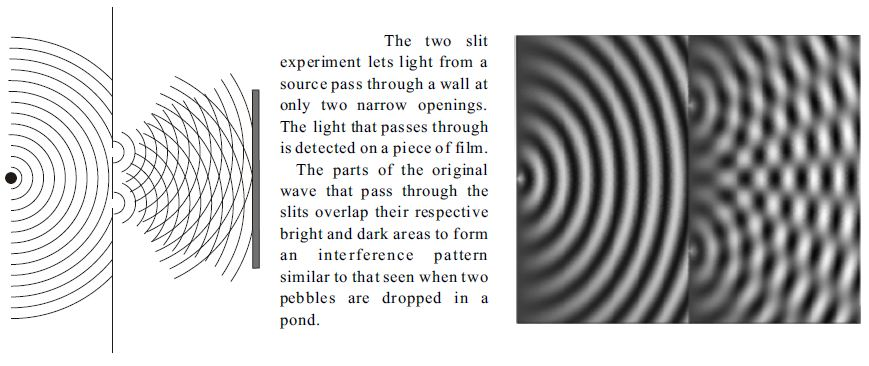
Before I present the reply, I need to give some background on how the argument the atheist is using arises in quantum mechanics.  There is a classic experiment used to demonstrate the non-intuitive nature of the quantum world.  It is called the two-slit experiment.  Light is made up of discrete packets of energy called “quanta.”  You can never have a half, or any fraction of, a quanta.  In one sense, it is like having a gum ball from a gum ball machine. You get a whole gum ball. You can smash it, chew it, or whatever, but you still have the same about of gum and it only comes in whole gum balls.

So, light is generated from atoms and absorbed by other atoms as quanta packets of energy (called a photon).  The light we see in a room with a typical incandescent light bulb is many millions of quanta, so one quanta of photon energy is very, very small.  In the experiment, a single quanta of light is shot towards the double slit (see figure below). 

There is a piece of film on the other side. When both slits are open, the light appears to go through one of the two slits and be absorbed by the film at one point at a random position. But when this is done over millions of shots, the image on the film is an interference pattern as if the photons went through both slits at the same time (the image on the film is the classical wave interference pattern of light).  An interference pattern is the crossing pattern you see when you drop two pebbles in a pond as the same time and the waves interfere – high crests and low crests – with light it is bright and dark areas.  

But since only one photon is shot at a time, it is odd that the film shows an interference pattern when intuition would say a particle of light, the photon, would only go through one slit or the other, but couldn’t go through both. To test that, one can put a detector at the slits to try and see if the photon goes through one slit or the other, or both. When that is done, the photons are detected at only one slit or the other, randomly, and the interference pattern on the film disappears (it is what you would expect if the photons did go through only one slit or the other).

So, knowing which slit the photon goes through destroys the interference that appears on the film that would appear when you don’t know which slit the photon goes through. Quantum mechanics is a mathematical formulation of this behavior for predicting the outcome of experiments called observations.  Each detection on the film would be an observation. As such, what is called an observation does not require a human observer, but does require some sort of detector, whether it be a film, a photo-detector, or anything that could absorb the photon. Now knowing the weird behavior of the quantum world, I give the reply to the question. 

[Bill Pratt] In part 2 of this series, Walt completes his explanation as to why quantum mechanics does not violate the law of non-contradiction.