Did First Century Christians Believe in Miracles Because They Were Pre-Scientific?

Post Author: Bill Pratt

I just finished reading a wonderful book by New Testament scholar Craig Blomberg, called The Historical Reliability of the Gospels.  In his chapter where he discusses the miracles recorded in the Gospels, he had this to say about the scientific objection to miracles.

In short, the scientific objection to the credibility of miracles is that the discovery of the natural, physical laws by which the universe operates has proved them impossible.  Those who hold this view sometimes go on to explain that people used to believe in miracles because they had only a primitive scientific understanding.  The Christian doctrines of the virgin birth and resurrection, for example, could spring from just such a pre-scientific milieu.  Only a moment’s thought is required, however, to realize that people of every age have known that two human parents are needed for conception and that death is irreversible! (emphasis mine)

Well put, Dr. Blomberg.  Well put.

Should We Read the Bible Literally?

Post Author:  Bill Pratt

My seminary professor, Norm Geisler, used to say, “Everything the Bible affirms is literally true, but not true, literally.”  What he meant by this is that we cannot read the Bible in a wooden, “literal” way when it is clearly using figurative language.

A good Catholic friend of mine once asked me how I interpreted Bible passages.  I answered, “I try to understand what the author’s intended meaning was in the historical context in which he wrote.”  She answered, “Oh, well that’s exactly how I interpret the Bible.  I thought that evangelicals interpreted everything literally.”

Clearly we have a failure to communicate!  There seem to be at least two ways that the word literal is used.  First, literal can mean interpreting language in a way that does not allow for any symbolism or figures of speech.  If someone said, “I have traveled to the four corners of the earth,” a literalist in this sense would assume that the earth must be a flat, four sided shape, and that I actually did travel to each corner of this geometric shape.

Second, literal can mean interpreting language in the exact way it was intended by the author without unduly introducing symbolism or figurative language where it was never intended.  This is what most evangelicals mean when we say that you should interpret the Bible “literally.”  We do not mean that there is no use of figurative language in the Bible.  There obviously is.  As Bill Foster says in his book, Meet the Skeptic, “Informed Christians recognize that the Bible is full of literary devices and figurative language such as metaphor, simile, metonymy, typology, allegory, personification, and so forth.”

The reason conservative Christians tend to emphasize reading the Bible literally is because some readers do tend to interpret passages in the Bible that seem to be written in a non-figurative way as figurative.  There are those that claim that the resurrection of Jesus should be taken figuratively, for example.  Traditional Christians point out that the authors of the New Testament clearly meant the resurrection accounts to be taken literally, not figuratively.  Jesus Christ actually rose from the dead in a physical body.

So, yes, we should read the Bible literally, as long as we agree on what literal means.

How Old Do You Think the Earth Is?

Post Author: Bill Pratt

I consider the age of the earth to be a secondary issue among Christians (not something to divide over), but I am curious about what the readers of this blog think about it.  If you have not answered the poll question on the home page of Tough Questions Answered, please drop by and vote.   The poll is located on the right side of the home page, in the sidebar area.

God bless,

Bill

What is the Cause of the Universe?

Post Author: Bill Pratt

See if you can follow this argument, which is one form of the cosmological argument.

  1. Everything that begins to exist has a cause.
  2. The universe began to exist.
  3. Therefore the universe has a cause.

The first premise should be uncontroversial.  If something begins to exist, it needs a cause of its existence.

The second premise draws upon the findings of science in the last century.  We have Einstein’s theory of relativity dictating a beginning to space, time, and matter.  We have enormous evidence for the Big Bang, which is the moment the universe exploded into existence about 13. 7 billion years ago.  We also have the second law of thermodynamics, which says that the amount of energy available for work is decreasing in the universe – a universe that is decaying cannot be infinitely old because it would have run out of usable energy by now.

To sum up the last paragraph, science seems to have shown that the universe did indeed have a beginning.  All of time, space, and matter came into existence 13.7 billion years ago.  If that is the case, then the universe needs a cause, and that cause cannot be a part of the universe, because nothing can cause itself to exist.

So what kind of cause are we talking about?  Based on the cosmological argument, we can deduce that this cause of the universe has the following properties: self-existence, timelessness, nonspatiality, immateriality, unimaginable power, and personhood.

Self-existence because whatever is the cause of the universe must ultimately be uncaused.  If it is not, then the argument just moves back one step.  There has to be a first uncaused cause.

This cause cannot exist in the time/space/material universe because then it would exist within the very universe it created.  That is impossible.

The cause must be incredibly powerful to have created the entire universe and all of its physical laws.

The cause must be personal because an impersonal force would be deterministic and mechanistic, not possessing free will.  A mechanistic being only operates according to the programming it received from something else.  But if the cause of the universe received programming from something else, then we have again not provided the answer to the cause of the universe.  We have just found a middle-man.  The cause had to make a choice to create and only beings who are personal can make choices.

All of these are attributes of the God of Christianity.  That is not to say we have proven the exact God of Christianity exists, but we have certainly made a persuasive argument that a being with some of his qualities exists.

Now that’s something to think about.

Must Science Exclude Intelligence as a Cause?

Post Author: Bill Pratt

According to John Heininger, the answer is “no.”  What follows is an extended quotation from John, who submitted this as a comment to our blog.  His comment makes some great points in a succinct fashion about the nature of science, especially with respect to the ruling of the Dover trial in 2005.

Methodological Naturalism: The Severing of Science.

In recent decades there have been ideologically driven efforts by versed interests to sever science and remove it from its complete and proper context; on the mistaken notion that science must be solely about naturalistic material processes, to the exclusion of all else. This assertion is neither scientific nor realistic – and is unsustainable.

Firstly, naturalistic science falls well short of ever answering ultimate questions of origins and existence. A reality acknowledged even by hard core atheists, who, none-the-less, operate on the blind faith notion that naturalism and raw materialism will increasingly explain all of reality, to the point where nothing beyond the material world is ever necessary, including God.

The noted atheistic philosopher Jean Paul Sarte however highlighted the absurdity of this aspiration, and finally conceded that this hope could never be achieved. Said Sarte, “A finite point without an infinite reference point is meaningless and absurd.” He realized that because human knowledge would forever be finite and limited humanity would never ever be in a position to have the ultimate big picture. And science has discovered that the further we push back the frontiers of scientific knowledge the more unanswered questions we have.

This is not to say that we should not continue with increased effort to discover all we can about the natural world, and always seek “firstly” to explain the mysteries of nature and the universe in purely naturalistic terms, as the empirical and scientific science method does, and does well.

Science is about the facts. It’s about discovering truths about the natural world, entirely by natural laws and processes alone (Dover). However, this is only the “initial” part of what constitutes science and the scientific method, and utterly ignores the foundational realities on which all of science ultimately rests and operates.

The foundational truth about science and the natural world is that it cannot be ultimately explained by naturalistic laws or material processes alone. Every scientist knows that all of science ultimately rests entirely on phenomena that have absolutely no naturalistic explanation.

The Dover ID trial severed science, and turned science on its head. It was decreed at Dover that natural law and material processes alone must define what is science. This turned out to be ultimately loopy logic, as the gatekeeper itself, natural law, has no naturalistic explanation, and there is nothing to suggest this will ever change (Sarte). This is rather like appointing an unidentified alien to guard planet earth from all other unidentified aliens, particularly God.

None-the-less, this loopy logic was made both the measure, and the means of defining science. It was both inadequate and defective. While matter, energy and other natural phenomena are the principle focus of science, the scientific community has absolutely no idea of what matter and energy ultimately is, or how it came into existence. This is particularly true in regard to the origin and nature of the dependent universe itself.

A contingent dying universe that is running down towards head death and maximum entropy cannot explain itself. And there is absolutely no verifiable naturalistic explanation as to how our dependent cosmos came into being, or how a dead universe devoid of energy would ever wind itself up again to the initial state of minimum entropy, a state of maximum usable energy, information, and order.

Moreover, all of science is based on material and mathematical relationships. But no scientist has even the foggiest notion of how these material and mathematical relationships came into existence. Nor is there the foggiest notion of where the cosmological constants came from, naturalistically.

Secondly, central to science is the foundational acceptance that we live in a universe that clearly manifests regularity, predictability and mathematical order. A reality every scientist in every field automatically assumes in order to be able to do science. All scientists assume we live in a universe where reason and intelligence can be applied to science, and such a universe must of necessity clearly manifest intelligence, at every level.

Therefore, to argue that the ID concept – of the universe being intelligently designed by an intelligent cause – has no place in science or science education, is to deny the foundational reality on which every field of science and western technology ultimately operates, every day, and in every way.

Methodological naturalism severs science. It’s insistence that all of science and science education must be restricted exclusively to purely naturalistic explanations is to split science in two. And specifically excludes the principle phenomena and foundational principles on which all of science is founded. And this is exactly what happened at Dover – no intelligence allowed.

The unsustainable methodological naturalism now being imposed on science and science education must be challenged. It is nothing less than indoctrinating students on philosophical naturalism and atheism, which the highest court in the United States, the U.S. Supreme Court, has ruled to be a religion, in the full sense of the word.

Does the Appearance of Design Prove God's Existence?

Post Author: Bill Pratt

Certainly the appearance of design in the natural world makes a strong case for the existence of a super-intelligent being, but I’m getting ahead of myself.

Many people look at the world around them and marvel at its functionality and complexity.  A common reaction to the functionality and complexity of the world is to wonder who or what made it that way.

Based on that intuition about the world, theists, those who believe in a single creator God, have made an argument about the existence of God in the following way.

  1. Every design has a designer.
  2. The universe exhibits complex design.
  3. Therefore the universe has a designer.

Premise 1 is fairly straightforward.  If something can be shown to be designed, it must have had a designer.

Premise 2, however, requires evidence.  Below is an extended quotation from William Lane Craig, one of the foremost Christian scholars of our day.

During the last thirty years or so, scientists have discovered that the existence of intelligent life depends on a complex and delicate balance of initial conditions given in the big bang itself.  Scientists once believed that whatever the initial conditions of the universe, eventually intelligent life might evolve.  But we now know that our existence is balanced on a knife’s edge.  It seems vastly more probable that a life-prohibiting universe rather than a life-permitting universe such as ours should exist.  The existence of intelligent life depends on a conspiracy of initial conditions that must be fine-tuned to a degree that is literally incomprehensible and incalculable.  For example, Stephen Hawking has estimated that if the rate of the universe’s expansion one second after the big bang had been smaller by even one part in a hundred thousand million million, the universe would have re-collapsed into a hot fireball.  British physicist P. C. W. Davies has calculated that the odds against the initial conditions being suitable for later star formation (without which planets could not exist) is one followed by a thousand billion billion zeroes, at least.  He also estimates that a change in the strength of gravity or of the weak force by only one part in 10,100 would have prevented a life-permitting universe. Roger Penrose of Oxford University has calculated that the odds of the big bang’s low entropy condition existing by chance are on the order of one out of 10 to the 123rd power.  There are [many] such quantities and constants present in the big bang that must be fine-tuned in this way if the universe is to permit life. And it’s not just each quantity that must be finely tuned; their ratios to one another must be also finely tuned. Therefore, improbability is added to improbability to improbability until our minds are reeling in incomprehensible numbers.

It is not just the physical conditions that must be present in the universe for life to exist that exhibit complex design.  There is also the issue of life itself.

Living cells are composed of DNA.  DNA consists of nitrogen bases called adenine, thymine, cytosine, and guanine which are commonly represented by the letters A, T, C and G.  These letters form genetic codes which provide the instructions for the building and replicating of all living things.  The four letter genetic code is identical to any other written language.  The sequences of genetic letters spell out exact instructions just like a sentence in English would.

To give you an idea of how complex life is, a single-celled amoeba contains the equivalent of 1,000 sets of an encyclopedia in its DNA.  The human genome is composed of about three billion nucleotide base pairs.  Years ago, Carl Sagan estimated that there is the equivalent of 20 million books of information stored in the human brain.  This number is considered to be conservative now.  The amount of information contained in living cells and the human brain is truly staggering, and thus the conclusion of complex design seems easily warranted.

Before we move on, I need to quickly add that the evidence presented above of design in the fine tuning of the universe to support life and of the composition of life itself is merely scratching the surface.  Many fantastic books have been written in the past 20 years detailing far more evidence of design in the natural world than what was mentioned above, so hopefully I have just whet your appetite to read more!

But now, if we have shown that the universe is indeed characterized by complex design, then who or what is the designer?

I think we can make the following conclusions about the designer.  The designer is super-intelligent and purposeful.  The intelligence of the designer far surpasses any kind of human intelligence ever seen.  The designer is purposeful because all designs have purposes behind them.  We are not dealing with a being who is randomly creating with no purpose.

Have we arrived at the God of the Bible?  No, we haven’t, but we have certainly made a strong case for the existence of a designer who has at least a couple of the attributes of the God of the Bible, and we have eliminated the possibility that no such designer exists.  We haved ruled out the possibility that the universe is caused by some irrational or purely non-intelligent source.

Theistic arguments for the existence of a Designer confirm the intuition that many people have had since the dawn of man.  To say that everything we see in the world around us just happened by chance is simply unbelievable.

Is Historical Evidence Convincing to Skeptics of Christianity?

Post Author: Bill Pratt

Only if the skeptic is open to the existence of a God who can intervene in the affairs of the world.

I have discussed the historical reliability of the New Testament with many skeptics over the years.  The skeptics I typically speak to inevitably dismiss or downplay much of the historical evidence that I present.  They argue that ancient writers didn’t understand the difference between history and myth, that mythical stories of gods were rampant in the ancient world, that ancients were credulous and unsophisticated, and so on.

As soon as I respond to one of these arguments, they have another one along the same line.  It turns out, however, that the reason most of them don’t believe the Bible is historically reliable is because they don’t believe the miracles included in the Bible could possibly have occurred.  They don’t believe the miracles could have occurred because they don’t believe a God exists who can perform miracles.

Obviously, if no God exists who can perform miracles, then miracles cannot occur!

On the contrary, those who are open to the God of Christianity existing often find the historical evidence to be quite impressive.  Why?  Because they believe that a God who can perform miracles might exist.  They may not be totally convinced, but they don’t dismiss it out of hand.

My advice to any Christian who is discussing the historical reliability of the Bible with a skeptic is to pause and ask the skeptic if they believe in the real possibility of a God who can intervene miraculously in the world.  If they don’t, you need to drop back and discuss that issue first.  Otherwise, you may very well be wasting your time.

Do "Missing Links" Prove Evolution?

Post Author: Bill Pratt

Seldom a month goes by that a major announcement isn’t made about a fossil that demonstrates the evolutionary lineage of some animal.  These announcements have always fascinated me because of the bold claims that are made.

But something I have struggled with for a long time is understanding exactly how paleontologists can make decisive claims about lineage based on the fossil record.  Recently, Greg Koukl, of Stand To Reason, wrote a fascinating article about this very topic.  In particular, he was addressing the fossil dubbed “Ida,” which is supposedly a missing link in the human evolutionary chain.  According to one scientist, “Ida is an example of a transitional fossil between primitive primates and the prosimian and anthropoid branches, the latter of which eventually led to humans. . . . She is the earliest, and one of the most significant links, ever found.”

Koukl explains the way paleontologists label a fossil a “missing link”:

If a fossil is midway in development between two other specimens (if it shares physical characteristics of both) and falls between them in time, it is considered transitional even if the distances in time are very great. This is the empirical situation paleontologists actually face when surveying the fossil record.

Since Ida existed 47 million years ago, and modern humans were found in the fossil record 100,000 years ago, there is a huge time delta between the two.  Paleontologists need to fill in the blanks between the two fossils of 46.9 million years.  There are, indeed, a handful of hominid fossils before modern humans, such as the well-known Lucy, which is one of the earliest hominid fossils ever found.  Lucy existed 3 million years, but that still leaves a 44 million year gap to Ida.

According to Koukl, “Simply because Ida’s bodily characteristics (morphology) rest between two groups on the Darwinian tree of life, she is immediately declared the common ancestor – the missing link – between both groups,” regardless of the massive amount of time separating them.

Koukl asks the reader to imagine the Darwinian tree of life as a series of roads and highways leading from east to west in the continental US.  If you have access to Google Earth, you could see the highways all interconnected from satellite photos.  But sometimes there are clouds that block your view and you cannot see all the roads as they are interconnected.  Imagine further:

A massive front covers the continental U.S. save for occasional gaps that allow you to glimpse short pieces of highway every few hundred miles.  Your task is to determine which sections of road connect with each other to form routes from the east to specific destinations in the west like L.A., San Francisco, or Seattle.

Would you be justified in inferring a connection if one section in west Texas fell between a length of highway in central New Mexico and one in southern Arkansas as long as each section ran roughly in the same direction?

I think you can immediately see the peril of this approach.  Clearly, there would be no way to tell from the empirical evidence alone which sections of road connected with other segments of highway to lead you to a specific destination. In the same way, how can we have confidence that one specimen in the fossil record is the ancestor of another specimen that is millions of years removed from it in time?

The lesson here is simple: You must first know that the highways link up before you can trust that any particular segments of the roadway connect the route. By parallel, you must first assume that evolution is true before you can place alleged transitions in their “proper” evolutionary pathways.

In other words, missing links can never answer the question as to whether common descent has really occurred.  Only after you assume that common descent is true does it make sense to try and make these ancestral connections between fossils.  The fossil record cannot prove that humans are descended from a creature that lived 47 million years ago.

If all the clouds cleared away, and we could see the millions of small transitions that occurred between Ida and Lucy, and then Lucy to modern humans, then we would have a compelling case for claiming that we know the ancestry of humans.  But the fossil record is fragmentary, leaving gaps of millions of years between fossils, which represents millions of transitional forms.

As long as large clouds block our view  (i.e., the fossil record is fragmentary), we cannot know, and it is extremely disingenuous of scientists to tell us that they do know these things.  The data does not allow for that kind of confidence.
Once Saved, Always Saved?

Post Author: Bill Pratt

Once a person is justified (saved), can they lose their salvation?  This seems like an important question, but there are differing views within Christendom.

Calvinists, both moderate and 5-point, affirm eternal security.  Eternal security is the idea that once a person is truly saved, he can never lose his salvation.  Calvinists point to many verses that seem to teach eternal security, such as 1 John 5:13, John 6:37, John 6:39-40, and John 10:27-28.

Arminians, both classical and Wesleyan, believe that a person can lose his salvation.  Classical Arminians believe that a person who apostasizes (denies that Jesus is the Son of God) loses his salvation.  Wesleyans believe that there are several (the number varies) serious sins, that if willfully committed, cause a person to lose his salvation.  This position is similar to the Roman Catholic view.

I happen to agree with the Calvinists on this issue, that once a person is truly saved, it is forever.

But there is another question to consider.  How does a person know he was ever saved in the first place?  According to Norman Geisler, a person can know they were saved if they “manifest the fruit of the Spirit (cf. Gal. 5:22-23).  He adds,

Throughout his first epistle John lists ways we can know that we are one of God’s elect:

(1) if we keep His commandments (2:3);
(2) if we keep His Word (2:4);
(3) if we walk in love (2:5);
(4) if we love the brethren (3:14);
(5) if we love in deed, not only in word (3:19);
(6) if we have the Holy Spirit within us (3:24);
(7) if we love one another (4:13); and
(8) if we don’t continue in sin (5:18; cf. 3:9).

I’ve discussed this issue with my Catholic friends and they always point out that when someone apostasizes or appears to be living in egregious sin, Calvinists like to say, “He was never saved in the first place.”  This seems like a convenient way to never allow a person to lose his salvation!  They have a point.  We truly do not know about other people’s salvation and we shouldn’t be making judgments about that.  We can judge their fruit, but never their salvation.  God just does not give us that information.

However, with regard to our own salvation, I think we can be sure if we examine ourselves, as suggested above.  I can’t imagine going through my Christian walk, wondering every day if I was really saved.  I settled that issue a long time ago.  Have you?

Americans are Skeptical of Darwinian Evolution

Post Author: Bill Pratt

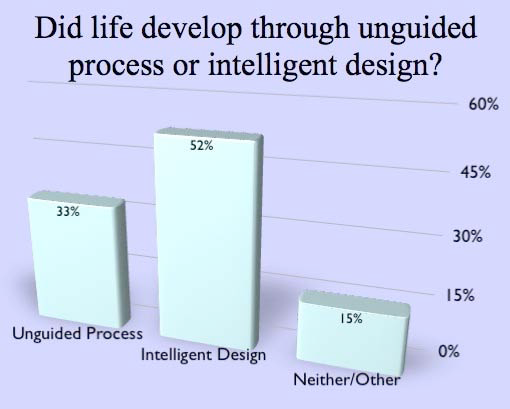
Poll results like these demonstrate the failure of proponents of Darwinian evolution to provide persuasive scientific evidence for their viewpoint.  Worse than that, the attempt to squash the intelligent design movement is seemingly back-firing.  Americans overwhelmingly support academic freedom on the issue of the origins and development of life.

It is time for Darwinists to quit saying “Evolution is a fact” and actually provide some compelling scientific evidence that supports the position that random mutations and natural selection are the engines that drove the development of all life on earth.

zogby graph 6-30-09